Templates


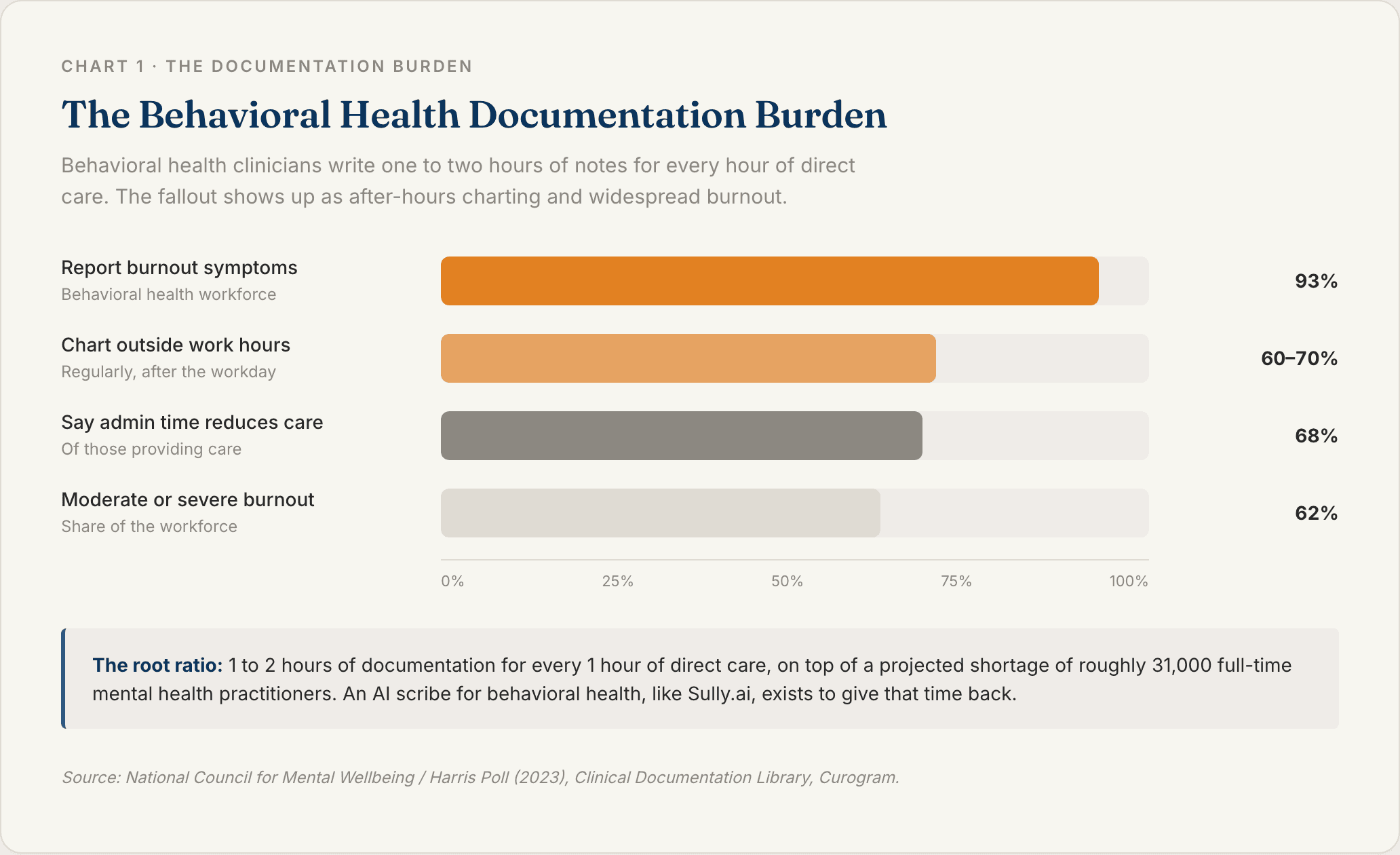
Behavioral health clinicians spend one to two hours documenting for every hour of direct care [6]. That ratio is the quiet reason 93% of the behavioral health workforce reports burnout symptoms [1]. The charting never ends, and most of it happens after the last client leaves.
An AI scribe for behavioral health changes that math. It listens to the session, then writes a structured clinical note. A DAP, SOAP, BIRP, or GIRP note shows up ready to review, so you stop charting at 10 p.m.
This guide covers what these tools actually do, how they differ from a general medical scribe, the compliance questions to ask before you buy, and how the leading options compare. Sully.ai is included, and so are the specialists built only for therapy and psychiatry.
Key Takeaway
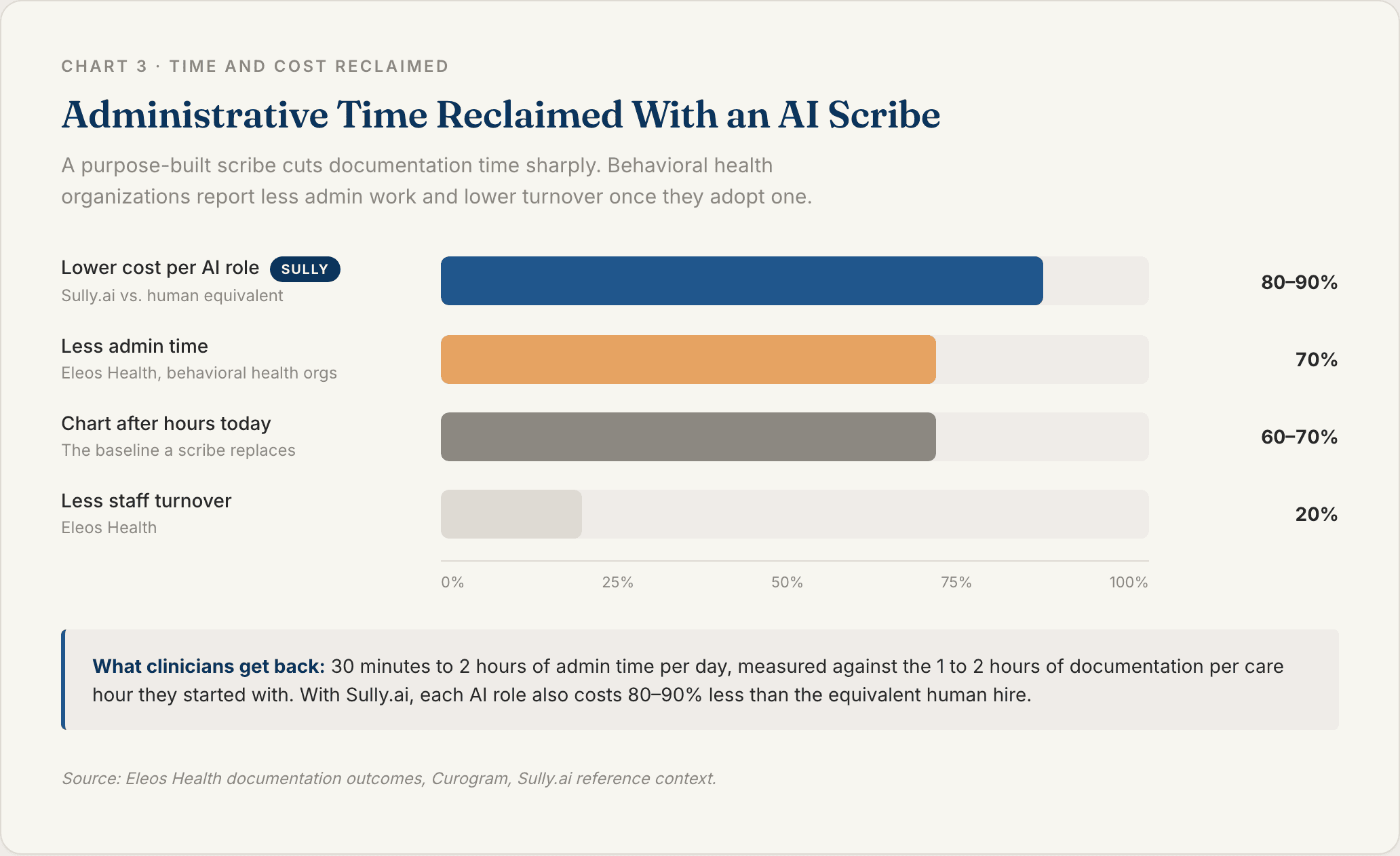
An AI scribe for behavioral health is an ambient documentation tool that listens to a therapy or psychiatry session and automatically drafts structured clinical notes (DAP, SOAP, BIRP, or GIRP), plus treatment plans and progress summaries. Unlike general medical scribes, behavioral health scribes are tuned to capture narrative detail, mental status exams, risk assessments, and medication-management context. The best options are HIPAA compliant with a signed BAA, integrate with your EHR, and support insurance medical-necessity documentation. Clinicians currently spend one to two hours on documentation for every hour of direct care [6], and a purpose-built AI scribe can cut that administrative time by roughly 30 minutes to two hours per day [4].
Why Behavioral Health Documentation Pushes Clinicians Toward Burnout
Start with the number that frames everything: one to two hours of documentation for every hour of direct care [6]. No other part of the job scales that badly.
The result shows up in the burnout data. More than nine in 10 behavioral health workers (93%) report burnout, and 62% describe it as moderate or severe [1]. In the APA's own practitioner survey, 36% of psychologists said they feel burned out while demand keeps climbing [2].
This is not a caseload problem you can fix by seeing fewer clients. It's a paperwork problem.
The Hidden Cost of After Hours Charting
Most clinicians finish their notes on their own time. Surveys of behavioral health professionals find that 60% to 70% regularly complete documentation outside scheduled work hours [5].
That after-hours work has a cost beyond lost evenings. A 2024 systematic review found that greater time spent on administrative tasks is linked to lower career satisfaction and higher burnout [3].
Every minute spent writing a note is a minute not spent on care, supervision, or recovery.
Why Insurance and Medical Necessity Rules Add Hours
Behavioral health notes are heavier than most specialties. Payers want documented medical necessity, treatment-plan linkage, and narrative justification for each session.
So clinicians end up writing the same information twice, once for the clinical record and once for the billing record [6]. That duplication is one of the top drivers of documentation burden, and it's exactly where automation pays off.
How Workforce Shortages Raise the Stakes
There aren't enough clinicians to absorb the overflow. A third of the behavioral health workforce reports spending most of their time on administrative tasks, and 68% of those who provide care say that admin time pulls them away from patients [1].
SAMHSA projects a shortage of roughly 31,000 full-time mental health practitioners [1]. When every clinician hour is scarce, reclaiming documentation time is not a nicety. It's capacity.
What an AI Scribe for Behavioral Health Actually Does
An AI scribe for behavioral health uses ambient listening to turn a live or recorded session into a finished clinical note. You talk to your client. The scribe handles the write-up.
Here's what that looks like in practice.
Ambient Capture During the Session
The scribe runs quietly in the background on a laptop or phone, in person or over telehealth. There's no manual note-taking and no template to fill in mid-session.
Good tools work across settings and languages. Some behavioral health platforms capture sessions in more than 150 languages [4], which matters for culturally competent care.
Structured Therapy Notes in DAP SOAP BIRP and GIRP Formats
This is where behavioral health scribes earn their keep. They write the note formats therapists actually use: DAP, SOAP, BIRP, and GIRP.
A general medical scribe usually defaults to SOAP and stops there. A behavioral health scribe lets you pick the format, customize the template, and match the structure your payer expects.
Treatment Plans and Progress Tracking
The strongest tools go past the single session note. They draft treatment plans, track goals across visits, and surface progress over time.
That's the line between a basic note generator and a real documentation platform. Progress tracking is what turns a pile of notes into a clinical story.
How an AI Scribe for Behavioral Health Differs From a General Medical Scribe
Behavioral health documentation is a different language. A scribe built for primary care, then pointed at a therapy session, tends to miss what matters.
That's why the specialists in this space were built from the ground up for psychiatry and therapy instead of retrofitting a medical template.
Capturing Narrative and Emotional Nuance
A therapy note hinges on affect, themes, the therapeutic alliance, and the client's own words. It isn't a list of vitals and lab values.
Clinicians worry, with reason, that a generic scribe flattens all of that into a sterile summary. A behavioral health model is tuned to keep the narrative and the emotional detail intact.
Documenting the Mental Status Exam and Risk Assessment
The mental status exam and risk assessment are behavioral-health-specific, and they carry real clinical and legal weight.
A general scribe handles them poorly or skips them. A purpose-built one structures the MSE and flags risk and safety-planning language so nothing critical falls out of the record.
Handling Psychotherapy and Medication Management Notes
Psychiatry and PMHNP visits blend therapy with prescribing. One encounter needs both a narrative and a structured medication-management section.
Behavioral health scribes support combined therapy-and-med-check notes in a single document, which a primary-care scribe is not designed to produce.
HIPAA Compliance and Data Privacy in Mental Health Documentation
Behavioral health records are among the most sensitive data in healthcare. Compliance is the first qualifying question, not the last.
The American Psychiatric Association publishes a list of questions clinicians should ask any AI scribe vendor [9]. Use it. If a vendor dodges these, walk away.
Business Associate Agreements and Data Storage
Any compliant vendor must sign a Business Associate Agreement (BAA). Protected health information should be encrypted, and you should know where it's stored.
Ask directly: do you sign a BAA, where does my data live, and is it hosted in the US? These are the literal questions the specialist vendors answer on their own pages, so a clear answer should be easy to get.
Whether Sessions Are Recorded or Used to Train Models
Two questions matter most to clinicians. Is the session recording stored after the note is written, and is my data used to train shared AI models?
Require the answers in writing. The ones you want are "recordings are not retained" and "your data does not train shared models" [9].
Features That Separate the Best AI Scribes for Mental Health
Compliance gets a vendor onto your shortlist. These three features decide whether the tool actually saves you time.
EHR Integration and Workflow Fit
The scribe has to push notes into your EHR, or replace it, without copy-paste. Integration depth is the whole game. A note you have to paste by hand is a note you're still doing yourself.
This is where the integration model matters. Sully.ai integrates once and works with Epic, Cerner, Meditech, and Athenahealth, instead of forcing a separate connection per tool.
Note Customization and Clinical Accuracy
Clinicians abandon scribes that produce generic notes. The tool should learn your style, support custom templates, and let you edit freely.
Accuracy is what builds trust. A note you have to rewrite every time is slower than typing it yourself.
Billing Codes and Medical Necessity Support
The best tools connect documentation to revenue. They extract ICD-10 and CPT codes and make sure the note supports medical necessity, which cuts denials.
This is where a connected workforce pulls ahead. Sully's AI Coder reads the finished note and pulls clean codes before a denial can happen.
Best AI Scribes for Behavioral Health Compared
There's no single best tool. There's a best fit for your setting. Here's an honest read on six options, with the full feature matrix below.
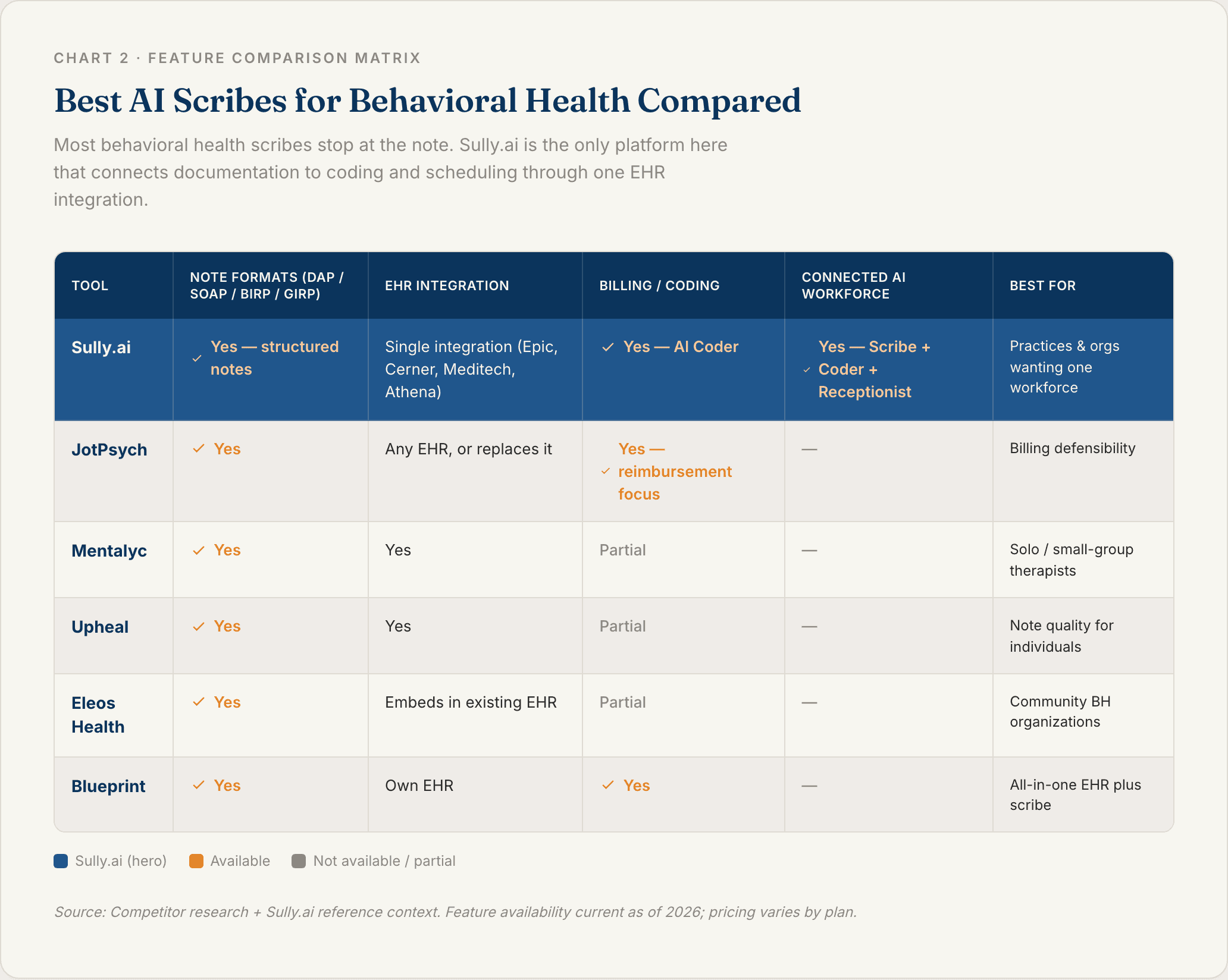
1. Sully.ai
Sully.ai is an AI workforce for healthcare, not a single behavioral health app. The AI Scribe captures documentation, and because it shares context with the AI Coder, the AI Receptionist, and the AI Triage Nurse, the finished note flows straight into coding and scheduling.
That makes it the strongest fit for multi-clinician practices and behavioral health organizations that want documentation, billing, and scheduling behind one EHR integration instead of three separate vendors. Each AI role costs 80% to 90% less than the equivalent human hire.
Best for: practices and groups that want one connected AI workforce.
2. JotPsych
JotPsych is built exclusively for behavioral health, with a focus on reimbursement-ready, audit-proof notes. It's used by more than 10,000 behavioral health practices.
Best for: practices where billing defensibility is the top priority.
3. Mentalyc
Mentalyc is a therapist-focused platform with AI notes, treatment plans, progress tracking, and session insights. It's HIPAA and SOC 2 compliant.
Best for: solo and small-group therapists who want progress analytics.
4. Upheal
Upheal is frequently ranked best overall for therapists, with strong note quality and a good telehealth fit.
Best for: individual therapists who prioritize note quality.
5. Eleos Health
Eleos embeds into existing EHR workflows with no APIs required. It reports 70% less admin time, twice the client engagement, and 20% less staff turnover [4].
Best for: community behavioral health organizations.
6. Blueprint
Blueprint is an AI-assisted EHR for therapists, with notes, scheduling, and billing, and AI starting at a low per-session price.
Best for: therapists who want an all-in-one EHR plus scribe.
How to Roll Out an AI Scribe Across a Behavioral Health Practice
Adopting a scribe should take weeks, not the 12 to 18 months healthcare usually spends evaluating a new vendor. Keep the rollout small and measured.
Running a Pilot With a Small Clinician Group
Start with three to five clinicians across different note types: therapy, psychiatry, and intake. Confirm the BAA and EHR integration before anyone records a session.
Then gather honest feedback on note quality. If the notes need heavy editing, fix that before you expand.
Measuring Time Saved and Note Quality
Decide what you'll measure up front. Track minutes saved per note, the drop in after-hours charting, the note-edit rate, and the denial rate.
Benchmark against the 30 minutes to two hours per day that clinicians reclaim with a good scribe [4], measured against the one-to-two-hour-per-care-hour baseline you started with [6].
Building a Connected Behavioral Health Workforce With Sully.ai
A scribe alone reclaims your documentation time. That's worth a lot. But it leaves the bigger problem untouched.
The bigger problem is fragmentation. Most practices run separate tools for notes, coding, scheduling, and follow-up, and none of them talk to each other. You save time on the note, then lose it again moving data between systems.
Sully.ai is built as a workforce instead of a tool. The AI Scribe writes the note, hands it to the AI Coder for a clean claim, and passes scheduling to the AI Receptionist, all behind one EHR integration. There's roughly $250 billion in automatable administrative work in US healthcare, and this is how you start claiming your share of it.
Sully already supports more than 5,000 providers and has delivered over 50 million hours of AI work. If you want to see how an AI workforce handles behavioral health documentation end to end, that's the next step.
FAQ
Q: What is an AI scribe for behavioral health? An AI scribe for behavioral health is an ambient documentation tool that listens to a therapy or psychiatry session and automatically generates a structured clinical note, such as a DAP, SOAP, BIRP, or GIRP note, along with treatment plans and progress summaries. It's tuned for mental health documentation, capturing narrative detail, mental status exams, and risk assessments that general medical scribes typically miss. Platforms like Sully.ai go further by connecting the finished note to coding and scheduling automatically.
Q: Are AI therapy notes HIPAA compliant? They're compliant only if the vendor signs a Business Associate Agreement, encrypts protected health information, and does not use your session data to train shared AI models. Before adopting any tool, confirm in writing whether session recordings are stored and where your data is hosted. The American Psychiatric Association publishes a set of evaluation questions clinicians can use for exactly this purpose [9].
Q: Can an AI scribe write DAP, SOAP, and BIRP notes? Yes. Behavioral-health-specific AI scribes support the formats clinicians actually use, including DAP, SOAP, BIRP, and GIRP, and let you choose or customize the template. General medical scribes usually default to SOAP only. Many behavioral health tools also generate combined therapy and medication-management notes for psychiatry and PMHNP visits.
Q: Will an AI scribe replace human therapists or scribes? No. An AI scribe automates documentation, not clinical judgment or the therapeutic relationship. It removes the administrative load, since clinicians spend one to two hours documenting per hour of care [6], so they can spend more time with clients and less time charting after hours [5].
Q: How much does an AI scribe for behavioral health cost? Pricing ranges from free tiers and around $0.99 per session on the low end to monthly subscriptions near $99 for individual clinicians, with custom enterprise pricing for organizations. For multi-clinician practices, an AI workforce model like Sully.ai can be more cost-effective, because each AI role costs 80% to 90% less than an equivalent human hire and one integration covers documentation, coding, and scheduling.
Sources
[1] National Council for Mental Wellbeing — New Study: Behavioral Health Workforce Shortage Will Negatively Impact Society. https://www.thenationalcouncil.org/news/help-wanted/ [2] American Psychological Association — 2023 Practitioner Pulse Survey: Psychologists Reaching Their Limits. https://www.apa.org/pubs/reports/practitioner/2023-psychologist-reach-limits [3] Journal of General Internal Medicine — Measuring Documentation Burden in Healthcare. https://pmc.ncbi.nlm.nih.gov/articles/PMC11534919/ [4] Eleos Health — Documentation: AI Built for Behavioral Health. https://eleos.health/documentation/ [5] Clinical Documentation Library — How to Reduce Documentation Burnout as a Therapist. https://clinicaldocslibrary.com/guides/documentation-burnout/ [6] Curogram — Documentation Burden in Behavioral Health: How to Reduce Charting Time. https://curogram.com/blog/mental-health/behavioral-health-documentation-burden [9] American Psychiatric Association — AI Scribe Tools. https://www.psychiatry.org/psychiatrists/practice/artificial-intelligence/ai-scribe-tools


Templates

Keep reading

Templates
/
AI Front Desk for Medical Practices: What It Changes Beyond Answering the Phone
The front desk is a revenue gate, not a phone. What an AI front desk actually does, what claim-denial data shows it should fix, and what it costs.

Templates
/
CPT Code 99202 With Examples and Why 99201 Is Gone
99202 is the lowest billable new patient code—and most practices skip straight to 99203. See when it's correct, the MDM floor, and two worked examples.

Templates
/
CPT Code 99212 With Examples and When a Visit Really Is This Small
99212 has the highest denial rate of any E/M code—most visits that reach it qualify for 99213. See the MDM floor, fee formula, and two worked examples.
