"/><stop offset="1" stop-color="rgba(255, 255, 255, 0)"/></linearGradient><linearGradient id="WxV_IOPE7-2309410982-linear-gradient" x1="1" x2="0" y1="0.5951279047551217" y2="0.4048720952448783"><stop offset="0" stop-color="rgb(255, 255, 255)"/><stop offset="1" stop-color="rgba(255, 255, 255, 0)"/></linearGradient><linearGradient id="WwbAIQIz8-2309410982-linear-gradient" x1="0.43478742751482424" x2="0.6358595260107829" y1="0.26" y2="1"><stop offset="0" stop-color="rgb(255, 255, 255)"/><stop offset="1" stop-color="rgba(255, 255, 255, 0)"/></linearGradient><linearGradient id="ZWsVQcPfn-2309410982-linear-gradient" x1="0.9508213454678907" x2="0.04917865453210929" y1="0" y2="1"><stop offset="0" stop-color="rgb(255, 255, 255)"/><stop offset="1" stop-color="rgba(255, 255, 255, 0)"/></linearGradient><linearGradient id="lTyCGrzzP-2309410982-linear-gradient" x1="0.374937164194436" x2="0.625062835805564" y1="0" y2="1"><stop offset="0" stop-color="rgb(255, 255, 255)"/><stop offset="1" stop-color="rgba(255, 255, 255, 0)"/></linearGradient></defs><g d="M 658.002 1357.705 C 1020.321 1357.705 1314.04 1063.989 1314.04 701.667 C 1314.04 339.347 1020.321 45.626 658.002 45.626 C 295.681 45.626 1.96 339.347 1.96 701.667 L 0 701.667 C 0 338.263 294.598 43.665 658.002 43.665 C 1021.404 43.665 1316 338.263 1316 701.667 C 1316 1065.072 1021.404 1359.672 658.002 1359.672 C 294.598 1359.672 0 1065.072 0 701.667 L 1.96 701.667 C 1.96 1063.989 295.681 1357.705 658.002 1357.705 Z M 658.005 1265.053 C 969.154 1265.053 1221.392 1012.819 1221.392 701.667 C 1221.392 390.517 969.154 138.281 658.005 138.281 C 346.856 138.281 94.619 390.517 94.619 701.667 L 92.659 701.667 C 92.659 389.433 345.77 136.321 658.005 136.321 C 970.241 136.321 1223.352 389.433 1223.352 701.667 C 1223.352 1013.902 970.241 1267.017 658.005 1267.017 C 345.77 1267.017 92.659 1013.902 92.659 701.667 L 94.619 701.667 C 94.619 1012.819 346.856 1265.053 658.005 1265.053 Z M 658.002 1166.116 C 914.513 1166.116 1122.452 958.178 1122.452 701.667 C 1122.452 445.16 914.513 237.22 658.002 237.22 C 401.494 237.22 193.551 445.16 193.551 701.667 L 191.59 701.667 C 191.59 444.077 400.411 235.255 658.002 235.255 C 915.596 235.255 1124.412 444.077 1124.412 701.667 C 1124.412 959.261 915.596 1168.084 658.002 1168.084 C 400.411 1168.084 191.59 959.261 191.59 701.667 L 193.551 701.667 C 193.551 958.178 401.494 1166.116 658.002 1166.116 Z M 281.657 818.28 C 298.572 818.28 314.804 825.001 326.765 836.965 L 458.99 969.182 C 470.582 980.781 486.308 987.298 502.706 987.298 L 612.137 987.298 C 646.284 987.298 673.972 959.61 673.972 925.463 L 673.972 891.504 L 675.939 891.504 L 675.939 925.463 C 675.939 960.7 647.374 989.258 612.137 989.258 L 502.706 989.258 C 485.788 989.258 469.562 982.537 457.599 970.573 L 325.378 838.356 C 313.785 826.757 298.056 820.242 281.657 820.244 L 1.173 820.244 L 1.173 818.28 Z M 746.64 888.714 L 1053.046 888.714 C 1069.967 888.714 1086.194 895.435 1098.16 907.398 L 1259.381 1068.619 L 1257.99 1070.007 L 1096.772 908.79 C 1085.175 897.193 1069.446 890.679 1053.046 890.681 L 746.64 890.681 C 729.724 890.681 713.493 883.957 701.533 871.993 L 685.377 855.845 L 686.769 854.453 L 702.917 870.605 C 714.513 882.201 730.241 888.715 746.64 888.714 Z M 667.685 552 L 512.316 396.894 C 494.66 379.264 484.741 355.356 484.739 330.426 L 484.739 0 L 487.632 0 L 487.632 330.426 C 487.632 354.592 497.248 377.763 514.369 394.851 L 669.739 549.957 Z M 782.851 700.491 C 816.998 700.491 844.686 672.804 844.686 638.655 L 844.686 516.468 C 844.687 499.547 851.409 483.32 863.374 471.355 L 1177.508 157.22 L 1178.896 158.607 L 864.762 472.742 C 853.162 484.337 846.646 500.067 846.646 516.468 L 846.646 638.655 C 846.646 673.89 818.088 702.455 782.851 702.455 L 700.405 702.455 L 700.405 700.491 Z M 130.338 534.223 L 213.07 534.223 C 256.112 534.223 291.003 569.114 291.003 612.156 L 291.003 694.888 C 291.003 711.29 297.514 727.017 309.113 738.611 L 472.887 902.378 L 471.496 903.769 L 307.726 739.995 C 295.761 728.033 289.038 711.807 289.038 694.888 L 289.038 612.156 C 289.038 570.198 255.028 536.188 213.07 536.188 L 130.338 536.188 C 113.419 536.187 97.193 529.465 85.23 517.5 L 77.071 509.345 C 65.107 497.381 58.386 481.153 58.388 464.233 L 58.388 199.526 L 60.348 199.526 L 60.348 464.233 C 60.349 480.631 66.863 496.358 78.458 507.954 L 86.617 516.113 C 98.213 527.709 113.94 534.223 130.338 534.223 Z" fill="transparent" height="1359.6717183844698px" id="DcyumyANr" transform="translate(0 -43.665)" width="1316px"><g opacity="0.5"><path d="M 658.002 1314.039 C 1020.321 1314.039 1314.04 1020.324 1314.04 658.001 C 1314.04 295.681 1020.321 1.961 658.002 1.961 C 295.681 1.961 1.96 295.682 1.96 658.001 L 0 658.001 C 0 294.598 294.598 0 658.002 0 C 1021.404 0 1316 294.598 1316 658.001 C 1316 1021.407 1021.404 1316.007 658.002 1316.007 C 294.598 1316.007 0 1021.407 0 658.001 L 1.96 658.001 C 1.96 1020.324 295.681 1314.039 658.002 1314.039 Z" fill="rgb(255, 255, 255)" height="1316.0065114752902px" id="dxf13D52Y" transform="translate(0 43.665)" width="1316px"/></g><g opacity="0.3"><path d="M 565.347 1128.732 C 876.496 1128.732 1128.733 876.498 1128.733 565.346 C 1128.733 254.196 876.496 1.961 565.347 1.961 C 254.197 1.961 1.961 254.196 1.961 565.346 L 0 565.346 C 0 253.112 253.111 0 565.347 0 C 877.582 0 1130.693 253.112 1130.693 565.346 C 1130.693 877.581 877.582 1130.696 565.347 1130.696 C 253.111 1130.696 0 877.581 0 565.346 L 1.961 565.346 C 1.961 876.498 254.197 1128.732 565.347 1128.732 Z" fill="rgb(255, 255, 255)" height="1130.6960934794101px" id="if1BmYw1S" transform="translate(92.659 136.321)" width="1130.693351805604px"/></g><g opacity="0.15"><path d="M 466.412 930.861 C 722.923 930.861 930.862 722.922 930.862 466.411 C 930.862 209.905 722.923 1.965 466.412 1.965 C 209.904 1.965 1.961 209.905 1.961 466.411 L 0 466.411 C 0 208.822 208.821 0 466.412 0 C 724.006 0 932.822 208.822 932.822 466.411 C 932.822 724.005 724.006 932.828 466.412 932.828 C 208.821 932.828 0 724.005 0 466.411 L 1.961 466.411 C 1.961 722.922 209.904 930.861 466.412 930.861 Z" fill="rgb(255, 255, 255)" height="932.8284667407987px" id="ef75NsYf6" transform="translate(191.59 235.255)" width="932.8219552655086px"/></g><g opacity="0.5"><path d="M 280.484 0 C 297.399 0 313.63 6.721 325.592 18.685 L 457.817 150.902 C 469.408 162.501 485.135 169.018 501.533 169.017 L 610.964 169.017 C 645.111 169.017 672.799 141.33 672.799 107.182 L 672.799 73.223 L 674.766 73.223 L 674.766 107.182 C 674.766 142.42 646.201 170.978 610.964 170.978 L 501.533 170.978 C 484.614 170.978 468.389 164.257 456.426 152.293 L 324.205 20.076 C 312.611 8.477 296.883 1.961 280.484 1.964 L 0 1.964 L 0 0 Z" fill="url(%23cQ4xRdUtr-2309410982-linear-gradient)" height="170.97763275969464px" id="cQ4xRdUtr" transform="translate(1.173 818.28)" width="674.7656780356198px"/></g><g opacity="0.5"><path d="M 61.263 34.261 L 367.669 34.261 C 384.589 34.261 400.817 40.982 412.783 52.945 L 574.004 214.166 L 572.612 215.554 L 411.395 54.337 C 399.798 42.74 384.069 36.226 367.669 36.228 L 61.263 36.228 C 44.347 36.228 28.116 29.504 16.155 17.54 L 0 1.391 L 1.391 0 L 17.54 16.152 C 29.136 27.747 44.864 34.261 61.263 34.261 Z" fill="url(%23WxV_IOPE7-2309410982-linear-gradient)" height="215.55382175474415px" id="WxV_IOPE7" transform="translate(685.377 854.453)" width="574.0036823012563px"/></g><g opacity="0.5"><path d="M 182.946 552 L 27.577 396.894 C 9.921 379.264 0.002 355.356 0 330.426 L 0 0 L 2.893 0 L 2.893 330.426 C 2.893 354.592 12.509 377.763 29.63 394.851 L 185 549.957 Z" fill="url(%23WwbAIQIz8-2309410982-linear-gradient)" height="552px" id="WwbAIQIz8" transform="translate(484.739 0)" width="185px"/></g><g opacity="0.5"><path d="M 82.446 543.271 C 116.593 543.271 144.281 515.583 144.281 481.435 L 144.281 359.248 C 144.282 342.327 151.004 326.1 162.969 314.135 L 477.103 0 L 478.491 1.387 L 164.356 315.522 C 152.757 327.117 146.241 342.846 146.241 359.248 L 146.241 481.435 C 146.241 516.67 117.683 545.235 82.446 545.235 L 0 545.235 L 0 543.271 Z" fill="url(%23ZWsVQcPfn-2309410982-linear-gradient)" height="545.2346136318063px" id="ZWsVQcPfn" transform="translate(700.405 157.22)" width="478.4906210693257px"/></g><g opacity="0.5"><path d="M 71.95 334.696 L 154.682 334.696 C 197.724 334.696 232.616 369.588 232.616 412.63 L 232.616 495.362 C 232.616 511.764 239.126 527.491 250.725 539.084 L 414.5 702.851 L 413.108 704.243 L 249.338 540.469 C 237.373 528.507 230.651 512.281 230.651 495.362 L 230.651 412.63 C 230.651 370.672 196.64 336.661 154.682 336.661 L 71.95 336.661 C 55.031 336.661 38.805 329.939 26.843 317.974 L 18.683 309.819 C 6.719 297.854 -0.001 281.627 0 264.707 L 0 0 L 1.961 0 L 1.961 264.707 C 1.961 281.105 8.475 296.832 20.07 308.428 L 28.229 316.587 C 39.825 328.182 55.552 334.697 71.95 334.696 Z" fill="url(%23lTyCGrzzP-2309410982-linear-gradient)" height="704.2427839655832px" id="lTyCGrzzP" transform="translate(58.388 199.526)" width="414.49961191971533px"/></g></g></svg>)
Ask a pain physician what governs their documentation and you will hear about the CDC opioid guideline. Fair enough. It is the one everybody writes about.
There is a second rulebook, though, and it is the one that decides whether the injection you just performed gets paid.
It is your Medicare Administrative Contractor's Local Coverage Determination, it is far more prescriptive than most clinicians expect, and almost nobody covers it.
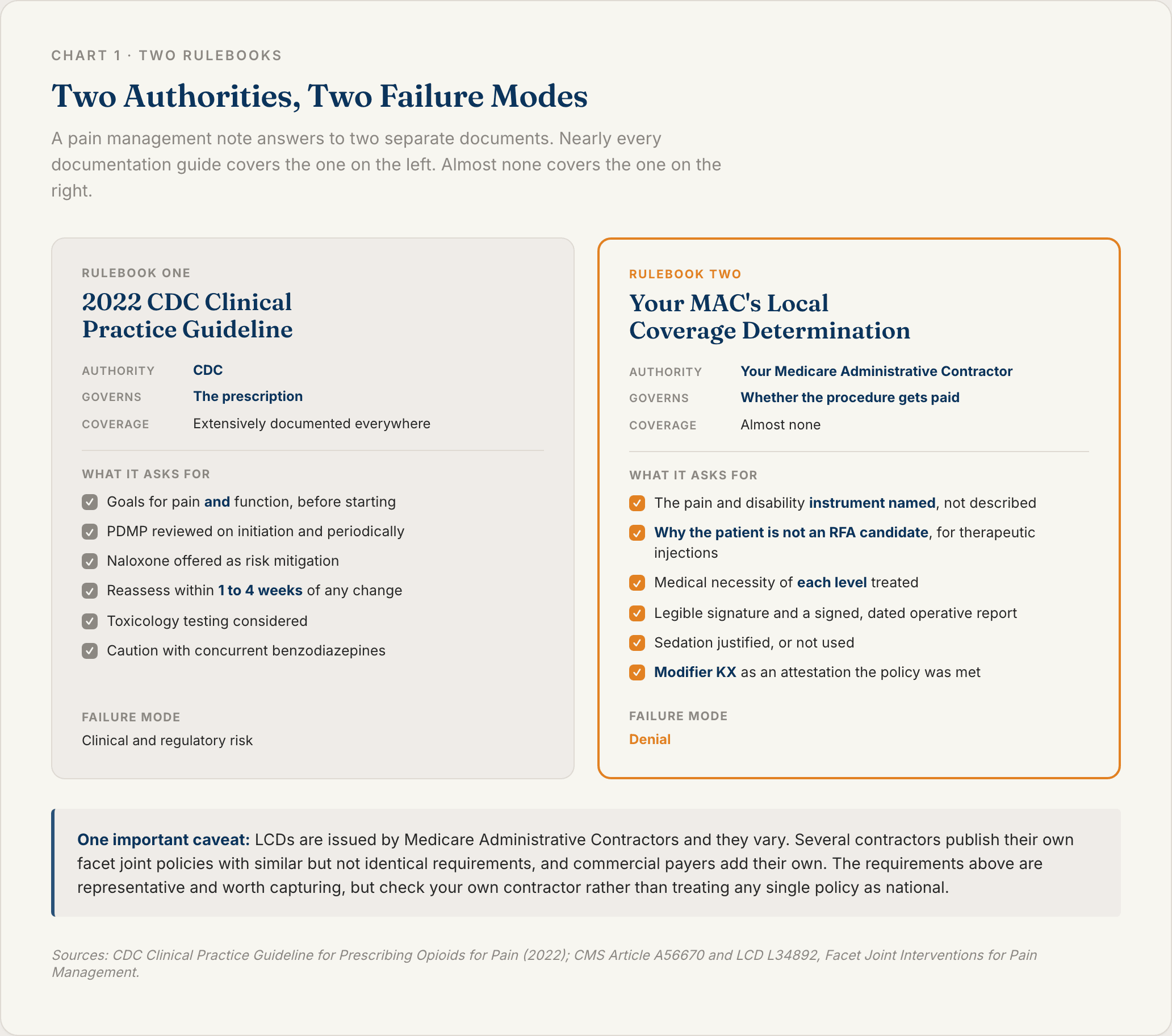
Key Takeaway: Pain management runs on two separate rulebooks, and almost every documentation guide covers only one. The 2022 CDC guideline tells you how to prescribe opioids safely: establish goals for pain and function, review the PDMP, offer naloxone, reassess within one to four weeks of any dose change [1]. The Medicare Local Coverage Determination tells you what the record must contain for an interventional procedure to be paid, and it is far more specific. It requires that the scales used to measure pain and disability be documented, and it names the acceptable ones including the NRS, VAS, Oswestry Disability Index and PROMIS. For a therapeutic injection it requires documentation of why the patient is not a candidate for radio frequency ablation. Where multiple levels are treated it requires the medical necessity of each to be documented separately. And modifier KX attests that all of it was met [2]. Sully.ai's AI Scribe writes into the EHR and the AI Coder carries the note through to the coded claim.
Pain Management Documentation Answers to Two Different Authorities
Most specialties have one set of documentation expectations. Pain management has two, written by different bodies, enforcing different things.
The CDC Guideline Governs the Prescription
The 2022 CDC Clinical Practice Guideline covers 12 recommendations for outpatients with acute, subacute or chronic pain. Establish treatment goals for pain and function before starting ongoing therapy. Review the state PDMP on initiation and periodically. Offer naloxone as part of risk mitigation. Reassess benefits and risks within one to four weeks of starting or escalating. Consider toxicology testing. Use particular caution with benzodiazepines [1].
This is the safety rulebook, and getting it wrong is a clinical and regulatory problem.
The Local Coverage Determination Governs the Procedure
The LCD is a different document entirely. It is issued by your Medicare Administrative Contractor, it concerns coverage rather than safety, and its failure mode is not a citation. It is a denial.
It is also much more specific than most people realise, and that is where the rest of this article goes.
Pain Management Has Two Rulebooks
Here is the argument. Every pain documentation guide worth reading covers the CDC guideline thoroughly. Almost none covers coverage policy at all. The most thorough guide in this space runs to nearly sixty sections, handles PDMP checks and MME arithmetic and tapering scenarios properly, and contains no mention of a Local Coverage Determination, modifier KX, or the requirement to name the instrument you assessed function with.
That is the expensive half to be missing. Three examples of what is actually in there.
It Is Not Enough to Assess Function, You Have to Name the Instrument
CMS puts it plainly: the scales used to assess the measurement of pain and/or disability must be documented in the medical record [2].
And it publishes the list of what counts. For pain intensity: verbal rating scales, the NRS and the VAS. For function and disability: the PDAS, the Oswestry Disability Index, the Oswestry Low Back Pain Disability Questionnaire, the Quebec Back Pain Disability Score, the Roland Morris scale, the Back Pain Functional Scale, and PROMIS profile domains [2].
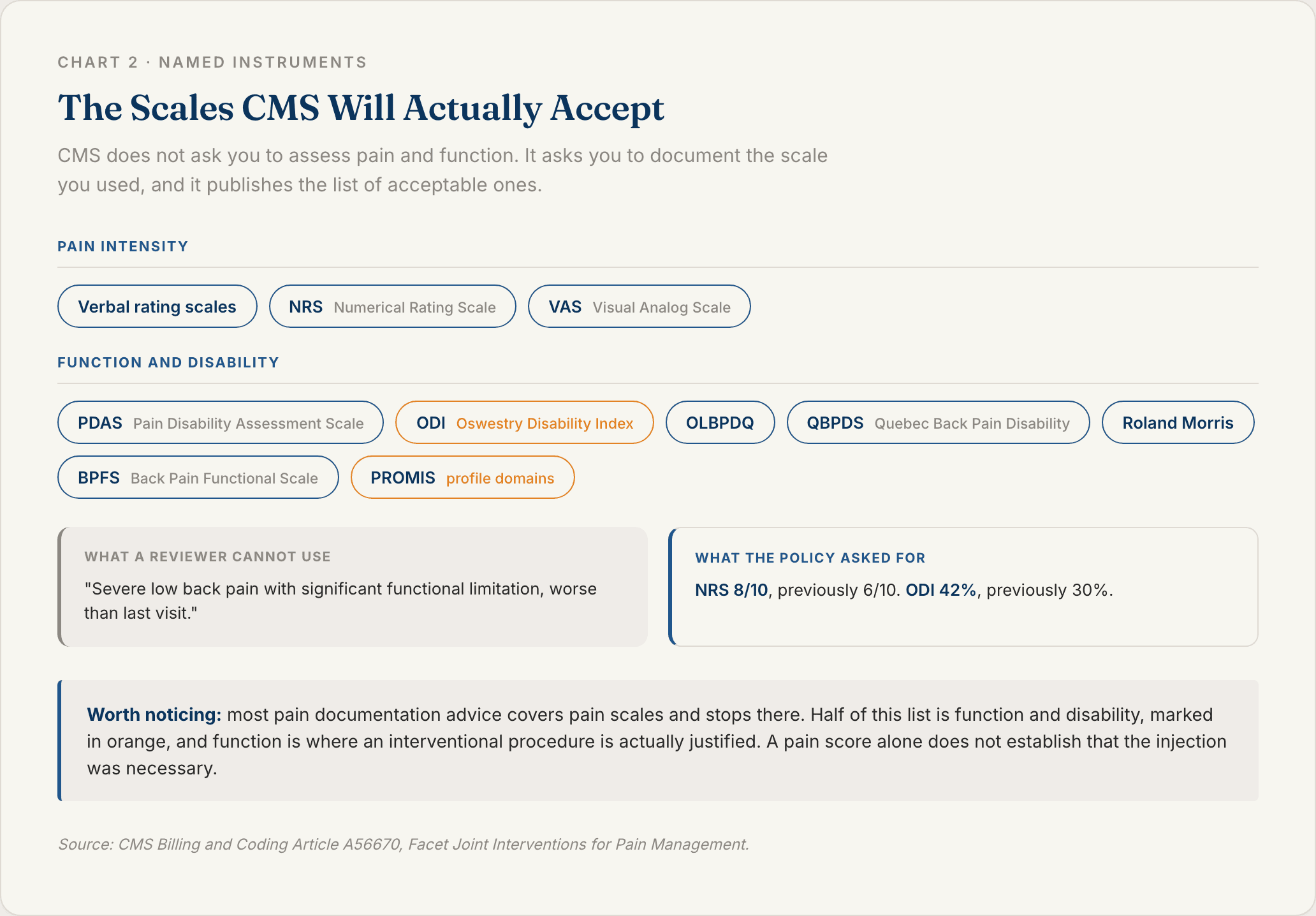
"Severe pain, function significantly limited" is a clinically reasonable sentence and a documentation failure. A reviewer was looking for a named instrument and a score, and prose does not contain one.
For a Therapeutic Injection You Have to Say Why Not RFA
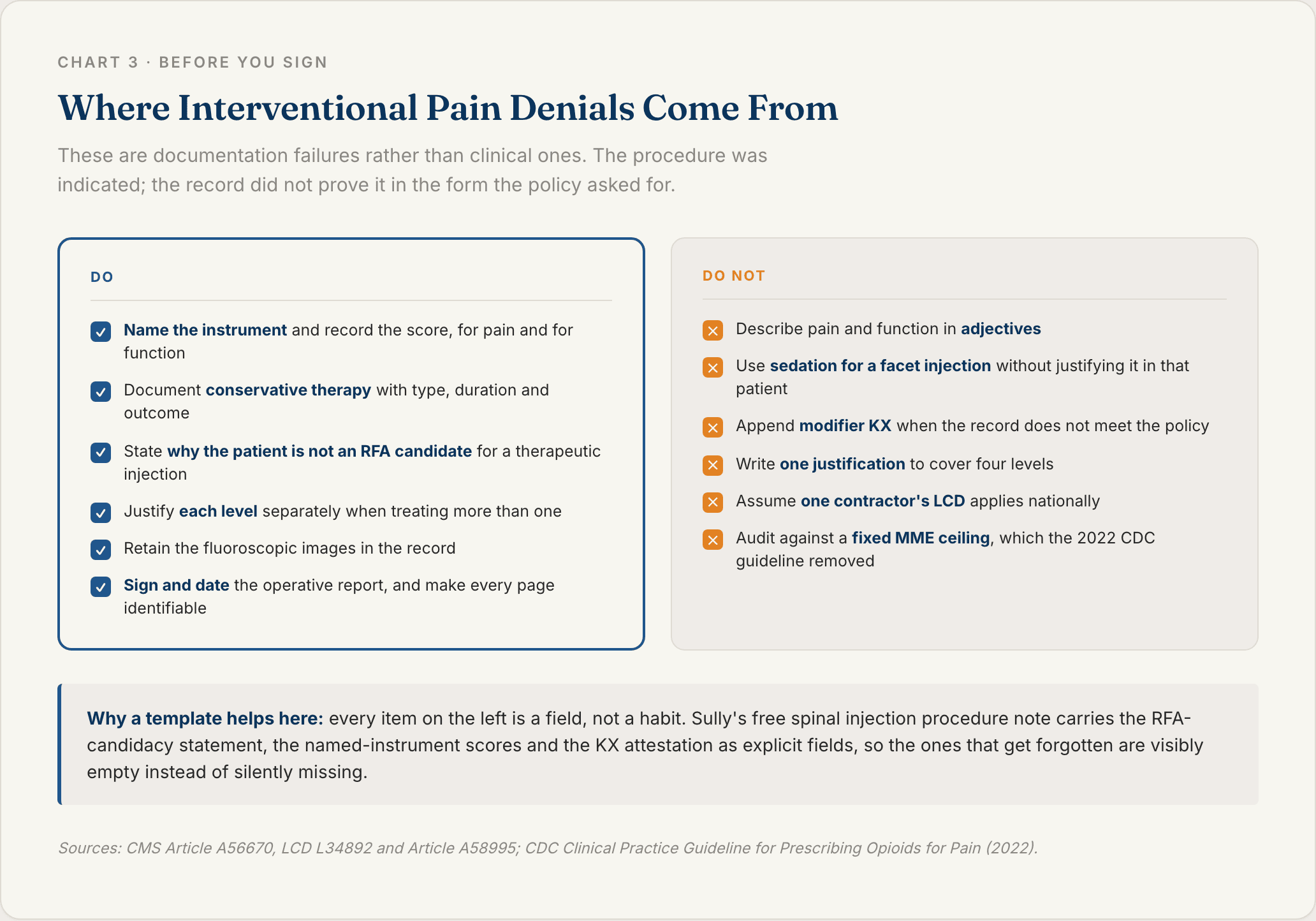
This is the requirement that surprises people most, and it is a single line in the policy: documentation of why the patient is not a candidate for RFA must be submitted for therapeutic injection procedures [2].
Not why the injection is indicated. Why radio frequency ablation is not the better option for this specific patient. If that sentence is not in the note, the field a reviewer is looking for is empty.
Multiple Levels Means Multiple Justifications
Where multiple injections are performed at the same or different spinal levels, the medical necessity of each injection has to be clearly documented. Frequent reporting of multiple blocks on the same day can trigger focused medical review [3].
One justification covering four levels is one justification, not four.
The Rest of the LCD, in Plain Terms
None of the following is difficult. It is just specific, and it is invisible if you have never read the policy.
Legibility, Identification and Signature
Every page of the record must be legible and carry appropriate patient identification including the dates of service. The documentation must include the legible signature of the clinician responsible for the care. And there has to be a signed and dated office visit record or operative report [2].
The record must also contain the performing provider's assessment as it relates to the patient's complaint for that visit, relevant history, and the results of pertinent tests [2].
Sedation Has to Be Justified or Left Off
Moderate or deep sedation, general anesthesia and monitored anesthesia care are not considered medically reasonable and necessary during facet joint injections. For epidural steroid injections they are described as usually unnecessary or rarely indicated, and in exceptional cases the documentation must clearly establish the need in that specific patient [3][4].
Modifier KX Is an Attestation, Not a Formality
KX means "requirements specified in the medical policy have been met" [2].
Appending it is a statement about your record. It is only a true statement if the record actually meets the policy, which is the whole reason the fields above matter.
One Caveat That Matters More Than the Rest
LCDs are issued by Medicare Administrative Contractors, and they vary. Several contractors publish their own facet joint policies with similar but not identical requirements, and commercial payers set their own criteria on top of that.
So do not treat any single policy, including the one quoted throughout this article, as a national rule. Read your own contractor's. The requirements above are representative and they are the right things to be capturing, but the specifics are local.
Free Pain Management Note Templates
Three templates covering the visits where documentation decides both safety and payment. Each carries the rules printed on the page.
Chronic pain initial evaluation template, two pages, recording pain and function on named instruments, with treatment goals split between pain and function
Opioid management follow-up template, with PDMP review, toxicology, naloxone and concurrent CNS depressants as explicit fields rather than remembered steps
Spinal injection procedure note template, built to the LCD, including the RFA-candidacy field and the KX attestation
What the CDC Guideline Actually Asks For
The safety rulebook is well covered elsewhere, so this is short. Two things are worth being precise about.
Goals for Pain and Goals for Function Are Two Fields
Recommendation 2 asks clinicians to work with patients to establish treatment goals for pain andfunction before starting ongoing opioid therapy for subacute or chronic pain [1].
Two goals, two fields. A single line about improving quality of life is neither.
The 2022 Version Removed the Dose Threshold on Purpose
This one still catches practices out. The 2022 guideline deliberately omits specific dosages from its recommendation statements, precisely to stop them being applied as inflexible rules. It advises avoiding increases above levels likely to yield diminishing returns in benefits relative to risks [1].
If your practice is still auditing against a fixed morphine milligram equivalent ceiling, it is auditing against the superseded 2016 framing. Record the total MME per day and the reasoning behind it, not a number treated as a limit.
Reassess Within One to Four Weeks of Any Change
Recommendation 7: evaluate benefits and risks within one to four weeks of starting opioid therapy for subacute or chronic pain, or of any dosage escalation, and reevaluate regularly after that [1].
How to Evaluate an AI Scribe for a Pain Practice
Four questions, in the order that matters.
Does It Capture the Instrument Name, Not Just the Score
Ask whether the output records "ODI 42" or "significant functional limitation." Only one of those survives a review.
Does It Produce a Procedure Note That Survives an LCD
Give it a four-level medial branch block. Check whether the output justifies each level, records the pre-procedure score on a named instrument, and contains a place for the RFA-candidacy statement.
Does It Track the Risk-Mitigation Steps as Discrete Fields
PDMP, toxicology, naloxone, concurrent CNS depressants. Prose that mentions them is not the same as fields that can be audited or reported.
Does It Reach the Claim
KX is an attestation and the per-level justification has to reach the claim line. A note that stops at the chart has not helped either.
Where Sully.ai Fits in a Pain Practice
Unlike endoscopy, an interventional pain procedure is usually performed with the patient awake and the physician narrating, so ambient capture has more to work with here than it does in a sedated procedure suite.
Sully's AI Scribe captures documentation during and after the visit and writes it into the EHR, on a single integration across Epic, Cerner, Meditech, Athenahealth and ambulatory and specialty systems. Clinicians can save how they want a note structured, so an instrument table stays a table with a name and a score in it rather than dissolving into a sentence.
The AI Coder then extracts the ICD-10 and CPT codes and submits the claim. That matters here because KX is an assertion about the record, and the level-by-level justification has to survive from the note to the claim line.
The AI Triage Nurse handles pre-visit intake and interval follow-up tracking. Of every specialty in this series, opioid management is the one where that fits best, because most of the work is monitoring between visits rather than during them.
Sully operates across 5,000+ providers, has delivered 50M+ hours of AI work, and prices each AI role 80 to 90 percent below the human equivalent [5].
Book a demo and bring a four-level medial branch block on a patient already taking opioids. That one case exercises both rulebooks at once.
FAQ
Q: What should an AI scribe for pain management do that a general scribe does not? It has to serve two rulebooks at once. The 2022 CDC guideline governs opioid prescribing and asks for goals for pain and function, PDMP review, naloxone offering, and reassessment within one to four weeks of a dose change [1]. The Medicare Local Coverage Determination governs whether an interventional procedure gets paid, and it is more prescriptive: it requires the pain and disability scales used to be named, requires documentation of why a patient is not an RFA candidate for therapeutic injections, and requires separate medical necessity for each level treated [2][3]. Sully.ai's AI Scribe writes the note into the EHR and hands it to the AI Coder, which submits the coded claim.
Q: What does Medicare require in a facet joint injection note? Every page legible and identified with patient information and dates of service, the legible signature of the responsible clinician, and a signed and dated operative report. The record must contain the performing provider's assessment as it relates to the complaint for that visit, relevant history, and pertinent test results. The scales used to measure pain and disability must be documented, from named instruments including the NRS, VAS, PDAS, Oswestry Disability Index, Oswestry Low Back Pain Disability Questionnaire, Quebec Back Pain Disability Score, Roland Morris, Back Pain Functional Scale and PROMIS. For therapeutic injection procedures, documentation of why the patient is not a candidate for radiofrequency ablation must be submitted [2].
Q: Is there still a maximum MME per day? Not in the 2022 CDC guideline. It deliberately omits specific dosage numbers from its recommendation statements to prevent them being applied as inflexible rules, and instead advises avoiding increases above levels likely to yield diminishing returns relative to risks [1]. Record the total MME per day and your reasoning. A practice still auditing against a fixed threshold is working from the superseded 2016 framing.
Q: Can you use sedation for a facet joint injection? Medicare guidance states that moderate or deep sedation, general anesthesia and monitored anesthesia care are not considered medically reasonable and necessary during facet joint injections. For epidural steroid injections they are described as usually unnecessary or rarely indicated, and in exceptional cases the documentation must clearly establish the need in that specific patient [3][4].
Q: Do you have free pain management note templates? Yes. Sully publishes three: a two-page chronic pain initial evaluation, an opioid management follow-up, and a spinal injection procedure note. The evaluation records pain and function on named instruments, the follow-up makes each risk-mitigation step a field, and the procedure note includes the RFA-candidacy requirement and the KX attestation.
Sources
[1] CDC and MMWR — CDC Clinical Practice Guideline for Prescribing Opioids for Pain, United States, 2022 [2] Centers for Medicare & Medicaid Services — Billing and Coding: Facet Joint Interventions for Pain Management, Article A56670 [3] Centers for Medicare & Medicaid Services — Facet Joint Interventions for Pain Management, LCD L34892 [4] Centers for Medicare & Medicaid Services — Billing and Coding: Epidural Steroid Injections for Pain Management, Article A58995 [5] Sully.ai — The AI Workforce for Healthcare
TABLE OF CONTENTS
Hire your
Medical AI Team
Take a look at our Medical AI Team
AI Receptionist
Manages patient scheduling, communications, and front-desk operations across all channels.
AI Scribe
Documents clinical encounters and maintains accurate EHR/EMR records in real-time.
AI Medical Coder
Assigns and validates medical codes to ensure accurate billing and regulatory compliance.
AI Nurse
Assesses patient urgency and coordinates appropriate care pathways based on clinical needs.