"/><stop offset="1" stop-color="rgba(255, 255, 255, 0)"/></linearGradient><linearGradient id="WxV_IOPE7-2309410982-linear-gradient" x1="1" x2="0" y1="0.5951279047551217" y2="0.4048720952448783"><stop offset="0" stop-color="rgb(255, 255, 255)"/><stop offset="1" stop-color="rgba(255, 255, 255, 0)"/></linearGradient><linearGradient id="WwbAIQIz8-2309410982-linear-gradient" x1="0.43478742751482424" x2="0.6358595260107829" y1="0.26" y2="1"><stop offset="0" stop-color="rgb(255, 255, 255)"/><stop offset="1" stop-color="rgba(255, 255, 255, 0)"/></linearGradient><linearGradient id="ZWsVQcPfn-2309410982-linear-gradient" x1="0.9508213454678907" x2="0.04917865453210929" y1="0" y2="1"><stop offset="0" stop-color="rgb(255, 255, 255)"/><stop offset="1" stop-color="rgba(255, 255, 255, 0)"/></linearGradient><linearGradient id="lTyCGrzzP-2309410982-linear-gradient" x1="0.374937164194436" x2="0.625062835805564" y1="0" y2="1"><stop offset="0" stop-color="rgb(255, 255, 255)"/><stop offset="1" stop-color="rgba(255, 255, 255, 0)"/></linearGradient></defs><g d="M 658.002 1357.705 C 1020.321 1357.705 1314.04 1063.989 1314.04 701.667 C 1314.04 339.347 1020.321 45.626 658.002 45.626 C 295.681 45.626 1.96 339.347 1.96 701.667 L 0 701.667 C 0 338.263 294.598 43.665 658.002 43.665 C 1021.404 43.665 1316 338.263 1316 701.667 C 1316 1065.072 1021.404 1359.672 658.002 1359.672 C 294.598 1359.672 0 1065.072 0 701.667 L 1.96 701.667 C 1.96 1063.989 295.681 1357.705 658.002 1357.705 Z M 658.005 1265.053 C 969.154 1265.053 1221.392 1012.819 1221.392 701.667 C 1221.392 390.517 969.154 138.281 658.005 138.281 C 346.856 138.281 94.619 390.517 94.619 701.667 L 92.659 701.667 C 92.659 389.433 345.77 136.321 658.005 136.321 C 970.241 136.321 1223.352 389.433 1223.352 701.667 C 1223.352 1013.902 970.241 1267.017 658.005 1267.017 C 345.77 1267.017 92.659 1013.902 92.659 701.667 L 94.619 701.667 C 94.619 1012.819 346.856 1265.053 658.005 1265.053 Z M 658.002 1166.116 C 914.513 1166.116 1122.452 958.178 1122.452 701.667 C 1122.452 445.16 914.513 237.22 658.002 237.22 C 401.494 237.22 193.551 445.16 193.551 701.667 L 191.59 701.667 C 191.59 444.077 400.411 235.255 658.002 235.255 C 915.596 235.255 1124.412 444.077 1124.412 701.667 C 1124.412 959.261 915.596 1168.084 658.002 1168.084 C 400.411 1168.084 191.59 959.261 191.59 701.667 L 193.551 701.667 C 193.551 958.178 401.494 1166.116 658.002 1166.116 Z M 281.657 818.28 C 298.572 818.28 314.804 825.001 326.765 836.965 L 458.99 969.182 C 470.582 980.781 486.308 987.298 502.706 987.298 L 612.137 987.298 C 646.284 987.298 673.972 959.61 673.972 925.463 L 673.972 891.504 L 675.939 891.504 L 675.939 925.463 C 675.939 960.7 647.374 989.258 612.137 989.258 L 502.706 989.258 C 485.788 989.258 469.562 982.537 457.599 970.573 L 325.378 838.356 C 313.785 826.757 298.056 820.242 281.657 820.244 L 1.173 820.244 L 1.173 818.28 Z M 746.64 888.714 L 1053.046 888.714 C 1069.967 888.714 1086.194 895.435 1098.16 907.398 L 1259.381 1068.619 L 1257.99 1070.007 L 1096.772 908.79 C 1085.175 897.193 1069.446 890.679 1053.046 890.681 L 746.64 890.681 C 729.724 890.681 713.493 883.957 701.533 871.993 L 685.377 855.845 L 686.769 854.453 L 702.917 870.605 C 714.513 882.201 730.241 888.715 746.64 888.714 Z M 667.685 552 L 512.316 396.894 C 494.66 379.264 484.741 355.356 484.739 330.426 L 484.739 0 L 487.632 0 L 487.632 330.426 C 487.632 354.592 497.248 377.763 514.369 394.851 L 669.739 549.957 Z M 782.851 700.491 C 816.998 700.491 844.686 672.804 844.686 638.655 L 844.686 516.468 C 844.687 499.547 851.409 483.32 863.374 471.355 L 1177.508 157.22 L 1178.896 158.607 L 864.762 472.742 C 853.162 484.337 846.646 500.067 846.646 516.468 L 846.646 638.655 C 846.646 673.89 818.088 702.455 782.851 702.455 L 700.405 702.455 L 700.405 700.491 Z M 130.338 534.223 L 213.07 534.223 C 256.112 534.223 291.003 569.114 291.003 612.156 L 291.003 694.888 C 291.003 711.29 297.514 727.017 309.113 738.611 L 472.887 902.378 L 471.496 903.769 L 307.726 739.995 C 295.761 728.033 289.038 711.807 289.038 694.888 L 289.038 612.156 C 289.038 570.198 255.028 536.188 213.07 536.188 L 130.338 536.188 C 113.419 536.187 97.193 529.465 85.23 517.5 L 77.071 509.345 C 65.107 497.381 58.386 481.153 58.388 464.233 L 58.388 199.526 L 60.348 199.526 L 60.348 464.233 C 60.349 480.631 66.863 496.358 78.458 507.954 L 86.617 516.113 C 98.213 527.709 113.94 534.223 130.338 534.223 Z" fill="transparent" height="1359.6717183844698px" id="DcyumyANr" transform="translate(0 -43.665)" width="1316px"><g opacity="0.5"><path d="M 658.002 1314.039 C 1020.321 1314.039 1314.04 1020.324 1314.04 658.001 C 1314.04 295.681 1020.321 1.961 658.002 1.961 C 295.681 1.961 1.96 295.682 1.96 658.001 L 0 658.001 C 0 294.598 294.598 0 658.002 0 C 1021.404 0 1316 294.598 1316 658.001 C 1316 1021.407 1021.404 1316.007 658.002 1316.007 C 294.598 1316.007 0 1021.407 0 658.001 L 1.96 658.001 C 1.96 1020.324 295.681 1314.039 658.002 1314.039 Z" fill="rgb(255, 255, 255)" height="1316.0065114752902px" id="dxf13D52Y" transform="translate(0 43.665)" width="1316px"/></g><g opacity="0.3"><path d="M 565.347 1128.732 C 876.496 1128.732 1128.733 876.498 1128.733 565.346 C 1128.733 254.196 876.496 1.961 565.347 1.961 C 254.197 1.961 1.961 254.196 1.961 565.346 L 0 565.346 C 0 253.112 253.111 0 565.347 0 C 877.582 0 1130.693 253.112 1130.693 565.346 C 1130.693 877.581 877.582 1130.696 565.347 1130.696 C 253.111 1130.696 0 877.581 0 565.346 L 1.961 565.346 C 1.961 876.498 254.197 1128.732 565.347 1128.732 Z" fill="rgb(255, 255, 255)" height="1130.6960934794101px" id="if1BmYw1S" transform="translate(92.659 136.321)" width="1130.693351805604px"/></g><g opacity="0.15"><path d="M 466.412 930.861 C 722.923 930.861 930.862 722.922 930.862 466.411 C 930.862 209.905 722.923 1.965 466.412 1.965 C 209.904 1.965 1.961 209.905 1.961 466.411 L 0 466.411 C 0 208.822 208.821 0 466.412 0 C 724.006 0 932.822 208.822 932.822 466.411 C 932.822 724.005 724.006 932.828 466.412 932.828 C 208.821 932.828 0 724.005 0 466.411 L 1.961 466.411 C 1.961 722.922 209.904 930.861 466.412 930.861 Z" fill="rgb(255, 255, 255)" height="932.8284667407987px" id="ef75NsYf6" transform="translate(191.59 235.255)" width="932.8219552655086px"/></g><g opacity="0.5"><path d="M 280.484 0 C 297.399 0 313.63 6.721 325.592 18.685 L 457.817 150.902 C 469.408 162.501 485.135 169.018 501.533 169.017 L 610.964 169.017 C 645.111 169.017 672.799 141.33 672.799 107.182 L 672.799 73.223 L 674.766 73.223 L 674.766 107.182 C 674.766 142.42 646.201 170.978 610.964 170.978 L 501.533 170.978 C 484.614 170.978 468.389 164.257 456.426 152.293 L 324.205 20.076 C 312.611 8.477 296.883 1.961 280.484 1.964 L 0 1.964 L 0 0 Z" fill="url(%23cQ4xRdUtr-2309410982-linear-gradient)" height="170.97763275969464px" id="cQ4xRdUtr" transform="translate(1.173 818.28)" width="674.7656780356198px"/></g><g opacity="0.5"><path d="M 61.263 34.261 L 367.669 34.261 C 384.589 34.261 400.817 40.982 412.783 52.945 L 574.004 214.166 L 572.612 215.554 L 411.395 54.337 C 399.798 42.74 384.069 36.226 367.669 36.228 L 61.263 36.228 C 44.347 36.228 28.116 29.504 16.155 17.54 L 0 1.391 L 1.391 0 L 17.54 16.152 C 29.136 27.747 44.864 34.261 61.263 34.261 Z" fill="url(%23WxV_IOPE7-2309410982-linear-gradient)" height="215.55382175474415px" id="WxV_IOPE7" transform="translate(685.377 854.453)" width="574.0036823012563px"/></g><g opacity="0.5"><path d="M 182.946 552 L 27.577 396.894 C 9.921 379.264 0.002 355.356 0 330.426 L 0 0 L 2.893 0 L 2.893 330.426 C 2.893 354.592 12.509 377.763 29.63 394.851 L 185 549.957 Z" fill="url(%23WwbAIQIz8-2309410982-linear-gradient)" height="552px" id="WwbAIQIz8" transform="translate(484.739 0)" width="185px"/></g><g opacity="0.5"><path d="M 82.446 543.271 C 116.593 543.271 144.281 515.583 144.281 481.435 L 144.281 359.248 C 144.282 342.327 151.004 326.1 162.969 314.135 L 477.103 0 L 478.491 1.387 L 164.356 315.522 C 152.757 327.117 146.241 342.846 146.241 359.248 L 146.241 481.435 C 146.241 516.67 117.683 545.235 82.446 545.235 L 0 545.235 L 0 543.271 Z" fill="url(%23ZWsVQcPfn-2309410982-linear-gradient)" height="545.2346136318063px" id="ZWsVQcPfn" transform="translate(700.405 157.22)" width="478.4906210693257px"/></g><g opacity="0.5"><path d="M 71.95 334.696 L 154.682 334.696 C 197.724 334.696 232.616 369.588 232.616 412.63 L 232.616 495.362 C 232.616 511.764 239.126 527.491 250.725 539.084 L 414.5 702.851 L 413.108 704.243 L 249.338 540.469 C 237.373 528.507 230.651 512.281 230.651 495.362 L 230.651 412.63 C 230.651 370.672 196.64 336.661 154.682 336.661 L 71.95 336.661 C 55.031 336.661 38.805 329.939 26.843 317.974 L 18.683 309.819 C 6.719 297.854 -0.001 281.627 0 264.707 L 0 0 L 1.961 0 L 1.961 264.707 C 1.961 281.105 8.475 296.832 20.07 308.428 L 28.229 316.587 C 39.825 328.182 55.552 334.697 71.95 334.696 Z" fill="url(%23lTyCGrzzP-2309410982-linear-gradient)" height="704.2427839655832px" id="lTyCGrzzP" transform="translate(58.388 199.526)" width="414.49961191971533px"/></g></g></svg>)
A physical that turns into a conversation about blood pressure is two services. Most primary care notes record it as one.
That gap is where a lot of primary care revenue quietly goes. The work happened, the physician did it, and the note described it so smoothly that nobody could tell where the wellness visit ended and the problem visit began.
Which is a strange thing to ask an AI scribe to fix, because a smooth, readable note is exactly what an ambient scribe is built to produce.
Key Takeaway:An AI scribe for primary care has to do more than shorten the note. It has to keep the note billable. Between 40 and 55 percent of preventive visits surface an additional problem, and when the preventive service and the problem-oriented E/M get blended into one narrative, wellness visits with same-day problem evaluations see denial rates of 22 to 35 percent [1]. Modifier 25 only pays when the note shows a chief complaint, an HPI, an exam, and medical decision making for the problem that stand apart from the physical. The evidence on time savings is also more modest than the marketing suggests: a randomized trial of 238 physicians found a 9.5 percent reduction in time-in-note for one tool and no significant change for another [2]. Sully.ai's AI Scribe writes into the EHR across Epic, Cerner, Meditech, and Athenahealth, plus primary care systems including Elation, Practice Fusion, NextGen, and AdvancedMD, and the AI Coder carries the note through to the coded claim.
Primary Care Documentation Decides What the Visit Is Worth
In most specialties the note is a clinical record that also happens to support a bill. In primary care it is closer to the reverse. The note is the evidence for a set of coding decisions that get made on every single encounter.
That is not true of a colonoscopy or a joint replacement, where the procedure code is obvious. It is very true of a 20 minute visit covering three chronic problems, a medication change, and a flu shot.
Family Medicine Spends Two Hours in the EHR for Every Hour of Care
The scale of the documentation problem is well measured. Researchers at the University of Wisconsin and the AMA tracked 142 family medicine physicians using EHR event logs plus direct time-motion observation, and found they spent close to two hours on EHR work for every hour of direct patient care [3].
In a typical 11.4 hour workday, that came to roughly six hours inside the record.
Documentation and order entry made up the largest slice. Which is why it is the obvious thing to automate, and why every scribe vendor points at this number.
The Note Is the Claim
Here is the part the time-savings pitch skips. Primary care carries more coding decisions per visit than almost any other outpatient specialty.
Every encounter needs an E/M level. Preventive codes are banded by age and by whether the patient is new or established. Medicare wellness visits use their own G-codes with their own rules. Modifiers decide whether two services on one day both get paid.
Family medicine encounters average around three diagnoses each. Every one of those decisions is defended, or not, by what the note says.
Why One Smooth Note Is the Wrong Output for Primary Care
Nearly every AI scribe guide written for primary care argues about minutes saved per note. That is the wrong first question, and the strongest evidence says the minutes are smaller than advertised anyway.
The question that matters is whether the note keeps the work billable. Primary care is the specialty where a single visit is most often two services. A physical that turns into a blood pressure decision. A wellness visit where the patient mentions their knee. Those are separately payable, but only when the documentation shows two services that stand on their own.
An ambient scribe is built to produce one clean, flowing narrative. That instinct is precisely what payers deny. A tool that writes a beautiful blended note has not saved you anything. It has moved the cost from your evening to your accounts receivable.
A Wellness Visit Is Often Two Services
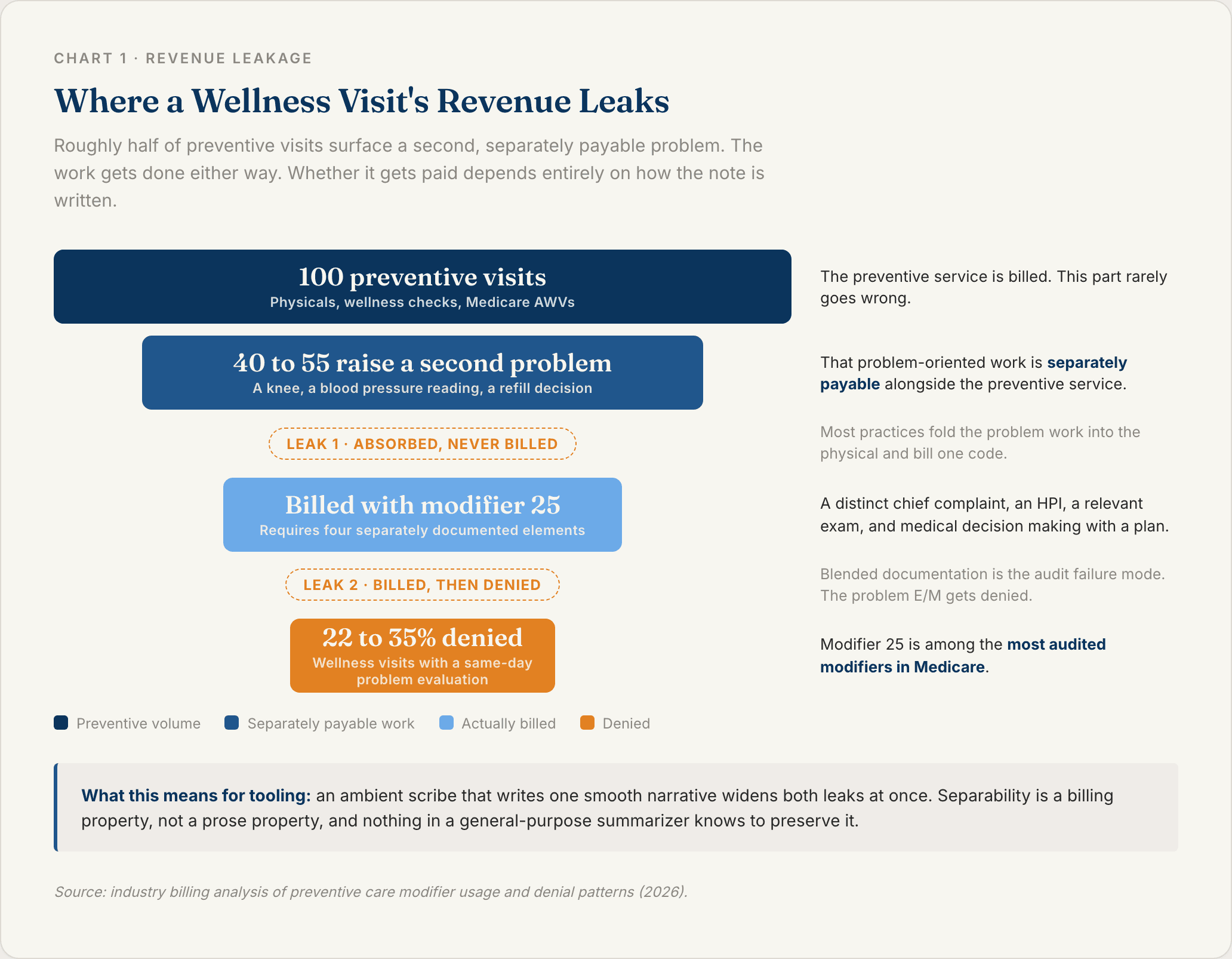
Somewhere between 40 and 55 percent of patients who come in for a wellness exam raise an additional problem while they are there [1].
This is not an edge case. It is closer to half of the preventive schedule.
That problem-oriented work is separately payable alongside the preventive service. Most practices absorb it instead, because sorting out the documentation feels like more trouble than the extra reimbursement is worth.
Blended Documentation Is What Payers Deny
For the practices that do bill it, the second failure point is documentation quality. Wellness visits billed with a same-day problem evaluation see denial rates of 22 to 35 percent when the modifier use or the documentation is wrong [1].
Modifier 25 is among the most audited modifiers in Medicare, and MAC scrutiny of annual wellness visit claims increased through 2025 and 2026 [1].
The failure mode is specific and worth stating plainly. The history, assessment, and plan for the problem have to stand alone. Blended documentation results in the problem-oriented E/M being denied [1].
Ambient Tools Optimize for Readability, Not Separability
An ambient scribe hears one conversation and writes one narrative, because that is what a well-written note looks like to a human reader.
Separability is a billing property, not a prose property. Nothing in a general-purpose summarizer knows to preserve it.
Some vendors have gotten close to this by accident. A few now structure notes by problem, giving each its own history and plan, and they market it as clinical clarity. It happens to be the right shape for a modifier 25 claim too, but that is not why they built it, and none of them tell you to use it that way.
The Three Documentation Traps in a Primary Care Day
These are the three places where a note either supports the claim or quietly fails it.
Selecting an E/M Level on Time or Medical Decision Making
Since the 2021 revision, office visit E/M is selected on either total time on the date of the encounter or medical decision making. Never both. It is 99202 to 99205 for a new patient, 99212 to 99215 for an established one.
Pick the time path and the note has to record the total time. Pick the MDM path and the note has to show the problems addressed, the data reviewed, and the risk.
A note that lists diagnoses without any reasoning supports neither path. That is the most common shape an AI-generated assessment takes.
Modifier 25 and the Four Elements It Requires
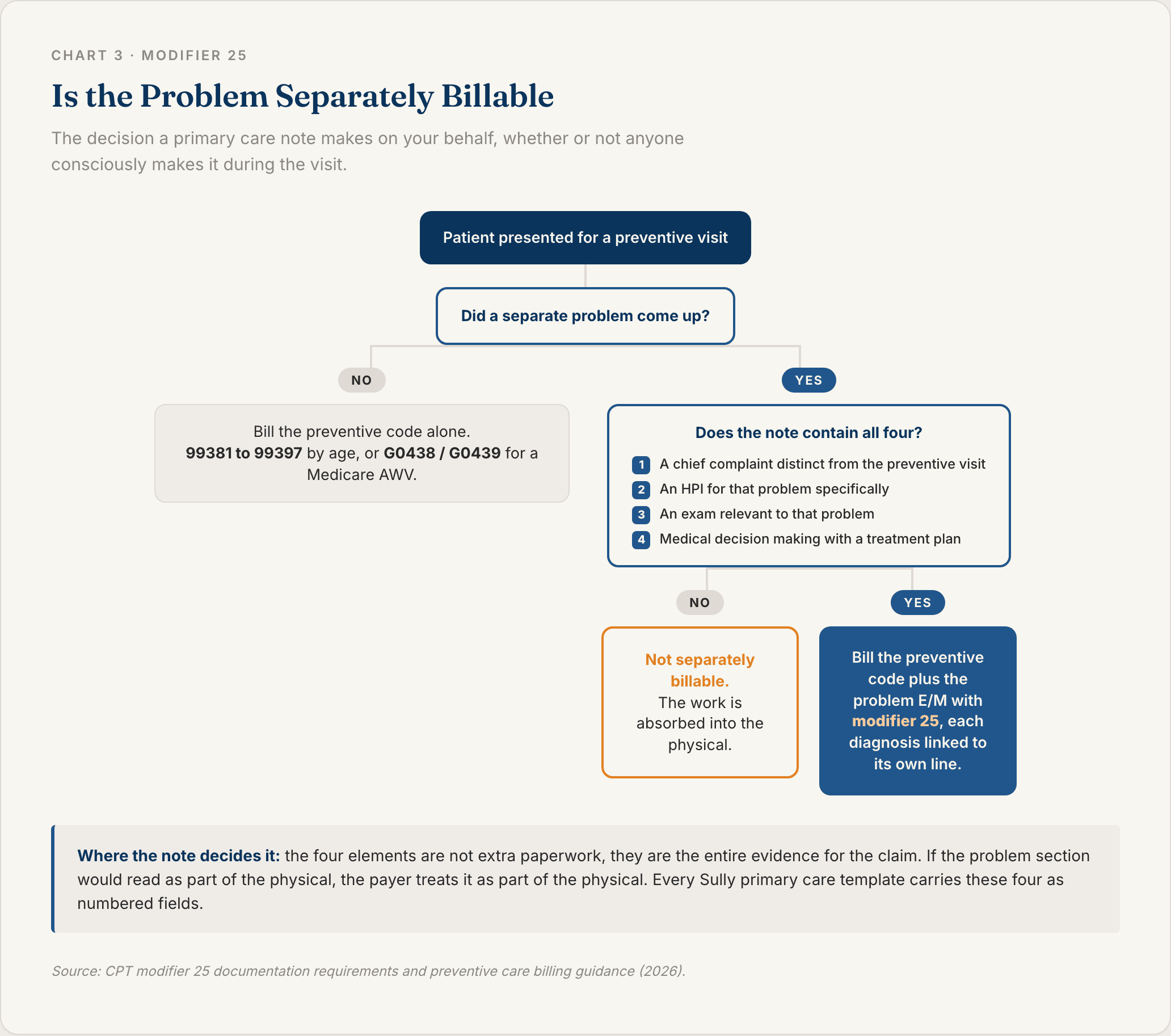
Append modifier 25 to the problem E/M when the problem work is significant and separately identifiable from the preventive service.
Four things have to be visible in the note for that problem specifically:
A chief complaint distinct from the preventive visit
An HPI for that problem
An exam relevant to it
Medical decision making with a treatment plan
Then link the diagnoses correctly. The problem diagnosis goes on the E/M line, the preventive diagnosis on the preventive line [1].
The Medicare Annual Wellness Visit Element List
The AWV is a fixed checklist, and a visit that misses an item does not get paid.
G0438 is the initial visit, once per lifetime, and it has to come before G0439. Neither is payable within 365 days of G0402, the initial preventive physical exam. A second G0438 auto-denies [4].
Two elements are mandatory and get missed constantly: the health risk assessment, and the written personalized prevention plan actually furnished to the patient [4][5]. Screenings for depression, cognition, and functional ability need the tool named and the result recorded. "Screened, negative" is what gets rejected.
One more thing that surprises people. An AWV is not a head-to-toe physical, and Medicare does not cover a routine annual physical.
Free Primary Care Note Templates
These three cover the visits where the documentation actually decides the payment. Each one has the payer rules printed on the page, which is the part a blank SOAP box in the EHR will never give you.
Primary care office visit note template for the everyday problem-oriented visit, structured so the note supports the level of service you bill on either time or medical decision making
Medicare Annual Wellness Visit template covering every required element of G0438 and G0439 across two pages, including the health risk assessment and the written prevention plan
Preventive visit plus problem visit template for modifier 25, splitting the visit into a preventive section and a problem section with the four required elements as numbered fields
What the Evidence Actually Says About AI Scribes in Primary Care
The published research on AI scribes is better than most vendor pages suggest and worse than most vendor claims. Both things are true at once, and the spread is wide enough to matter when you are choosing.
Where the Time Savings Are Real
The Permanente Medical Group ran the largest evaluation to date. Across 7,260 physicians and more than 2.5 million encounters over 63 weeks, AI scribe use added up to the equivalent of 1,794 working days saved in a year [6].
Physicians reported a positive effect on patient interactions at 84 percent, and improved work satisfaction at 82 percent [6]. Primary care was among the highest-utilization specialties.
Patients noticed too. Forty-seven percent said their doctor spent less time looking at a computer [6].
Where the Numbers Disagree
Then there is the randomized evidence, which is more sober.
A pragmatic randomized trial put 238 outpatient physicians across 14 specialties into three arms: two different ambient scribes and a usual-care control. One tool produced a 9.5 percent decrease in time-in-note against control, about 41 seconds per note. The other showed no significant change at all [2].
A primary care simulation study reported a 69.1 percent reduction in documentation time, but that was nine physicians working with standardized patients rather than a real panel [7].
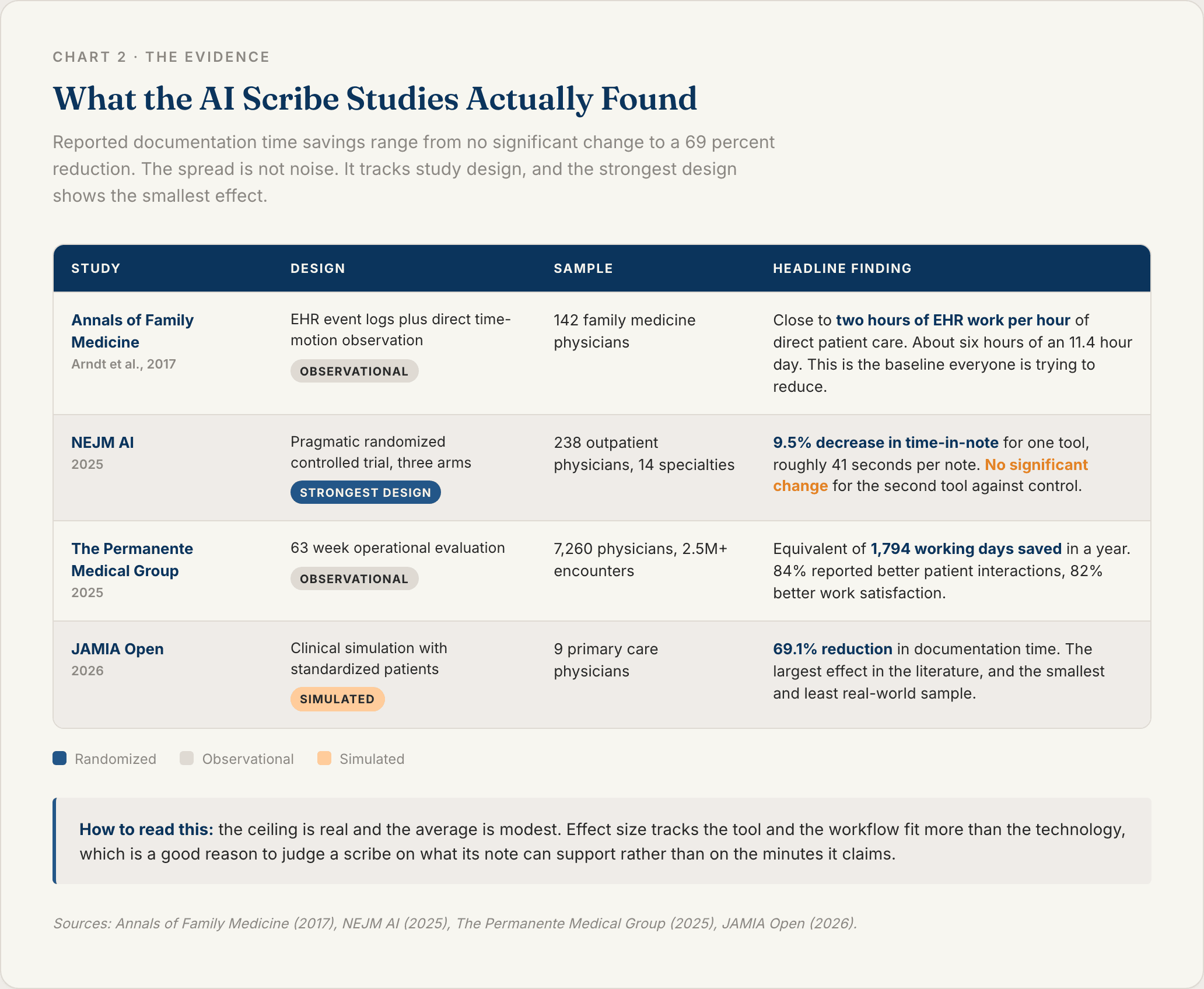
The honest read: the ceiling is real, the average is modest, and most of the variance comes down to the tool and how well it fits the workflow. Which is a good argument for judging a scribe on something other than its time claim.
What AI Scribes Still Get Wrong
Family medicine faculty writing in CMAJ flagged the failure modes directly. AI scribes can hallucinate content that did not happen, omit key information, and struggle with languages other than English [8].
They also specifically struggle with documenting physical examinations [8].
That last one lands harder in primary care than anywhere else, because the exam is the substance of a preventive visit. If the exam documentation is thin, the preventive code is the thing at risk.
The same authors note that AI scribes remain unregulated, and that the clinician is responsible for the final note no matter who drafted it [8].
None of that is an argument for waiting. It is an argument for choosing on the right criteria, because every one of those failure modes is something you can test for before you sign anything.
How to Evaluate an AI Scribe for a Primary Care Practice
Four questions, in the order that matters.
Does It Separate Problems or Blend Them
Give it a recorded visit that starts as a physical and turns into a hypertension decision. Look at the output and ask whether it contains two sections that could each stand alone, or one story.
This is the test most demos will fail, and it is the one that costs you money.
Does It Support the Level of Service You Bill
Ask whether it captures total time on the date of the encounter. Then ask whether the assessment carries reasoning or just a diagnosis list.
Those are the two paths to an E/M level. A note has to serve one of them.
Does It Carry the Preventive Element List
Run an annual wellness visit through it. Check whether the health risk assessment, the screening tools and their scores, and the written prevention plan come out as discrete elements or get summarized into prose.
Does It Write Into the EHR and Reach the Claim
A note you copy and paste is a note you handled twice. At 22 patients a day that adds up fast.
And a note that stops at the chart, never informing the code, has solved half the problem.
Where Sully.ai Fits in a Primary Care Practice
Separability is really a note-structure problem, and note structure is something you set once instead of policing every visit. Clinicians using Sully can save how they want a note built, so a preventive section and a problem section stay distinct by default rather than depending on discipline on a busy Thursday.
Sully's AI Scribe captures documentation during and after the visit and writes it into the EHR on a single integration, across Epic, Cerner, Meditech, Athenahealth, and primary care systems including Elation, Practice Fusion, NextGen, and AdvancedMD.
The AI Coder then extracts the ICD-10 and CPT codes and submits the claim. That handoff is the point. The note and the claim stop being two separate jobs done by two separate people weeks apart.
The AI Receptionist handles the recall and outreach that fill the wellness visit schedule in the first place, which is the other half of preventive revenue.
Sully operates across 5,000+ providers, has delivered 50M+ hours of AI work, and prices each AI role 80 to 90 percent below the human equivalent [9].
Book a demo and bring a real visit. Ideally one that started as a physical and turned into something else.
FAQ
Q: What should an AI scribe for primary care do that a general scribe does not? It has to keep the note billable, not just short. Primary care visits frequently contain two services, a preventive one and a problem-oriented one, and those are separately payable only when the documentation for each stands on its own. A general ambient scribe produces one flowing narrative, which is exactly the blended documentation payers deny. It also has to support E/M level selection on either total time or medical decision making, and carry the required element list for a Medicare Annual Wellness Visit.
Q: How much time do AI scribes actually save primary care physicians? Less than the marketing suggests, and it depends heavily on the tool. A randomized trial of 238 outpatient physicians found one scribe cut time-in-note by 9.5 percent, about 41 seconds per note, while another showed no significant change against control [2]. Larger operational evaluations report bigger effects: The Permanente Medical Group measured the equivalent of 1,794 working days saved across 7,260 physicians in a year [6]. Primary care physicians start from roughly two hours of EHR work per hour of direct patient care [3].
Q: When can you bill a problem visit and a preventive visit on the same day? When the problem work is significant and separately identifiable from the preventive service. Append modifier 25 to the problem E/M code, 99202 to 99205 for a new patient or 99212 to 99215 for an established one, and document four things for the problem specifically: a chief complaint distinct from the preventive visit, an HPI, a relevant exam, and medical decision making with a treatment plan. Link the problem diagnosis to the E/M line and the preventive diagnosis to the preventive line [1].
Q: Why do Medicare Annual Wellness Visits get denied? Three reasons. Sequence, since G0438 is once per lifetime and must come before G0439, so a second G0438 auto-denies. Timing, since neither is payable within 365 days of the G0402 initial preventive physical exam. And missing elements, since the health risk assessment and the written personalized prevention plan furnished to the patient are both required, and screenings need the tool and the result recorded rather than a bare conclusion [4][5].
Q: Do you have free primary care note templates? Yes. Sully publishes three: an office visit note built around E/M level selection, a two-page Medicare Annual Wellness Visit template covering every required element, and a preventive-plus-problem template that lays out the four elements modifier 25 requires. Each has the payer rules printed on the page.
Sources
[1] Medical Billers and Coders — How Does Incorrect Modifier Usage Impact Preventive Care Billing? [2] NEJM AI — Ambient AI Scribes in Clinical Practice: A Randomized Trial [3] Annals of Family Medicine — Tethered to the EHR: Primary Care Physician Workload Assessment Using EHR Event Log Data and Time-Motion Observations [4] American Academy of Family Physicians — How To Implement And Code Medicare's Annual Wellness Visit [5] Centers for Medicare & Medicaid Services — Annual Wellness Visit: Social Determinants of Health Risk Assessment [6] The Permanente Medical Group— Analysis: AI Scribes Save Physicians Time, Improve Patient Interactions and Work Satisfaction [7] JAMIA Open — Evaluating the Impact of Artificial Intelligence Scribes on Clinical Documentation in Primary Care: A Simulation Study [8] CMAJ— Artificial Intelligence Scribes in Primary Care [9] Sully.ai — The AI Workforce for Healthcare
TABLE OF CONTENTS
Hire your
Medical AI Team
Take a look at our Medical AI Team
AI Receptionist
Manages patient scheduling, communications, and front-desk operations across all channels.
AI Scribe
Documents clinical encounters and maintains accurate EHR/EMR records in real-time.
AI Medical Coder
Assigns and validates medical codes to ensure accurate billing and regulatory compliance.
AI Nurse
Assesses patient urgency and coordinates appropriate care pathways based on clinical needs.