Article

The average physician spends more than 14 hours per week on prior authorization tasks [1]. That's nearly two full workdays spent not seeing patients, not documenting care, and not billing for services rendered.
It's spent on hold with payers, re-entering data that already exists in the EHR, and checking portal statuses that could change without notice.
Prior authorization was designed to ensure treatments are medically necessary and covered. The intent is reasonable. The execution is broken.
This guide covers how prior authorization automation works, which technologies power it, what the 2024 CMS Final Rule requires of your practice, and which platforms are leading the category.
Key Takeaway
Prior authorization automation uses AI, robotic process automation (RPA), and healthcare data standards like EDI X12 278 to automatically extract clinical data from EHR systems, submit PA requests to payers, and track approval status without manual staff intervention. The CAQH 2023 Index shows manual PA transactions cost providers approximately $11 per request compared to $2 for fully electronic transactions [3]. The 2024 CMS Interoperability and Prior Authorization Final Rule (effective January 2026) now requires payers to respond within 72 hours for urgent requests and seven days for standard requests, making automation not just a cost lever but a compliance necessity [2]. Platforms like Sully.ai go further by integrating PA automation into a coordinated AI workforce, where the AI Scribe captures documentation, the AI Coder extracts ICD-10 and CPT codes, and clean claims are submitted before denials occur.
Why Prior Authorization Creates a Bottleneck in Healthcare Delivery
Prior authorization is, at its core, a data problem. The clinical information payers need to make a decision already sits in the EHR. Getting it out, formatted correctly, and submitted to the right payer through the right channel is where things fall apart.
There are more than 1,000 payers in the US. Each has its own portal, its own forms, and its own criteria. Manual PA isn't just slow. It's structurally incapable of scaling.
The Administrative Cost of Manual PA Workflows
Each manual PA transaction costs a provider approximately $11.15, compared to $2.11 for a fully electronic transaction [3]. That gap adds up fast.
A practice submitting 50 PA requests per week spends more than $25,000 per year in transaction costs alone, before accounting for staff time. Add the time cost: the AMA's 2023 survey shows physicians spending 14-plus hours per week on PA tasks, and the total cost per request approaches $36 [1].
For every physician seeing patients, there are roughly 10 administrative staff behind them [1]. PA is a major reason why.
By the numbers: A practice with 200 PA requests per month could be spending more than $80,000 per year in combined transaction and staff time costs on prior authorization alone.
How PA Delays Affect Patient Outcomes
Speed matters in medicine. PA delays don't just frustrate staff. They harm patients.
According to AMA data, 93% of physicians say PA delays patient care [1]. More troubling: 25% report that a PA delay led to a serious adverse event for a patient, including hospitalization or permanent damage [1].
When a patient is waiting on approval for a specialty medication, they're often managing a chronic condition that gets worse without treatment. If approval takes five days and the patient stops their regimen in the meantime, both the outcome and the downstream billing opportunity suffer.
Staff Burnout Driven by High-Volume PA Tasks
PA is exactly the kind of work that burns people out: repetitive, rules-based, high-volume, and consequential if you get it wrong.
Staff spend hours on hold with payer call centers, re-entering data that already exists in the chart, and logging into multiple portals to track submissions. This isn't a small-practice problem. Health systems running Epic still have dedicated PA teams navigating payer portals by hand.
Automation exists to eliminate this kind of work. PA is near the top of the list.
How Prior Authorization Automation Works
Modern PA automation isn't a form-filler or a portal shortcut. It's a system that reads clinical data, applies payer rules, submits the request through the right channel, and tracks the response, all without a staff member touching it [4].
Here's how each step works in practice.
AI-Driven Data Extraction from EHR Systems
When a provider orders a procedure or medication that requires PA, the system reads the patient's chart automatically. It pulls diagnosis codes, lab values, medication history, and prior treatment records.
This is where natural language processing (NLP) makes a real difference. AI can extract data from unstructured physician notes, not just structured EHR fields. If a note says the patient tried and failed two prior medications, the system captures that without anyone reading and re-typing it [4].
The manual alternative: a staff member opens the EHR, reads the chart, then manually re-enters values into a payer portal. Automation eliminates that entire step.
Automated Submission Through EDI 278 and Payer Portals
Once the data is assembled, the system submits the PA request through the appropriate channel. There are three main options:
EDI X12 278 (the HIPAA-mandated standard for PA requests and responses)
Payer APIs (increasingly available as FHIR requirements expand)
RPA-driven portal automation (for payers that still don't offer API access)
The system selects the right channel based on payer and plan type. As CMS requirements push more payers to support FHIR APIs by January 2026, the mix will shift further toward real-time API submission and away from portal workarounds [2].
Real-Time Status Tracking Without Staff Intervention
After submission, the system polls for responses automatically. No one needs to call the payer or check a portal.
When the payer responds (approved, denied, or requesting additional information), the system routes the decision back into the EHR and notifies the right team member. Denials can automatically trigger appeal workflows with supporting documentation pre-populated.
This step alone eliminates several hours of follow-up work per staff member per week.
Technologies Powering Prior Authorization Automation
PA automation isn't one technology. It's a stack. Understanding what each layer does helps when evaluating vendors, because not every platform uses all of them [4].
Robotic Process Automation in PA Workflows
RPA uses software bots to mimic human actions in web interfaces: logging into payer portals, navigating forms, clicking buttons, and downloading decisions.
It was the first major PA automation technology and is still widely used because most payers don't offer API access. The limitation is real, though. RPA is brittle. It breaks when a payer changes its portal UI, and it doesn't understand clinical context. It automates mechanical steps but not judgment calls.
RPA works best as a stopgap for payers without EDI or FHIR API support, not as a long-term foundation.
AI and Natural Language Processing for Clinical Data
AI and NLP add the intelligence layer that RPA lacks. They can read a physician's note and identify that a patient tried and failed two prior medications, a common payer requirement for approving a specialty drug.
They can also flag missing documentation before the PA goes out. That pre-submission validation is where the denial-rate impact comes from. Generative AI is now being applied here too: some platforms can draft prior authorization letters and clinical justifications directly from patient data [4].
MACPAC has documented that AI adoption in Medicaid PA contexts is accelerating, with more programs moving toward AI-assisted automation rather than pure RPA [4].
Healthcare APIs and EDI Standards
EDI X12 278 is the HIPAA-mandated standard for PA requests and responses. Adoption has been uneven. Many payers still route PA through portals rather than EDI, which is why RPA remains in the picture.
HL7 FHIR APIs represent the next generation. The CMS 2024 Final Rule requires Medicare Advantage, Medicaid, and CHIP payers to support FHIR-based PA APIs by January 2026, enabling real-time data exchange [2]. Three key FHIR implementation guides govern PA: CRD (Coverage Requirements Discovery), DTR (Documentation Templates and Rules), and PAS (Prior Authorization Support).
If you're evaluating a PA automation vendor, ask which of these they support. The answer tells you a lot about their technical roadmap.
What the CMS Prior Authorization Final Rule Means for Providers
The CMS Interoperability and Prior Authorization Final Rule (CMS-0057-F), finalized in January 2024, is the most significant federal action on PA in decades. Most coverage focuses on what payers must do. The provider implications matter just as much [2].
New Decision Timelines and Compliance Requirements
Starting January 1, 2026, Medicare Advantage, Medicaid, and CHIP plans must meet new requirements across the board.
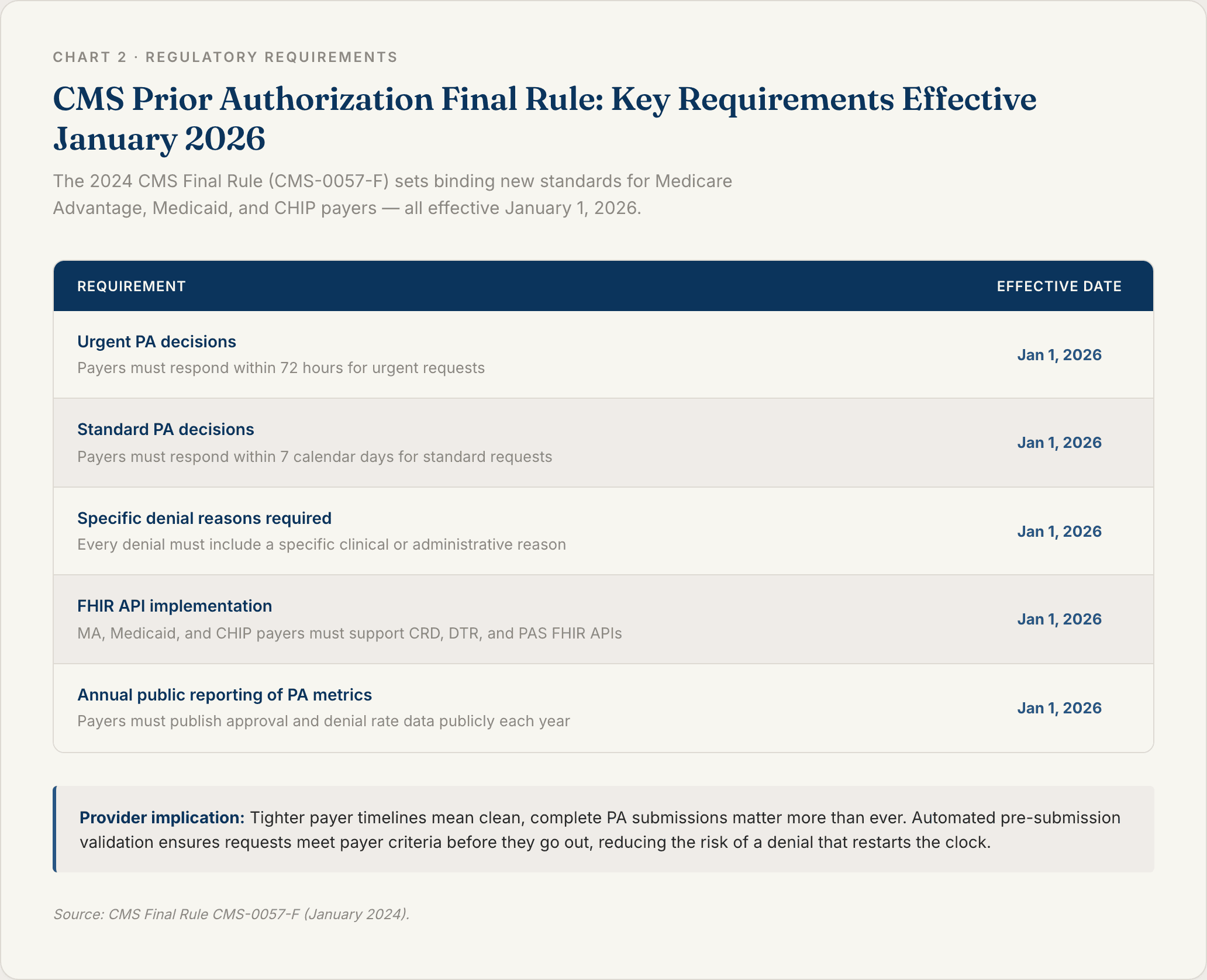
The requirement that payers provide a specific reason for every denial is particularly significant. It gives providers a clear basis for appeal, and it gives automation platforms real data to improve pre-submission validation over time.
For providers, tighter payer timelines create pressure to submit complete, well-documented requests on the first pass. Automated systems that pre-validate against payer criteria before submission dramatically reduce the risk of a denial that restarts the clock.
FHIR API Standards and EHR Integration
The rule also requires covered payers to implement FHIR APIs using the CRD, DTR, and PAS implementation guides by January 2026. For providers, this creates a real opportunity [2].
If your PA automation platform supports FHIR, you can request PA determinations in real time at the point of care, before the patient leaves the office. That closes the gap between ordering a treatment and knowing whether it's covered.
Epic and Cerner are both building FHIR PA workflows into their platforms. Providers evaluating PA automation should verify whether their vendor is certified against the CMS IG specifications. That compatibility is what enables real-time PA at the point of prescribing.
The Business Case for Prior Authorization Software
The ROI of PA automation comes from two places: reducing what you spend per transaction, and reducing how often you need to rework a denial. Both add up faster than most finance teams expect [1][3].
Prior Authorization Best Practices That Reduce Denial Rates
The biggest driver of PA ROI isn't speed. It's denial prevention.
First-pass PA denial rates at many practices exceed 30% [5][6]. Every denial triggers rework: additional documentation, appeal letters, resubmission. That rework costs money and delays care further.
Automation reduces denial rates through four mechanisms:
Pre-submission criteria matching: The system checks the patient record against payer criteria before sending, so only complete, qualifying requests go out.
Clinical documentation alerts: If a required element is missing (like documentation of a failed first-line therapy), the system flags it before submission.
Payer-specific rule libraries: Platforms that maintain current payer criteria databases mean the system knows what each payer requires, updated continuously.
Appeal automation: When a denial comes in, the system routes it to the appropriate appeal workflow with supporting documentation already populated.
Automation that applies pre-submission validation can bring first-pass denial rates below 5% for many procedure types [3].
ROI and Cost Savings Compared to Manual Prior Authorization Workflows
Here's a model you can apply to your own practice:
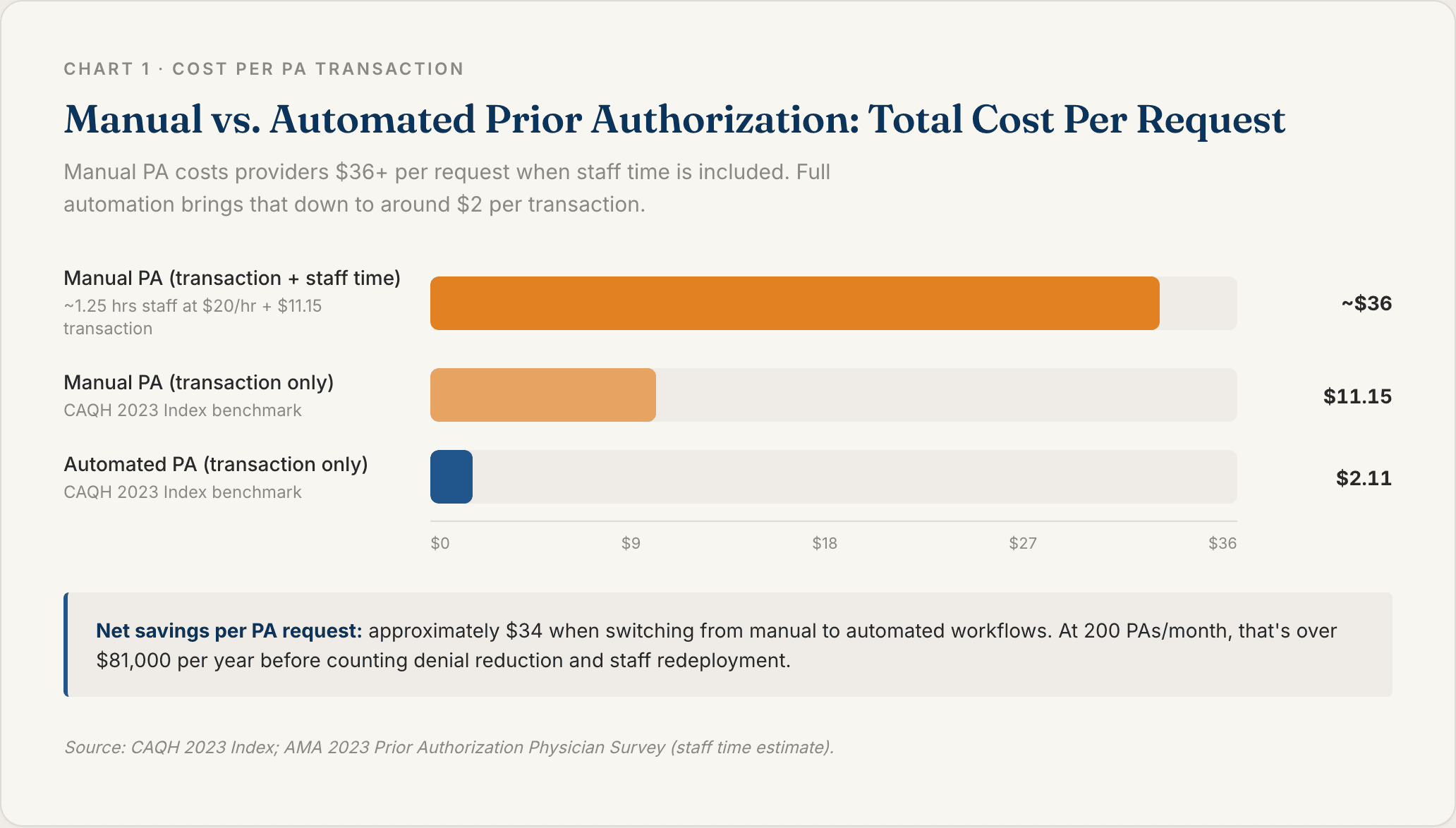
Manual PA: approximately $11.15 per transaction (CAQH) plus roughly $25 in staff time at an estimated 1.25 hours per request [1][3]
Automated PA: approximately $2.11 per transaction plus near-zero staff time for standard cases
Net savings per PA: approximately $34
At 200 PAs per month: around $6,800 per month, or $81,600 per year
That's before counting indirect savings from fewer denied claims, fewer appeals, fewer write-offs, and recaptured staff time for higher-value work.
Sully.ai's AI roles cost 80-90% less than human equivalents. For practices running dedicated PA coordinator headcount, the math shifts dramatically once automation handles the volume.
Faster Time to Therapy and Patient Satisfaction
In value-based care models, patient experience affects reimbursement. When PA is delayed, patients miss appointments, abandon prescriptions, or switch providers.
Automated PA can compress the approval cycle from three to five days down to same-day or next-day for many standard requests. For specialty medications, that difference means patients start therapy faster, which improves medication adherence, outcomes, and quality scores like STAR ratings.
Better PA speed is better clinical performance. The two are directly connected.
Prior Authorization Automation Platforms Worth Evaluating
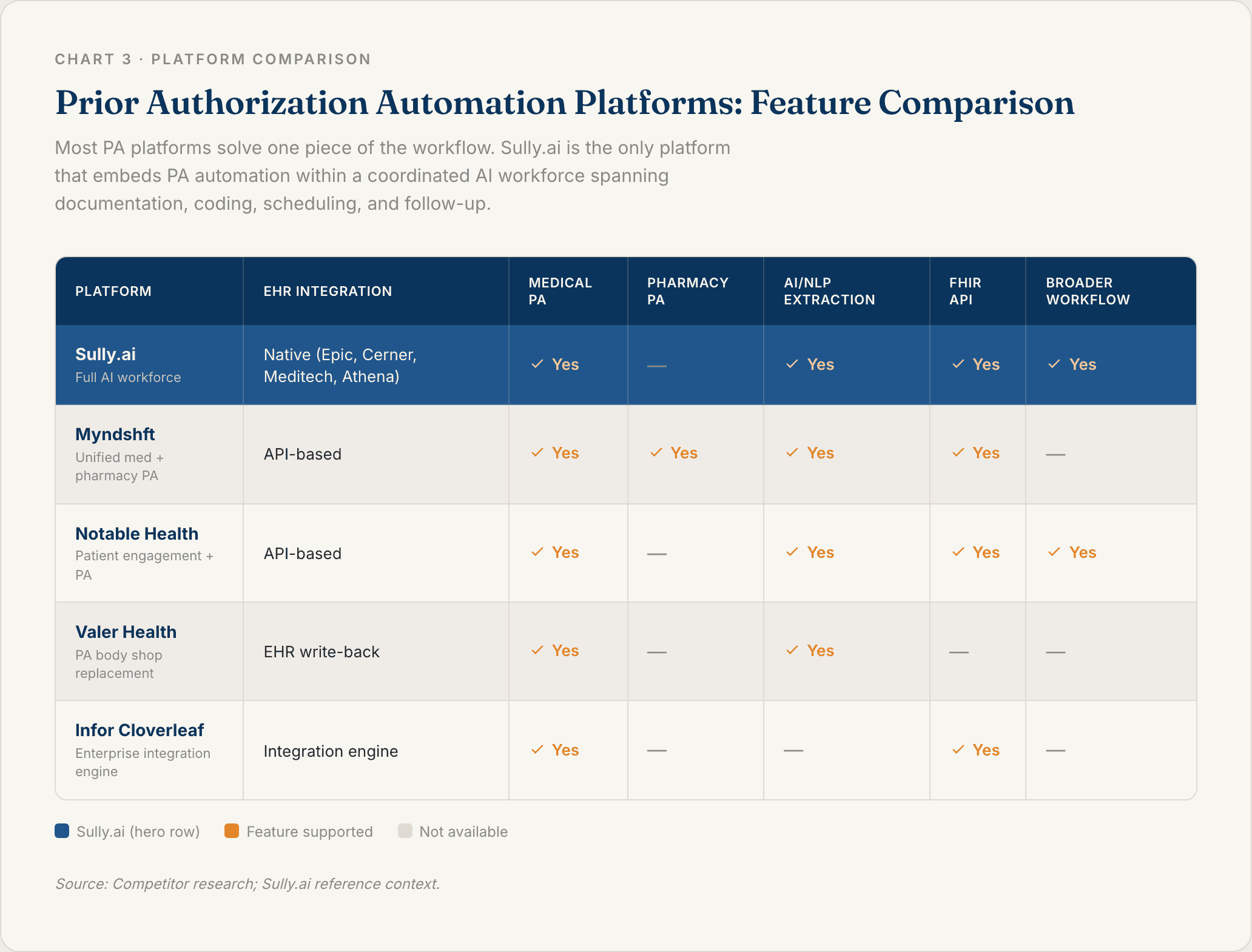
Not all PA automation platforms work the same way. Some focus exclusively on PA. Others embed it within a broader administrative workflow. Here's how the leading options compare.
1. Sully.ai
Sully.ai approaches prior authorization differently from every other platform on this list. Rather than offering a standalone PA tool, Sully deploys a coordinated AI workforce where PA automation is built into the clinical and billing workflow from the start.
The AI Scribe captures the clinical encounter. The AI Coder extracts every ICD-10 and CPT code from the documentation. The system identifies whether the ordered procedure or medication requires PA, assembles the request with clinical documentation already in hand, and submits the clean claim before a denial can occur. No separate portal. No manual handoff. No siloed tool to manage on top of everything else.
Sully integrates once with the EHR (Epic, Cerner, Meditech, Athenahealth) and all agents share context. Operates 24/7 at 80-90% less cost than the human roles they replace.
2. Myndshft
Myndshft is the only platform in this category to offer unified medical and pharmacy PA automation on a single platform. It uses a self-learning rules engine with a synchronized payer criteria library, enabling real-time PA determinations for both medication and procedure requests.
Best fit for organizations that need to manage medical and pharmacy PA at scale, including health systems and payers looking for shared infrastructure.
3. Notable Health
Notable Health builds PA automation as part of a broader AI-driven patient engagement and workflow platform. Its PA workflow follows five stages: criteria detection, data collection, request submission, status tracking, and denial management, all agent-driven without staff involvement.
Strong for health systems that want PA automation embedded within a larger clinical workflow initiative rather than managed as a separate product.
4. Valer Health
Valer targets one specific problem: replacing the manual PA body shop. Most large practices run dedicated PA teams that still review, confirm, and submit each request by hand. Valer's platform handles submission, status tracking, payer decision verification, and EHR write-back automatically, with minimal human touchpoints.
Worth evaluating if your practice still runs a PA coordinator team and you want a direct replacement for that headcount.
5. Infor Cloverleaf
Infor Cloverleaf approaches PA from an integration engine perspective. It uses cloud-based microservices and event-driven workflows to standardize PA submissions and responses across complex health system environments.
Best suited for enterprise health systems already running Cloverleaf for clinical data integration that want to extend that infrastructure to cover PA workflows.
Prior Authorization Automation as Part of an AI-Driven Healthcare Workforce
PA automation as a standalone tool solves one problem. It doesn't fix the data fragmentation, the documentation burden, or the post-visit follow-up gap that sit on either side of it.
The practices seeing the biggest gains aren't just automating PA. They're connecting it to the full administrative workflow.
From Clinical Documentation to Clean Claim Without Manual Touchpoints
Here's what an end-to-end automated PA workflow looks like when documentation and coding are part of the same system:
The AI Scribe captures the clinical encounter in real time during the visit
The AI Coder extracts every ICD-10 and CPT code from the documentation
The system identifies whether the ordered procedure or medication requires PA
The PA request is assembled and submitted automatically, with clinical documentation already in hand
The clean claim is submitted before a denial can occur
PA platforms that sit outside the documentation workflow have to re-extract data the EHR already contains. That re-extraction step is where errors get introduced and time gets wasted.
Sully eliminates that step because the Scribe and Coder operate on the same patient record, in real time, as part of the same system. The clinical data flows directly into the PA request without anyone touching it in between.
How AI Agents Collaborate Across the Full Revenue Cycle
The coordination doesn't stop at PA submission. After PA is approved, the AI Receptionist confirms the appointment. After the visit, the AI Triage Nurse follows up on prescription adherence. If a patient hasn't filled their prescription, the Nurse reaches out. If they don't respond, the Receptionist books the follow-up slot.
No patient falls through. No manual follow-up call needed.
Sully operates across 5,000-plus providers and has delivered more than 50 million hours of AI work. That's what separates a workforce from a toolset: agents that share context, hand off cases, and operate as a team rather than as separate products.
If your practice is ready to stop managing PA as a standalone problem and start treating it as one layer of a coordinated administrative system, request a demo at sully.ai.
FAQ
Q: What is prior authorization automation?
Prior authorization automation uses AI, RPA, and healthcare data standards (EDI X12 278, FHIR APIs) to handle PA requests without manual staff intervention. Instead of a staff member logging into a payer portal, extracting data from the EHR, and typing it into a form, an automated system extracts the clinical data, matches it against payer criteria, submits the request, and tracks the response. Platforms like Sully.ai go further, connecting PA automation to clinical documentation and coding so clean claims are submitted before denials occur.
Q: How does prior authorization automation integrate with EHR systems?
Most PA automation platforms integrate with EHR systems via HL7 FHIR APIs, HL7 v2 interfaces, or native EHR app store integrations (Epic App Orchard, Cerner App Market). The integration lets the automation platform read patient charts, pull diagnostic codes and clinical documentation, and write PA status back into the patient record. Sully.ai uses a single EHR integration that works across Epic, Cerner, Meditech, and Athenahealth, so all AI agents (including the AI Coder that handles PA-adjacent billing tasks) share the same patient data without duplicate integrations.
Q: What is the CMS Interoperability and Prior Authorization Final Rule?
The CMS Interoperability and Prior Authorization Final Rule (CMS-0057-F), finalized in January 2024, requires Medicare Advantage, Medicaid, and CHIP payers to implement FHIR-based PA APIs by January 1, 2026 and to respond to standard PA requests within seven calendar days and urgent requests within 72 hours [2]. Payers must also provide specific reasons for all denials and report PA metrics publicly. For providers, this rule accelerates the shift toward real-time, EHR-embedded PA, making now the right time to evaluate platforms that support FHIR-based workflows.
Q: How does prior authorization automation reduce claim denials?
Automated PA systems apply pre-submission validation: checking the PA request against payer-specific criteria before it's sent. Requests missing required documentation, failing payer criteria, or routed to the wrong channel are caught before submission, not after. First-pass denial rates from manual PA often exceed 30% [5][6]. Automated systems with payer rules libraries and clinical data extraction can bring that figure below 5% for many procedure types, reducing the cost of appeals and the revenue lost from abandoned claims [3].
Q: What is the best prior authorization automation software for healthcare providers?
The best platform depends on your practice's scope. Sully.ai is best for organizations that want PA automation as part of a coordinated AI workforce, connecting documentation, coding, PA, and follow-up in a single integrated system. Myndshft is best for organizations managing both medical and pharmacy PA at scale. Notable Health is strong for health systems embedding PA automation within broader patient engagement workflows. Valer Health is a good fit for practices with dedicated PA teams that need a direct replacement for manual workflows. Infor Cloverleaf suits enterprise health systems with complex integration environments.
Sources
[1] American Medical Association (AMA) — 2023 AMA Prior Authorization Physician Survey. https://www.ama-assn.org/practice-management/prior-authorization/2023-ama-prior-authorization-survey-results
[2] Centers for Medicare & Medicaid Services (CMS) — CMS Interoperability and Prior Authorization Final Rule (CMS-0057-F). https://www.cms.gov/newsroom/fact-sheets/cms-interoperability-and-prior-authorization-final-rule-cms-0057-f-0
[3] CAQH — 2023 CAQH Index: A Report on the Adoption of Electronic Business Transactions. https://www.caqh.org/explorations/caqh-index
[4] MACPAC (Medicaid and CHIP Payment and Access Commission) — Automation in the Prior Authorization Process. https://www.macpac.gov/publication/automation-in-the-prior-authorization-process/
[5] KFF (Kaiser Family Foundation) — Prior Authorization in Medicare Advantage. https://www.kff.org/medicare/issue-brief/prior-authorization-in-medicare-advantage/
[6] HHS Office of Inspector General (OIG) — Some Medicare Advantage Organization Denials of Prior Authorization Requests Raise Concerns About Beneficiary Access to Medically Necessary Care. https://oig.hhs.gov/reports-and-publications/featured-reports/medicare-advantage-prior-authorization/


Article

Keep reading

Article
/
How to Add an AI Receptionist to eClinicalWorks and the 23 Percent That Still Reaches a Human
CCM requires 20 minutes of non-face-to-face time and a care plan—but the clock stops the moment the patient is in the room. See billing rules and examples.

Article
/
Dental Answering Service: What It Costs, and Where Missed Calls End Up
What a dental answering service costs, how after-hours dental calls are handled, and where the calls you miss actually end up, with federal ED data.

Article
/
After-Hours Medical Answering Service: Coverage Models and On-Call Routing
What happens to your patients' calls after 5pm, the four coverage models compared, and how to design on-call routing that does not end at the emergency department.
