"/><stop offset="1" stop-color="rgba(255, 255, 255, 0)"/></linearGradient><linearGradient id="WxV_IOPE7-2309410982-linear-gradient" x1="1" x2="0" y1="0.5951279047551217" y2="0.4048720952448783"><stop offset="0" stop-color="rgb(255, 255, 255)"/><stop offset="1" stop-color="rgba(255, 255, 255, 0)"/></linearGradient><linearGradient id="WwbAIQIz8-2309410982-linear-gradient" x1="0.43478742751482424" x2="0.6358595260107829" y1="0.26" y2="1"><stop offset="0" stop-color="rgb(255, 255, 255)"/><stop offset="1" stop-color="rgba(255, 255, 255, 0)"/></linearGradient><linearGradient id="ZWsVQcPfn-2309410982-linear-gradient" x1="0.9508213454678907" x2="0.04917865453210929" y1="0" y2="1"><stop offset="0" stop-color="rgb(255, 255, 255)"/><stop offset="1" stop-color="rgba(255, 255, 255, 0)"/></linearGradient><linearGradient id="lTyCGrzzP-2309410982-linear-gradient" x1="0.374937164194436" x2="0.625062835805564" y1="0" y2="1"><stop offset="0" stop-color="rgb(255, 255, 255)"/><stop offset="1" stop-color="rgba(255, 255, 255, 0)"/></linearGradient></defs><g d="M 658.002 1357.705 C 1020.321 1357.705 1314.04 1063.989 1314.04 701.667 C 1314.04 339.347 1020.321 45.626 658.002 45.626 C 295.681 45.626 1.96 339.347 1.96 701.667 L 0 701.667 C 0 338.263 294.598 43.665 658.002 43.665 C 1021.404 43.665 1316 338.263 1316 701.667 C 1316 1065.072 1021.404 1359.672 658.002 1359.672 C 294.598 1359.672 0 1065.072 0 701.667 L 1.96 701.667 C 1.96 1063.989 295.681 1357.705 658.002 1357.705 Z M 658.005 1265.053 C 969.154 1265.053 1221.392 1012.819 1221.392 701.667 C 1221.392 390.517 969.154 138.281 658.005 138.281 C 346.856 138.281 94.619 390.517 94.619 701.667 L 92.659 701.667 C 92.659 389.433 345.77 136.321 658.005 136.321 C 970.241 136.321 1223.352 389.433 1223.352 701.667 C 1223.352 1013.902 970.241 1267.017 658.005 1267.017 C 345.77 1267.017 92.659 1013.902 92.659 701.667 L 94.619 701.667 C 94.619 1012.819 346.856 1265.053 658.005 1265.053 Z M 658.002 1166.116 C 914.513 1166.116 1122.452 958.178 1122.452 701.667 C 1122.452 445.16 914.513 237.22 658.002 237.22 C 401.494 237.22 193.551 445.16 193.551 701.667 L 191.59 701.667 C 191.59 444.077 400.411 235.255 658.002 235.255 C 915.596 235.255 1124.412 444.077 1124.412 701.667 C 1124.412 959.261 915.596 1168.084 658.002 1168.084 C 400.411 1168.084 191.59 959.261 191.59 701.667 L 193.551 701.667 C 193.551 958.178 401.494 1166.116 658.002 1166.116 Z M 281.657 818.28 C 298.572 818.28 314.804 825.001 326.765 836.965 L 458.99 969.182 C 470.582 980.781 486.308 987.298 502.706 987.298 L 612.137 987.298 C 646.284 987.298 673.972 959.61 673.972 925.463 L 673.972 891.504 L 675.939 891.504 L 675.939 925.463 C 675.939 960.7 647.374 989.258 612.137 989.258 L 502.706 989.258 C 485.788 989.258 469.562 982.537 457.599 970.573 L 325.378 838.356 C 313.785 826.757 298.056 820.242 281.657 820.244 L 1.173 820.244 L 1.173 818.28 Z M 746.64 888.714 L 1053.046 888.714 C 1069.967 888.714 1086.194 895.435 1098.16 907.398 L 1259.381 1068.619 L 1257.99 1070.007 L 1096.772 908.79 C 1085.175 897.193 1069.446 890.679 1053.046 890.681 L 746.64 890.681 C 729.724 890.681 713.493 883.957 701.533 871.993 L 685.377 855.845 L 686.769 854.453 L 702.917 870.605 C 714.513 882.201 730.241 888.715 746.64 888.714 Z M 667.685 552 L 512.316 396.894 C 494.66 379.264 484.741 355.356 484.739 330.426 L 484.739 0 L 487.632 0 L 487.632 330.426 C 487.632 354.592 497.248 377.763 514.369 394.851 L 669.739 549.957 Z M 782.851 700.491 C 816.998 700.491 844.686 672.804 844.686 638.655 L 844.686 516.468 C 844.687 499.547 851.409 483.32 863.374 471.355 L 1177.508 157.22 L 1178.896 158.607 L 864.762 472.742 C 853.162 484.337 846.646 500.067 846.646 516.468 L 846.646 638.655 C 846.646 673.89 818.088 702.455 782.851 702.455 L 700.405 702.455 L 700.405 700.491 Z M 130.338 534.223 L 213.07 534.223 C 256.112 534.223 291.003 569.114 291.003 612.156 L 291.003 694.888 C 291.003 711.29 297.514 727.017 309.113 738.611 L 472.887 902.378 L 471.496 903.769 L 307.726 739.995 C 295.761 728.033 289.038 711.807 289.038 694.888 L 289.038 612.156 C 289.038 570.198 255.028 536.188 213.07 536.188 L 130.338 536.188 C 113.419 536.187 97.193 529.465 85.23 517.5 L 77.071 509.345 C 65.107 497.381 58.386 481.153 58.388 464.233 L 58.388 199.526 L 60.348 199.526 L 60.348 464.233 C 60.349 480.631 66.863 496.358 78.458 507.954 L 86.617 516.113 C 98.213 527.709 113.94 534.223 130.338 534.223 Z" fill="transparent" height="1359.6717183844698px" id="DcyumyANr" transform="translate(0 -43.665)" width="1316px"><g opacity="0.5"><path d="M 658.002 1314.039 C 1020.321 1314.039 1314.04 1020.324 1314.04 658.001 C 1314.04 295.681 1020.321 1.961 658.002 1.961 C 295.681 1.961 1.96 295.682 1.96 658.001 L 0 658.001 C 0 294.598 294.598 0 658.002 0 C 1021.404 0 1316 294.598 1316 658.001 C 1316 1021.407 1021.404 1316.007 658.002 1316.007 C 294.598 1316.007 0 1021.407 0 658.001 L 1.96 658.001 C 1.96 1020.324 295.681 1314.039 658.002 1314.039 Z" fill="rgb(255, 255, 255)" height="1316.0065114752902px" id="dxf13D52Y" transform="translate(0 43.665)" width="1316px"/></g><g opacity="0.3"><path d="M 565.347 1128.732 C 876.496 1128.732 1128.733 876.498 1128.733 565.346 C 1128.733 254.196 876.496 1.961 565.347 1.961 C 254.197 1.961 1.961 254.196 1.961 565.346 L 0 565.346 C 0 253.112 253.111 0 565.347 0 C 877.582 0 1130.693 253.112 1130.693 565.346 C 1130.693 877.581 877.582 1130.696 565.347 1130.696 C 253.111 1130.696 0 877.581 0 565.346 L 1.961 565.346 C 1.961 876.498 254.197 1128.732 565.347 1128.732 Z" fill="rgb(255, 255, 255)" height="1130.6960934794101px" id="if1BmYw1S" transform="translate(92.659 136.321)" width="1130.693351805604px"/></g><g opacity="0.15"><path d="M 466.412 930.861 C 722.923 930.861 930.862 722.922 930.862 466.411 C 930.862 209.905 722.923 1.965 466.412 1.965 C 209.904 1.965 1.961 209.905 1.961 466.411 L 0 466.411 C 0 208.822 208.821 0 466.412 0 C 724.006 0 932.822 208.822 932.822 466.411 C 932.822 724.005 724.006 932.828 466.412 932.828 C 208.821 932.828 0 724.005 0 466.411 L 1.961 466.411 C 1.961 722.922 209.904 930.861 466.412 930.861 Z" fill="rgb(255, 255, 255)" height="932.8284667407987px" id="ef75NsYf6" transform="translate(191.59 235.255)" width="932.8219552655086px"/></g><g opacity="0.5"><path d="M 280.484 0 C 297.399 0 313.63 6.721 325.592 18.685 L 457.817 150.902 C 469.408 162.501 485.135 169.018 501.533 169.017 L 610.964 169.017 C 645.111 169.017 672.799 141.33 672.799 107.182 L 672.799 73.223 L 674.766 73.223 L 674.766 107.182 C 674.766 142.42 646.201 170.978 610.964 170.978 L 501.533 170.978 C 484.614 170.978 468.389 164.257 456.426 152.293 L 324.205 20.076 C 312.611 8.477 296.883 1.961 280.484 1.964 L 0 1.964 L 0 0 Z" fill="url(%23cQ4xRdUtr-2309410982-linear-gradient)" height="170.97763275969464px" id="cQ4xRdUtr" transform="translate(1.173 818.28)" width="674.7656780356198px"/></g><g opacity="0.5"><path d="M 61.263 34.261 L 367.669 34.261 C 384.589 34.261 400.817 40.982 412.783 52.945 L 574.004 214.166 L 572.612 215.554 L 411.395 54.337 C 399.798 42.74 384.069 36.226 367.669 36.228 L 61.263 36.228 C 44.347 36.228 28.116 29.504 16.155 17.54 L 0 1.391 L 1.391 0 L 17.54 16.152 C 29.136 27.747 44.864 34.261 61.263 34.261 Z" fill="url(%23WxV_IOPE7-2309410982-linear-gradient)" height="215.55382175474415px" id="WxV_IOPE7" transform="translate(685.377 854.453)" width="574.0036823012563px"/></g><g opacity="0.5"><path d="M 182.946 552 L 27.577 396.894 C 9.921 379.264 0.002 355.356 0 330.426 L 0 0 L 2.893 0 L 2.893 330.426 C 2.893 354.592 12.509 377.763 29.63 394.851 L 185 549.957 Z" fill="url(%23WwbAIQIz8-2309410982-linear-gradient)" height="552px" id="WwbAIQIz8" transform="translate(484.739 0)" width="185px"/></g><g opacity="0.5"><path d="M 82.446 543.271 C 116.593 543.271 144.281 515.583 144.281 481.435 L 144.281 359.248 C 144.282 342.327 151.004 326.1 162.969 314.135 L 477.103 0 L 478.491 1.387 L 164.356 315.522 C 152.757 327.117 146.241 342.846 146.241 359.248 L 146.241 481.435 C 146.241 516.67 117.683 545.235 82.446 545.235 L 0 545.235 L 0 543.271 Z" fill="url(%23ZWsVQcPfn-2309410982-linear-gradient)" height="545.2346136318063px" id="ZWsVQcPfn" transform="translate(700.405 157.22)" width="478.4906210693257px"/></g><g opacity="0.5"><path d="M 71.95 334.696 L 154.682 334.696 C 197.724 334.696 232.616 369.588 232.616 412.63 L 232.616 495.362 C 232.616 511.764 239.126 527.491 250.725 539.084 L 414.5 702.851 L 413.108 704.243 L 249.338 540.469 C 237.373 528.507 230.651 512.281 230.651 495.362 L 230.651 412.63 C 230.651 370.672 196.64 336.661 154.682 336.661 L 71.95 336.661 C 55.031 336.661 38.805 329.939 26.843 317.974 L 18.683 309.819 C 6.719 297.854 -0.001 281.627 0 264.707 L 0 0 L 1.961 0 L 1.961 264.707 C 1.961 281.105 8.475 296.832 20.07 308.428 L 28.229 316.587 C 39.825 328.182 55.552 334.697 71.95 334.696 Z" fill="url(%23lTyCGrzzP-2309410982-linear-gradient)" height="704.2427839655832px" id="lTyCGrzzP" transform="translate(58.388 199.526)" width="414.49961191971533px"/></g></g></svg>)
You already run NextGen, and you want the visit notes written for you without leaving the chart. The problem is that documentation eats the day. Physicians spend close to two hours on the EHR and deskwork for every hour of direct patient care [1], and family doctors log about 86 minutes of nightly "pajama time" finishing charts [2].
This guide covers whether NextGen has its own scribe, the three ways a scribe connects to it, a step by step setup, and the tools worth shortlisting.
Key Takeaway
To add an AI scribe to NextGen, you connect a HIPAA-compliant ambient documentation tool to the chart in one of three ways: NextGen's native Ambient Assist (available for both NextGen Enterprise and NextGen Office), a browser extension that pushes the finished note into the chart, or a bi-directional API integration that reads patient data and writes structured fields back. A browser extension can be live in minutes. API write-back takes longer but lands coded, structured data automatically. NextGen reports Ambient Assist can save providers up to 2.5 hours a day on documentation [3].
What an AI Scribe Adds to the NextGen Workflow
An AI scribe listens to the visit and turns the conversation into a structured SOAP note. You talk to the patient like normal. The scribe drafts the note in seconds, and you review it instead of typing it.
NextGen users want this for a specific reason: the charting load is heavy and it follows you home. The numbers below are the burden a scribe is meant to remove.
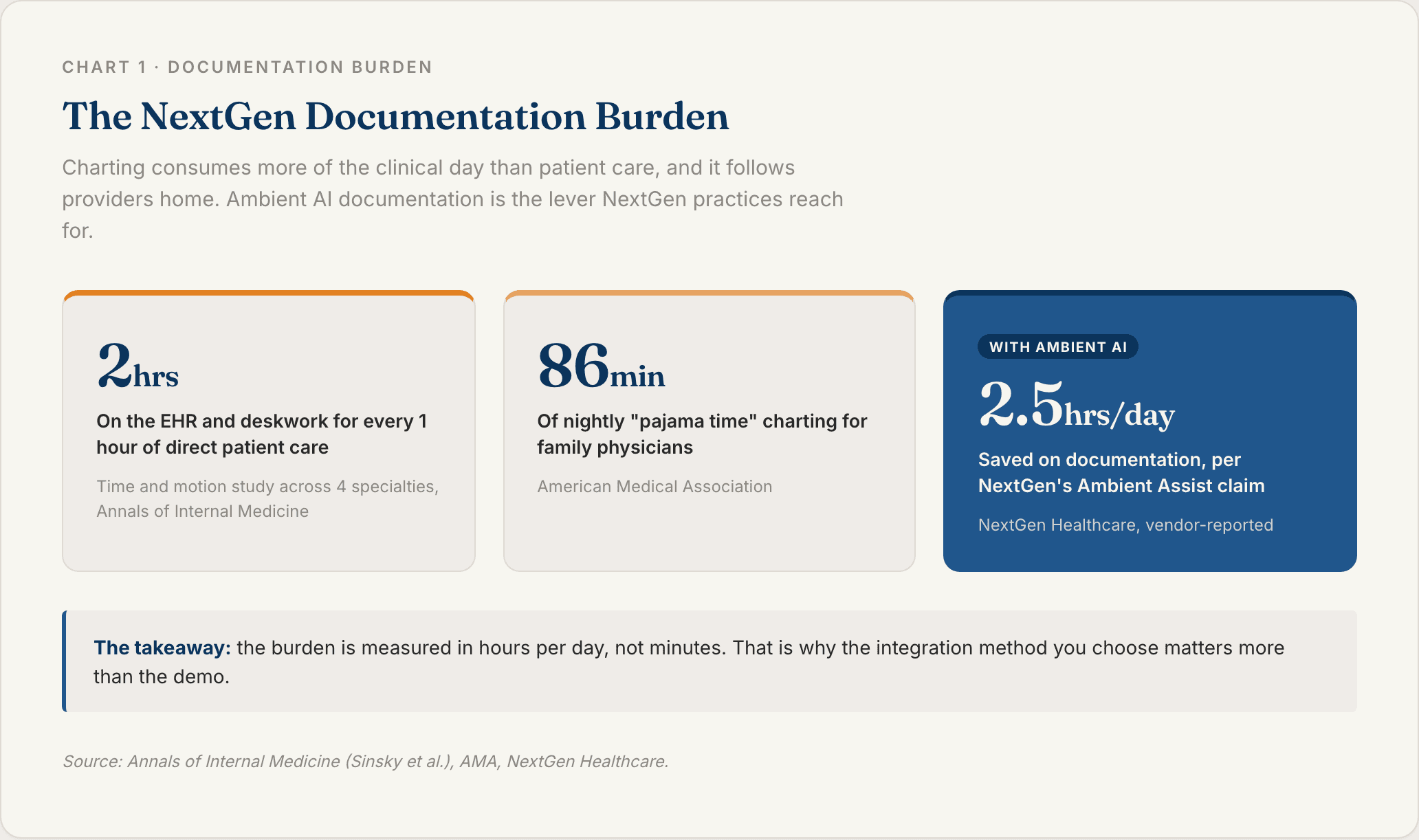
Ambient documentation is also where healthcare AI adoption is moving fastest, with scribes leading the first wave of AI tools that clinicians actually use day to day [4]. NextGen noticed and built ambient AI directly into the product: Ambient Assist generates a structured SOAP note seconds after the conversation ends, pending your review [3].
Still, a scribe is only as useful as how cleanly the note lands in the chart. That depends on how it connects, which is the rest of this guide.
Ambient Documentation Versus Manual Charting
The old flow is some version of typing during the visit, or dictating and then copy-pasting after. Either way you are still doing data entry.
The ambient flow is listen, draft, review, sign. Ambient Assist, for example, drafts the SOAP note and surfaces suggestions for ICD-10s, medications, and lab or imaging orders before you sign [3].
The difference that matters is the editing tax. A shallow tool dumps one block of text into one field, so you re-format and re-file every note. A good tool maps each section to the right place, so review takes a minute, not ten. DeepScribe makes the same argument from the third-party side: integration depth decides whether the scribe removes work or relocates it [5].
NextGen Offers a Native Scribe for Both Office and Enterprise
NextGen sells two platforms. NextGen Enterprise serves larger ambulatory groups, and NextGen Office serves smaller practices.
The native scribe now covers both. Ambient Assist runs on Enterprise through NextGen Mobile, and NextGen Office has its own built-in version for small practices [3][10]. So your first question is not whether a native option exists, but whether it goes deep enough for your workflow.
That is where third-party tools come in. They connect to both platforms through extensions or APIs [5], and the deeper ones do things the native scribe does not, which is what the rest of this guide compares.
How AI Scribes Connect to NextGen
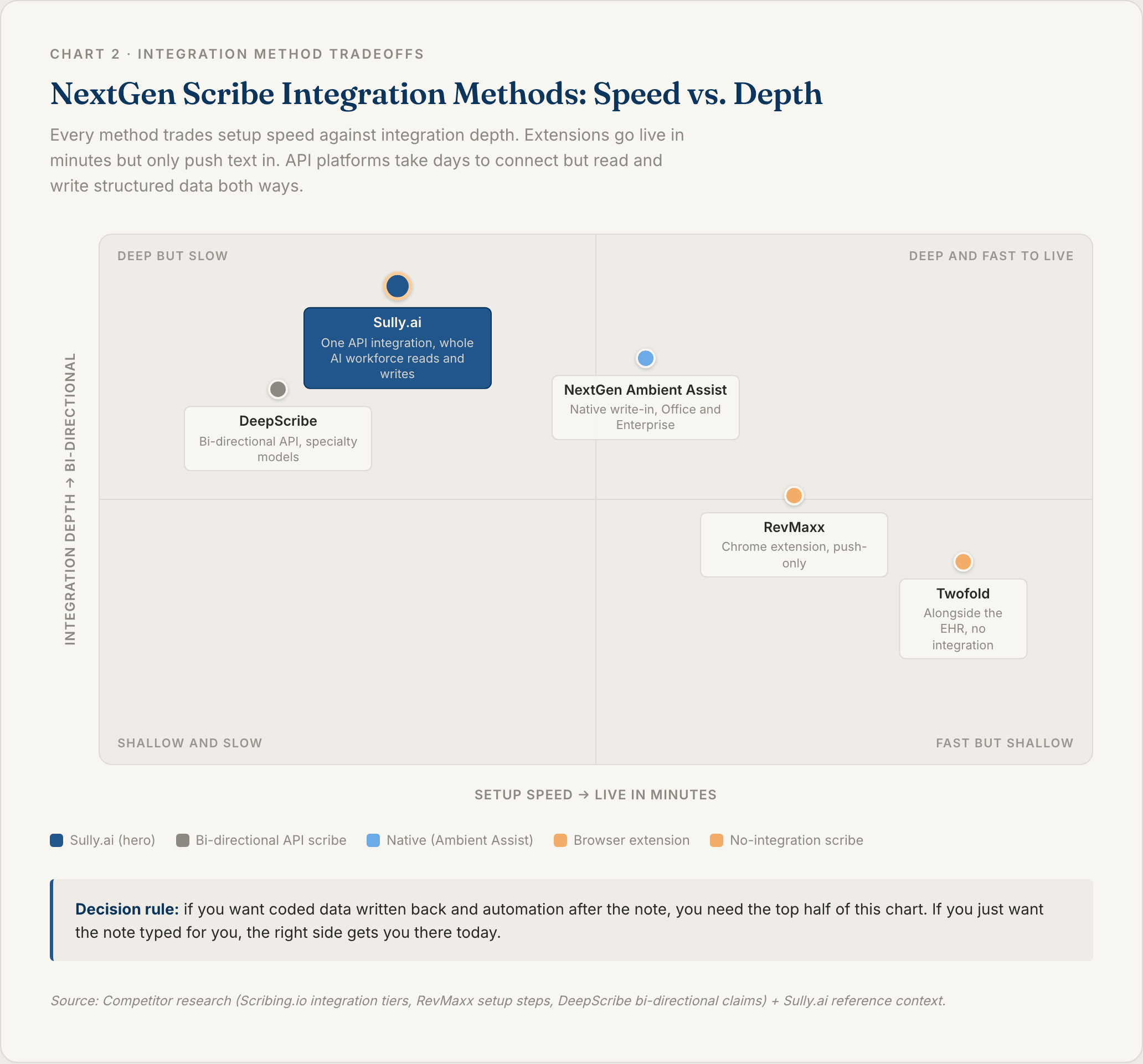
There is no single "add scribe" button. There are three integration depths, and the depth decides how much manual work is left over.
The key distinction: "integrated" and "bi-directional" are not the same thing. A tool can push a note into NextGen without ever reading anything out of it. NextGen also runs an API Vendor Program and an API Marketplace with public documentation, which makes deeper third-party integration more feasible than on closed systems [6]. On top of that, every certified EHR must expose a standardized FHIR R4 API under federal rules [7][8].
Integration type | Reads patient data in | Writes the note back | Writes discrete coded fields | Setup speed | Needs NextGen admin |
|---|---|---|---|---|---|
Native (Ambient Assist) | Yes | Yes | Suggestions (ICD-10, meds, orders) | Medium (native enablement) | Yes |
Browser extension | No (push-only) | Yes | Limited | Fast (minutes) | No |
Bi-directional API | Yes | Yes | Yes | Slower (days) | Yes |
Native Documentation With NextGen Ambient Assist
Ambient Assist is the native option, and it comes in two forms. On Enterprise, the provider records the visit through NextGen Mobile and the AI generates a fully structured SOAP note in seconds that lands in the chart pending review [3]. NextGen Office has its own built-in version for small practices [10].
Either way, it makes smart suggestions for ICD-10 codes, medications, and lab or imaging orders, and it supports Spanish-language visits [3]. NextGen's headline claim: up to 2.5 hours saved per provider per day [3].
The pros are real: no third-party connector, one vendor, and the note lands natively. The cons are about depth and lock-in. The native scribe handles documentation but not the coding, scheduling, and follow-up around it, and you are tied to a single vendor's roadmap.
Browser Extension Integrations
Tools like RevMaxx run as a Chrome extension alongside NextGen. The workflow is five steps: enable the extension, start the patient visit, let the AI generate the note, review and edit, then push it into NextGen [9].
This is the fastest route to a working scribe. There is no API engagement and no IT project, and most practices are live in minutes.
The tradeoff is depth. Extensions are typically push-only: the scribe writes in, but it does not read patient context out. Twofold takes the lightest approach of all, generating notes alongside NextGen without touching the integration layer at all.
Bi-Directional API Integrations
The deepest tier. Using NextGen's APIs, a scribe can pull patient data in (schedule, problems, medications) to pre-chart the visit, and write structured data back (notes, ICD-10 diagnoses, orders) as discrete fields instead of a text blob [6][7].
DeepScribe markets a bi-directional NextGen integration with specialty-specific models for fields like orthopedics, cardiology, and gastroenterology [5].
This is also where multi-agent platforms operate. Sully.ai integrates with the EHR once, and then its agents share that connection: the AI Scribe writes the note, the AI Coder extracts the codes, the AI Receptionist books the follow-up. The integration is the foundation the whole AI team stands on.
How to Add an AI Scribe to NextGen Step by Step
Five steps take you from "we should get a scribe" to a validated note in the chart.
1. Confirm Your NextGen Platform and Access
First, know which platform you run: NextGen Enterprise or NextGen Office. Both have a native Ambient Assist option (Enterprise through NextGen Mobile, Office through its own built-in version), and both can also use third-party scribes [3][10].
Then identify your NextGen administrator. API connections and app enablement need admin rights; browser extensions usually do not. If you are considering an API tool, ask the vendor whether they participate in NextGen's API program [6].
2. Choose Your Integration Method
Match the method to your practice. Native fits Enterprise groups already on NextGen Mobile. Extensions fit small practices that want speed. Bi-directional API fits anyone who wants coded data written back and automation after the note.
The decision rule is simple: if you want discrete write-back plus downstream automation (coding, scheduling, follow-up), you need API-level integration. If you just want the note typed for you, an extension gets you there today.
3. Install the Scribe and Connect to NextGen
For the native route, work with your NextGen rep to enable Ambient Assist through NextGen Mobile [3].
For extensions, install from the Chrome Web Store, sign in while logged into NextGen, and grant microphone access [9]. For API tools, the vendor connects to your NextGen instance through the API program [6].
Whichever route you pick, two things are non-negotiable before any patient audio is recorded: a signed BAA and HIPAA-compliant data handling [7][8].
4. Map Note Sections to NextGen Templates
This is the make-or-break step. Configure how each note section (HPI, ROS, assessment, plan) maps to the correct NextGen template fields, and how diagnoses link to each problem instead of landing as one block.
Good tools do this automatically. Verify it during setup anyway, because NextGen practices often run heavily customized specialty templates, and a mapping that works in a demo can miss in your environment [5]. Test against the templates you actually use.
5. Run a Test Visit and Review the Note
Pick a high-complexity, multi-problem encounter as the test. The hardest case is the one that reveals mapping gaps.
Confirm the note lands in the chart, codes attach to the right diagnoses, and suggestions populate. If providers chart on NextGen Mobile or in telehealth visits, test those flows specifically.
Then measure the editing tax: how many edits before signature? If review takes longer than typing would have, the integration is too shallow. Validate before you roll out practice-wide.
What to Look For in a NextGen AI Scribe
Four criteria separate the tools on the shortlist.
Depth of EHR Integration
Push-only versus bi-directional is the question that decides your daily experience. The deepest tools read context in and write discrete data out. A browser overlay writes text in and stops there.
Ask vendors to demo the write-back into your NextGen templates, not a generic demo environment [5]. The demo case always works. Your cardiology template is the real test.
Specialty Template and Workflow Fit
NextGen serves multi-specialty ambulatory groups, and most run customized templates. The scribe has to handle your specialty's note structure and vocabulary, not a primary-care demo case.
DeepScribe lists specialty-specific models across orthopedics, cardiology, gastroenterology, urology, neurology, and nephrology as its evaluation bar [5]. Whatever tool you pick, run the evaluation on your hardest specialty, not your easiest.
Discrete Field and Coding Support
Does the tool write ICD-10 and CPT codes linked to each diagnosis, or does it just paste a note? Coding support protects revenue and reduces denials.
Ambient Assist surfaces ICD-10, medication, and order suggestions [3]. API-tier tools go further and write structured data. And this is exactly where a scribe stops and a coder begins, which is why Sully pairs its AI Scribe with an AI Coder that extracts every ICD-10 and CPT code and submits clean claims.
Security and HIPAA Compliance
The non-negotiables: HIPAA compliance, a signed BAA, encryption, de-identified PHI handling, and access controls. Certified EHR APIs operate under the ONC Cures Act rules, which also govern how your data can move [7][8].
Keep the security review practical. Ask where audio is processed, how long recordings are retained, who can access transcripts, and whether the vendor will sign your BAA before the pilot starts.
Best AI Scribes for NextGen
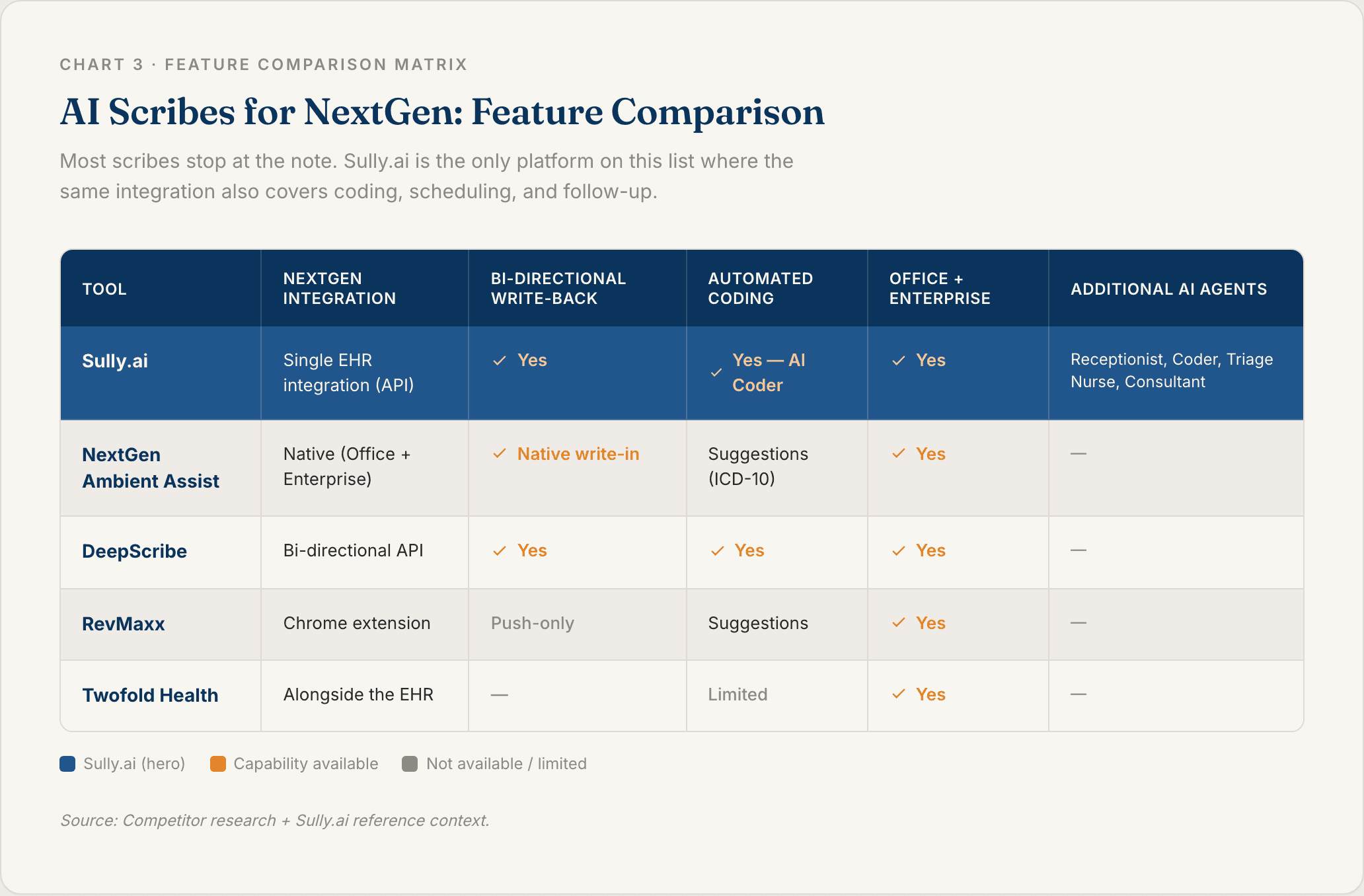
Five tools worth shortlisting, compared on the criteria above.
1. Sully.ai
Sully.ai is more than a scribe. It is a coordinated AI workforce built for healthcare, and the AI Scribe is one member of the team.
The Scribe captures documentation during and after the visit. Because Sully integrates once with the EHR and its agents share context, the Scribe hands off to the AI Coder (ICD-10 and CPT extraction, clean claims), the AI Receptionist (scheduling and confirmations), and the AI Triage Nurse (intake and follow-up).
That single integration is the key difference. Most scribes connect to one EHR and stop there. Sully's model is one integration that the whole AI team works through, and it connects with NextGen along with Epic, Cerner, Meditech, and Athenahealth. Each AI role costs 80 to 90% less than the equivalent human role, and Sully operates across 5,000+ providers with 50M+ hours of AI work delivered.
Best fit: practices that want documentation solved and the admin work around it (coding, scheduling, follow-up) handled by the same connected team instead of a stack of disconnected tools.
2. NextGen Ambient Assist
The native option, available for both NextGen Enterprise (through NextGen Mobile) and NextGen Office. Ambient listening generates a structured SOAP note in seconds with ICD-10, medication, and order suggestions, pending review, with Spanish support included [3][10].
Standout: native data landing with no third-party connector, and NextGen's claim of up to 2.5 hours saved per day [3]. Best fit: practices that want the in-house option and do not need coding or scheduling automation layered on top.
3. DeepScribe
A standalone scribe with bi-directional NextGen integration and specialty-specific AI models across orthopedics, cardiology, gastroenterology, urology, neurology, and nephrology [5].
Standout: integration depth plus specialty customization. Best fit: multi-specialty NextGen groups that want discrete write-back from a dedicated scribe.
4. RevMaxx
A Chrome-extension scribe with a five-step NextGen workflow: enable, start the visit, auto-generate, review, push [9]. It adds coding suggestions and markets HIPAA-compliant handling with no heavy installs.
Standout: minutes-to-live deployment. Best fit: solo and small practices that want a scribe today without an IT project.
5. Twofold Health
A lightweight scribe that generates SOAP and specialty notes alongside NextGen without replacing it or requiring integration plumbing, covering in-person and telehealth visits with HIPAA-compliant handling.
Standout: the lowest-friction adoption on this list. Best fit: clinicians who want AI notes immediately with zero workflow surgery.
Move From a Single Scribe to a Full AI Workforce
Adding a scribe to NextGen solves documentation. It does not touch the rest of the visit's admin load: the coding, the claim, the follow-up call, the intake for the next patient.
The average hospital already runs on about 800 different software tools, and point-solution AI adds more silos to that pile. Ten AI tools that do not talk to each other are not a workforce. They are ten more logins.
Sully takes the other path. Integrate the EHR once, then a team of AI employees shares context and hands off cases. The Scribe writes the note, the AI Coder extracts every ICD-10 and CPT code, and a clean claim goes out before a denial can occur. Meanwhile the AI Receptionist books the follow-up before the provider finishes the next visit. Each AI role costs 80 to 90% less than the equivalent human role.
If you are weighing a scribe for NextGen, it is worth seeing what the full team looks like in action.
FAQ
Q: What is a NextGen AI scribe?
A NextGen AI scribe is an ambient documentation tool that listens to the patient visit and drafts a structured clinical note inside or alongside the NextGen chart, so the provider reviews and signs instead of typing. Options range from NextGen's native Ambient Assist to third-party tools and full AI workforce platforms like Sully.ai that also handle coding and scheduling.
Q: How do I add an AI scribe to NextGen?
Pick an integration method (native Ambient Assist, browser extension, or bi-directional API), confirm your NextGen platform and admin access, connect the tool, map note sections to your NextGen templates, and validate with a test visit. Browser extensions can be live in minutes. API-level write-back takes longer but lands structured, coded data automatically.
Q: Does NextGen have a built in AI scribe?
Yes. NextGen offers Ambient Assist, an ambient AI documentation tool available for both NextGen Enterprise (through NextGen Mobile) and NextGen Office. It generates a structured SOAP note in seconds with suggestions for ICD-10s, medications, and lab or imaging orders, and NextGen reports it can save providers up to 2.5 hours a day [3][10].
Q: Do you need API access to use an AI scribe with NextGen?
Not always. Browser-extension and copy-paste scribes can put notes into NextGen without API access or IT help. To read patient context and write structured, coded data back into discrete fields, you need a tool connected through NextGen's API program or FHIR R4 interface.
Q: How much does an AI scribe for NextGen cost?
Standalone scribes typically run from roughly $99 to several hundred dollars per provider per month, up to enterprise contracts for larger groups. Platforms that bundle multiple AI roles change the math: Sully.ai reports each AI role costs 80 to 90% less than the equivalent human hire, so the comparison is the full admin team, not just one scribe seat.
Sources
[1] Annals of Internal Medicine (Sinsky et al.) — Allocation of Physician Time in Ambulatory Practice: A Time and Motion Study in 4 Specialties. https://pmc.ncbi.nlm.nih.gov/articles/PMC5593724/
[2] American Medical Association (AMA) — Family doctors spend 86 minutes of "pajama time" with EHRs nightly. https://www.ama-assn.org/practice-management/digital-health/family-doctors-spend-86-minutes-pajama-time-ehrs-nightly
[3] NextGen Healthcare — Ambient AI for Medical Documentation: NextGen Ambient Assist. https://www.nextgen.com/solutions/provider-experience/ambient-assist
[4] Menlo Ventures — 2025: The State of AI in Healthcare. https://menlovc.com/perspective/2025-the-state-of-ai-in-healthcare/
[5] DeepScribe — Best AI Medical Scribe for NextGen EHR (2026). https://www.deepscribe.ai/resources/best-ai-medical-scribe-for-nextgen-ehr-2026
[6] NextGen Healthcare — Interoperability: NextGen Share, API Vendor Program, and API Marketplace. https://www.nextgen.com/solutions/interoperability
[7] ONC / HealthIT.gov (ASTP) — Standardized API for Patient and Population Services (§170.315(g)(10), HL7 FHIR R4). https://www.healthit.gov/test-method/standardized-api-patient-and-population-services
[8] Federal Register / ONC — 21st Century Cures Act: Interoperability, Information Blocking, and the ONC Health IT Certification Program. https://www.federalregister.gov/documents/2020/05/01/2020-07419/21st-century-cures-act-interoperability-information-blocking-and-the-onc-health-it-certification
[9] RevMaxx — NextGen EHR & RevMaxx Integration: Smarter Clinical Workflow. https://www.revmaxx.co/nextgen-ehr-integration/
[10] NextGen Healthcare — AI-Powered Charting for Small Practices: NextGen Office Ambient Assist. https://www.nextgen.com/solutions/provider-experience/office-ambient-assist
TABLE OF CONTENTS
Hire your
Medical AI Team
Take a look at our Medical AI Team
AI Receptionist
Manages patient scheduling, communications, and front-desk operations across all channels.
AI Scribe
Documents clinical encounters and maintains accurate EHR/EMR records in real-time.
AI Medical Coder
Assigns and validates medical codes to ensure accurate billing and regulatory compliance.
AI Nurse
Assesses patient urgency and coordinates appropriate care pathways based on clinical needs.