"/><stop offset="1" stop-color="rgba(255, 255, 255, 0)"/></linearGradient><linearGradient id="WxV_IOPE7-2309410982-linear-gradient" x1="1" x2="0" y1="0.5951279047551217" y2="0.4048720952448783"><stop offset="0" stop-color="rgb(255, 255, 255)"/><stop offset="1" stop-color="rgba(255, 255, 255, 0)"/></linearGradient><linearGradient id="WwbAIQIz8-2309410982-linear-gradient" x1="0.43478742751482424" x2="0.6358595260107829" y1="0.26" y2="1"><stop offset="0" stop-color="rgb(255, 255, 255)"/><stop offset="1" stop-color="rgba(255, 255, 255, 0)"/></linearGradient><linearGradient id="ZWsVQcPfn-2309410982-linear-gradient" x1="0.9508213454678907" x2="0.04917865453210929" y1="0" y2="1"><stop offset="0" stop-color="rgb(255, 255, 255)"/><stop offset="1" stop-color="rgba(255, 255, 255, 0)"/></linearGradient><linearGradient id="lTyCGrzzP-2309410982-linear-gradient" x1="0.374937164194436" x2="0.625062835805564" y1="0" y2="1"><stop offset="0" stop-color="rgb(255, 255, 255)"/><stop offset="1" stop-color="rgba(255, 255, 255, 0)"/></linearGradient></defs><g d="M 658.002 1357.705 C 1020.321 1357.705 1314.04 1063.989 1314.04 701.667 C 1314.04 339.347 1020.321 45.626 658.002 45.626 C 295.681 45.626 1.96 339.347 1.96 701.667 L 0 701.667 C 0 338.263 294.598 43.665 658.002 43.665 C 1021.404 43.665 1316 338.263 1316 701.667 C 1316 1065.072 1021.404 1359.672 658.002 1359.672 C 294.598 1359.672 0 1065.072 0 701.667 L 1.96 701.667 C 1.96 1063.989 295.681 1357.705 658.002 1357.705 Z M 658.005 1265.053 C 969.154 1265.053 1221.392 1012.819 1221.392 701.667 C 1221.392 390.517 969.154 138.281 658.005 138.281 C 346.856 138.281 94.619 390.517 94.619 701.667 L 92.659 701.667 C 92.659 389.433 345.77 136.321 658.005 136.321 C 970.241 136.321 1223.352 389.433 1223.352 701.667 C 1223.352 1013.902 970.241 1267.017 658.005 1267.017 C 345.77 1267.017 92.659 1013.902 92.659 701.667 L 94.619 701.667 C 94.619 1012.819 346.856 1265.053 658.005 1265.053 Z M 658.002 1166.116 C 914.513 1166.116 1122.452 958.178 1122.452 701.667 C 1122.452 445.16 914.513 237.22 658.002 237.22 C 401.494 237.22 193.551 445.16 193.551 701.667 L 191.59 701.667 C 191.59 444.077 400.411 235.255 658.002 235.255 C 915.596 235.255 1124.412 444.077 1124.412 701.667 C 1124.412 959.261 915.596 1168.084 658.002 1168.084 C 400.411 1168.084 191.59 959.261 191.59 701.667 L 193.551 701.667 C 193.551 958.178 401.494 1166.116 658.002 1166.116 Z M 281.657 818.28 C 298.572 818.28 314.804 825.001 326.765 836.965 L 458.99 969.182 C 470.582 980.781 486.308 987.298 502.706 987.298 L 612.137 987.298 C 646.284 987.298 673.972 959.61 673.972 925.463 L 673.972 891.504 L 675.939 891.504 L 675.939 925.463 C 675.939 960.7 647.374 989.258 612.137 989.258 L 502.706 989.258 C 485.788 989.258 469.562 982.537 457.599 970.573 L 325.378 838.356 C 313.785 826.757 298.056 820.242 281.657 820.244 L 1.173 820.244 L 1.173 818.28 Z M 746.64 888.714 L 1053.046 888.714 C 1069.967 888.714 1086.194 895.435 1098.16 907.398 L 1259.381 1068.619 L 1257.99 1070.007 L 1096.772 908.79 C 1085.175 897.193 1069.446 890.679 1053.046 890.681 L 746.64 890.681 C 729.724 890.681 713.493 883.957 701.533 871.993 L 685.377 855.845 L 686.769 854.453 L 702.917 870.605 C 714.513 882.201 730.241 888.715 746.64 888.714 Z M 667.685 552 L 512.316 396.894 C 494.66 379.264 484.741 355.356 484.739 330.426 L 484.739 0 L 487.632 0 L 487.632 330.426 C 487.632 354.592 497.248 377.763 514.369 394.851 L 669.739 549.957 Z M 782.851 700.491 C 816.998 700.491 844.686 672.804 844.686 638.655 L 844.686 516.468 C 844.687 499.547 851.409 483.32 863.374 471.355 L 1177.508 157.22 L 1178.896 158.607 L 864.762 472.742 C 853.162 484.337 846.646 500.067 846.646 516.468 L 846.646 638.655 C 846.646 673.89 818.088 702.455 782.851 702.455 L 700.405 702.455 L 700.405 700.491 Z M 130.338 534.223 L 213.07 534.223 C 256.112 534.223 291.003 569.114 291.003 612.156 L 291.003 694.888 C 291.003 711.29 297.514 727.017 309.113 738.611 L 472.887 902.378 L 471.496 903.769 L 307.726 739.995 C 295.761 728.033 289.038 711.807 289.038 694.888 L 289.038 612.156 C 289.038 570.198 255.028 536.188 213.07 536.188 L 130.338 536.188 C 113.419 536.187 97.193 529.465 85.23 517.5 L 77.071 509.345 C 65.107 497.381 58.386 481.153 58.388 464.233 L 58.388 199.526 L 60.348 199.526 L 60.348 464.233 C 60.349 480.631 66.863 496.358 78.458 507.954 L 86.617 516.113 C 98.213 527.709 113.94 534.223 130.338 534.223 Z" fill="transparent" height="1359.6717183844698px" id="DcyumyANr" transform="translate(0 -43.665)" width="1316px"><g opacity="0.5"><path d="M 658.002 1314.039 C 1020.321 1314.039 1314.04 1020.324 1314.04 658.001 C 1314.04 295.681 1020.321 1.961 658.002 1.961 C 295.681 1.961 1.96 295.682 1.96 658.001 L 0 658.001 C 0 294.598 294.598 0 658.002 0 C 1021.404 0 1316 294.598 1316 658.001 C 1316 1021.407 1021.404 1316.007 658.002 1316.007 C 294.598 1316.007 0 1021.407 0 658.001 L 1.96 658.001 C 1.96 1020.324 295.681 1314.039 658.002 1314.039 Z" fill="rgb(255, 255, 255)" height="1316.0065114752902px" id="dxf13D52Y" transform="translate(0 43.665)" width="1316px"/></g><g opacity="0.3"><path d="M 565.347 1128.732 C 876.496 1128.732 1128.733 876.498 1128.733 565.346 C 1128.733 254.196 876.496 1.961 565.347 1.961 C 254.197 1.961 1.961 254.196 1.961 565.346 L 0 565.346 C 0 253.112 253.111 0 565.347 0 C 877.582 0 1130.693 253.112 1130.693 565.346 C 1130.693 877.581 877.582 1130.696 565.347 1130.696 C 253.111 1130.696 0 877.581 0 565.346 L 1.961 565.346 C 1.961 876.498 254.197 1128.732 565.347 1128.732 Z" fill="rgb(255, 255, 255)" height="1130.6960934794101px" id="if1BmYw1S" transform="translate(92.659 136.321)" width="1130.693351805604px"/></g><g opacity="0.15"><path d="M 466.412 930.861 C 722.923 930.861 930.862 722.922 930.862 466.411 C 930.862 209.905 722.923 1.965 466.412 1.965 C 209.904 1.965 1.961 209.905 1.961 466.411 L 0 466.411 C 0 208.822 208.821 0 466.412 0 C 724.006 0 932.822 208.822 932.822 466.411 C 932.822 724.005 724.006 932.828 466.412 932.828 C 208.821 932.828 0 724.005 0 466.411 L 1.961 466.411 C 1.961 722.922 209.904 930.861 466.412 930.861 Z" fill="rgb(255, 255, 255)" height="932.8284667407987px" id="ef75NsYf6" transform="translate(191.59 235.255)" width="932.8219552655086px"/></g><g opacity="0.5"><path d="M 280.484 0 C 297.399 0 313.63 6.721 325.592 18.685 L 457.817 150.902 C 469.408 162.501 485.135 169.018 501.533 169.017 L 610.964 169.017 C 645.111 169.017 672.799 141.33 672.799 107.182 L 672.799 73.223 L 674.766 73.223 L 674.766 107.182 C 674.766 142.42 646.201 170.978 610.964 170.978 L 501.533 170.978 C 484.614 170.978 468.389 164.257 456.426 152.293 L 324.205 20.076 C 312.611 8.477 296.883 1.961 280.484 1.964 L 0 1.964 L 0 0 Z" fill="url(%23cQ4xRdUtr-2309410982-linear-gradient)" height="170.97763275969464px" id="cQ4xRdUtr" transform="translate(1.173 818.28)" width="674.7656780356198px"/></g><g opacity="0.5"><path d="M 61.263 34.261 L 367.669 34.261 C 384.589 34.261 400.817 40.982 412.783 52.945 L 574.004 214.166 L 572.612 215.554 L 411.395 54.337 C 399.798 42.74 384.069 36.226 367.669 36.228 L 61.263 36.228 C 44.347 36.228 28.116 29.504 16.155 17.54 L 0 1.391 L 1.391 0 L 17.54 16.152 C 29.136 27.747 44.864 34.261 61.263 34.261 Z" fill="url(%23WxV_IOPE7-2309410982-linear-gradient)" height="215.55382175474415px" id="WxV_IOPE7" transform="translate(685.377 854.453)" width="574.0036823012563px"/></g><g opacity="0.5"><path d="M 182.946 552 L 27.577 396.894 C 9.921 379.264 0.002 355.356 0 330.426 L 0 0 L 2.893 0 L 2.893 330.426 C 2.893 354.592 12.509 377.763 29.63 394.851 L 185 549.957 Z" fill="url(%23WwbAIQIz8-2309410982-linear-gradient)" height="552px" id="WwbAIQIz8" transform="translate(484.739 0)" width="185px"/></g><g opacity="0.5"><path d="M 82.446 543.271 C 116.593 543.271 144.281 515.583 144.281 481.435 L 144.281 359.248 C 144.282 342.327 151.004 326.1 162.969 314.135 L 477.103 0 L 478.491 1.387 L 164.356 315.522 C 152.757 327.117 146.241 342.846 146.241 359.248 L 146.241 481.435 C 146.241 516.67 117.683 545.235 82.446 545.235 L 0 545.235 L 0 543.271 Z" fill="url(%23ZWsVQcPfn-2309410982-linear-gradient)" height="545.2346136318063px" id="ZWsVQcPfn" transform="translate(700.405 157.22)" width="478.4906210693257px"/></g><g opacity="0.5"><path d="M 71.95 334.696 L 154.682 334.696 C 197.724 334.696 232.616 369.588 232.616 412.63 L 232.616 495.362 C 232.616 511.764 239.126 527.491 250.725 539.084 L 414.5 702.851 L 413.108 704.243 L 249.338 540.469 C 237.373 528.507 230.651 512.281 230.651 495.362 L 230.651 412.63 C 230.651 370.672 196.64 336.661 154.682 336.661 L 71.95 336.661 C 55.031 336.661 38.805 329.939 26.843 317.974 L 18.683 309.819 C 6.719 297.854 -0.001 281.627 0 264.707 L 0 0 L 1.961 0 L 1.961 264.707 C 1.961 281.105 8.475 296.832 20.07 308.428 L 28.229 316.587 C 39.825 328.182 55.552 334.697 71.95 334.696 Z" fill="url(%23lTyCGrzzP-2309410982-linear-gradient)" height="704.2427839655832px" id="lTyCGrzzP" transform="translate(58.388 199.526)" width="414.49961191971533px"/></g></g></svg>)
Search for telehealth documentation requirements and you will find dozens of guides explaining place of service 02 versus 10, when to append modifier 95, and how to record consent. They are mostly correct.
Almost none of them mention that the rules they are describing expire on 31 December 2027 [1].
That gap matters more than it sounds. The things scheduled to change are not footnotes. They are whether your patient can be at home, whether your profession can bill Medicare for telehealth at all, whether a phone call counts, and whether a behavioral health patient has to be seen in person first.
Here is both halves: the coding rules you need today, and the expiry date that decides what you should be writing in the note right now.
Key Takeaway: Telehealth documentation has two halves and the internet only covers one. The first half is the codes. Use place of service 02 when the patient is somewhere other than their home, and POS 10 when they are at home, because since 1 January 2024 telehealth furnished to a patient at home is paid at the non-facility rate, which is the higher of the two [1][2]. Medicare identifies telehealth through place of service, while most commercial and Medicare Advantage payers still want modifier 95 for audio-video and 93 for audio-only [2]. The second half is that all of it has an expiry date. Current flexibilities run through 31 December 2027. On 1 January 2028, except for behavioral health, patients generally have to be in a medical facility in a rural area again, physical therapists, occupational therapists, speech-language pathologists and audiologists can no longer furnish Medicare telehealth at all, audio-only narrows to behavioral health, and the behavioral health in-person visit requirement switches on [1].
The Two Halves of Telehealth Documentation
A telehealth note carries everything an in-person note carries, plus a small block of fields that exist only because the visit was virtual. Most guidance stops there.
The complete picture has a second half, and it is the one with a deadline on it.
The Codes, Which Everybody Covers
This is the well-trodden part. Place of service 02 or 10 depending on where the patient sat. Modifier 95 or 93 depending on who is paying. Consent captured, identity verified, modality recorded, location documented.
All of it is real, all of it drives payment, and we will cover it precisely below. It is just not the whole job.
The Expiry Date, Which Almost Nobody Does
Medicare telehealth flexibilities are written into law with an end date attached. Congress extended them in early 2026, and the current set runs through 31 December 2027 [1].
So the note you write this year is evidence about a visit that may be audited under a different rulebook. That changes what belongs in it.
Patient Location Is a Payment Field
Where the patient physically sat during the visit is not a pleasantry. It picks the code, and the code picks the rate.
POS 02 and POS 10 Are Not Interchangeable
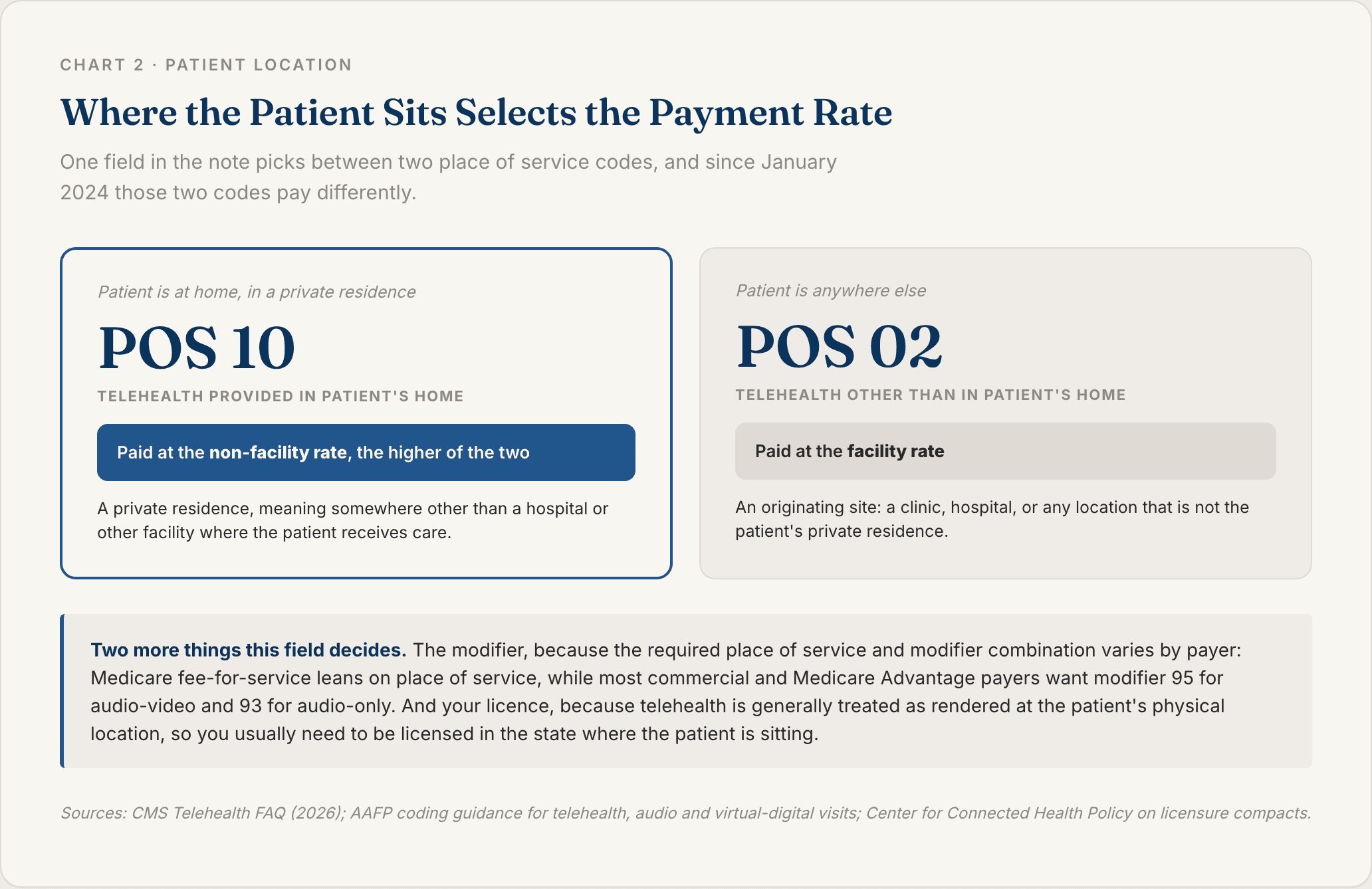
CMS is direct about the split. Use POS 02 for telehealth provided other than in the patient's home, and POS 10 for telehealth provided in the patient's home, meaning a private residence rather than a hospital or other facility where the patient receives care [1].
The distinction is about the patient's location, not yours. A patient joining from their kitchen is POS 10. The same patient joining from their employer's office or a clinic room is POS 02.
Since 2024, Home Pays More
In the CY 2024 Physician Fee Schedule final rule, CMS finalized that starting 1 January 2024, claims for Medicare telehealth services provided to patients in their homes are paid at the non-facility payment rate[1]. Telehealth provided at an originating site under POS 02 is paid at the facility rate [2].
The non-facility rate is the higher of the two. Which means a practice that defaults to POS 02 out of habit, for visits patients are taking from their living rooms, is taking a quiet pay cut on every claim.
The fix is not a billing rule. It is a documentation field. If the note says where the patient was, the coder has what they need.
Medicare Uses Place of Service, Commercial Payers Want Modifier 95
Here is where one visit turns into two different claims.
Medicare fee-for-service identifies telehealth through place of service. The AAFP puts it plainly: Medicare does not require a modifier for audio-video telehealth services, though it does require the appropriate place of service code [2]. For audio-only, append modifier 93 [2]. Federally qualified health centers and rural health centers use modifier FQ, 93, or both, since they carry the same meaning [2].
Commercial, self-funded, and Medicare Advantage policies vary, and many still expect modifier 95 on synchronous audio-video visits [2]. Treat that as payer convention rather than a CMS rule, and check the payer rather than applying one habit across the board.
Every Telehealth Rule You Are Following Has an Expiry Date
Telehealth is the only area of clinical documentation where the rules have a statutory expiry date printed on them, and essentially nobody writing about telehealth documentation mentions it.
The most thorough place-of-service guide in the search results runs 13 sections and three FAQs. It covers meaning, purpose, reimbursement impact, documentation requirements, when to use each code, what they cannot be used for, effects on claims, audits, and how to combine them. It never once says that the arrangement it describes ends on 31 December 2027.
That silence has a cost. A practice documenting only to today's rules, without recording which side of the line each patient sits on, will spend early 2028 reconstructing it from memory.
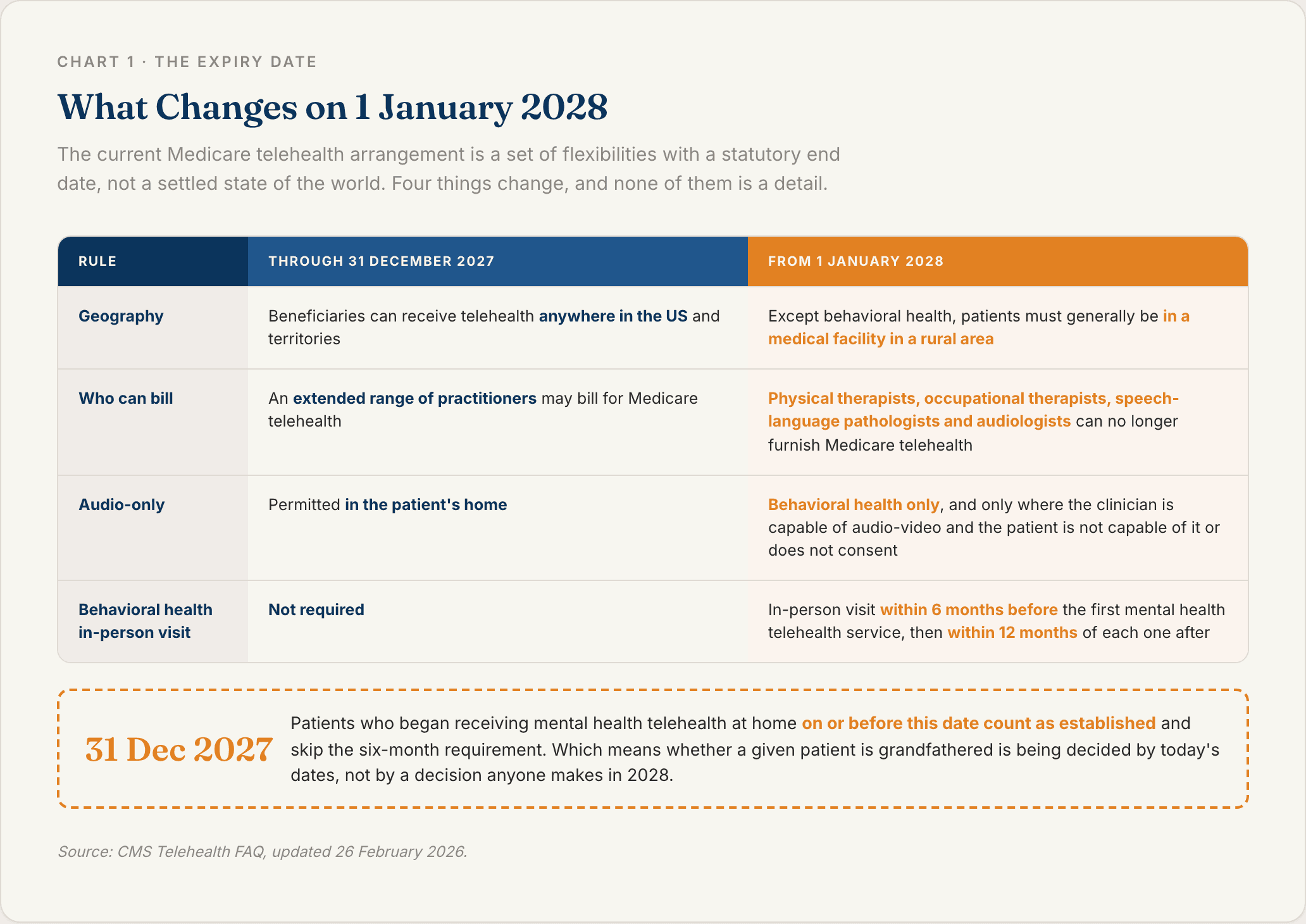
Four things change. All four are quoted from the CMS Telehealth FAQ.
Geography Comes Back on 1 January 2028
Through 31 December 2027, beneficiaries can receive Medicare telehealth services anywhere in the United States and its territories. Starting 1 January 2028, except for behavioral health services, beneficiaries will generally need to be in a medical facility and in a rural area [1].
For a virtual-first practice, that is the whole operating model, with a date on it.
Four Professions Lose Telehealth Billing Entirely
Starting 1 January 2028, physical therapists, occupational therapists, speech-language pathologists, and audiologists can no longer furnish Medicare telehealth services [1].
This is the largest single change in the set and the least reported. Outpatient therapy furnished remotely by hospital staff to patients at home follows the same pattern: billable through 31 December 2027, not billable from 1 January 2028 [1].
Audio-Only Narrows to Behavioral Health
Audio-only is permitted in the patient's home through 31 December 2027. From 1 January 2028, physicians and practitioners may use two-way, real-time audio-only technology for behavioral health servicesin the home, and only where the clinician is technically capable of audio-video and the beneficiary is not capable of it or does not consent to using it [1]. New and established patients both qualify.
Read that condition closely. It makes the reason a visit was audio-only part of the coverage rule, which makes it a documentation requirement rather than a courtesy.
Behavioral Health Gains an In-Person Requirement
Under section 1834(m), an in-person, non-telehealth visit within six months prior to the first mental health telehealth service becomes effective after 31 December 2027. After that first service in the home, an in-person service is required within 12 months of each mental health telehealth service, with limited exceptions [1].
Those in-person visits may be performed by a physician or practitioner of the same specialty in the same group practice if the treating clinician is unavailable [1].
And the part worth acting on today: patients who began receiving mental health telehealth at home on or before 31 December 2027 are considered established, skip the prior six-month requirement entirely, and need one in-person visit every 12 months after that date [1].
Whether a 2028 claim is billable is partly decided by what a 2026 note recorded.
Free Telehealth Note Templates
We built three telehealth templates that carry the fields above as structure rather than memory. Each is a branded, print-ready PDF.
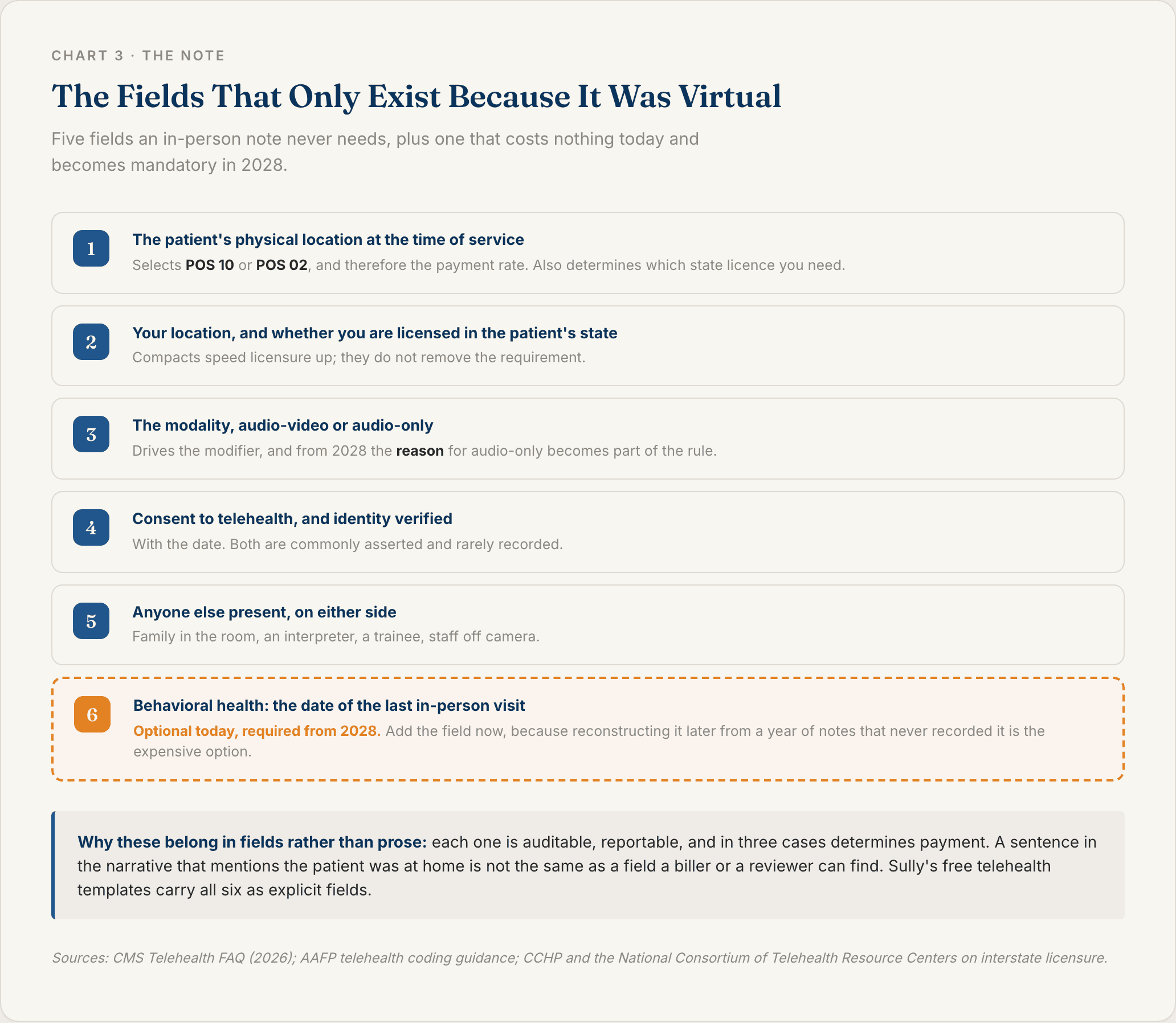
Telehealth visit note template, a standard visit note plus the five fields that exist only because the visit was virtual, including patient location with its place-of-service consequence.
Behavioral health telehealth note template, with a mental status exam, a remote-specific risk assessment, and an in-person visit tracker built for the requirement arriving in 2028.
Telehealth compliance checklist, a practice-level readiness sheet organised around what changes on 1 January 2028.
Three Changes That Already Happened in 2026
Not everything moved in the restrictive direction. Three changes took effect on 1 January 2026, and they went largely unnoticed because they loosened rules rather than tightening them.
Frequency Limits Are Permanently Gone
Telehealth frequency limits on subsequent inpatient visits, subsequent nursing facility visits, and critical care consultations were permanently removed [1].
Permanently is the operative word. This one does not expire with the rest.
Direct Supervision Can Be Virtual
The presence required for direct supervision may now be met through real-time audio-video technology, excluding audio-only, for services without a 010 or 090 global surgery indicator [1].
For practices running incident-to billing, that changes where the supervising clinician has to physically be.
Teaching Physicians Can Be Virtually Present
Teaching physicians may have a virtual presence in all teaching settings, but only for Medicare telehealth services, and only during the key portion of the service [1].
What to Put in the Note Now
The practical payoff. None of this costs more than a few seconds per visit, and some of it is impossible to recreate later.
The Five Fields That Only Exist Because It Was Virtual
Every telehealth note should carry these, ideally as discrete fields rather than a sentence buried in the narrative.
The patient's physical location at the time of service, specific enough to pick POS 02 or 10 and to send help in an emergency.
Your location and state licensure. Telehealth is considered rendered at the patient's physical location, so the clinician typically needs a license in the patient's state [3]. Multi-state practice is common enough that most states now participate in a licensure compact of some kind [3][4].
The modality, audio-video or audio-only, and the platform used.
Consent to telehealth and identity verification, with the date consent was obtained.
Anyone else present on either side of the call, including family members, interpreters, and trainees.
One more field belongs alongside them, and it is the one that protects the claim clinically: what you could not assess remotely, and whether it mattered to the decision you made [5]. That converts an incomplete exam from an audit vulnerability into documented clinical judgment.
Record Why, Not Just What, for Audio-Only
Today, an audio-only visit in the home is billable and the reason is optional. From 1 January 2028, coverage depends on the clinician being capable of video and the patient not being capable of it or not consenting [1].
So write the reason now. "Patient does not have a smartphone" and "patient declined video" are one-line entries that become the justification for the claim under the next rulebook.
For Behavioral Health, Start Tracking the In-Person Date Now
If you see behavioral health patients virtually, add three items to the chart: the date of the last in-person, non-telehealth visit, who furnished it, and when the next one is due.
Then record whether the patient began at-home mental health telehealth on or before 31 December 2027, because that single line decides whether they ever need a prior in-person visit at all [1].
This field costs nothing today. Reconstructing it across a panel in 2028 is the expensive version.
Where Sully.ai Fits in a Virtual Care Practice
A template makes the fields exist. Something still has to fill them in, and after a full day of virtual visits that is where the plan usually breaks down.
A telehealth visit is unusually well suited to ambient capture. The whole encounter is conversation, on a platform, with both parties speaking clearly into a microphone. The patient says where they are. Consent is given out loud. The clinician says what they cannot assess over video.
Sully's AI Scribe, which captures the visit and writes the structured note into your EHR, keeps that virtual encounter block as discrete fields rather than prose. The AI Coder, which extracts the ICD-10 and CPT codes and submits the claim, is exactly where the place of service and the payer-appropriate modifier have to land correctly. And the AI Receptionist, which handles scheduling and patient outreach, is what a practice needs when an in-person visit becomes a recurring compliance requirement rather than a clinical preference.
They run on one integration across Epic, Cerner, Meditech, and Athenahealth, across 5,000+ providers and more than 50 million hours of AI work, at 80 to 90 percent below the cost of the equivalent human role.
If you are still deciding which tool fits, our comparison of the best AI scribes for telehealth covers the vendor landscape. If you already know what you need, see how the AI Scribe handles a virtual visit and bring the hardest case you have: an audio-only behavioral health visit with the patient at home.
FAQ
Q: What has to be documented in a telehealth visit note? Five things that would not appear on an in-person note: the patient's physical location at the time of service, your location and whether you are licensed in the patient's state, the modality used, that consent to telehealth was obtained and the patient's identity verified, and who else was present on either side. Add the ordinary clinical content, plus a note of what could not be assessed remotely.
Q: When do you use place of service 02 versus 10? POS 02 is telehealth provided somewhere other than the patient's home. POS 10 is telehealth provided in the patient's home, meaning a private residence rather than a hospital or other facility. Since 1 January 2024, Medicare telehealth furnished to a patient at home is paid at the non-facility rate, which is higher than the facility rate paid under POS 02, so the location field has a direct payment consequence [1][2].
Q: Do you need modifier 95 for Medicare telehealth? Medicare does not require a modifier for audio-video telehealth services, because it identifies telehealth through place of service instead. Audio-only services take modifier 93, and FQHCs and RHCs use FQ, 93, or both [2]. Most commercial and Medicare Advantage payers do still want modifier 95 on synchronous audio-video, so the same visit gets constructed two different ways depending on who is paying.
Q: When do the current Medicare telehealth rules expire? 31 December 2027. On 1 January 2028, except for behavioral health, beneficiaries will generally need to be in a medical facility in a rural area, physical therapists, occupational therapists, speech-language pathologists and audiologists can no longer furnish Medicare telehealth, audio-only narrows to behavioral health in the home with a documented reason, and an in-person visit requirement applies to mental health telehealth [1].
Q: Do you have free telehealth note templates? Yes. Sully.ai publishes three: a telehealth visit note with the five virtual-specific fields, a behavioral health telehealth note with an in-person visit tracker for the 2028 requirement, and a telehealth compliance checklist organised around what changes on 1 January 2028. All three are free to download.
Sources
[1] Centers for Medicare & Medicaid Services — Telehealth FAQ, updated 26 February 2026 [2] American Academy of Family Physicians — Coding for Telehealth: Audio, Video, and Virtual-Digital Visits [3] Center for Connected Health Policy — States with Telehealth Licensure Compacts [4] American Medical Association — Licensure and Telehealth Issue Brief [5] The Doctors Company — Telehealth Clinical Documentation Strategies
TABLE OF CONTENTS
Hire your
Medical AI Team
Take a look at our Medical AI Team
AI Receptionist
Manages patient scheduling, communications, and front-desk operations across all channels.
AI Scribe
Documents clinical encounters and maintains accurate EHR/EMR records in real-time.
AI Medical Coder
Assigns and validates medical codes to ensure accurate billing and regulatory compliance.
AI Nurse
Assesses patient urgency and coordinates appropriate care pathways based on clinical needs.