Templates


Most therapy note templates hand you one form. HIPAA assumes you keep two.
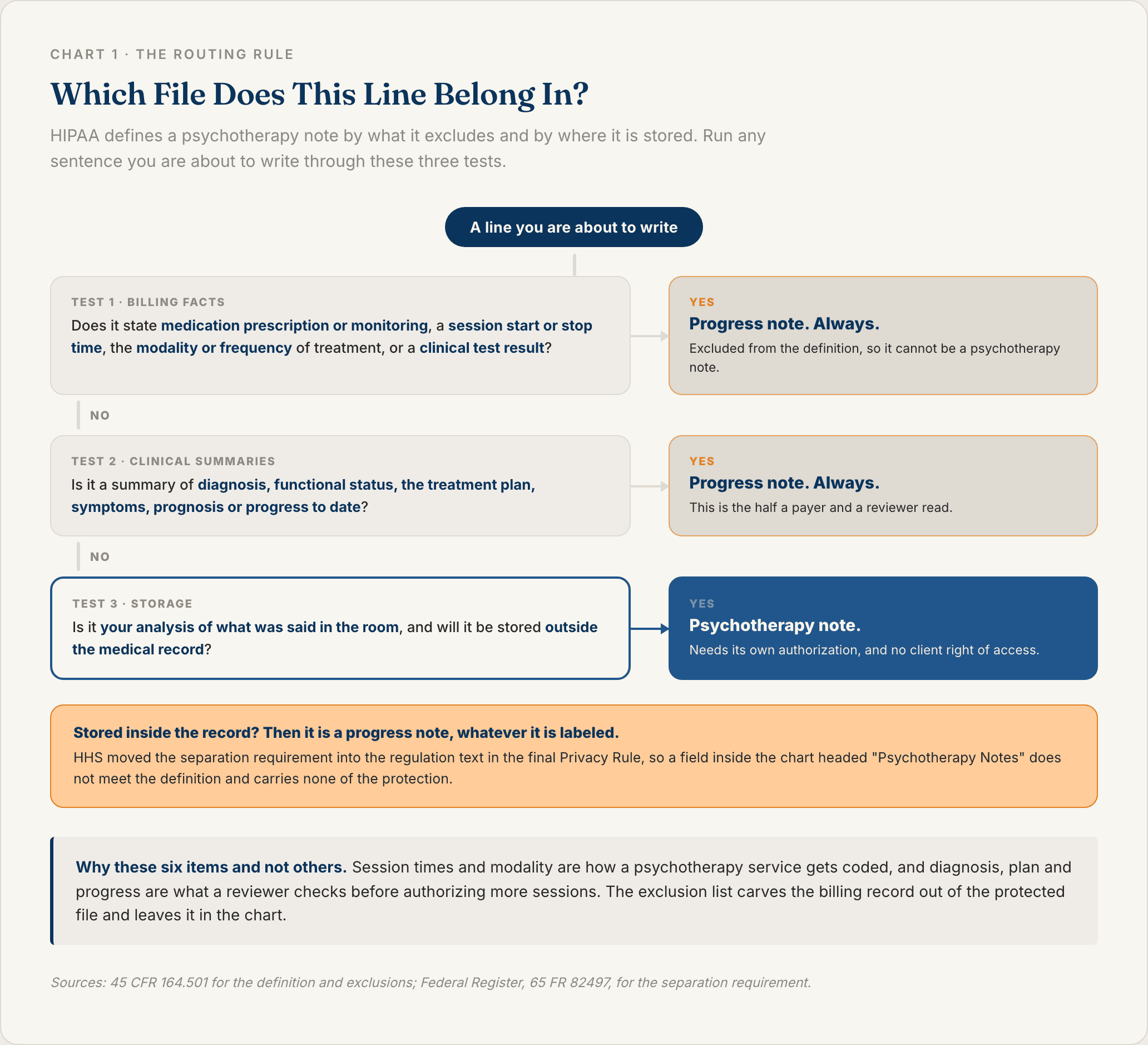
One is the progress note. It lives in the chart, and it carries the diagnosis, the treatment plan, the symptoms, the modality, and the minute the session started and stopped. The other is the psychotherapy note, and the rule that defines it is stranger than most people expect. It is defined by what it cannot contain, and by where it is stored.
Here are both blank templates, the three progress note formats with the same session written out in each, and the line that decides which file a sentence belongs in.
Key Takeaway:A therapy notes template is a structured form for recording a counseling session, and under HIPAA there are two of them. The progress note is part of the medical record and carries the session's diagnosis, treatment plan, symptoms, progress, modality, frequency, and start and stop times. The psychotherapy note is the clinician's separate analysis of the conversation, and 45 CFR 164.501 defines it by exclusion: medication prescription and monitoring, counseling session start and stop times, the modalities and frequencies of treatment furnished, results of clinical tests, and any summary of diagnosis, functional status, treatment plan, symptoms, prognosis and progress to date can never be part of it [1]. Separation is part of that definition rather than a filing preference, because HHS added the words "separated from the rest of the individual's medical record" to the regulation text in the final Privacy Rule [2]. A note kept inside the chart is a progress note whatever it is labeled. Sully.ai's AI Scribe captures the session detail the progress note needs and writes it into the record.
What a Therapy Notes Template Covers
Two files, two jobs.
The progress note describes the session. The psychotherapy note analyzes the conversation that happened inside it. Different content, different storage, different rules about who can read them.
Progress Notes Versus Psychotherapy Notes
The progress note is the record. It gets used for treatment, payment and health care operations like any other part of the chart, which is the point of it. A payer reads it. A supervisor reads it. A subsequent provider reads it.
The psychotherapy note is not the record. HIPAA requires a specific authorization for almost any use or disclosure of it, and there are only three exceptions: the person who wrote it can use it for treatment, the practice can use it for its own mental health training programs, and it can be used to defend a legal action brought by the client [3].
That difference is the whole reason the search term "psychotherapy notes vs progress notes" exists. Here is the version that actually helps: a progress note answers what happened and what you did about it. A psychotherapy note answers what you think is going on and why, and you are the only intended reader.
The Six Things That Can Never Be a Psychotherapy Note
The regulation does not tell you what a psychotherapy note contains. It tells you what it excludes [1]:
Medication prescription and monitoring
Counseling session start and stop times
The modalities and frequencies of treatment furnished
Results of clinical tests
Any summary of diagnosis, functional status, the treatment plan, symptoms, prognosis, and progress to date
Read that list again with a claim form in front of you.
Session times and modality are how a psychotherapy service gets coded. Medicare pays psychotherapy with a patient under 90832 through 90838, family psychotherapy under 90846 and 90847, and group psychotherapy under 90853 [4]. Every one of those is a timed, modality-specific service. Diagnosis, treatment plan and progress are what a utilization reviewer checks before authorizing more sessions.
So the exclusion list is not arbitrary. It carves the billing record out of the protected file and leaves it in the chart, where a payer can reach it. What is left over, your reading of the session, is the part that gets protected.
Why Separation Is Part of the Definition
This is the part almost every guide gets wrong, and it is worth being exact about.
When HHS wrote the proposed Privacy Rule, separation was mentioned only in the preamble. In the final rule they moved it into the regulation itself, stating that they "add to the regulation text the requirement that, to meet the definition of psychotherapy notes, the information must be separated from the rest of the individual's medical record" [2].
Separation is not a consequence of the label. It is part of the definition. A field inside your EHR chart with "Psychotherapy Notes" printed above it is not a psychotherapy note. It is a progress note with an optimistic heading, and it carries none of the protection.
The American Psychological Association tells psychologists the same thing in its record keeping guidelines: psychotherapy notes as defined by HIPAA "are necessarily kept apart from other parts of the record" [5].
The practical rule that follows is blunt. If you cannot store it separately, do not write it, because a psychotherapy note kept in the chart gets all of the discoverability and none of the protection.
The Therapy Notes Template
Two blocks. Keep them in two places.
The Blank Progress Note to Copy
PROGRESS NOTE
Client:
Date of service:
Start time / Stop time / Duration:
Modality:(individual, family, group, telehealth)
Participants:
CPT code:
Presenting concern this session:
Mental status observations:
Interventions delivered:
Client response:
Risk assessment:
Plan:
Next appointment:
Clinician signature and credentials:
Times and modality are in this file because they cannot be in the other one [1]. Same for the diagnosis, the plan and the progress summary.
The Separate Psychotherapy Note to Copy
PSYCHOTHERAPY NOTE(stored outside the medical record)
Date:
Session reference:
Working hypothesis about what is maintaining the problem:
Transference and countertransference observations:
Questions to bring to supervision:
Theories not yet shared with the client:
Notice what is missing. No diagnosis summary, no treatment plan, no symptom list, no test results, no times, no medication management. Any one of those pulls the file back into the chart's category by definition [1].
The block is short on purpose. A psychotherapy note that reads like a second progress note is just a second progress note.
Therapy Note Formats and the Session Each One Suits
All three formats below are progress note formats. None of them is a psychotherapy note, whichever one you pick.
The choice is about which part of the session the structure forces you to write down.

SOAP When the Session Tracks Symptoms
Subjective, Objective, Assessment, Plan.
SOAP splits what the client reported from what you observed, which makes it the strongest format when the record needs to show symptom change over time. The weak point is Objective. In a therapy context that field means mental status and observed behavior, not vitals, and it is where most SOAP therapy notes go vague.
DAP When the Session Turns on One Intervention
DAP collapses report and observation into a single Data block. It suits sessions where the useful record is what you did and how the client responded, rather than an inventory of symptoms. Fewer fields, less duplication, faster to write.
BIRP When Behavior and Response Are the Record
Behavior, Intervention, Response, Plan.
BIRP forces an explicit intervention line and an explicit response line. That is exactly what a utilization reviewer looks for when deciding whether to authorize more sessions, which is why community mental health and substance use programs tend to standardize on it.
Where Sully.ai Fits in Therapy Documentation
Therapists write notes between sessions or after the last client leaves. By then the specific detail that makes a note defensible, the intervention you actually used, the client's response in their own words, the risk check you ran, has faded into a general impression of the hour.
Sully.ai's AI Scribe captures what happens in the session and writes it into the progress note. Clinicians save how they want notes built, so SOAP comes back as SOAP and BIRP comes back as BIRP instead of depending on who was typing. It runs on a single integration across Epic, Cerner, Meditech and Athenahealth.
The honest boundary matters more on this topic than most. An ambient scribe writes the progress note. It does not write the psychotherapy note, and it should not. That file is defined by sitting outside the medical record, and anything a scribe files into the chart is, by definition, in the chart [2].
What Sully removes is the reason people collapse two files into one, which is that writing the first one properly takes the evening.
Sully operates across 5,000+ providers, has delivered 50M+ hours of AI work, and prices each AI role 80 to 90 percent below the human equivalent [6].
Therapy Notes Examples Written Out
One session, three renderings. Same client, same 53 minutes, so you can see what each structure keeps and what it drops.
The session: 34 year old client, sixth session, generalized anxiety, working on avoidance of work meetings. The therapist set up a behavioral experiment. The client attended one meeting, spoke once, then had a panic response and left early.
A DAP Note for an Anxiety Follow-Up
PROGRESS NOTE
Date: 4 September 2026 | Start: 1002 | **Stop** 1055 | **Duration** 53 min
Modality: Individual, in person | CPT: 90837
Data: Client attended the agreed behavioral experiment, a 30 minute team meeting, and contributed one comment. Reported heart racing and a sense of unreality building over roughly ten minutes, then left before the meeting ended. Describes the exit as "proof I can't do it." Presented alert, oriented, mildly agitated, speech rapid at the start of session and settling by minute 20. Denies suicidal or homicidal ideation. Sleep improved from four to six hours per night.
Assessment:Partial success on the exposure target, reframed by the client as failure. Avoidance is being maintained by the escape rather than by the anxiety itself. Sleep improvement suggests overall symptom burden is easing despite the client's read of the week.
Plan: Continue weekly individual CBT. Next session: build a graded exposure ladder with an explicit staying-in criterion. Client to record anxiety ratings at five minute intervals during the next meeting. Review medication question with prescriber at the next joint appointment.
The Same Session as a SOAP Note
Subjective:Client reports attending a 30 minute team meeting, speaking once, then experiencing racing heart and unreality and leaving early. States "it's proof I can't do it." Reports sleep improved from four to six hours.
Objective: Alert and oriented. Mildly agitated. Speech rapid early in session, settling by minute 20. No suicidal or homicidal ideation elicited.
Assessment:Partial completion of the exposure target, interpreted by the client as failure. Escape is maintaining the avoidance. Sleep improvement suggests easing symptom burden.
Plan: Weekly individual CBT continues. Graded exposure ladder next session with a staying-in criterion. Client to log anxiety ratings at five minute intervals. Medication question to the prescriber.
Same hour, same facts. What moved is that the client's report split away from your observations, and the assessment got shorter because SOAP puts more weight on the two blocks above it.
The Psychotherapy Note From That Same Session
PSYCHOTHERAPY NOTE (separate file)
My working read is that the meeting was never the target. The escape is doing something for him, and I think it is protecting a belief about competence that predates this job. He shifted the subject twice when I got near his father's promotion.
I noticed I wanted to congratulate him for going at all, and I sat on it. That impulse says more about my discomfort with his flatness than about what he needed.
Bring to supervision: am I moving on exposure because it is working or because it is measurable?
Look at what is not in there. No times, no code, no plan, no symptom summary, no diagnosis. Almost nothing from the progress note appears here, and almost nothing here belongs in the progress note.

What the Second File Costs You If You Get It Wrong
A Blanket Authorization Does Not Reach It
The general release your front desk collects does not cover psychotherapy notes, and it cannot be widened to cover them.
HIPAA requires a specific authorization for any use or disclosure of psychotherapy notes, outside the three exceptions above [3]. It then closes the obvious workaround: an authorization for psychotherapy notes "may only be combined with another authorization for a use or disclosure of psychotherapy notes" [3].
One form for everything is not an option here. It has to be its own document.
Patients Have No Right of Access to It
Clients have a right to inspect and get a copy of their record. That right explicitly excludes psychotherapy notes [7].
Now the flip side, which is the part worth sitting with. That exclusion only holds while the notes are genuinely separate. A practice that keeps everything in one chart has quietly handed every client a right of access to the therapist's private working notes, including the countertransference line and the supervision question.
The two-file structure is not extra paperwork. It is the only version where the second file means anything.
Book a demo and bring last week's notes. The question worth asking is which file your private thinking is currently sitting in.
FAQ
Q: What is the difference between therapy notes and progress notes? In everyday use "therapy notes" covers both files a therapist keeps, and HIPAA only defines one of them. A progress note is part of the medical record and carries the diagnosis, treatment plan, symptoms, progress, modality, and start and stop times. A psychotherapy note is the clinician's separate analysis of the conversation, kept apart from the record, and 45 CFR 164.501 excludes every one of those progress note items from it [1].
Q: What are psychotherapy notes under HIPAA? Notes recorded in any medium by a mental health professional documenting or analyzing the contents of conversation during a private, group, joint or family counseling session, and separated from the rest of the individual's medical record [1]. The separation is part of the definition, not a filing habit. HHS moved that requirement into the regulation text in the final Privacy Rule so the category could not be claimed for notes kept inside the chart [2].
Q: Do patients have a right to see their therapy notes? They have a right of access to the progress note, like any other part of the record. They do not have a right of access to psychotherapy notes, which HIPAA excludes from the individual right of access [7]. That exclusion depends entirely on the notes being separate, so a psychotherapy note stored inside the chart is reachable like everything else in it.
Q: Which therapy note format should I use? SOAP suits symptom-led sessions where the record needs to show change over time. DAP suits sessions that turn on a single intervention. BIRP forces an explicit behavior line and response line, which is why community mental health and substance use programs tend to use it. All three are progress note formats, so none of them turns a note into a psychotherapy note.
Q: Do you have a free therapy notes template? Yes. The blank progress note and the separate psychotherapy note are both on this page as copy-paste blocks, with one session written out as a DAP note, a SOAP note and a psychotherapy note so you can see what each structure keeps. Sully.ai's AI Scribe can also capture the session and write the progress note in whichever format you have saved.
Sources
[1] Office of the Federal Register — 45 CFR 164.501, Definitions [2] Office of the Federal Register — Standards for Privacy of Individually Identifiable Health Information, Final Rule, 65 FR 82497 [3] Office of the Federal Register — 45 CFR 164.508, Uses and disclosures for which an authorization is required [4] Centers for Medicare & Medicaid Services — Medicare and Mental Health Coverage, MLN1986542[5] American Psychological Association — Record Keeping Guidelines [6] Sully.ai — The AI Workforce for Healthcare [7] Office of the Federal Register — 45 CFR 164.524, Access of individuals to protected health information


Templates

Keep reading

Templates
/
AI Front Desk for Medical Practices: What It Changes Beyond Answering the Phone
The front desk is a revenue gate, not a phone. What an AI front desk actually does, what claim-denial data shows it should fix, and what it costs.

Templates
/
CPT Code 99202 With Examples and Why 99201 Is Gone
99202 is the lowest billable new patient code—and most practices skip straight to 99203. See when it's correct, the MDM floor, and two worked examples.
Templates
/
CPT Code 99212 With Examples and When a Visit Really Is This Small
99212 has the highest denial rate of any E/M code—most visits that reach it qualify for 99213. See the MDM floor, fee formula, and two worked examples.
