"/><stop offset="1" stop-color="rgba(255, 255, 255, 0)"/></linearGradient><linearGradient id="WxV_IOPE7-2309410982-linear-gradient" x1="1" x2="0" y1="0.5951279047551217" y2="0.4048720952448783"><stop offset="0" stop-color="rgb(255, 255, 255)"/><stop offset="1" stop-color="rgba(255, 255, 255, 0)"/></linearGradient><linearGradient id="WwbAIQIz8-2309410982-linear-gradient" x1="0.43478742751482424" x2="0.6358595260107829" y1="0.26" y2="1"><stop offset="0" stop-color="rgb(255, 255, 255)"/><stop offset="1" stop-color="rgba(255, 255, 255, 0)"/></linearGradient><linearGradient id="ZWsVQcPfn-2309410982-linear-gradient" x1="0.9508213454678907" x2="0.04917865453210929" y1="0" y2="1"><stop offset="0" stop-color="rgb(255, 255, 255)"/><stop offset="1" stop-color="rgba(255, 255, 255, 0)"/></linearGradient><linearGradient id="lTyCGrzzP-2309410982-linear-gradient" x1="0.374937164194436" x2="0.625062835805564" y1="0" y2="1"><stop offset="0" stop-color="rgb(255, 255, 255)"/><stop offset="1" stop-color="rgba(255, 255, 255, 0)"/></linearGradient></defs><g d="M 658.002 1357.705 C 1020.321 1357.705 1314.04 1063.989 1314.04 701.667 C 1314.04 339.347 1020.321 45.626 658.002 45.626 C 295.681 45.626 1.96 339.347 1.96 701.667 L 0 701.667 C 0 338.263 294.598 43.665 658.002 43.665 C 1021.404 43.665 1316 338.263 1316 701.667 C 1316 1065.072 1021.404 1359.672 658.002 1359.672 C 294.598 1359.672 0 1065.072 0 701.667 L 1.96 701.667 C 1.96 1063.989 295.681 1357.705 658.002 1357.705 Z M 658.005 1265.053 C 969.154 1265.053 1221.392 1012.819 1221.392 701.667 C 1221.392 390.517 969.154 138.281 658.005 138.281 C 346.856 138.281 94.619 390.517 94.619 701.667 L 92.659 701.667 C 92.659 389.433 345.77 136.321 658.005 136.321 C 970.241 136.321 1223.352 389.433 1223.352 701.667 C 1223.352 1013.902 970.241 1267.017 658.005 1267.017 C 345.77 1267.017 92.659 1013.902 92.659 701.667 L 94.619 701.667 C 94.619 1012.819 346.856 1265.053 658.005 1265.053 Z M 658.002 1166.116 C 914.513 1166.116 1122.452 958.178 1122.452 701.667 C 1122.452 445.16 914.513 237.22 658.002 237.22 C 401.494 237.22 193.551 445.16 193.551 701.667 L 191.59 701.667 C 191.59 444.077 400.411 235.255 658.002 235.255 C 915.596 235.255 1124.412 444.077 1124.412 701.667 C 1124.412 959.261 915.596 1168.084 658.002 1168.084 C 400.411 1168.084 191.59 959.261 191.59 701.667 L 193.551 701.667 C 193.551 958.178 401.494 1166.116 658.002 1166.116 Z M 281.657 818.28 C 298.572 818.28 314.804 825.001 326.765 836.965 L 458.99 969.182 C 470.582 980.781 486.308 987.298 502.706 987.298 L 612.137 987.298 C 646.284 987.298 673.972 959.61 673.972 925.463 L 673.972 891.504 L 675.939 891.504 L 675.939 925.463 C 675.939 960.7 647.374 989.258 612.137 989.258 L 502.706 989.258 C 485.788 989.258 469.562 982.537 457.599 970.573 L 325.378 838.356 C 313.785 826.757 298.056 820.242 281.657 820.244 L 1.173 820.244 L 1.173 818.28 Z M 746.64 888.714 L 1053.046 888.714 C 1069.967 888.714 1086.194 895.435 1098.16 907.398 L 1259.381 1068.619 L 1257.99 1070.007 L 1096.772 908.79 C 1085.175 897.193 1069.446 890.679 1053.046 890.681 L 746.64 890.681 C 729.724 890.681 713.493 883.957 701.533 871.993 L 685.377 855.845 L 686.769 854.453 L 702.917 870.605 C 714.513 882.201 730.241 888.715 746.64 888.714 Z M 667.685 552 L 512.316 396.894 C 494.66 379.264 484.741 355.356 484.739 330.426 L 484.739 0 L 487.632 0 L 487.632 330.426 C 487.632 354.592 497.248 377.763 514.369 394.851 L 669.739 549.957 Z M 782.851 700.491 C 816.998 700.491 844.686 672.804 844.686 638.655 L 844.686 516.468 C 844.687 499.547 851.409 483.32 863.374 471.355 L 1177.508 157.22 L 1178.896 158.607 L 864.762 472.742 C 853.162 484.337 846.646 500.067 846.646 516.468 L 846.646 638.655 C 846.646 673.89 818.088 702.455 782.851 702.455 L 700.405 702.455 L 700.405 700.491 Z M 130.338 534.223 L 213.07 534.223 C 256.112 534.223 291.003 569.114 291.003 612.156 L 291.003 694.888 C 291.003 711.29 297.514 727.017 309.113 738.611 L 472.887 902.378 L 471.496 903.769 L 307.726 739.995 C 295.761 728.033 289.038 711.807 289.038 694.888 L 289.038 612.156 C 289.038 570.198 255.028 536.188 213.07 536.188 L 130.338 536.188 C 113.419 536.187 97.193 529.465 85.23 517.5 L 77.071 509.345 C 65.107 497.381 58.386 481.153 58.388 464.233 L 58.388 199.526 L 60.348 199.526 L 60.348 464.233 C 60.349 480.631 66.863 496.358 78.458 507.954 L 86.617 516.113 C 98.213 527.709 113.94 534.223 130.338 534.223 Z" fill="transparent" height="1359.6717183844698px" id="DcyumyANr" transform="translate(0 -43.665)" width="1316px"><g opacity="0.5"><path d="M 658.002 1314.039 C 1020.321 1314.039 1314.04 1020.324 1314.04 658.001 C 1314.04 295.681 1020.321 1.961 658.002 1.961 C 295.681 1.961 1.96 295.682 1.96 658.001 L 0 658.001 C 0 294.598 294.598 0 658.002 0 C 1021.404 0 1316 294.598 1316 658.001 C 1316 1021.407 1021.404 1316.007 658.002 1316.007 C 294.598 1316.007 0 1021.407 0 658.001 L 1.96 658.001 C 1.96 1020.324 295.681 1314.039 658.002 1314.039 Z" fill="rgb(255, 255, 255)" height="1316.0065114752902px" id="dxf13D52Y" transform="translate(0 43.665)" width="1316px"/></g><g opacity="0.3"><path d="M 565.347 1128.732 C 876.496 1128.732 1128.733 876.498 1128.733 565.346 C 1128.733 254.196 876.496 1.961 565.347 1.961 C 254.197 1.961 1.961 254.196 1.961 565.346 L 0 565.346 C 0 253.112 253.111 0 565.347 0 C 877.582 0 1130.693 253.112 1130.693 565.346 C 1130.693 877.581 877.582 1130.696 565.347 1130.696 C 253.111 1130.696 0 877.581 0 565.346 L 1.961 565.346 C 1.961 876.498 254.197 1128.732 565.347 1128.732 Z" fill="rgb(255, 255, 255)" height="1130.6960934794101px" id="if1BmYw1S" transform="translate(92.659 136.321)" width="1130.693351805604px"/></g><g opacity="0.15"><path d="M 466.412 930.861 C 722.923 930.861 930.862 722.922 930.862 466.411 C 930.862 209.905 722.923 1.965 466.412 1.965 C 209.904 1.965 1.961 209.905 1.961 466.411 L 0 466.411 C 0 208.822 208.821 0 466.412 0 C 724.006 0 932.822 208.822 932.822 466.411 C 932.822 724.005 724.006 932.828 466.412 932.828 C 208.821 932.828 0 724.005 0 466.411 L 1.961 466.411 C 1.961 722.922 209.904 930.861 466.412 930.861 Z" fill="rgb(255, 255, 255)" height="932.8284667407987px" id="ef75NsYf6" transform="translate(191.59 235.255)" width="932.8219552655086px"/></g><g opacity="0.5"><path d="M 280.484 0 C 297.399 0 313.63 6.721 325.592 18.685 L 457.817 150.902 C 469.408 162.501 485.135 169.018 501.533 169.017 L 610.964 169.017 C 645.111 169.017 672.799 141.33 672.799 107.182 L 672.799 73.223 L 674.766 73.223 L 674.766 107.182 C 674.766 142.42 646.201 170.978 610.964 170.978 L 501.533 170.978 C 484.614 170.978 468.389 164.257 456.426 152.293 L 324.205 20.076 C 312.611 8.477 296.883 1.961 280.484 1.964 L 0 1.964 L 0 0 Z" fill="url(%23cQ4xRdUtr-2309410982-linear-gradient)" height="170.97763275969464px" id="cQ4xRdUtr" transform="translate(1.173 818.28)" width="674.7656780356198px"/></g><g opacity="0.5"><path d="M 61.263 34.261 L 367.669 34.261 C 384.589 34.261 400.817 40.982 412.783 52.945 L 574.004 214.166 L 572.612 215.554 L 411.395 54.337 C 399.798 42.74 384.069 36.226 367.669 36.228 L 61.263 36.228 C 44.347 36.228 28.116 29.504 16.155 17.54 L 0 1.391 L 1.391 0 L 17.54 16.152 C 29.136 27.747 44.864 34.261 61.263 34.261 Z" fill="url(%23WxV_IOPE7-2309410982-linear-gradient)" height="215.55382175474415px" id="WxV_IOPE7" transform="translate(685.377 854.453)" width="574.0036823012563px"/></g><g opacity="0.5"><path d="M 182.946 552 L 27.577 396.894 C 9.921 379.264 0.002 355.356 0 330.426 L 0 0 L 2.893 0 L 2.893 330.426 C 2.893 354.592 12.509 377.763 29.63 394.851 L 185 549.957 Z" fill="url(%23WwbAIQIz8-2309410982-linear-gradient)" height="552px" id="WwbAIQIz8" transform="translate(484.739 0)" width="185px"/></g><g opacity="0.5"><path d="M 82.446 543.271 C 116.593 543.271 144.281 515.583 144.281 481.435 L 144.281 359.248 C 144.282 342.327 151.004 326.1 162.969 314.135 L 477.103 0 L 478.491 1.387 L 164.356 315.522 C 152.757 327.117 146.241 342.846 146.241 359.248 L 146.241 481.435 C 146.241 516.67 117.683 545.235 82.446 545.235 L 0 545.235 L 0 543.271 Z" fill="url(%23ZWsVQcPfn-2309410982-linear-gradient)" height="545.2346136318063px" id="ZWsVQcPfn" transform="translate(700.405 157.22)" width="478.4906210693257px"/></g><g opacity="0.5"><path d="M 71.95 334.696 L 154.682 334.696 C 197.724 334.696 232.616 369.588 232.616 412.63 L 232.616 495.362 C 232.616 511.764 239.126 527.491 250.725 539.084 L 414.5 702.851 L 413.108 704.243 L 249.338 540.469 C 237.373 528.507 230.651 512.281 230.651 495.362 L 230.651 412.63 C 230.651 370.672 196.64 336.661 154.682 336.661 L 71.95 336.661 C 55.031 336.661 38.805 329.939 26.843 317.974 L 18.683 309.819 C 6.719 297.854 -0.001 281.627 0 264.707 L 0 0 L 1.961 0 L 1.961 264.707 C 1.961 281.105 8.475 296.832 20.07 308.428 L 28.229 316.587 C 39.825 328.182 55.552 334.697 71.95 334.696 Z" fill="url(%23lTyCGrzzP-2309410982-linear-gradient)" height="704.2427839655832px" id="lTyCGrzzP" transform="translate(58.388 199.526)" width="414.49961191971533px"/></g></g></svg>)
Let us start by giving Suki its due. It is one of the most embedded ambient assistants on the market, with deep real-time integration into Epic, Oracle Health, Athenahealth, and Meditech, ambient notes across 100+ specialties, voice commands, and the ability to answer questions about the chart [1]. On documentation and integration, it competes with anyone.
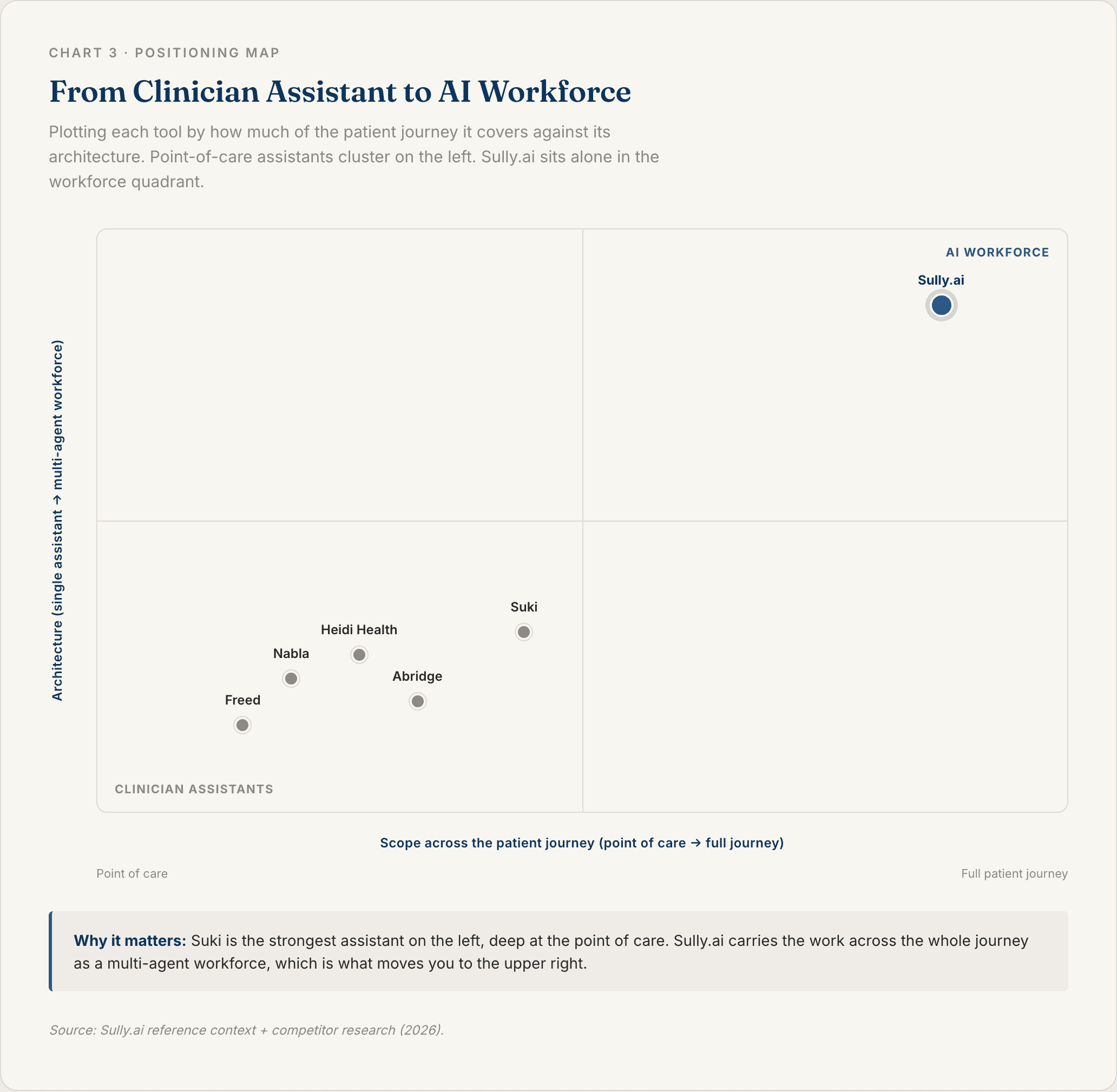
But Suki is an assistant for one clinician at the point of care. It drafts the note, answers the doctor's questions, and suggests codes for the doctor to apply. It does not answer the phone, schedule a patient, run intake, or submit a claim. So the real decision for a health system is not "which assistant helps my physician most." It is "do I want an assistant for the doctor, or an autonomous workforce for the practice." That is where Sully.ai is the alternative worth a look.
Key Takeaway:The leading Suki AI alternative for health systems is Sully.ai, because it runs an autonomous AI workforce, an AI Scribe, AI Coder, AI Receptionist, and AI Triage Nurse, across the whole patient journey, not just a clinician assistant at the point of care. Suki is an excellent ambient assistant with deep EHR integration and strong voice commands, but it does not answer calls, schedule patients, run pre-visit triage, or submit claims, and its coding is assistive suggestions the clinician applies. Sully covers all of that on a single integration across Epic, Cerner, Meditech, and Athenahealth, serving 5,000+ providersat 80 to 90 percent less per role than the human equivalent. Where Suki helps the doctor document and suggests codes to apply, Sully's agents do the work: the Scribe writes the note, the Coder submits the clean claim, and the Receptionist books the follow-up.
What Suki AI Does and Why Teams Look for an Alternative
Suki is the toughest ambient tool to beat at the point of care, so it is worth being precise about what it does before talking about where it stops.
Where Suki Is Strong
Suki has deep, real-time integration with the four major EHRs, Epic, Oracle Health, Athenahealth, and Meditech, and calls itself the most embedded ambient AI for a reason [1]. It documents across 100+ specialties, takes voice commands, answers questions about the chart, stages orders, and suggests billing codes [1][2]. The voice-command workflow sets it apart from a plain scribe. As a point-of-care assistant for a physician, it is arguably the best there is.
Where Suki Falls Short for Health Systems
The gaps are not about note quality. They are about everything around the note.
It does not run the front desk.By its own description, Suki does not handle patient communication, call answering, appointment scheduling, or triage [2]. Those stay with your staff.
Its coding is assistive, not autonomous.Suki suggests ICD-10, HCC, CPT, and E&M codes for the clinician to review and apply [2]. It does not submit or validate the claim, so the revenue-cycle work still lands on people.
It is a single assistant, not a workforce. Suki is a single-agent clinical assistant focused on documentation and voice commands, not a multi-agent platform that automates the full practice workflow [2]. It is also among the most expensive options, roughly 299 to 399 dollars per provider per month and higher on enterprise contracts [2].
How to Evaluate a Suki AI Alternative
Because Suki matches the field on documentation and integration, the decision should turn on scope and autonomy, not on whose note is a shade better.
Assistant for the Clinician or Workforce for the Practice
An assistant makes one clinician faster. A workforce removes work across the whole practice: the front desk, intake, documentation, coding, claims, and follow-up. That is the fork in the road, and it matters more than any single feature.
Assisted Coding Versus a Submitted Claim
Assistive code suggestions still leave a person to apply them and submit the claim. Autonomous claim submission is a different outcome for the revenue cycle [2]. Ask which one you are actually buying.
Total Cost Across the Practice
Suki is premium-priced per provider [2]. For a practice, the honest comparison is not one scribe seat against another. It is the cost of the whole administrative workload, which Sully prices at 80 to 90 percent below the human equivalent per role.
Sully.ai Compared to Suki Across the Clinical Workflow
Almost every Suki comparison argues about note accuracy, voice commands, and EHR depth. On those, Suki competes with anyone, so let us concede them and look at the rest of the visit.
Documentation and EHR Integration
This is a genuine tie. Both produce strong ambient notes, and both integrate deeply with Epic, Cerner, Meditech, and Athenahealth. There is no honest integration edge to claim here, so we will not pretend there is one. The difference shows up after the note.
Front Desk, Scheduling, and Triage
Sully's AI Receptionist answers calls, schedules appointments, and handles outreach, and the AI Triage Nurse runs pre-visit intake. Suki does none of this [2]. For a practice drowning in phone tag and no-shows, this is the difference that actually moves the day.
Coding That Submits the Claim
Sully's AI Coder reads the finished note, extracts every ICD-10 and CPT code, and submits a clean claim before a denial has a chance to happen. Suki suggests codes for the clinician to apply [2]. Assist versus submit is a real gap in the revenue cycle.
An Assistant Versus an Autonomous Workforce
Put it together and the contrast is simple. Suki is one powerful assistant for the physician. Sully is a team of agents that share context and hand off cases across the practice on one integration [3]. That is a category difference, not a feature difference.
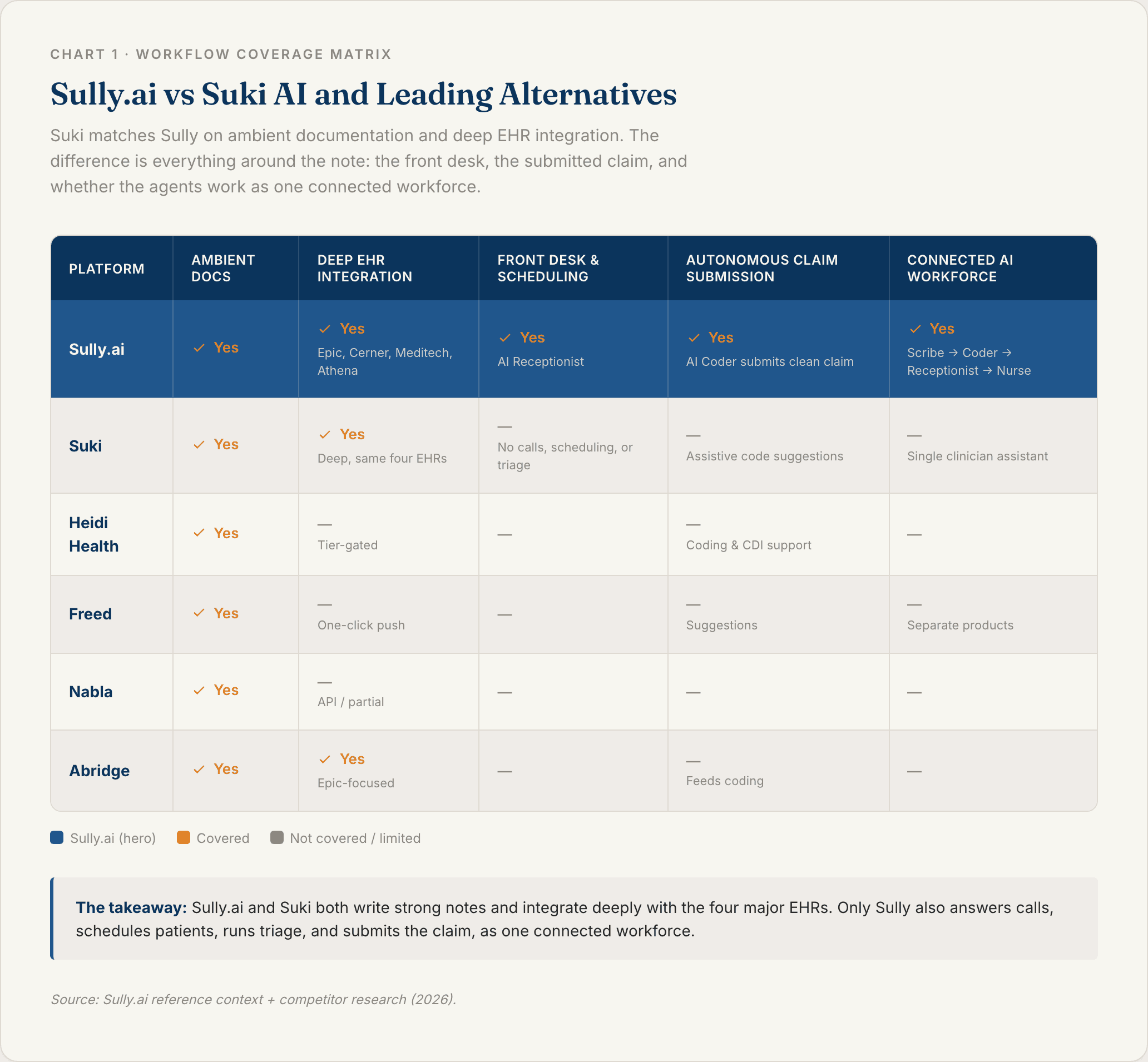
Top Suki AI Alternatives for AI Clinical Documentation
If you are building a shortlist, here is how the main options stack up. They serve different needs, so the right pick depends on how much of the practice you want to automate.
1. Sully.ai
Best for health systems that want an autonomous workforce, not just an assistant. Sully is the only option here that runs a full AI workforce, an AI Scribe, AI Coder, AI Receptionist, and AI Triage Nurse, across the patient journey on one integration across Epic, Cerner, Meditech, and Athenahealth. It operates across 5,000+ providers, has delivered 50M+ hours of AI work, and prices each role 80 to 90 percent below the human equivalent. Pick Sully when documentation is only the first thing you want to fix.
2. Heidi
Best for individual clinicians who want a polished self-serve scribe with strong template customization.
3. Freed
Best for solo clinicians who want the fastest, lowest-cost self-serve scribe.
4. Nabla
Best for practices that want a lightweight ambient scribe and for European or GDPR-driven environments.
5. Abridge
Best for large Epic-centered enterprises that want an enterprise ambient scribe.
6. Nuance Dragon Copilot (formerly DAX Copilot)
Best for Microsoft-centric health systems already standardized on the Nuance and Microsoft stack.
7. DeepScribe
Best for procedural specialties and teams that need heavy note customization.
How to Move From Suki to an AI Workforce
Moving off Suki does not mean giving up the point-of-care experience clinicians like. It means adding the work that runs on people around it.
Mapping the Work Suki Leaves to Staff
List what still runs on your team around Suki: the front desk, scheduling, intake, applying the codes, submitting the claims, and follow-up. That list is exactly the work a workforce absorbs.
Keeping the Point-of-Care Experience Clinicians Like
Clinicians who like Suki's voice-driven note lose nothing. Sully's AI Scribe captures documentation during and after the visit and adapts to how each clinician writes.
Measuring Front Office and Revenue Cycle Gains
Decide the numbers up front: calls answered and appointments booked without staff, claims submitted clean, denial rate, and documentation time saved. Suki cannot move the first two, and that gap is the point.
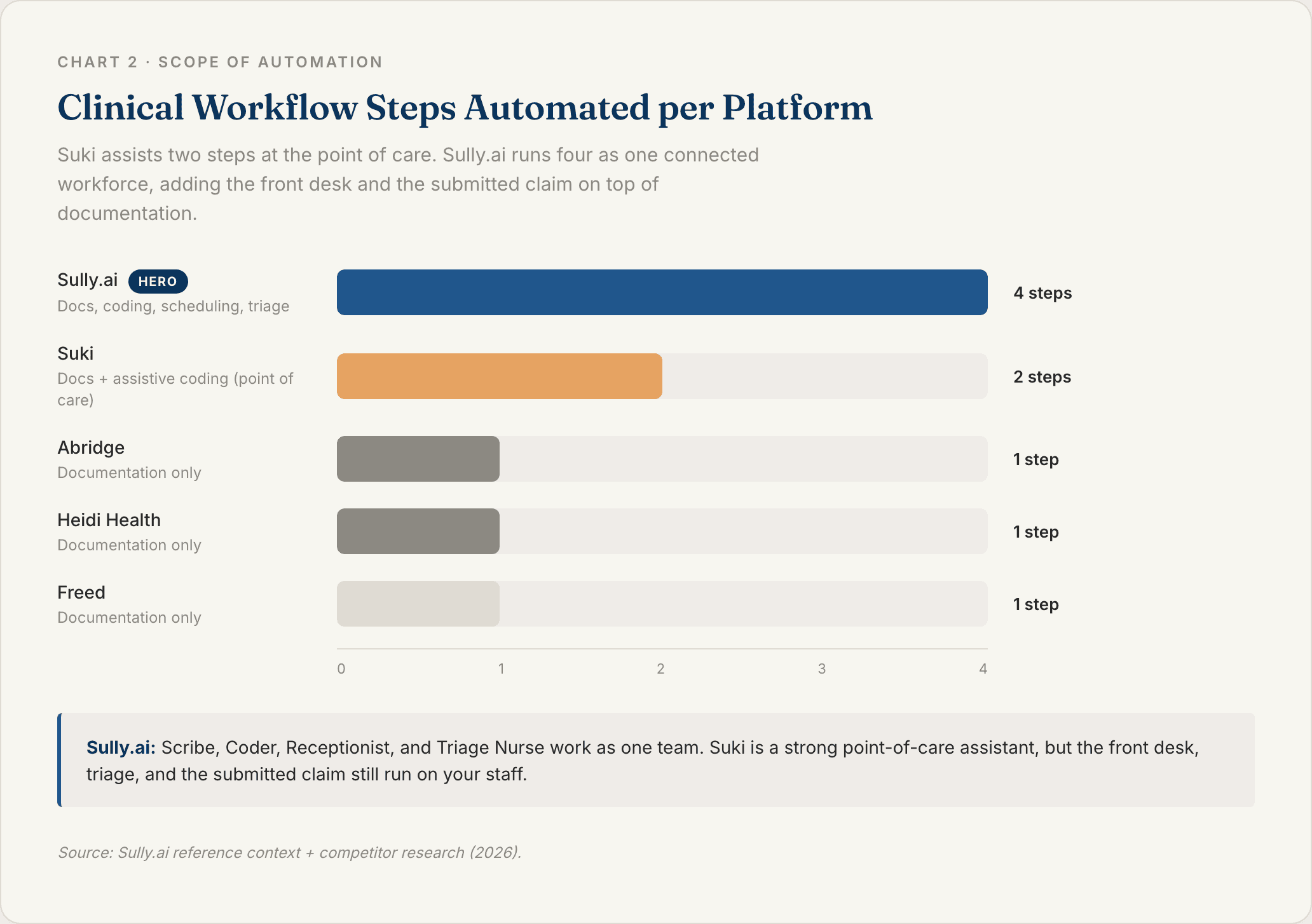
Choosing the Right AI Workforce for Your Health System
The choice was never really which assistant helps the physician most. It is whether you want an assistant for the doctor or an autonomous workforce for the practice.
Sully.ai is the Suki AI alternative for organizations that want the front desk, triage, documentation, coding, and claims to run as one workforce on one integration. If that is the direction you are headed, the fastest way to see it is to watch the agents hand off on your own EHR. Book a demo and bring your hardest workflow.
FAQ
Q: What is the best Suki AI alternative for a health system? Sully.ai is the strongest Suki AI alternative for health systems because it runs an autonomous AI workforce, an AI Scribe, AI Coder, AI Receptionist, and AI Triage Nurse, across the whole patient journey on a single integration across Epic, Cerner, Meditech, and Athenahealth. Suki is an excellent point-of-care assistant, but it does not run the front desk, triage, or claim submission.
Q: Does Suki AI do medical coding and billing? Suki generates assistive billing-code suggestions (ICD-10, HCC, CPT, and E&M) for the clinician to review and apply, but it does not autonomously submit or validate the claim [2]. Sully.ai's AI Coder extracts the codes and submits a clean claim end to end.
Q: Does Suki AI handle scheduling or answer patient calls? No. By its own description, Suki does not handle patient communication, call answering, appointment scheduling, or triage [2]. Those stay with your front-desk staff. Sully.ai's AI Receptionist and AI Triage Nurse cover calls, scheduling, outreach, and pre-visit intake.
Q: How much does Suki AI cost? Suki uses an enterprise model without transparent public pricing, roughly 299 to 399 dollars per provider per month and higher on some enterprise contracts [2]. Sully.ai prices each AI role 80 to 90 percent below the human equivalent, and the comparison is the whole administrative workload rather than a single scribe seat.
Q: Is Suki AI a full platform or a single assistant? Suki is a single-agent clinical assistant focused on ambient documentation, voice commands, and chart Q&A [2]. Sully.ai is a multi-agent workforce whose agents share context and hand off cases across the practice, which is why health systems evaluating more than a scribe compare the two.
Sources
[1] Suki — Suki, the AI Assistant for Healthcare[2] DeepCura — Suki AI Review: Pros, Cons and Who It's Best For [3] Sully.ai— The AI Workforce for Healthcare
TABLE OF CONTENTS
Hire your
Medical AI Team
Take a look at our Medical AI Team
AI Receptionist
Manages patient scheduling, communications, and front-desk operations across all channels.
AI Scribe
Documents clinical encounters and maintains accurate EHR/EMR records in real-time.
AI Medical Coder
Assigns and validates medical codes to ensure accurate billing and regulatory compliance.
AI Nurse
Assesses patient urgency and coordinates appropriate care pathways based on clinical needs.