"/><stop offset="1" stop-color="rgba(255, 255, 255, 0)"/></linearGradient><linearGradient id="WxV_IOPE7-2309410982-linear-gradient" x1="1" x2="0" y1="0.5951279047551217" y2="0.4048720952448783"><stop offset="0" stop-color="rgb(255, 255, 255)"/><stop offset="1" stop-color="rgba(255, 255, 255, 0)"/></linearGradient><linearGradient id="WwbAIQIz8-2309410982-linear-gradient" x1="0.43478742751482424" x2="0.6358595260107829" y1="0.26" y2="1"><stop offset="0" stop-color="rgb(255, 255, 255)"/><stop offset="1" stop-color="rgba(255, 255, 255, 0)"/></linearGradient><linearGradient id="ZWsVQcPfn-2309410982-linear-gradient" x1="0.9508213454678907" x2="0.04917865453210929" y1="0" y2="1"><stop offset="0" stop-color="rgb(255, 255, 255)"/><stop offset="1" stop-color="rgba(255, 255, 255, 0)"/></linearGradient><linearGradient id="lTyCGrzzP-2309410982-linear-gradient" x1="0.374937164194436" x2="0.625062835805564" y1="0" y2="1"><stop offset="0" stop-color="rgb(255, 255, 255)"/><stop offset="1" stop-color="rgba(255, 255, 255, 0)"/></linearGradient></defs><g d="M 658.002 1357.705 C 1020.321 1357.705 1314.04 1063.989 1314.04 701.667 C 1314.04 339.347 1020.321 45.626 658.002 45.626 C 295.681 45.626 1.96 339.347 1.96 701.667 L 0 701.667 C 0 338.263 294.598 43.665 658.002 43.665 C 1021.404 43.665 1316 338.263 1316 701.667 C 1316 1065.072 1021.404 1359.672 658.002 1359.672 C 294.598 1359.672 0 1065.072 0 701.667 L 1.96 701.667 C 1.96 1063.989 295.681 1357.705 658.002 1357.705 Z M 658.005 1265.053 C 969.154 1265.053 1221.392 1012.819 1221.392 701.667 C 1221.392 390.517 969.154 138.281 658.005 138.281 C 346.856 138.281 94.619 390.517 94.619 701.667 L 92.659 701.667 C 92.659 389.433 345.77 136.321 658.005 136.321 C 970.241 136.321 1223.352 389.433 1223.352 701.667 C 1223.352 1013.902 970.241 1267.017 658.005 1267.017 C 345.77 1267.017 92.659 1013.902 92.659 701.667 L 94.619 701.667 C 94.619 1012.819 346.856 1265.053 658.005 1265.053 Z M 658.002 1166.116 C 914.513 1166.116 1122.452 958.178 1122.452 701.667 C 1122.452 445.16 914.513 237.22 658.002 237.22 C 401.494 237.22 193.551 445.16 193.551 701.667 L 191.59 701.667 C 191.59 444.077 400.411 235.255 658.002 235.255 C 915.596 235.255 1124.412 444.077 1124.412 701.667 C 1124.412 959.261 915.596 1168.084 658.002 1168.084 C 400.411 1168.084 191.59 959.261 191.59 701.667 L 193.551 701.667 C 193.551 958.178 401.494 1166.116 658.002 1166.116 Z M 281.657 818.28 C 298.572 818.28 314.804 825.001 326.765 836.965 L 458.99 969.182 C 470.582 980.781 486.308 987.298 502.706 987.298 L 612.137 987.298 C 646.284 987.298 673.972 959.61 673.972 925.463 L 673.972 891.504 L 675.939 891.504 L 675.939 925.463 C 675.939 960.7 647.374 989.258 612.137 989.258 L 502.706 989.258 C 485.788 989.258 469.562 982.537 457.599 970.573 L 325.378 838.356 C 313.785 826.757 298.056 820.242 281.657 820.244 L 1.173 820.244 L 1.173 818.28 Z M 746.64 888.714 L 1053.046 888.714 C 1069.967 888.714 1086.194 895.435 1098.16 907.398 L 1259.381 1068.619 L 1257.99 1070.007 L 1096.772 908.79 C 1085.175 897.193 1069.446 890.679 1053.046 890.681 L 746.64 890.681 C 729.724 890.681 713.493 883.957 701.533 871.993 L 685.377 855.845 L 686.769 854.453 L 702.917 870.605 C 714.513 882.201 730.241 888.715 746.64 888.714 Z M 667.685 552 L 512.316 396.894 C 494.66 379.264 484.741 355.356 484.739 330.426 L 484.739 0 L 487.632 0 L 487.632 330.426 C 487.632 354.592 497.248 377.763 514.369 394.851 L 669.739 549.957 Z M 782.851 700.491 C 816.998 700.491 844.686 672.804 844.686 638.655 L 844.686 516.468 C 844.687 499.547 851.409 483.32 863.374 471.355 L 1177.508 157.22 L 1178.896 158.607 L 864.762 472.742 C 853.162 484.337 846.646 500.067 846.646 516.468 L 846.646 638.655 C 846.646 673.89 818.088 702.455 782.851 702.455 L 700.405 702.455 L 700.405 700.491 Z M 130.338 534.223 L 213.07 534.223 C 256.112 534.223 291.003 569.114 291.003 612.156 L 291.003 694.888 C 291.003 711.29 297.514 727.017 309.113 738.611 L 472.887 902.378 L 471.496 903.769 L 307.726 739.995 C 295.761 728.033 289.038 711.807 289.038 694.888 L 289.038 612.156 C 289.038 570.198 255.028 536.188 213.07 536.188 L 130.338 536.188 C 113.419 536.187 97.193 529.465 85.23 517.5 L 77.071 509.345 C 65.107 497.381 58.386 481.153 58.388 464.233 L 58.388 199.526 L 60.348 199.526 L 60.348 464.233 C 60.349 480.631 66.863 496.358 78.458 507.954 L 86.617 516.113 C 98.213 527.709 113.94 534.223 130.338 534.223 Z" fill="transparent" height="1359.6717183844698px" id="DcyumyANr" transform="translate(0 -43.665)" width="1316px"><g opacity="0.5"><path d="M 658.002 1314.039 C 1020.321 1314.039 1314.04 1020.324 1314.04 658.001 C 1314.04 295.681 1020.321 1.961 658.002 1.961 C 295.681 1.961 1.96 295.682 1.96 658.001 L 0 658.001 C 0 294.598 294.598 0 658.002 0 C 1021.404 0 1316 294.598 1316 658.001 C 1316 1021.407 1021.404 1316.007 658.002 1316.007 C 294.598 1316.007 0 1021.407 0 658.001 L 1.96 658.001 C 1.96 1020.324 295.681 1314.039 658.002 1314.039 Z" fill="rgb(255, 255, 255)" height="1316.0065114752902px" id="dxf13D52Y" transform="translate(0 43.665)" width="1316px"/></g><g opacity="0.3"><path d="M 565.347 1128.732 C 876.496 1128.732 1128.733 876.498 1128.733 565.346 C 1128.733 254.196 876.496 1.961 565.347 1.961 C 254.197 1.961 1.961 254.196 1.961 565.346 L 0 565.346 C 0 253.112 253.111 0 565.347 0 C 877.582 0 1130.693 253.112 1130.693 565.346 C 1130.693 877.581 877.582 1130.696 565.347 1130.696 C 253.111 1130.696 0 877.581 0 565.346 L 1.961 565.346 C 1.961 876.498 254.197 1128.732 565.347 1128.732 Z" fill="rgb(255, 255, 255)" height="1130.6960934794101px" id="if1BmYw1S" transform="translate(92.659 136.321)" width="1130.693351805604px"/></g><g opacity="0.15"><path d="M 466.412 930.861 C 722.923 930.861 930.862 722.922 930.862 466.411 C 930.862 209.905 722.923 1.965 466.412 1.965 C 209.904 1.965 1.961 209.905 1.961 466.411 L 0 466.411 C 0 208.822 208.821 0 466.412 0 C 724.006 0 932.822 208.822 932.822 466.411 C 932.822 724.005 724.006 932.828 466.412 932.828 C 208.821 932.828 0 724.005 0 466.411 L 1.961 466.411 C 1.961 722.922 209.904 930.861 466.412 930.861 Z" fill="rgb(255, 255, 255)" height="932.8284667407987px" id="ef75NsYf6" transform="translate(191.59 235.255)" width="932.8219552655086px"/></g><g opacity="0.5"><path d="M 280.484 0 C 297.399 0 313.63 6.721 325.592 18.685 L 457.817 150.902 C 469.408 162.501 485.135 169.018 501.533 169.017 L 610.964 169.017 C 645.111 169.017 672.799 141.33 672.799 107.182 L 672.799 73.223 L 674.766 73.223 L 674.766 107.182 C 674.766 142.42 646.201 170.978 610.964 170.978 L 501.533 170.978 C 484.614 170.978 468.389 164.257 456.426 152.293 L 324.205 20.076 C 312.611 8.477 296.883 1.961 280.484 1.964 L 0 1.964 L 0 0 Z" fill="url(%23cQ4xRdUtr-2309410982-linear-gradient)" height="170.97763275969464px" id="cQ4xRdUtr" transform="translate(1.173 818.28)" width="674.7656780356198px"/></g><g opacity="0.5"><path d="M 61.263 34.261 L 367.669 34.261 C 384.589 34.261 400.817 40.982 412.783 52.945 L 574.004 214.166 L 572.612 215.554 L 411.395 54.337 C 399.798 42.74 384.069 36.226 367.669 36.228 L 61.263 36.228 C 44.347 36.228 28.116 29.504 16.155 17.54 L 0 1.391 L 1.391 0 L 17.54 16.152 C 29.136 27.747 44.864 34.261 61.263 34.261 Z" fill="url(%23WxV_IOPE7-2309410982-linear-gradient)" height="215.55382175474415px" id="WxV_IOPE7" transform="translate(685.377 854.453)" width="574.0036823012563px"/></g><g opacity="0.5"><path d="M 182.946 552 L 27.577 396.894 C 9.921 379.264 0.002 355.356 0 330.426 L 0 0 L 2.893 0 L 2.893 330.426 C 2.893 354.592 12.509 377.763 29.63 394.851 L 185 549.957 Z" fill="url(%23WwbAIQIz8-2309410982-linear-gradient)" height="552px" id="WwbAIQIz8" transform="translate(484.739 0)" width="185px"/></g><g opacity="0.5"><path d="M 82.446 543.271 C 116.593 543.271 144.281 515.583 144.281 481.435 L 144.281 359.248 C 144.282 342.327 151.004 326.1 162.969 314.135 L 477.103 0 L 478.491 1.387 L 164.356 315.522 C 152.757 327.117 146.241 342.846 146.241 359.248 L 146.241 481.435 C 146.241 516.67 117.683 545.235 82.446 545.235 L 0 545.235 L 0 543.271 Z" fill="url(%23ZWsVQcPfn-2309410982-linear-gradient)" height="545.2346136318063px" id="ZWsVQcPfn" transform="translate(700.405 157.22)" width="478.4906210693257px"/></g><g opacity="0.5"><path d="M 71.95 334.696 L 154.682 334.696 C 197.724 334.696 232.616 369.588 232.616 412.63 L 232.616 495.362 C 232.616 511.764 239.126 527.491 250.725 539.084 L 414.5 702.851 L 413.108 704.243 L 249.338 540.469 C 237.373 528.507 230.651 512.281 230.651 495.362 L 230.651 412.63 C 230.651 370.672 196.64 336.661 154.682 336.661 L 71.95 336.661 C 55.031 336.661 38.805 329.939 26.843 317.974 L 18.683 309.819 C 6.719 297.854 -0.001 281.627 0 264.707 L 0 0 L 1.961 0 L 1.961 264.707 C 1.961 281.105 8.475 296.832 20.07 308.428 L 28.229 316.587 C 39.825 328.182 55.552 334.697 71.95 334.696 Z" fill="url(%23lTyCGrzzP-2309410982-linear-gradient)" height="704.2427839655832px" id="lTyCGrzzP" transform="translate(58.388 199.526)" width="414.49961191971533px"/></g></g></svg>)
Every major healthcare role is feeling the pressure of artificial intelligence, but the pace and nature of that pressure vary wildly depending on which corner of the hospital you stand in. A pharmacy technician watching robotic arms fill 16 million prescriptions a month at Walgreens micro-fulfillment centers is living a different AI reality than a nurse using predictive analytics to catch sepsis before it escalates, or a medical coder whose routine claims are now processed by algorithms.
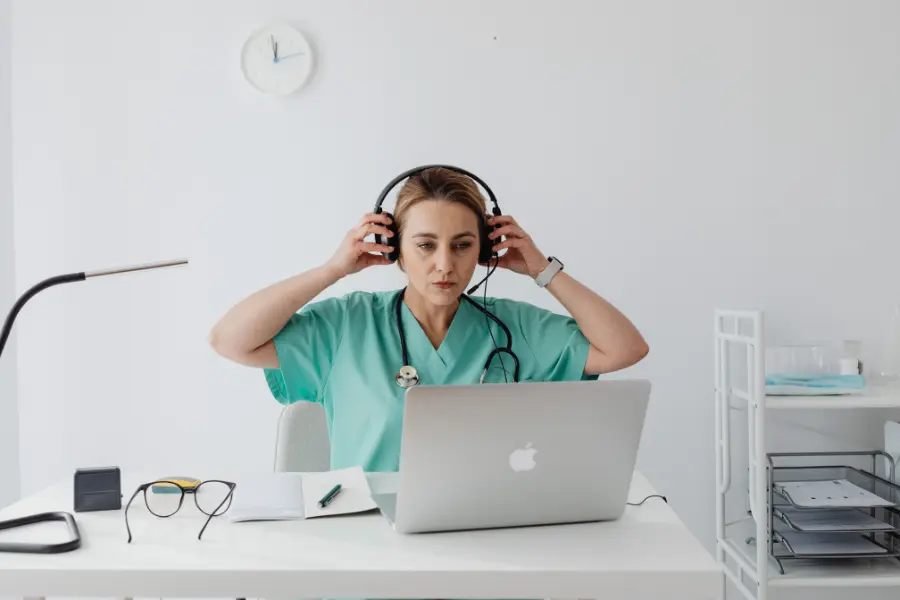
Most coverage of AI in healthcare treats each role in isolation. You'll find plenty of articles asking "Will AI replace pharmacy technicians?" or "Is radiology the most disrupted specialty?" but almost none that compare the speed, depth, and character of AI adoption across these roles side by side. That comparison matters. It reveals which healthcare workers face the most immediate task displacement, which roles are gaining new capabilities, and where the real career risks and opportunities sit in 2026 and beyond.
Why Pharmacy Automation Is Outpacing Most Clinical Roles
Pharmacy may not grab the same AI headlines as radiology or surgical robotics, but in terms of operational automation, the kind that changes what workers do on a daily basis, it's arguably further along than any other healthcare function. The reason is structural: a large share of pharmacy technician tasks are repetitive. Counting pills, managing inventory, processing insurance claims, and packaging prescriptions are all activities that robotic systems and AI software can handle reliably. Roughly 40% of pharmacy technician tasks have high automation potential due to their predictable nature. That's a higher proportion than most patient-facing clinical roles, where human judgment and physical adaptability remain harder to replicate.
The biggest pharmacy chains have moved aggressively into centralized robotic fulfillment. Walgreens now operates 11 micro-fulfillment centers that use robotic technology to fill prescriptions, processing around 16 million prescriptions per month. These facilities currently serve approximately 4,800 stores, with plans to expand to 5,000 before year's end. The company reports roughly $500 million in savings from the investment so far.
CVS takes a different approach, leveraging centralized AI and robotics across its network of more than 9,000 stores. Walmart's automated pharmacy facilities process up to 100,000 prescriptions daily, with plans to support 90% of its stores by 2026. They're industrial-scale operations that have already shifted the daily work of thousands of pharmacy technicians away from manual dispensing and toward system oversight and patient interaction.
Radiology — The Most AI-Saturated Medical Specialty
FDA Clearances Tell the Story
By the end of 2025, the FDA had authorized 1,104 AI-enabled radiology devices, representing 76% of all AI-enabled medical device authorizations since tracking began. The agency cleared 258 AI devices in 2025 alone, the most in its history , and radiology captured three-quarters of them. The AI medical imaging market reflects this momentum, expanding from $7.52 billion in 2025 to a projected $26.16 billion by 2030. Over 70% of U.S. radiology departments have increased their reliance on AI tools as of 2025.
How Technician Roles Are Shifting
For radiology technicians specifically, automation is changing three dimensions of the job:
Automated positioning and scanning — Imaging machines increasingly handle routine positioning with minimal human intervention, reducing the operator's role during straightforward procedures.
AI-driven image preprocessing — Software now enhances and adjusts images automatically, replacing many manual adjustments that technicians previously handled.
Automated metadata extraction and reporting — Tools that extract imaging data and generate preliminary reports have shifted documentation work away from technicians and toward more complex analytical tasks.
Despite these shifts, the BLS projects radiology employment will grow 5% from 2024 to 2034, faster than the 3% average across all occupations. The field is demanding new competencies. Proficiency with AI systems, data interpretation, and interdisciplinary knowledge in informatics are becoming baseline expectations for new graduates. Many radiology departments now hold daily "AI QA" meetings in which teams review cases in which AI flagged discrepancies with human reads. The radiologist's role is evolving from reading every image to overseeing AI diagnostics and focusing attention on the cases that genuinely need expert human judgment.
Medical Coding: Where AI Handles the Repetitive, Humans Handle the Complex
The 40% Automation Threshold
Industry estimates suggest that 40% of medical coding is projected to be automated as of 2025. That figure covers the straightforward claims: routine office visits, standard diagnostic codes, and predictable procedure classifications where AI can match or exceed human accuracy. The remaining 60% is where things get complicated. Complex multi-procedure cases and appeals for denied claims all require the contextual judgment that current AI systems lack. A machine can reliably code a straightforward diabetes follow-up visit. It struggles with a patient who presented for one condition, was discovered to have another during the visit, underwent an unplanned procedure, and has insurance that requires specific modifier combinations.
From Coder to Auditor
The practical effect is a role transformation rather than elimination. Medical coders are increasingly moving into auditing and oversight positions. Coders with automation oversight training command 14% to 18% higher salaries than those without AI-related skills, according to the American Medical Billing Association. Meanwhile, the BLS projects 9% growth in medical coding careers, and nearly 25% of current hospital coders are approaching retirement age.
Platforms like Sully.ai illustrate how this hybrid model works in practice. The AI Medical Coder operates as a single module within a broader suite of healthcare AI agents, handling routine coding tasks, routing complex cases to human reviewers, and integrating directly with EHR systems like Epic. The platform's approach, where every AI-generated output remains a draft until a human approves it, reflects the consensus model emerging across the industry: AI handles volume, humans handle judgment.
Nursing: AI as a Safety Net, Not a Substitute
Nursing occupies the opposite end of the automation spectrum from pharmacy dispensing. The core of nursing work resists automation in ways that inventory management and pill counting do not. That doesn't mean AI isn't making significant inroads. It is. But the nature of AI's impact on nursing is fundamentally different: it's additive rather than substitutive.
Triage Accuracy Gains
One of the most measurable AI impacts in nursing is emergency department triage. A study of 166,175 ED patient encounters found that the AI triage model KATE™ achieved 75.7% accuracy in predicting ESI acuity assignments, compared with 59.8% for triage nurses, a 26.9% improvement.
Other AI triage systems have demonstrated even stronger results. TextRNN achieved an 86.23% success rate in predicting severity levels across 161,198 ED visits, and the accuracy range across published AI triage models spans 80.5% to 99.1%.
Implementation of AI-informed triage systems has been associated with improved patient flow: low-acuity visits increased 48.2% (meaning more patients were correctly identified as lower severity), while mid-acuity visits decreased 18.7%, and high-acuity visits decreased 8.8%. Machine learning models have helped reduce mistriage rates for critically ill patients from 1.2% to 0.9%.
ICU Monitoring and Predictive Analytics
In intensive care settings, AI applications span continuous patient monitoring, predictive risk modeling, and clinical decision support. Predictive analytics are particularly prominent for forecasting clinical events that can deteriorate rapidly:
Sepsis onset prediction — AI models can flag early warning signs hours before clinical symptoms become apparent, giving nurses and physicians critical lead time.
Pressure injury prevention — Algorithms analyze patient positioning data, mobility patterns, and risk factors to alert nursing staff before injuries develop.
Delirium episodes — Predictive models identify patients at elevated risk, allowing proactive intervention rather than reactive treatment.
Cardiac event forecasting — Continuous monitoring systems flag subtle rhythm changes that human observers might miss during routine checks.
As of 2025, nearly 44% of hospitals in U.S. metro counties reported using AI in their operations, with ambient clinical documentation achieving 100% adoption across surveyed organizations. But the nursing workforce itself isn't shrinking. AI in nursing creates a safety net rather than replacing the hands-on care that defines the profession.

Clinical Lab Work: Automation Solving a Staffing Crisis
Clinical laboratory work presents a unique case in the AI adoption story because automation is arriving as a solution to a workforce that's already critically understaffed. 38% cite staffing shortages as their most significant challenge. For the second consecutive year, automation and AI ranked as the top trends in laboratory medicine, driven primarily by their role in handling increased workloads that existing staff can't cover.
AI in clinical labs is following a familiar pattern: automating routine sample processing, quality-control checks, and result validation while freeing technicians to focus on complex interpretive work such as microscopy, plate interpretation, and antimicrobial susceptibility testing. Digital pathology is gaining momentum, with a majority of diagnostic laboratory leaders investing in AI-powered image analysis for tissue samples.
The transformation is shifting the laboratory professional's role from primarily technical and organizational to more medical and interpretive. Lab workers are increasingly involved in test selection guidance and direct consultation with physicians. These are functions that require the kind of contextual medical knowledge that AI cannot yet replicate in healthcare settings.
What the Cross-Role Comparison Reveals
The five roles fall along a spectrum defined by task repeatability and physical predictability:
Pharmacy technician work sits at the high-automation end, with 40% of tasks highly automatable and major chains already operating at an industrial scale with robotic fulfillment.
Medical coding follows closely, with 40% of coding projected to be automated, though automation is limited by the complexity and ambiguity of non-routine cases.
Radiology leads in AI tool proliferation (1,104 FDA-cleared devices), but the technician's role is shifting rather than shrinking, with 5% job growth projected.
Clinical lab work is rapidly adopting automation, but primarily to address a staffing crisis rather than to reduce headcount.
Nursing sits at the low-automation end. AI enhances safety and decision-making but doesn't replace the physical, emotional, and improvisational core of the work.
Across all five roles, the professionals who will thrive share a common profile. They're not the ones who can do routine tasks fastest. They're the ones who can oversee automated systems and communicate with patients and colleagues in ways that technology doesn't replicate.
Industry forecasts suggest a 40% increase in demand for AI-related skills in healthcare over the next five years. That demand cuts across every role examined here, from pharmacy technicians who need to manage robotic dispensing systems to medical coders who need to audit AI-generated claims to nurses who need to interpret AI-driven risk scores.
The next phase of healthcare AI will create new intersections between roles that have traditionally operated in silos. AI platforms that span multiple functions are already emerging. Sully.ai, for example, offers role-based AI agents that cover clinical documentation, medical coding, triage, scheduling, and consultation within a single integrated system. They connect workflows that previously required separate tools and handoffs.

This convergence matters because the biggest inefficiencies in healthcare aren't within individual roles. They're in the gaps between them: the miscommunication between pharmacy and nursing, the delays between lab results and clinical decisions, the coding errors that stem from incomplete documentation. AI's most transformative impact may ultimately be in bridging those gaps rather than optimizing any single role in isolation.
For healthcare workers across these fields, the strategic response is the same. The question is whether you're building the skills to work alongside it effectively. That means developing technical literacy with AI tools, strengthening the judgment and interpersonal capabilities that machines can't replicate, and understanding how your role connects to the broader system that AI is increasingly tying together. The workers who treat AI as a collaborator rather than a competitor will find themselves doing more meaningful, better-compensated work than the repetitive tasks that automation is taking over.
Sources:
Walgreens Doubles Down on Robots to Fill Prescriptions Amid Turnaround — CNBC
AI, Automation, and the Future of Radiology Technician Degree Careers — Research.com
Experts See 17 Laboratory Trends Dominating 2025 — Clinical Lab Products
Clinical Impact of Artificial Intelligence-Based Triage Systems — PMC/National Library of Medicine
FDA AI Approvals Surge Past 1k for Radiology — The Imaging Wire
Should Lab Staff Be Concerned About Automation? — Today's Clinical Lab
It's Time to Get Real About AI in Pharmacy Operations — Pharmacy Times
TABLE OF CONTENTS
Hire your
Medical AI Team
Take a look at our Medical AI Team
AI Receptionist
Manages patient scheduling, communications, and front-desk operations across all channels.
AI Scribe
Documents clinical encounters and maintains accurate EHR/EMR records in real-time.
AI Medical Coder
Assigns and validates medical codes to ensure accurate billing and regulatory compliance.
AI Nurse
Assesses patient urgency and coordinates appropriate care pathways based on clinical needs.