"/><stop offset="1" stop-color="rgba(255, 255, 255, 0)"/></linearGradient><linearGradient id="WxV_IOPE7-2309410982-linear-gradient" x1="1" x2="0" y1="0.5951279047551217" y2="0.4048720952448783"><stop offset="0" stop-color="rgb(255, 255, 255)"/><stop offset="1" stop-color="rgba(255, 255, 255, 0)"/></linearGradient><linearGradient id="WwbAIQIz8-2309410982-linear-gradient" x1="0.43478742751482424" x2="0.6358595260107829" y1="0.26" y2="1"><stop offset="0" stop-color="rgb(255, 255, 255)"/><stop offset="1" stop-color="rgba(255, 255, 255, 0)"/></linearGradient><linearGradient id="ZWsVQcPfn-2309410982-linear-gradient" x1="0.9508213454678907" x2="0.04917865453210929" y1="0" y2="1"><stop offset="0" stop-color="rgb(255, 255, 255)"/><stop offset="1" stop-color="rgba(255, 255, 255, 0)"/></linearGradient><linearGradient id="lTyCGrzzP-2309410982-linear-gradient" x1="0.374937164194436" x2="0.625062835805564" y1="0" y2="1"><stop offset="0" stop-color="rgb(255, 255, 255)"/><stop offset="1" stop-color="rgba(255, 255, 255, 0)"/></linearGradient></defs><g d="M 658.002 1357.705 C 1020.321 1357.705 1314.04 1063.989 1314.04 701.667 C 1314.04 339.347 1020.321 45.626 658.002 45.626 C 295.681 45.626 1.96 339.347 1.96 701.667 L 0 701.667 C 0 338.263 294.598 43.665 658.002 43.665 C 1021.404 43.665 1316 338.263 1316 701.667 C 1316 1065.072 1021.404 1359.672 658.002 1359.672 C 294.598 1359.672 0 1065.072 0 701.667 L 1.96 701.667 C 1.96 1063.989 295.681 1357.705 658.002 1357.705 Z M 658.005 1265.053 C 969.154 1265.053 1221.392 1012.819 1221.392 701.667 C 1221.392 390.517 969.154 138.281 658.005 138.281 C 346.856 138.281 94.619 390.517 94.619 701.667 L 92.659 701.667 C 92.659 389.433 345.77 136.321 658.005 136.321 C 970.241 136.321 1223.352 389.433 1223.352 701.667 C 1223.352 1013.902 970.241 1267.017 658.005 1267.017 C 345.77 1267.017 92.659 1013.902 92.659 701.667 L 94.619 701.667 C 94.619 1012.819 346.856 1265.053 658.005 1265.053 Z M 658.002 1166.116 C 914.513 1166.116 1122.452 958.178 1122.452 701.667 C 1122.452 445.16 914.513 237.22 658.002 237.22 C 401.494 237.22 193.551 445.16 193.551 701.667 L 191.59 701.667 C 191.59 444.077 400.411 235.255 658.002 235.255 C 915.596 235.255 1124.412 444.077 1124.412 701.667 C 1124.412 959.261 915.596 1168.084 658.002 1168.084 C 400.411 1168.084 191.59 959.261 191.59 701.667 L 193.551 701.667 C 193.551 958.178 401.494 1166.116 658.002 1166.116 Z M 281.657 818.28 C 298.572 818.28 314.804 825.001 326.765 836.965 L 458.99 969.182 C 470.582 980.781 486.308 987.298 502.706 987.298 L 612.137 987.298 C 646.284 987.298 673.972 959.61 673.972 925.463 L 673.972 891.504 L 675.939 891.504 L 675.939 925.463 C 675.939 960.7 647.374 989.258 612.137 989.258 L 502.706 989.258 C 485.788 989.258 469.562 982.537 457.599 970.573 L 325.378 838.356 C 313.785 826.757 298.056 820.242 281.657 820.244 L 1.173 820.244 L 1.173 818.28 Z M 746.64 888.714 L 1053.046 888.714 C 1069.967 888.714 1086.194 895.435 1098.16 907.398 L 1259.381 1068.619 L 1257.99 1070.007 L 1096.772 908.79 C 1085.175 897.193 1069.446 890.679 1053.046 890.681 L 746.64 890.681 C 729.724 890.681 713.493 883.957 701.533 871.993 L 685.377 855.845 L 686.769 854.453 L 702.917 870.605 C 714.513 882.201 730.241 888.715 746.64 888.714 Z M 667.685 552 L 512.316 396.894 C 494.66 379.264 484.741 355.356 484.739 330.426 L 484.739 0 L 487.632 0 L 487.632 330.426 C 487.632 354.592 497.248 377.763 514.369 394.851 L 669.739 549.957 Z M 782.851 700.491 C 816.998 700.491 844.686 672.804 844.686 638.655 L 844.686 516.468 C 844.687 499.547 851.409 483.32 863.374 471.355 L 1177.508 157.22 L 1178.896 158.607 L 864.762 472.742 C 853.162 484.337 846.646 500.067 846.646 516.468 L 846.646 638.655 C 846.646 673.89 818.088 702.455 782.851 702.455 L 700.405 702.455 L 700.405 700.491 Z M 130.338 534.223 L 213.07 534.223 C 256.112 534.223 291.003 569.114 291.003 612.156 L 291.003 694.888 C 291.003 711.29 297.514 727.017 309.113 738.611 L 472.887 902.378 L 471.496 903.769 L 307.726 739.995 C 295.761 728.033 289.038 711.807 289.038 694.888 L 289.038 612.156 C 289.038 570.198 255.028 536.188 213.07 536.188 L 130.338 536.188 C 113.419 536.187 97.193 529.465 85.23 517.5 L 77.071 509.345 C 65.107 497.381 58.386 481.153 58.388 464.233 L 58.388 199.526 L 60.348 199.526 L 60.348 464.233 C 60.349 480.631 66.863 496.358 78.458 507.954 L 86.617 516.113 C 98.213 527.709 113.94 534.223 130.338 534.223 Z" fill="transparent" height="1359.6717183844698px" id="DcyumyANr" transform="translate(0 -43.665)" width="1316px"><g opacity="0.5"><path d="M 658.002 1314.039 C 1020.321 1314.039 1314.04 1020.324 1314.04 658.001 C 1314.04 295.681 1020.321 1.961 658.002 1.961 C 295.681 1.961 1.96 295.682 1.96 658.001 L 0 658.001 C 0 294.598 294.598 0 658.002 0 C 1021.404 0 1316 294.598 1316 658.001 C 1316 1021.407 1021.404 1316.007 658.002 1316.007 C 294.598 1316.007 0 1021.407 0 658.001 L 1.96 658.001 C 1.96 1020.324 295.681 1314.039 658.002 1314.039 Z" fill="rgb(255, 255, 255)" height="1316.0065114752902px" id="dxf13D52Y" transform="translate(0 43.665)" width="1316px"/></g><g opacity="0.3"><path d="M 565.347 1128.732 C 876.496 1128.732 1128.733 876.498 1128.733 565.346 C 1128.733 254.196 876.496 1.961 565.347 1.961 C 254.197 1.961 1.961 254.196 1.961 565.346 L 0 565.346 C 0 253.112 253.111 0 565.347 0 C 877.582 0 1130.693 253.112 1130.693 565.346 C 1130.693 877.581 877.582 1130.696 565.347 1130.696 C 253.111 1130.696 0 877.581 0 565.346 L 1.961 565.346 C 1.961 876.498 254.197 1128.732 565.347 1128.732 Z" fill="rgb(255, 255, 255)" height="1130.6960934794101px" id="if1BmYw1S" transform="translate(92.659 136.321)" width="1130.693351805604px"/></g><g opacity="0.15"><path d="M 466.412 930.861 C 722.923 930.861 930.862 722.922 930.862 466.411 C 930.862 209.905 722.923 1.965 466.412 1.965 C 209.904 1.965 1.961 209.905 1.961 466.411 L 0 466.411 C 0 208.822 208.821 0 466.412 0 C 724.006 0 932.822 208.822 932.822 466.411 C 932.822 724.005 724.006 932.828 466.412 932.828 C 208.821 932.828 0 724.005 0 466.411 L 1.961 466.411 C 1.961 722.922 209.904 930.861 466.412 930.861 Z" fill="rgb(255, 255, 255)" height="932.8284667407987px" id="ef75NsYf6" transform="translate(191.59 235.255)" width="932.8219552655086px"/></g><g opacity="0.5"><path d="M 280.484 0 C 297.399 0 313.63 6.721 325.592 18.685 L 457.817 150.902 C 469.408 162.501 485.135 169.018 501.533 169.017 L 610.964 169.017 C 645.111 169.017 672.799 141.33 672.799 107.182 L 672.799 73.223 L 674.766 73.223 L 674.766 107.182 C 674.766 142.42 646.201 170.978 610.964 170.978 L 501.533 170.978 C 484.614 170.978 468.389 164.257 456.426 152.293 L 324.205 20.076 C 312.611 8.477 296.883 1.961 280.484 1.964 L 0 1.964 L 0 0 Z" fill="url(%23cQ4xRdUtr-2309410982-linear-gradient)" height="170.97763275969464px" id="cQ4xRdUtr" transform="translate(1.173 818.28)" width="674.7656780356198px"/></g><g opacity="0.5"><path d="M 61.263 34.261 L 367.669 34.261 C 384.589 34.261 400.817 40.982 412.783 52.945 L 574.004 214.166 L 572.612 215.554 L 411.395 54.337 C 399.798 42.74 384.069 36.226 367.669 36.228 L 61.263 36.228 C 44.347 36.228 28.116 29.504 16.155 17.54 L 0 1.391 L 1.391 0 L 17.54 16.152 C 29.136 27.747 44.864 34.261 61.263 34.261 Z" fill="url(%23WxV_IOPE7-2309410982-linear-gradient)" height="215.55382175474415px" id="WxV_IOPE7" transform="translate(685.377 854.453)" width="574.0036823012563px"/></g><g opacity="0.5"><path d="M 182.946 552 L 27.577 396.894 C 9.921 379.264 0.002 355.356 0 330.426 L 0 0 L 2.893 0 L 2.893 330.426 C 2.893 354.592 12.509 377.763 29.63 394.851 L 185 549.957 Z" fill="url(%23WwbAIQIz8-2309410982-linear-gradient)" height="552px" id="WwbAIQIz8" transform="translate(484.739 0)" width="185px"/></g><g opacity="0.5"><path d="M 82.446 543.271 C 116.593 543.271 144.281 515.583 144.281 481.435 L 144.281 359.248 C 144.282 342.327 151.004 326.1 162.969 314.135 L 477.103 0 L 478.491 1.387 L 164.356 315.522 C 152.757 327.117 146.241 342.846 146.241 359.248 L 146.241 481.435 C 146.241 516.67 117.683 545.235 82.446 545.235 L 0 545.235 L 0 543.271 Z" fill="url(%23ZWsVQcPfn-2309410982-linear-gradient)" height="545.2346136318063px" id="ZWsVQcPfn" transform="translate(700.405 157.22)" width="478.4906210693257px"/></g><g opacity="0.5"><path d="M 71.95 334.696 L 154.682 334.696 C 197.724 334.696 232.616 369.588 232.616 412.63 L 232.616 495.362 C 232.616 511.764 239.126 527.491 250.725 539.084 L 414.5 702.851 L 413.108 704.243 L 249.338 540.469 C 237.373 528.507 230.651 512.281 230.651 495.362 L 230.651 412.63 C 230.651 370.672 196.64 336.661 154.682 336.661 L 71.95 336.661 C 55.031 336.661 38.805 329.939 26.843 317.974 L 18.683 309.819 C 6.719 297.854 -0.001 281.627 0 264.707 L 0 0 L 1.961 0 L 1.961 264.707 C 1.961 281.105 8.475 296.832 20.07 308.428 L 28.229 316.587 C 39.825 328.182 55.552 334.697 71.95 334.696 Z" fill="url(%23lTyCGrzzP-2309410982-linear-gradient)" height="704.2427839655832px" id="lTyCGrzzP" transform="translate(58.388 199.526)" width="414.49961191971533px"/></g></g></svg>)
Ambient AI has one premise. A clinician and a patient talk, and the tool turns the talking into a note.
Now think about a colonoscopy. The patient is sedated. There is no conversation to capture, and the note still has to get written.
That is not a small edge case in gastroenterology. It is the procedure that defines the specialty.
Key Takeaway: An AI scribe for gastroenterology runs into a problem no other specialty has: for the procedure that defines the specialty, there is no conversation to capture. The patient is sedated. A colonoscopy note is built from what the endoscopist observed, the images, the clock times, and the specimens, none of which is dialogue. That note then has three readers with different requirements. The payer needs to know whether the exam began as a screening, because when a screening becomes therapeutic the claim needs modifier PT for Medicare and modifier 33 for commercial and Medicaid plans, and getting that wrong is what produces surprise patient bills [1]. The next endoscopist needs the surveillance interval. The quality registry computes adenoma detection rate, cecal intubation rate, withdrawal time and resection documentation straight from the note, against 2024 ASGE and ACG targets of 35 percent, 95 percent, 8 minutes and 98 percent [2]. Sully.ai's AI Scribe writes into the EHR and the AI Coder carries the note through to the coded claim.
In Gastroenterology the Note Has No Conversation in It
Every other specialty in this series has a dialogue problem of some kind. Psychiatry needs the mental status exam preserved. Pediatrics needs data that was never spoken. Obstetrics needs a record that stays open for months.
Gastroenterology has something more basic. For the central procedure, there is nothing to listen to.
The Patient Is Asleep for the Part That Matters
A colonoscopy or an upper endoscopy happens under sedation. Whatever conversation exists happens before, during consent, and after, during instructions.
The procedure record itself is not speech. It is what the endoscopist saw, the photographs taken, the times on the clock, and the labels on the specimen jars.
What the Note Is Actually Made Of
Indication. Bowel preparation quality. Extent of examination and the landmarks that prove it. Insertion and withdrawal times. Lesion-level findings with sizes in millimetres. Specimens. Complications. A surveillance interval.
Almost none of that is something anybody said out loud.
Why Ambient AI Has the Least to Work With in Gastroenterology
Three consequences follow, and all three are worth testing before you buy anything.
There Is No Dialogue to Summarize
A tool can transcribe the consent conversation flawlessly and still have produced nothing that belongs in the procedure note.
That is not a criticism of the technology. It is a statement about where the information lives. Vendors selling into GI tend to talk about handling complex terminology, which is real, and which does not address this at all.
The Numbers Are Times and Measurements, Not Speech
Withdrawal time. Cecal intubation confirmed by landmark and photograph. A polyp measured at 6 millimetres. A Boston Bowel Prep Score by segment.
These come from the scope, the clock, and the endoscopist's eye. A microphone is not the input.
One Note, Three Readers, Three Different Requirements
Here is the part that actually decides whether a GI note is any good.
The payer needs the indication and, if you removed something, the right conversion modifier. The next endoscopist needs enough lesion detail to plan the follow-up, plus the interval you recommended. The quality registry computes your numbers from fields most notes treat as optional.
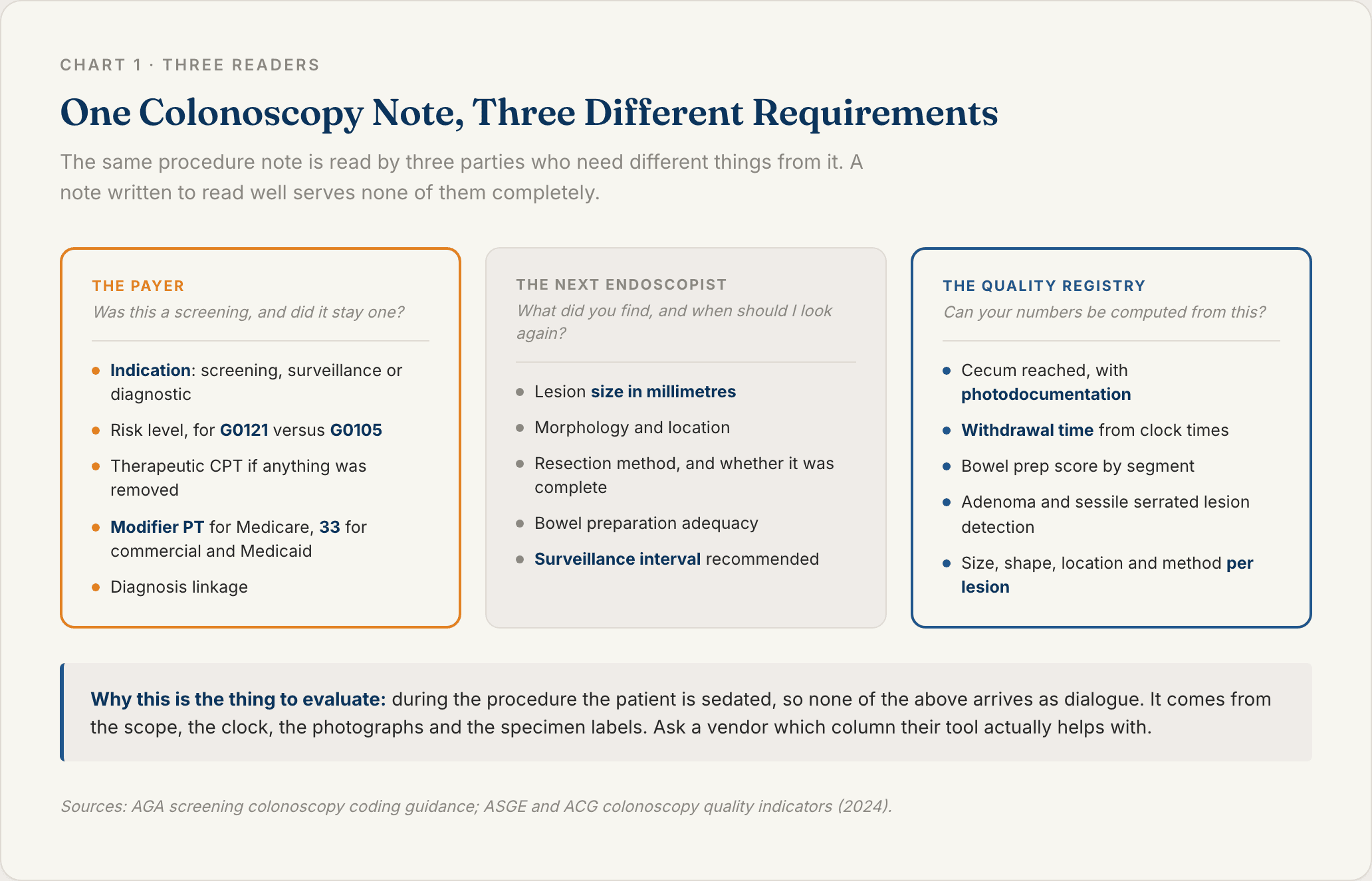
A note optimised to read well serves none of the three completely. That is the thing to judge a tool on.
The Coding Rule That Creates Surprise Patient Bills
If you take one operational thing from this article, take this one.
Screening, Surveillance and Diagnostic Are Three Different Claims
For Medicare, G0121 is average-risk screening at a 10-year interval and G0105 is high-risk screening at 24 months [1].
High risk has a specific definition: a sibling, parent or child with colorectal cancer or an adenomatous polyp, familial adenomatous polyposis, Lynch syndrome, a personal history of adenomatous polyps or colorectal cancer, or inflammatory bowel disease [1].
If the indication is not documented plainly, the coder has to infer it, and the patient discovers the inference on a bill.
When a Screening Becomes Therapeutic the Modifier Depends on the Payer
A screening colonoscopy where you remove something is no longer only a screening. The claim needs the therapeutic code: 45380 for biopsy, 45384 for hot biopsy forceps, 45385 for snare, 45388 for ablation [1].
It also needs a modifier that preserves the screening origin, so the patient keeps the screening benefit. That modifier is payer-dependent. Modifier PT for Medicare. Modifier 33 for commercial and Medicaid plans [1].
Same clinical event, different modifier depending on who is paying. Use the wrong one and the screening benefit is lost, which is the mechanism behind a large share of angry post-colonoscopy phone calls.
What the Patient Actually Owes
Under the Consolidated Appropriations Act, when a polyp is removed during a Medicare screening colonoscopy the beneficiary owes 15 percent from 2023 to 2026, then 10 percent from 2027 to 2029, and nothing from 2030 onward [1].
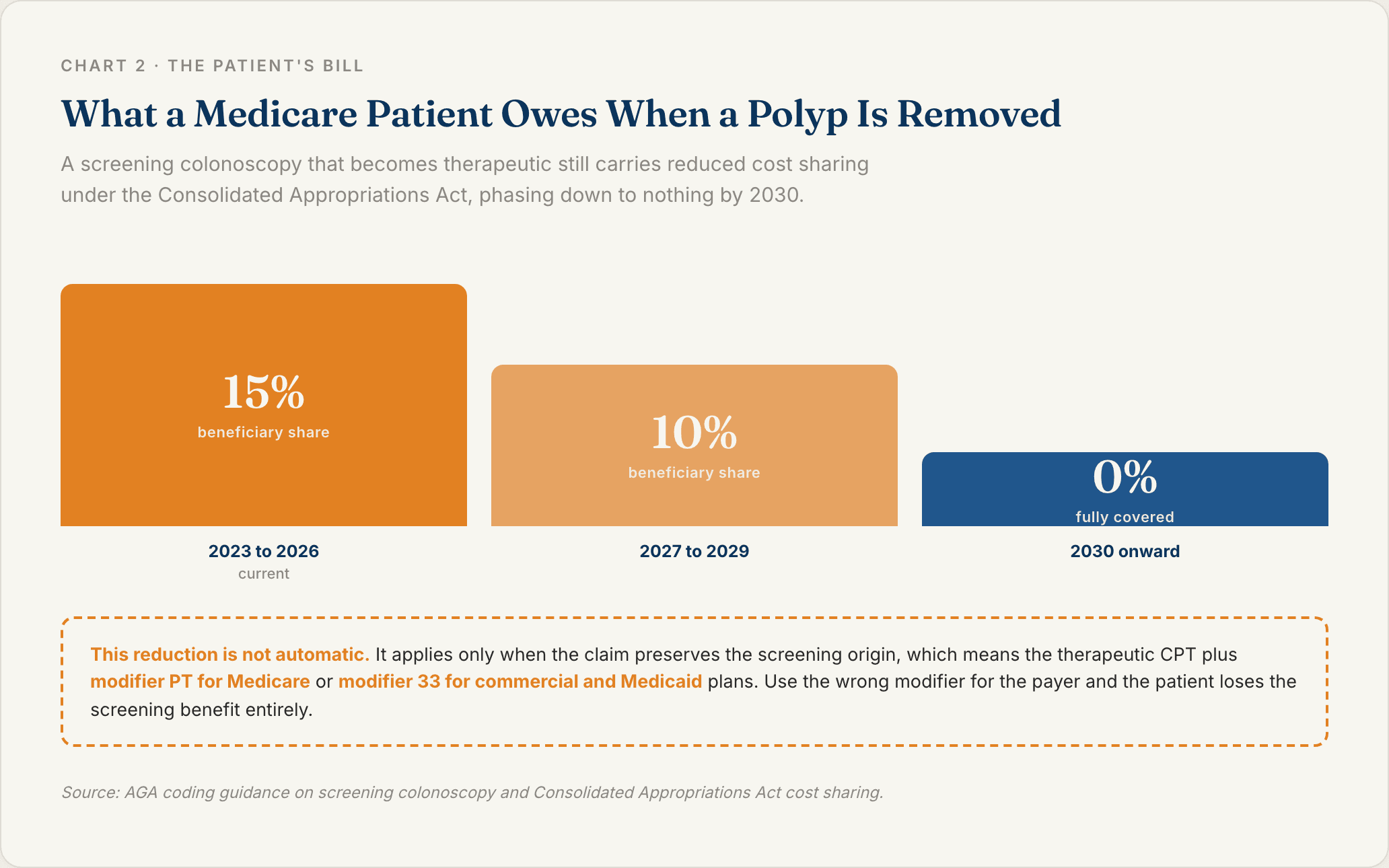
That reduction is not automatic. It depends on the claim carrying the screening origin correctly.
Free Gastroenterology Note Templates
Three templates for the notes where documentation decides the payment and the quality number. Each carries the rules printed on the page.
Colonoscopy procedure note template, two pages, with the indication as the first field and a findings table whose columns are exactly what the quality indicator asks for
Upper endoscopy procedure note template, for EGD, with extent, landmarks and the biopsy protocol as explicit fields rather than assumptions
GI consultation note template, for the new referral, with alarm features recorded as present or absent and an E/M path the note can support
Your Quality Numbers Are Documentation Numbers
This is the second thing worth knowing, and it changed recently enough that a lot of habits are out of date.
The 2024 Update Moved Withdrawal Time From Six Minutes to Eight
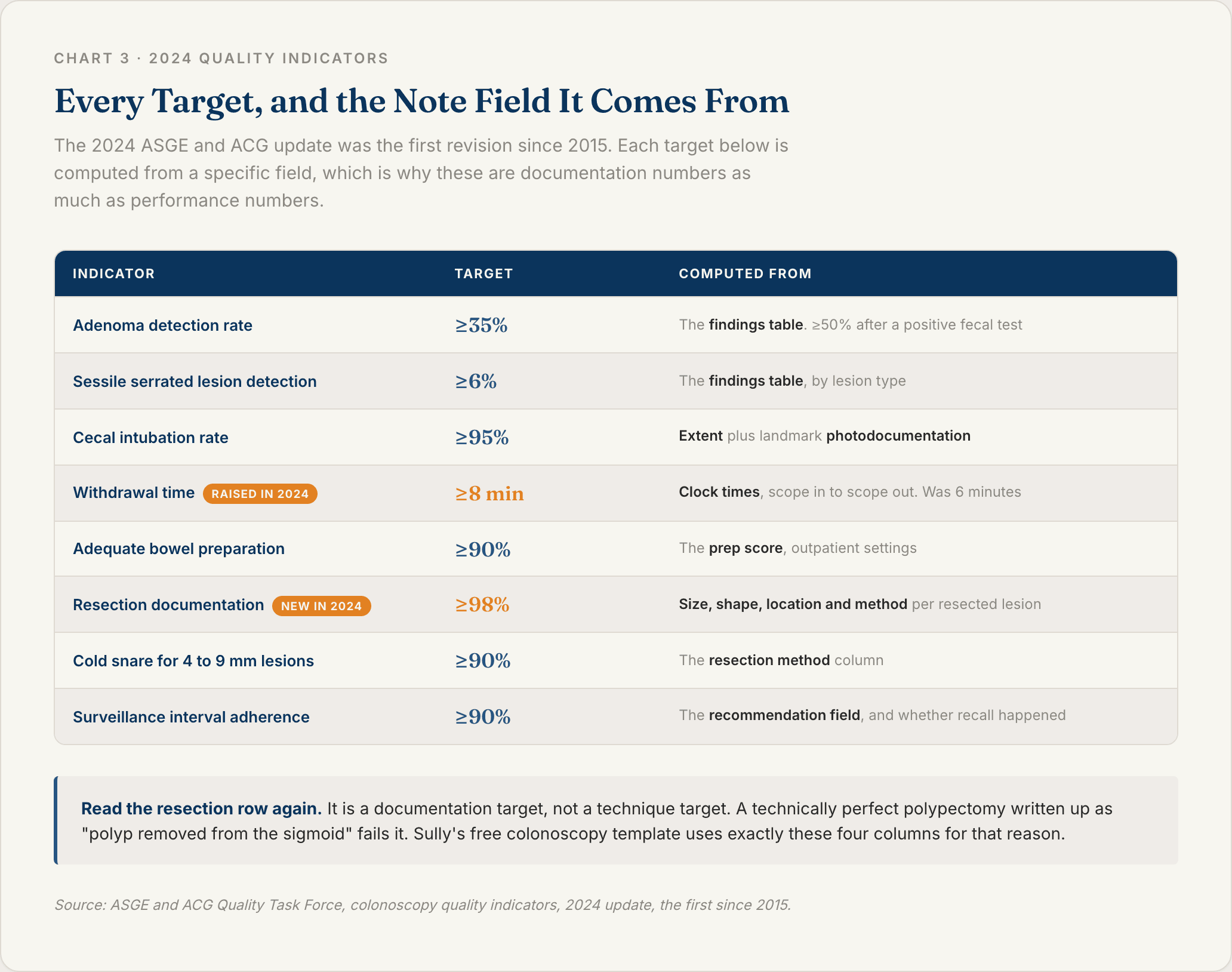
The ASGE and ACG quality task force updated the colonoscopy quality indicators in 2024, the first revision since 2015 [2].
The minimum average withdrawal time in normal colonoscopies for patients 45 and older is now 8 minutes, up from six. Forty-five is the age screening now starts [4]. Evidence suggests around nine minutes optimises detection of both adenomas and serrated lesions [2][3].
If your unit is still auditing against six, it is auditing against the previous standard.
The Priority Indicators and Their Targets
Adenoma detection rate ≥35 percent for screening, surveillance and diagnostic exams combined in patients 45 and older, and ≥50 percent after a positive fecal test. Sessile serrated lesion detection ≥6 percent. Cecal intubation ≥95 percent. Adequate bowel preparation ≥90 percent in outpatient settings [2].
Resection Documentation Is Itself an Indicator
This is the one that makes the argument. Among the new indicators: lesion size, shape, location and resection method documented for ≥98 percent of resected lesions, and cold snare used for ≥90 percent of 4 to 9 millimetre lesions [2].
Read that first one again. It is a documentation target, not a technique target. A technically perfect polypectomy described as "polyp removed from the sigmoid" fails it.
Why This Makes the Note the Measurement
A 1 percent increase in adenoma detection rate is associated with roughly a 3 percent lower colorectal cancer incidence and a 5 percent lower mortality risk [3].
That is a real clinical effect. And it can only be computed from what the note records, which means in practice your quality numbers measure your documentation at least as much as your endoscopy.
How to Evaluate an AI Scribe for a GI Practice
Four questions, in the order that matters.
Does It Do Anything for the Procedure Note
Ask where the procedure note is going to live. In most endoscopy units it lives in a dedicated endoscopy reporting system rather than the EHR, and a documentation platform that writes into the EHR is not going to change that. The fair question is not whether a vendor solves the procedure note, it is whether they are honest about which part of your documentation they touch.
Can It Capture Times and Measurements, Not Just Speech
Withdrawal time, prep score, lesion size, cecal photodocumentation. Ask where each one comes from in their workflow.
Does It Carry the Indication Through to the Claim
The indication is set at the start and has to survive to the modifier on the claim line. Ask what happens to it in between.
Does It Reach the Claim and the Registry
A note that stops at the chart has not helped the claim and has not helped the quality report either.
Where Sully.ai Fits in a GI Practice
Worth being straight about the limit first, because a GI practice will spot it immediately. No ambient tool listens its way to a colonoscopy findings table, and Sully's does not either. In most units that findings table lives in a dedicated endoscopy reporting system, and it will keep living there.
So here is the honest scope. The clinic side of gastroenterology, the consults, the follow-ups, the IBD and reflux and liver visits, is ordinary ambient territory and a large share of a GI physician's week. The chart and the claim are where a connected platform earns its keep.
Sully's AI Scribe captures documentation during and after the encounter and writes it into the EHR, on a single integration across Epic, Cerner, Meditech, Athenahealth and ambulatory and specialty systems. Clinicians can save how they want a note structured, so a findings table stays a table instead of dissolving into a paragraph.
The AI Coder then extracts the ICD-10 and CPT codes and submits the claim. That is the handoff that matters here, because the indication set at the start of the encounter has to survive all the way to the modifier on the claim line, and a note-only tool stops well short of it.
The AI Receptionist handles recall and outreach. In GI that is not just a care-gap tool: adherence to recommended surveillance intervals is itself one of the 2024 quality indicators [2].
Sully operates across 5,000+ providers, has delivered 50M+ hours of AI work, and prices each AI role 80 to 90 percent below the human equivalent [5].
Book a demo and bring a screening colonoscopy where you removed a 6 millimetre polyp. That single case exercises the indication, the modifier, the resection documentation and the surveillance interval all at once.
FAQ
Q: What should an AI scribe for gastroenterology do that a general scribe does not? It has to be useful for a note with no conversation in it. During a colonoscopy or EGD the patient is sedated, so the procedure record comes from observation, images, clock times and specimens rather than dialogue. It also has to carry the indication through to the claim, because whether the exam was screening, surveillance or diagnostic decides how it bills, and it has to capture the times and measurements the quality indicators are computed from. Sully.ai's AI Scribe writes the note into the EHR and hands it to the AI Coder, which submits the coded claim.
Q: What modifier do you use when a screening colonoscopy becomes therapeutic? It depends on the payer. Report the therapeutic CPT code, 45380 for biopsy, 45384 for hot biopsy forceps, 45385 for snare, or 45388 for ablation, and append modifier PT for Medicare claims or modifier 33 for commercial and Medicaid claims. The modifier preserves the screening origin so the patient keeps the screening benefit. Using the wrong one for the payer is a common cause of surprise patient bills [1].
Q: What does a Medicare patient owe if a polyp is removed during a screening colonoscopy? Under the Consolidated Appropriations Act the beneficiary is responsible for 15 percent of the cost from 2023 to 2026, 10 percent from 2027 to 2029, and nothing from 2030 onward [1].
Q: What are the current colonoscopy quality indicator targets? The 2024 ASGE and ACG update, the first since 2015, sets adenoma detection rate at ≥35 percent for screening, surveillance and diagnostic exams combined in patients 45 and older and ≥50 percent after a positive fecal test, sessile serrated lesion detection at ≥6 percent, cecal intubation at ≥95 percent, withdrawal time at ≥8 minutes, adequate bowel preparation at ≥90 percent in outpatient settings, and documentation of lesion size, shape, location and resection method for ≥98 percent of resected lesions [2].
Q: Do you have free gastroenterology note templates? Yes. Sully publishes three: a two-page colonoscopy procedure note, an upper endoscopy note, and a GI consultation note. The colonoscopy findings table uses the four fields the quality indicator asks for, and the coding block carries the modifier PT versus modifier 33 rule.
Sources
[1] American Gastroenterological Association — Coding FAQ: Screening Colonoscopy [2] ASGE and ACG Quality Task Force — Quality Indicators for Colonoscopy, 2024 Update [3] Gastroenterology Report — Key Quality Indicators in Colonoscopy [4] US Preventive Services Task Force — Colorectal Cancer: Screening [5] Sully.ai — The AI Workforce for Healthcare
TABLE OF CONTENTS
Hire your
Medical AI Team
Take a look at our Medical AI Team
AI Receptionist
Manages patient scheduling, communications, and front-desk operations across all channels.
AI Scribe
Documents clinical encounters and maintains accurate EHR/EMR records in real-time.
AI Medical Coder
Assigns and validates medical codes to ensure accurate billing and regulatory compliance.
AI Nurse
Assesses patient urgency and coordinates appropriate care pathways based on clinical needs.