"/><stop offset="1" stop-color="rgba(255, 255, 255, 0)"/></linearGradient><linearGradient id="WxV_IOPE7-2309410982-linear-gradient" x1="1" x2="0" y1="0.5951279047551217" y2="0.4048720952448783"><stop offset="0" stop-color="rgb(255, 255, 255)"/><stop offset="1" stop-color="rgba(255, 255, 255, 0)"/></linearGradient><linearGradient id="WwbAIQIz8-2309410982-linear-gradient" x1="0.43478742751482424" x2="0.6358595260107829" y1="0.26" y2="1"><stop offset="0" stop-color="rgb(255, 255, 255)"/><stop offset="1" stop-color="rgba(255, 255, 255, 0)"/></linearGradient><linearGradient id="ZWsVQcPfn-2309410982-linear-gradient" x1="0.9508213454678907" x2="0.04917865453210929" y1="0" y2="1"><stop offset="0" stop-color="rgb(255, 255, 255)"/><stop offset="1" stop-color="rgba(255, 255, 255, 0)"/></linearGradient><linearGradient id="lTyCGrzzP-2309410982-linear-gradient" x1="0.374937164194436" x2="0.625062835805564" y1="0" y2="1"><stop offset="0" stop-color="rgb(255, 255, 255)"/><stop offset="1" stop-color="rgba(255, 255, 255, 0)"/></linearGradient></defs><g d="M 658.002 1357.705 C 1020.321 1357.705 1314.04 1063.989 1314.04 701.667 C 1314.04 339.347 1020.321 45.626 658.002 45.626 C 295.681 45.626 1.96 339.347 1.96 701.667 L 0 701.667 C 0 338.263 294.598 43.665 658.002 43.665 C 1021.404 43.665 1316 338.263 1316 701.667 C 1316 1065.072 1021.404 1359.672 658.002 1359.672 C 294.598 1359.672 0 1065.072 0 701.667 L 1.96 701.667 C 1.96 1063.989 295.681 1357.705 658.002 1357.705 Z M 658.005 1265.053 C 969.154 1265.053 1221.392 1012.819 1221.392 701.667 C 1221.392 390.517 969.154 138.281 658.005 138.281 C 346.856 138.281 94.619 390.517 94.619 701.667 L 92.659 701.667 C 92.659 389.433 345.77 136.321 658.005 136.321 C 970.241 136.321 1223.352 389.433 1223.352 701.667 C 1223.352 1013.902 970.241 1267.017 658.005 1267.017 C 345.77 1267.017 92.659 1013.902 92.659 701.667 L 94.619 701.667 C 94.619 1012.819 346.856 1265.053 658.005 1265.053 Z M 658.002 1166.116 C 914.513 1166.116 1122.452 958.178 1122.452 701.667 C 1122.452 445.16 914.513 237.22 658.002 237.22 C 401.494 237.22 193.551 445.16 193.551 701.667 L 191.59 701.667 C 191.59 444.077 400.411 235.255 658.002 235.255 C 915.596 235.255 1124.412 444.077 1124.412 701.667 C 1124.412 959.261 915.596 1168.084 658.002 1168.084 C 400.411 1168.084 191.59 959.261 191.59 701.667 L 193.551 701.667 C 193.551 958.178 401.494 1166.116 658.002 1166.116 Z M 281.657 818.28 C 298.572 818.28 314.804 825.001 326.765 836.965 L 458.99 969.182 C 470.582 980.781 486.308 987.298 502.706 987.298 L 612.137 987.298 C 646.284 987.298 673.972 959.61 673.972 925.463 L 673.972 891.504 L 675.939 891.504 L 675.939 925.463 C 675.939 960.7 647.374 989.258 612.137 989.258 L 502.706 989.258 C 485.788 989.258 469.562 982.537 457.599 970.573 L 325.378 838.356 C 313.785 826.757 298.056 820.242 281.657 820.244 L 1.173 820.244 L 1.173 818.28 Z M 746.64 888.714 L 1053.046 888.714 C 1069.967 888.714 1086.194 895.435 1098.16 907.398 L 1259.381 1068.619 L 1257.99 1070.007 L 1096.772 908.79 C 1085.175 897.193 1069.446 890.679 1053.046 890.681 L 746.64 890.681 C 729.724 890.681 713.493 883.957 701.533 871.993 L 685.377 855.845 L 686.769 854.453 L 702.917 870.605 C 714.513 882.201 730.241 888.715 746.64 888.714 Z M 667.685 552 L 512.316 396.894 C 494.66 379.264 484.741 355.356 484.739 330.426 L 484.739 0 L 487.632 0 L 487.632 330.426 C 487.632 354.592 497.248 377.763 514.369 394.851 L 669.739 549.957 Z M 782.851 700.491 C 816.998 700.491 844.686 672.804 844.686 638.655 L 844.686 516.468 C 844.687 499.547 851.409 483.32 863.374 471.355 L 1177.508 157.22 L 1178.896 158.607 L 864.762 472.742 C 853.162 484.337 846.646 500.067 846.646 516.468 L 846.646 638.655 C 846.646 673.89 818.088 702.455 782.851 702.455 L 700.405 702.455 L 700.405 700.491 Z M 130.338 534.223 L 213.07 534.223 C 256.112 534.223 291.003 569.114 291.003 612.156 L 291.003 694.888 C 291.003 711.29 297.514 727.017 309.113 738.611 L 472.887 902.378 L 471.496 903.769 L 307.726 739.995 C 295.761 728.033 289.038 711.807 289.038 694.888 L 289.038 612.156 C 289.038 570.198 255.028 536.188 213.07 536.188 L 130.338 536.188 C 113.419 536.187 97.193 529.465 85.23 517.5 L 77.071 509.345 C 65.107 497.381 58.386 481.153 58.388 464.233 L 58.388 199.526 L 60.348 199.526 L 60.348 464.233 C 60.349 480.631 66.863 496.358 78.458 507.954 L 86.617 516.113 C 98.213 527.709 113.94 534.223 130.338 534.223 Z" fill="transparent" height="1359.6717183844698px" id="DcyumyANr" transform="translate(0 -43.665)" width="1316px"><g opacity="0.5"><path d="M 658.002 1314.039 C 1020.321 1314.039 1314.04 1020.324 1314.04 658.001 C 1314.04 295.681 1020.321 1.961 658.002 1.961 C 295.681 1.961 1.96 295.682 1.96 658.001 L 0 658.001 C 0 294.598 294.598 0 658.002 0 C 1021.404 0 1316 294.598 1316 658.001 C 1316 1021.407 1021.404 1316.007 658.002 1316.007 C 294.598 1316.007 0 1021.407 0 658.001 L 1.96 658.001 C 1.96 1020.324 295.681 1314.039 658.002 1314.039 Z" fill="rgb(255, 255, 255)" height="1316.0065114752902px" id="dxf13D52Y" transform="translate(0 43.665)" width="1316px"/></g><g opacity="0.3"><path d="M 565.347 1128.732 C 876.496 1128.732 1128.733 876.498 1128.733 565.346 C 1128.733 254.196 876.496 1.961 565.347 1.961 C 254.197 1.961 1.961 254.196 1.961 565.346 L 0 565.346 C 0 253.112 253.111 0 565.347 0 C 877.582 0 1130.693 253.112 1130.693 565.346 C 1130.693 877.581 877.582 1130.696 565.347 1130.696 C 253.111 1130.696 0 877.581 0 565.346 L 1.961 565.346 C 1.961 876.498 254.197 1128.732 565.347 1128.732 Z" fill="rgb(255, 255, 255)" height="1130.6960934794101px" id="if1BmYw1S" transform="translate(92.659 136.321)" width="1130.693351805604px"/></g><g opacity="0.15"><path d="M 466.412 930.861 C 722.923 930.861 930.862 722.922 930.862 466.411 C 930.862 209.905 722.923 1.965 466.412 1.965 C 209.904 1.965 1.961 209.905 1.961 466.411 L 0 466.411 C 0 208.822 208.821 0 466.412 0 C 724.006 0 932.822 208.822 932.822 466.411 C 932.822 724.005 724.006 932.828 466.412 932.828 C 208.821 932.828 0 724.005 0 466.411 L 1.961 466.411 C 1.961 722.922 209.904 930.861 466.412 930.861 Z" fill="rgb(255, 255, 255)" height="932.8284667407987px" id="ef75NsYf6" transform="translate(191.59 235.255)" width="932.8219552655086px"/></g><g opacity="0.5"><path d="M 280.484 0 C 297.399 0 313.63 6.721 325.592 18.685 L 457.817 150.902 C 469.408 162.501 485.135 169.018 501.533 169.017 L 610.964 169.017 C 645.111 169.017 672.799 141.33 672.799 107.182 L 672.799 73.223 L 674.766 73.223 L 674.766 107.182 C 674.766 142.42 646.201 170.978 610.964 170.978 L 501.533 170.978 C 484.614 170.978 468.389 164.257 456.426 152.293 L 324.205 20.076 C 312.611 8.477 296.883 1.961 280.484 1.964 L 0 1.964 L 0 0 Z" fill="url(%23cQ4xRdUtr-2309410982-linear-gradient)" height="170.97763275969464px" id="cQ4xRdUtr" transform="translate(1.173 818.28)" width="674.7656780356198px"/></g><g opacity="0.5"><path d="M 61.263 34.261 L 367.669 34.261 C 384.589 34.261 400.817 40.982 412.783 52.945 L 574.004 214.166 L 572.612 215.554 L 411.395 54.337 C 399.798 42.74 384.069 36.226 367.669 36.228 L 61.263 36.228 C 44.347 36.228 28.116 29.504 16.155 17.54 L 0 1.391 L 1.391 0 L 17.54 16.152 C 29.136 27.747 44.864 34.261 61.263 34.261 Z" fill="url(%23WxV_IOPE7-2309410982-linear-gradient)" height="215.55382175474415px" id="WxV_IOPE7" transform="translate(685.377 854.453)" width="574.0036823012563px"/></g><g opacity="0.5"><path d="M 182.946 552 L 27.577 396.894 C 9.921 379.264 0.002 355.356 0 330.426 L 0 0 L 2.893 0 L 2.893 330.426 C 2.893 354.592 12.509 377.763 29.63 394.851 L 185 549.957 Z" fill="url(%23WwbAIQIz8-2309410982-linear-gradient)" height="552px" id="WwbAIQIz8" transform="translate(484.739 0)" width="185px"/></g><g opacity="0.5"><path d="M 82.446 543.271 C 116.593 543.271 144.281 515.583 144.281 481.435 L 144.281 359.248 C 144.282 342.327 151.004 326.1 162.969 314.135 L 477.103 0 L 478.491 1.387 L 164.356 315.522 C 152.757 327.117 146.241 342.846 146.241 359.248 L 146.241 481.435 C 146.241 516.67 117.683 545.235 82.446 545.235 L 0 545.235 L 0 543.271 Z" fill="url(%23ZWsVQcPfn-2309410982-linear-gradient)" height="545.2346136318063px" id="ZWsVQcPfn" transform="translate(700.405 157.22)" width="478.4906210693257px"/></g><g opacity="0.5"><path d="M 71.95 334.696 L 154.682 334.696 C 197.724 334.696 232.616 369.588 232.616 412.63 L 232.616 495.362 C 232.616 511.764 239.126 527.491 250.725 539.084 L 414.5 702.851 L 413.108 704.243 L 249.338 540.469 C 237.373 528.507 230.651 512.281 230.651 495.362 L 230.651 412.63 C 230.651 370.672 196.64 336.661 154.682 336.661 L 71.95 336.661 C 55.031 336.661 38.805 329.939 26.843 317.974 L 18.683 309.819 C 6.719 297.854 -0.001 281.627 0 264.707 L 0 0 L 1.961 0 L 1.961 264.707 C 1.961 281.105 8.475 296.832 20.07 308.428 L 28.229 316.587 C 39.825 328.182 55.552 334.697 71.95 334.696 Z" fill="url(%23lTyCGrzzP-2309410982-linear-gradient)" height="704.2427839655832px" id="lTyCGrzzP" transform="translate(58.388 199.526)" width="414.49961191971533px"/></g></g></svg>)
A parent fills in a developmental screening form in the waiting room. A nurse draws up three vaccines. Someone plots a weight on a growth curve.
None of that happens in the conversation, and all of it is what makes the visit billable.
That is the part most AI scribe pitches for pediatrics skip. They talk about squirming toddlers and talkative parents, as though the hard thing about a pediatric visit is hearing it clearly. The hard thing is that half the note was never spoken aloud.
Key Takeaway: An AI scribe for pediatrics has two problems no other specialty has. First, most of what makes a pediatric visit billable is never said out loud: the growth percentile plotted on a chart, the M-CHAT score from a form filled in the waiting room, the vaccine components a nurse administered, the name of the screening tool and its result. A scribe that transcribes the conversation perfectly still misses all of it. Second, the adolescent note has the opposite requirement, because parts of it have to stay out of the parent's view, and one safety-net study found 60 percent of adolescent portal accounts were potentially being accessed by guardians [1]. Documentation is also not where pediatricians lose their evenings: access-log data from 56 primary care pediatricians shows only 8 percent of after-hours EHR time goes to documentation and orders, against 78 percent spent reviewing data and reports [2]. Sully.ai's AI Scribe writes into the EHR across Office Practicum, Epic, Cerner, Meditech, and Athenahealth, and the AI Coder carries the note through to the coded claim.
Pediatric Documentation Is Mostly Not the Conversation
A pediatric visit generates a conversation and a pile of structured data, and the two barely overlap.
The conversation holds the parent's concerns, the symptom history, and the counseling. The structured data holds almost everything a payer will look for.
Where a Pediatrician's EHR Hours Actually Go
The best evidence on this is not a survey. Researchers pulled EHR access logs for 56 primary care pediatricians at Nationwide Children's Hospital, covering more than 1.5 million access-log data points across 1,069 physician workdays [2].
Those pediatricians averaged 4.4 hours per workday inside the EHR during scheduled clinic hours, plus another 0.8 hours outside them. Roughly 10 minutes of after-hours EHR time for every hour spent in clinic [2].
Now the part nobody quotes. Of that after-hours time, 78 percent went to reviewing data and reports. Only 8 percent went to documentation and orders [2].
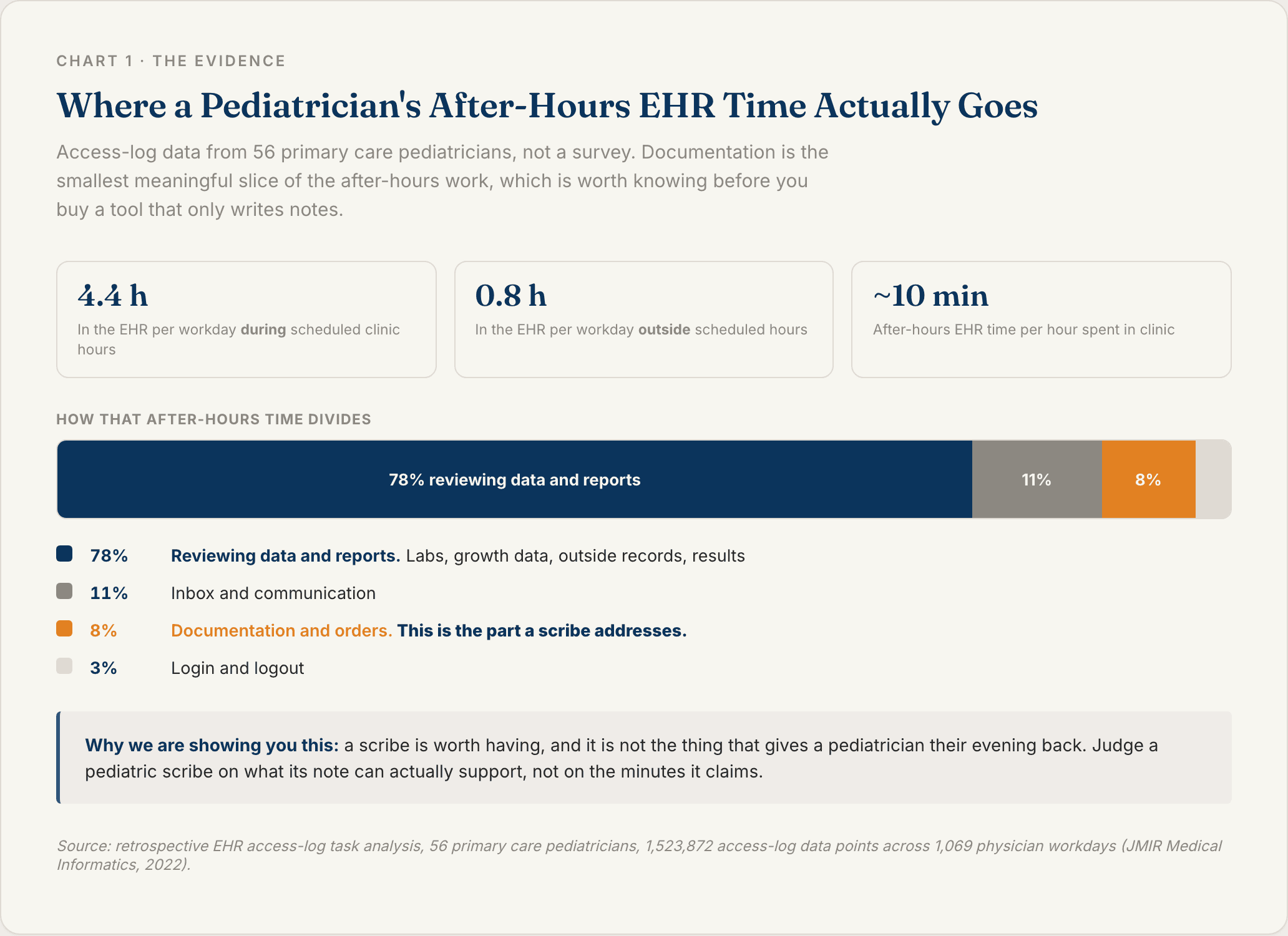
A scribe addresses the 8 percent. That is worth having, and it is not the same thing as giving a pediatrician their evening back. Any vendor who tells you otherwise is selling past the evidence.
Look at what the other 92 percent is, though. Reviewing results, working an inbox, chasing coordination. That is not writing work, so a better transcriber cannot touch it. It is work you reassign.
Which is the real argument against buying a single-purpose scribe and calling the problem solved, and a good reason to judge a pediatric tool on something other than minutes.
One Visit, Several Documents
A well-child visit does not produce a note. It produces a note, a growth chart entry, a set of screening instrument results, an immunization record that has to reach a state registry, and a record of anticipatory guidance.
A tool that produces a polished narrative has handled one of the five.
Why an Ambient Scribe Misses What Makes a Pediatric Visit Billable
Here is the argument, stated plainly.
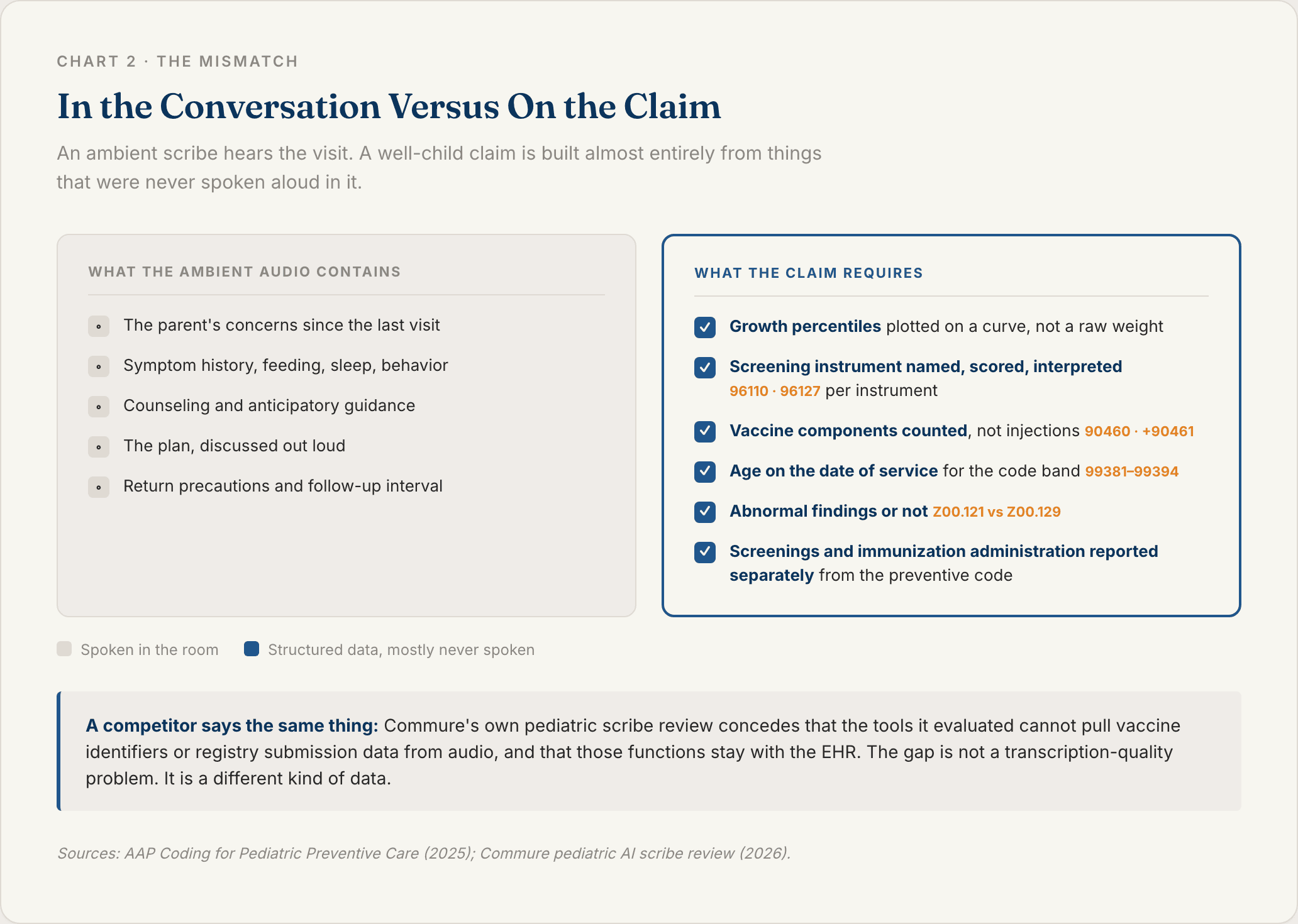
Pediatrics is the specialty where the note has to record what was never said. The reimbursable substance of a well-child visit is mostly structured data that never enters the dialogue. A percentile on a growth curve. A score from a form a parent completed before you walked in. A count of vaccine components administered by a nurse who was not part of the conversation.
Even the vendors closest to this concede it. Commure's own pediatric scribe review states that the tools it evaluated cannot pull vaccine identifiers or registry submission data from audio, and that those functions stay with the EHR [3].
That is a competitor telling you the mechanism. Three specific failure modes follow, and all three are testable in a demo.
The Percentile Is the Screen, Not the Number
A weight of 14 kilograms is data. The percentile is the finding.
Head circumference through 24 months, weight-for-length under 2 years, BMI from 2 years, and blood pressure percentile are all plotted rather than spoken. Nobody says "fifteenth percentile" out loud in a way a transcript can reliably capture, and a measurement without its percentile is not a screen.
The Score Comes From a Form, Not the Room
Developmental and autism screening runs on a validated instrument, usually completed by a parent before the clinician arrives.
CPT requires that the instrument be named, scored, and documented. A non-standardized screen is not separately reportable at all unless a specific payer allows it [4].
Nothing in the conversation supplies the tool name or the score. If your scribe cannot pull them, the screening either goes unbilled or goes on the claim unsupported.
The Vaccine Count Comes From the Nurse
Immunization administration is coded per component, not per injection. The components were drawn up by someone who was not part of the dialogue at all.
This is where the admission above bites hardest. Vaccine identifiers, lot numbers, and registry data are not in the audio, and they never will be.
The Coding Rules That Decide a Well-Child Claim
These are the rules that separate a paid well-child visit from a denied one. Neither of the two leading pediatric scribe guides contains a single one of them.
The Age on the Date of Service Picks the Code
Preventive medicine codes are age-banded. New patient: 99381 infant under 1 year, 99382 early childhood 1 to 4, 99383 late childhood 5 to 11, 99384 adolescent 12 to 17. Established patient: 99391 through 99394 across the same bands [4].
The age on the date of service governs, not the age at scheduling. A birthday between booking and the visit changes the code.
Diagnosis matters too. Z00.129 is a routine child health exam without abnormal findings. Z00.121 is the same exam with abnormal findings [4].
Developmental Screening and Immunizations Are Reported Separately
AAP is explicit about this, and practices still get it wrong. Immunization administration and any screening test that has its own CPT code are reported separately from the preventive medicine service, never bundled into it [4].
The preventive code already includes the age-appropriate history, the exam, the counseling, the anticipatory guidance, and the ordering of labs. It does not include the screens.
96110 covers developmental and autism screening, per instrument, with scoring and documentation. 96127 covers brief emotional and behavioral assessment, also per instrument [4]. Per instrument means a parent form and a teacher form are two units, not one.
Vaccine Administration Is Counted Per Component
This is the most commonly mis-coded thing in pediatrics, and the rule is precise.
90460 covers the first or only component of each vaccine, and only when a physician or qualified health professional performs face-to-face counseling. Then +90461 covers each additional component within that vaccine [4].
A component is the set of antigens that prevent disease caused by one organism. So MMR is three components. Conjugates and adjuvants do not count as components [4].
Without counseling, or for a patient 19 or older, you use 90471 and +90472 instead, and those are counted per injection rather than per component [4].
A Trivial Problem at a Well Visit Is Not Separately Billable
AAP's wording is worth knowing exactly: an insignificant or trivial illness, abnormality, or problem encountered in the process of performing the preventive medicine service should not be separately reported [4].
To bill a problem E/M on the same day as a well visit, that problem needs its own chief complaint, its own history, an exam relevant to it, and medical decision making, with modifier 25 on the E/M.
Free Pediatric Note Templates
Three templates covering the visits where documentation decides the payment. Each carries the payer rules and the recommended screening ages printed on the page, which is the part a blank note in the EHR will never give you.
Pediatric well-child visit note template for the periodic visit, two pages following the Bright Futures and AAP schedule, with a screening table that asks for the instrument and the score rather than a checkbox
Pediatric sick visit note template for the acute visit, with a weight-based dosing record and the modifier 25 boundary printed on the page
Pediatric ADHD evaluation template built to the AAP clinical practice guideline, with the two-setting and two-informant requirements as fields rather than assumptions [6]
The Adolescent Note Is the Opposite Problem
Everything above is about capturing more. Adolescence flips the requirement.
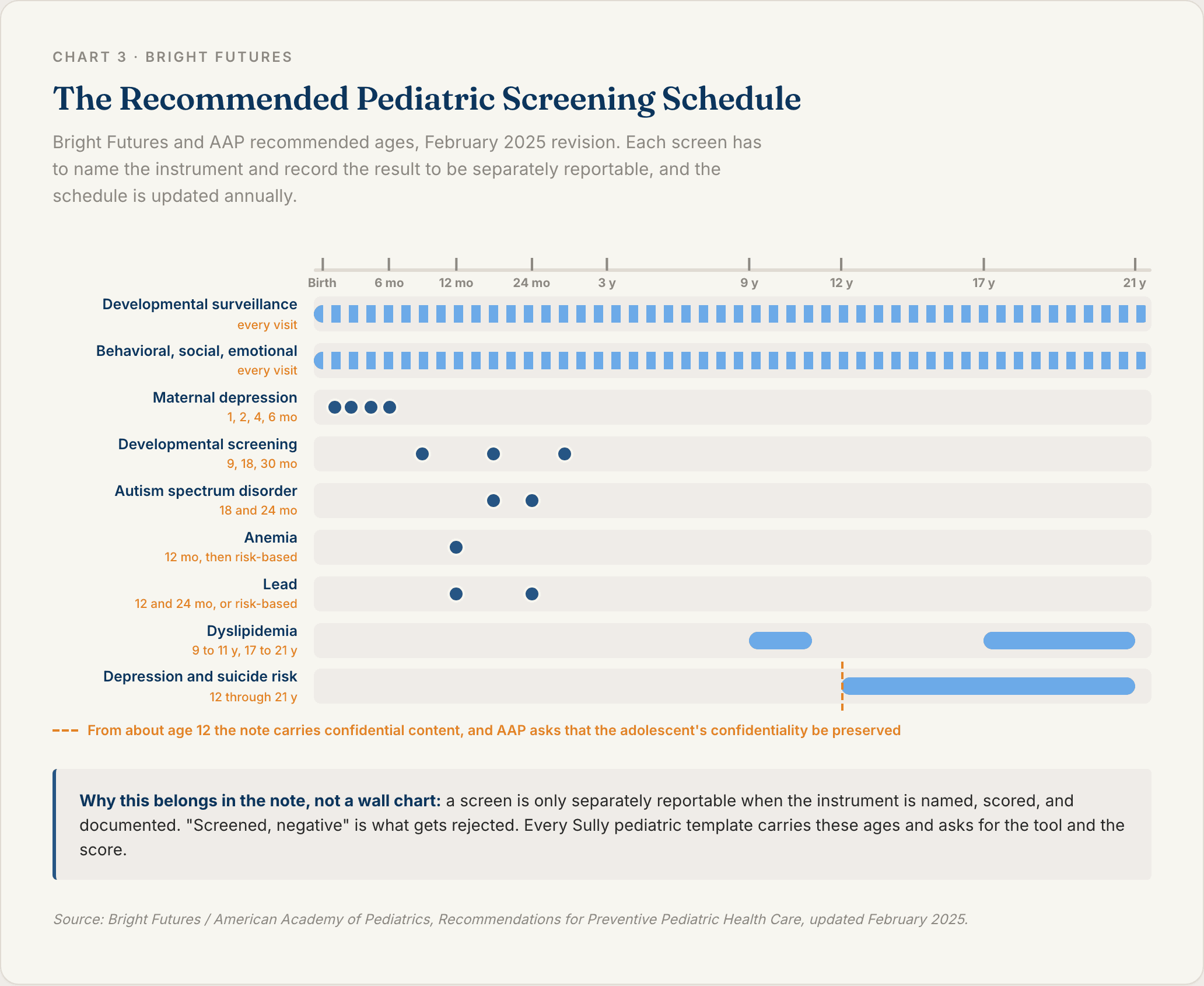
From roughly age 12 the note starts carrying content that has to stay out of a parent's view, and the tool's default behavior stops being neutral.
From About Age 12 the Note Carries Confidential Content
The Bright Futures and AAP periodicity schedule adds depression and suicide risk screening from 12 through 21 years, and it asks clinicians to make every effort to preserve the confidentiality of the adolescent while doing it [5].
That is not a soft suggestion in a footnote. It is a documentation requirement that conflicts directly with how a chart is normally shared. One estimate cited in the safety-net literature puts the share of adolescent patient notes containing confidential information at 25 percent [1].
Proxy Portal Access Breaks Adolescent Confidentiality in Practice
A 2023 quality-improvement project at Boston Medical Center reviewed 4,455 adolescent portal accounts. It found 60 percent were potentially being accessed by guardiansrather than by the adolescent [1].
Of the 2,255 accounts flagged and emailed, only 425 were updated by the adolescent. The remaining 1,830, or 81.2 percent, were deactivated [1].
The wider literature it cites is worse: erroneous guardian use of adolescent portal accounts runs at 64 to 80 percent [1].
So the working assumption should be that an adolescent's note is visible to a parent unless someone has actively arranged otherwise.
The Cures Act Removed the Easy Answer
NASPAG and SAHM issued a joint statement on the ONC Final Rule implementing the 21st Century Cures Act, and their recommendations are concrete: separate and differential portal access for the adolescent and the proxy, confidential note types in the EHR, and staff workflows built around confidentiality [7].
Worth being honest about the constraint. The preventing-harm exception is not a general licence to withhold a parent's access simply to protect a minor's confidentiality. This is a workflow and configuration problem, not something a policy exception solves for you.
What This Means for an Ambient Tool
A scribe whose default is to capture everything said and write it into the chart is the wrong default for an adolescent visit.
Ask any vendor two questions. Can the output be routed to a confidential note type? And can sensitive content be kept in its own section rather than merged into one narrative a proxy can read?
If the answer to both is no, the tool will make your confidentiality problem worse at exactly the ages where it matters most.
How to Evaluate an AI Scribe for a Pediatric Practice
Four questions, in the order that matters.
Does It Capture What Was Never Said
Bring a real well-child visit. Look at the output and check whether the percentile, the screening instrument name and score, and the vaccine components appear at all, or whether you got a nicely written version of the conversation.
This is the test that separates the tools, and most demos are not designed to show it.
Does It Support the Confidential Note
Ask directly. Can output go to a confidential note type, and how is sensitive adolescent content kept out of a proxy's view?
Does It Handle Age-Banded Coding
Ask whether it knows the age on the date of service drives the preventive code band, and whether screenings and immunization administration surface as separately reportable items rather than getting folded into the visit.
Does It Reach the Registry and the Claim
Immunization data has to reach a state registry. The coded claim has to leave the building.
A note that stops at the chart has solved the smaller half of the problem, and in pediatrics the smaller half is 8 percent of the evening [2].
Where Sully.ai Fits in a Pediatric Practice
Sully is a set of AI roles rather than a single tool, which matters for the 92 percent of after-hours work a scribe cannot reach.
Sully's AI Scribe captures documentation during and after the visit and writes it into the EHR, on a single integration across Office Practicum, Epic, Cerner, Meditech, Athenahealth, and ambulatory systems including Elation, Practice Fusion, NextGen, and AdvancedMD. Office Practicum matters here because it is the EHR a lot of independent pediatric practices actually run on, and it is on the same single integration as the enterprise systems. Clinicians can save how they want a note structured, so a screening block or a confidential adolescent section stays a distinct field rather than dissolving into a paragraph.
The AI Coder then extracts the ICD-10 and CPT codes and submits the claim. That matters more in pediatrics than almost anywhere else, because one well-child visit can carry a preventive code, per-component vaccine administration, and multiple per-instrument screenings. Three coding systems on a single claim is where a note-only tool stops being enough.
The AI Triage Nurse handles pre-visit intake, which is where screening instruments actually get completed. That is a direct answer to the problem this article opened with: the data an ambient tool cannot hear is often collected before the visit starts.
And the AI Receptionist handles recall and outreach, which is what keeps a periodicity schedule actually periodic.
Sully operates across 5,000+ providers, has delivered 50M+ hours of AI work, and prices each AI role 80 to 90 percent below the human equivalent [8].
Book a demo and bring a well-child visit with three vaccines and two screenings. That one encounter will tell you more than any feature list.
FAQ
Q: What should an AI scribe for pediatrics do that a general scribe does not? It has to capture what was never said out loud. Most of a well-child visit's billable substance is structured data rather than dialogue: the growth percentile, the screening instrument name and its score, and the count of vaccine components a nurse administered. It also has to handle the reverse problem for adolescents, where parts of the note need to stay out of a parent's view. A tool that only transcribes the conversation misses both. Sully.ai's AI Scribe writes into the EHR and hands the note to the AI Coder, which submits the coded claim.
Q: How much time do pediatricians spend in the EHR? Access-log data from 56 primary care pediatricians found an average of 4.4 hours per workday inside scheduled clinic hours plus 0.8 hours outside them, roughly 10 minutes of after-hours EHR time for every hour in clinic [2]. Worth knowing before you buy: only 8 percent of that after-hours time went to documentation and orders, while 78 percent went to reviewing data and reports [2]. A scribe addresses the 8 percent.
Q: How is vaccine administration coded for children? Per component, not per injection. 90460 covers the first or only component of each vaccine when a physician or qualified health professional counsels the family face to face, and +90461 covers each additional component within that vaccine. A component is the set of antigens preventing disease caused by one organism, so MMR counts as three. Conjugates and adjuvants do not count. Without counseling, or for patients 19 and over, 90471 and +90472 apply instead and are counted per injection [4].
Q: Which preventive code applies to a well-child visit? It depends on the patient's age on the date of service and whether they are new or established. New patient: 99381 for an infant under 1 year, 99382 early childhood 1 to 4, 99383 late childhood 5 to 11, 99384 adolescent 12 to 17. Established patient: 99391 through 99394 across the same bands. Diagnosis is Z00.129 for a routine child health exam without abnormal findings, or Z00.121 with [4]. Screening tests and immunization administration are reported separately, not bundled into the preventive code [4].
Q: Do you have free pediatric note templates? Yes. Sully publishes three: a two-page well-child visit note built to the Bright Futures and AAP periodicity schedule, a sick visit note with a weight-based dosing record, and an ADHD evaluation built to the AAP clinical practice guideline. Each carries the payer rules and the recommended screening ages printed on the page.
Sources
[1] Applied Clinical Informatics — Electronic Health Record Adolescent Confidentiality in a Safety Net Setting [2] JMIR Medical Informatics — Characterization of Electronic Health Record Use Outside Scheduled Clinic Hours Among Primary Care Pediatricians [3] Commure — AI Scribe for Pediatrics [4] American Academy of Pediatrics — Coding for Pediatric Preventive Care [5] Bright Futures and American Academy of Pediatrics — Recommendations for Preventive Pediatric Health Care [6] American Academy of Pediatrics — Clinical Practice Guideline for the Diagnosis, Evaluation, and Treatment of Attention-Deficit/Hyperactivity Disorder in Children and Adolescents [7] NASPAG and SAHM — The 21st Century Cures Act and Adolescent Confidentiality [8] Sully.ai — The AI Workforce for Healthcare
TABLE OF CONTENTS
Hire your
Medical AI Team
Take a look at our Medical AI Team
AI Receptionist
Manages patient scheduling, communications, and front-desk operations across all channels.
AI Scribe
Documents clinical encounters and maintains accurate EHR/EMR records in real-time.
AI Medical Coder
Assigns and validates medical codes to ensure accurate billing and regulatory compliance.
AI Nurse
Assesses patient urgency and coordinates appropriate care pathways based on clinical needs.