"/><stop offset="1" stop-color="rgba(255, 255, 255, 0)"/></linearGradient><linearGradient id="WxV_IOPE7-2309410982-linear-gradient" x1="1" x2="0" y1="0.5951279047551217" y2="0.4048720952448783"><stop offset="0" stop-color="rgb(255, 255, 255)"/><stop offset="1" stop-color="rgba(255, 255, 255, 0)"/></linearGradient><linearGradient id="WwbAIQIz8-2309410982-linear-gradient" x1="0.43478742751482424" x2="0.6358595260107829" y1="0.26" y2="1"><stop offset="0" stop-color="rgb(255, 255, 255)"/><stop offset="1" stop-color="rgba(255, 255, 255, 0)"/></linearGradient><linearGradient id="ZWsVQcPfn-2309410982-linear-gradient" x1="0.9508213454678907" x2="0.04917865453210929" y1="0" y2="1"><stop offset="0" stop-color="rgb(255, 255, 255)"/><stop offset="1" stop-color="rgba(255, 255, 255, 0)"/></linearGradient><linearGradient id="lTyCGrzzP-2309410982-linear-gradient" x1="0.374937164194436" x2="0.625062835805564" y1="0" y2="1"><stop offset="0" stop-color="rgb(255, 255, 255)"/><stop offset="1" stop-color="rgba(255, 255, 255, 0)"/></linearGradient></defs><g d="M 658.002 1357.705 C 1020.321 1357.705 1314.04 1063.989 1314.04 701.667 C 1314.04 339.347 1020.321 45.626 658.002 45.626 C 295.681 45.626 1.96 339.347 1.96 701.667 L 0 701.667 C 0 338.263 294.598 43.665 658.002 43.665 C 1021.404 43.665 1316 338.263 1316 701.667 C 1316 1065.072 1021.404 1359.672 658.002 1359.672 C 294.598 1359.672 0 1065.072 0 701.667 L 1.96 701.667 C 1.96 1063.989 295.681 1357.705 658.002 1357.705 Z M 658.005 1265.053 C 969.154 1265.053 1221.392 1012.819 1221.392 701.667 C 1221.392 390.517 969.154 138.281 658.005 138.281 C 346.856 138.281 94.619 390.517 94.619 701.667 L 92.659 701.667 C 92.659 389.433 345.77 136.321 658.005 136.321 C 970.241 136.321 1223.352 389.433 1223.352 701.667 C 1223.352 1013.902 970.241 1267.017 658.005 1267.017 C 345.77 1267.017 92.659 1013.902 92.659 701.667 L 94.619 701.667 C 94.619 1012.819 346.856 1265.053 658.005 1265.053 Z M 658.002 1166.116 C 914.513 1166.116 1122.452 958.178 1122.452 701.667 C 1122.452 445.16 914.513 237.22 658.002 237.22 C 401.494 237.22 193.551 445.16 193.551 701.667 L 191.59 701.667 C 191.59 444.077 400.411 235.255 658.002 235.255 C 915.596 235.255 1124.412 444.077 1124.412 701.667 C 1124.412 959.261 915.596 1168.084 658.002 1168.084 C 400.411 1168.084 191.59 959.261 191.59 701.667 L 193.551 701.667 C 193.551 958.178 401.494 1166.116 658.002 1166.116 Z M 281.657 818.28 C 298.572 818.28 314.804 825.001 326.765 836.965 L 458.99 969.182 C 470.582 980.781 486.308 987.298 502.706 987.298 L 612.137 987.298 C 646.284 987.298 673.972 959.61 673.972 925.463 L 673.972 891.504 L 675.939 891.504 L 675.939 925.463 C 675.939 960.7 647.374 989.258 612.137 989.258 L 502.706 989.258 C 485.788 989.258 469.562 982.537 457.599 970.573 L 325.378 838.356 C 313.785 826.757 298.056 820.242 281.657 820.244 L 1.173 820.244 L 1.173 818.28 Z M 746.64 888.714 L 1053.046 888.714 C 1069.967 888.714 1086.194 895.435 1098.16 907.398 L 1259.381 1068.619 L 1257.99 1070.007 L 1096.772 908.79 C 1085.175 897.193 1069.446 890.679 1053.046 890.681 L 746.64 890.681 C 729.724 890.681 713.493 883.957 701.533 871.993 L 685.377 855.845 L 686.769 854.453 L 702.917 870.605 C 714.513 882.201 730.241 888.715 746.64 888.714 Z M 667.685 552 L 512.316 396.894 C 494.66 379.264 484.741 355.356 484.739 330.426 L 484.739 0 L 487.632 0 L 487.632 330.426 C 487.632 354.592 497.248 377.763 514.369 394.851 L 669.739 549.957 Z M 782.851 700.491 C 816.998 700.491 844.686 672.804 844.686 638.655 L 844.686 516.468 C 844.687 499.547 851.409 483.32 863.374 471.355 L 1177.508 157.22 L 1178.896 158.607 L 864.762 472.742 C 853.162 484.337 846.646 500.067 846.646 516.468 L 846.646 638.655 C 846.646 673.89 818.088 702.455 782.851 702.455 L 700.405 702.455 L 700.405 700.491 Z M 130.338 534.223 L 213.07 534.223 C 256.112 534.223 291.003 569.114 291.003 612.156 L 291.003 694.888 C 291.003 711.29 297.514 727.017 309.113 738.611 L 472.887 902.378 L 471.496 903.769 L 307.726 739.995 C 295.761 728.033 289.038 711.807 289.038 694.888 L 289.038 612.156 C 289.038 570.198 255.028 536.188 213.07 536.188 L 130.338 536.188 C 113.419 536.187 97.193 529.465 85.23 517.5 L 77.071 509.345 C 65.107 497.381 58.386 481.153 58.388 464.233 L 58.388 199.526 L 60.348 199.526 L 60.348 464.233 C 60.349 480.631 66.863 496.358 78.458 507.954 L 86.617 516.113 C 98.213 527.709 113.94 534.223 130.338 534.223 Z" fill="transparent" height="1359.6717183844698px" id="DcyumyANr" transform="translate(0 -43.665)" width="1316px"><g opacity="0.5"><path d="M 658.002 1314.039 C 1020.321 1314.039 1314.04 1020.324 1314.04 658.001 C 1314.04 295.681 1020.321 1.961 658.002 1.961 C 295.681 1.961 1.96 295.682 1.96 658.001 L 0 658.001 C 0 294.598 294.598 0 658.002 0 C 1021.404 0 1316 294.598 1316 658.001 C 1316 1021.407 1021.404 1316.007 658.002 1316.007 C 294.598 1316.007 0 1021.407 0 658.001 L 1.96 658.001 C 1.96 1020.324 295.681 1314.039 658.002 1314.039 Z" fill="rgb(255, 255, 255)" height="1316.0065114752902px" id="dxf13D52Y" transform="translate(0 43.665)" width="1316px"/></g><g opacity="0.3"><path d="M 565.347 1128.732 C 876.496 1128.732 1128.733 876.498 1128.733 565.346 C 1128.733 254.196 876.496 1.961 565.347 1.961 C 254.197 1.961 1.961 254.196 1.961 565.346 L 0 565.346 C 0 253.112 253.111 0 565.347 0 C 877.582 0 1130.693 253.112 1130.693 565.346 C 1130.693 877.581 877.582 1130.696 565.347 1130.696 C 253.111 1130.696 0 877.581 0 565.346 L 1.961 565.346 C 1.961 876.498 254.197 1128.732 565.347 1128.732 Z" fill="rgb(255, 255, 255)" height="1130.6960934794101px" id="if1BmYw1S" transform="translate(92.659 136.321)" width="1130.693351805604px"/></g><g opacity="0.15"><path d="M 466.412 930.861 C 722.923 930.861 930.862 722.922 930.862 466.411 C 930.862 209.905 722.923 1.965 466.412 1.965 C 209.904 1.965 1.961 209.905 1.961 466.411 L 0 466.411 C 0 208.822 208.821 0 466.412 0 C 724.006 0 932.822 208.822 932.822 466.411 C 932.822 724.005 724.006 932.828 466.412 932.828 C 208.821 932.828 0 724.005 0 466.411 L 1.961 466.411 C 1.961 722.922 209.904 930.861 466.412 930.861 Z" fill="rgb(255, 255, 255)" height="932.8284667407987px" id="ef75NsYf6" transform="translate(191.59 235.255)" width="932.8219552655086px"/></g><g opacity="0.5"><path d="M 280.484 0 C 297.399 0 313.63 6.721 325.592 18.685 L 457.817 150.902 C 469.408 162.501 485.135 169.018 501.533 169.017 L 610.964 169.017 C 645.111 169.017 672.799 141.33 672.799 107.182 L 672.799 73.223 L 674.766 73.223 L 674.766 107.182 C 674.766 142.42 646.201 170.978 610.964 170.978 L 501.533 170.978 C 484.614 170.978 468.389 164.257 456.426 152.293 L 324.205 20.076 C 312.611 8.477 296.883 1.961 280.484 1.964 L 0 1.964 L 0 0 Z" fill="url(%23cQ4xRdUtr-2309410982-linear-gradient)" height="170.97763275969464px" id="cQ4xRdUtr" transform="translate(1.173 818.28)" width="674.7656780356198px"/></g><g opacity="0.5"><path d="M 61.263 34.261 L 367.669 34.261 C 384.589 34.261 400.817 40.982 412.783 52.945 L 574.004 214.166 L 572.612 215.554 L 411.395 54.337 C 399.798 42.74 384.069 36.226 367.669 36.228 L 61.263 36.228 C 44.347 36.228 28.116 29.504 16.155 17.54 L 0 1.391 L 1.391 0 L 17.54 16.152 C 29.136 27.747 44.864 34.261 61.263 34.261 Z" fill="url(%23WxV_IOPE7-2309410982-linear-gradient)" height="215.55382175474415px" id="WxV_IOPE7" transform="translate(685.377 854.453)" width="574.0036823012563px"/></g><g opacity="0.5"><path d="M 182.946 552 L 27.577 396.894 C 9.921 379.264 0.002 355.356 0 330.426 L 0 0 L 2.893 0 L 2.893 330.426 C 2.893 354.592 12.509 377.763 29.63 394.851 L 185 549.957 Z" fill="url(%23WwbAIQIz8-2309410982-linear-gradient)" height="552px" id="WwbAIQIz8" transform="translate(484.739 0)" width="185px"/></g><g opacity="0.5"><path d="M 82.446 543.271 C 116.593 543.271 144.281 515.583 144.281 481.435 L 144.281 359.248 C 144.282 342.327 151.004 326.1 162.969 314.135 L 477.103 0 L 478.491 1.387 L 164.356 315.522 C 152.757 327.117 146.241 342.846 146.241 359.248 L 146.241 481.435 C 146.241 516.67 117.683 545.235 82.446 545.235 L 0 545.235 L 0 543.271 Z" fill="url(%23ZWsVQcPfn-2309410982-linear-gradient)" height="545.2346136318063px" id="ZWsVQcPfn" transform="translate(700.405 157.22)" width="478.4906210693257px"/></g><g opacity="0.5"><path d="M 71.95 334.696 L 154.682 334.696 C 197.724 334.696 232.616 369.588 232.616 412.63 L 232.616 495.362 C 232.616 511.764 239.126 527.491 250.725 539.084 L 414.5 702.851 L 413.108 704.243 L 249.338 540.469 C 237.373 528.507 230.651 512.281 230.651 495.362 L 230.651 412.63 C 230.651 370.672 196.64 336.661 154.682 336.661 L 71.95 336.661 C 55.031 336.661 38.805 329.939 26.843 317.974 L 18.683 309.819 C 6.719 297.854 -0.001 281.627 0 264.707 L 0 0 L 1.961 0 L 1.961 264.707 C 1.961 281.105 8.475 296.832 20.07 308.428 L 28.229 316.587 C 39.825 328.182 55.552 334.697 71.95 334.696 Z" fill="url(%23lTyCGrzzP-2309410982-linear-gradient)" height="704.2427839655832px" id="lTyCGrzzP" transform="translate(58.388 199.526)" width="414.49961191971533px"/></g></g></svg>)
Write a prenatal note today and no claim goes out. Not that day, not that month.
That note joins twelve others and a delivery, and the whole thing bills once, as a package, sometimes eight months after the visit you just documented.
Which makes obstetrics the one specialty where the note is not finished when the visit is. It stays provisional until the pregnancy closes.
Key Takeaway: An AI scribe for OB-GYN has to understand that the unit of documentation is the pregnancy, not the visit. A single prenatal note does not produce a claim. It contributes to a global obstetric package billed once, after delivery. Routine antepartum care is usually about 13 visits, and if your group does not provide all of them, because the patient transferred, was referred, changed insurer, or miscarried, the pregnancy does not bill as a package at all: it becomes 59426 for seven or more antepartum visits, 59425 for four to six, or itemized E/M for one to three [1]. The number of visits is therefore a billing fact, and almost nobody is recording it. Ambient scribes are built around one conversation producing one note, which is the wrong shape for a record whose billing state stays open for most of a year. Sully.ai's AI Scribe writes into the EHR across Epic, Cerner, Meditech, Athenahealth and specialty platforms including ModMed, and the AI Coder carries the note through to the coded claim.
In Obstetrics the Unit of Documentation Is the Pregnancy
Most specialties settle up at the end of the encounter. You document, you code, the claim goes out, the visit is closed.
Obstetric care is billed as a package instead. One code covers antepartum care, the delivery, and postpartum care as a single event [1].
One Prenatal Note Does Not Produce a Claim
The global codes are 59400 for vaginal delivery, 59510 for cesarean, 59610 for vaginal after previous cesarean, and 59618 for cesarean following an attempted VBAC [1].
All routine prenatal visits until delivery sit inside them, approximately 13 for an uncomplicated pregnancy [1].
So a prenatal visit is real clinical work that generates no claim of its own. It is a deposit against a payment that comes later.
The Visit Count Is a Billing Fact
Here is the part that catches practices out. Whether this pregnancy bills as a package at all depends on how many antepartum visits your group actually provided.
Seven or more, without completing the package, is 59426. Four to six is 59425. One to three, and you itemize each E/M visit instead [1].

That is a number, not a narrative. And it is a number almost nobody is keeping, because no part of the documentation workflow asks for it until the moment it matters.
Why an Encounter-Shaped Scribe Cannot Close an Obstetric Package
Every AI scribe pitch for OB-GYN is organised by visit type. Prenatal, postpartum, annual gyn, contraception, infertility. That framing treats obstetrics as a set of encounters that happen to be about pregnancy.
The problem is not the encounters. It is that they belong to one record whose billing state stays open for most of a year.A tool built to produce one note per conversation has no concept of that.
Three failure modes follow, and all three are testable before you buy.
It Has No Concept of an Open Package
An ambient scribe finishes when the conversation finishes. It has done its job.
In obstetrics nothing has been resolved yet. The note is one of thirteen contributions to a claim that does not exist yet.
It Cannot Tell You Which Visits Were Inside the Package
A routine prenatal visit is bundled. A visit for a condition unrelated to the pregnancy, a chest infection, a urinary tract infection, is separately reportable [1].
On a recording those sound identical. Both are a clinician and a pregnant patient talking about a symptom. The distinction is a billing category, not an audible one, and it is the same separability problem primary care runs into with modifier 25, and getting it wrong costs money in both directions: under-bill the unrelated problem, or double-bill something already inside the package and face recoupment.
A Transfer of Care Rewrites What You Already Documented
Itemization applies when a patient transfers into or out of a practice, is referred, delivers with a physician outside the group, terminates or miscarries, or changes insurer mid-pregnancy [1].
At that moment every note you have already written changes meaning. Six routine prenatal visits stop being package components and become the basis for a 59425 claim.
Nothing in a per-conversation tool knows that the last six notes were just re-classified.
What the Global Obstetric Package Includes and Excludes
This is the list that prevents both under-billing and recoupment, and not one of the vendor guides written for OB-GYN publishes it.
The Confirmatory Visit Is the One You Can Still Bill
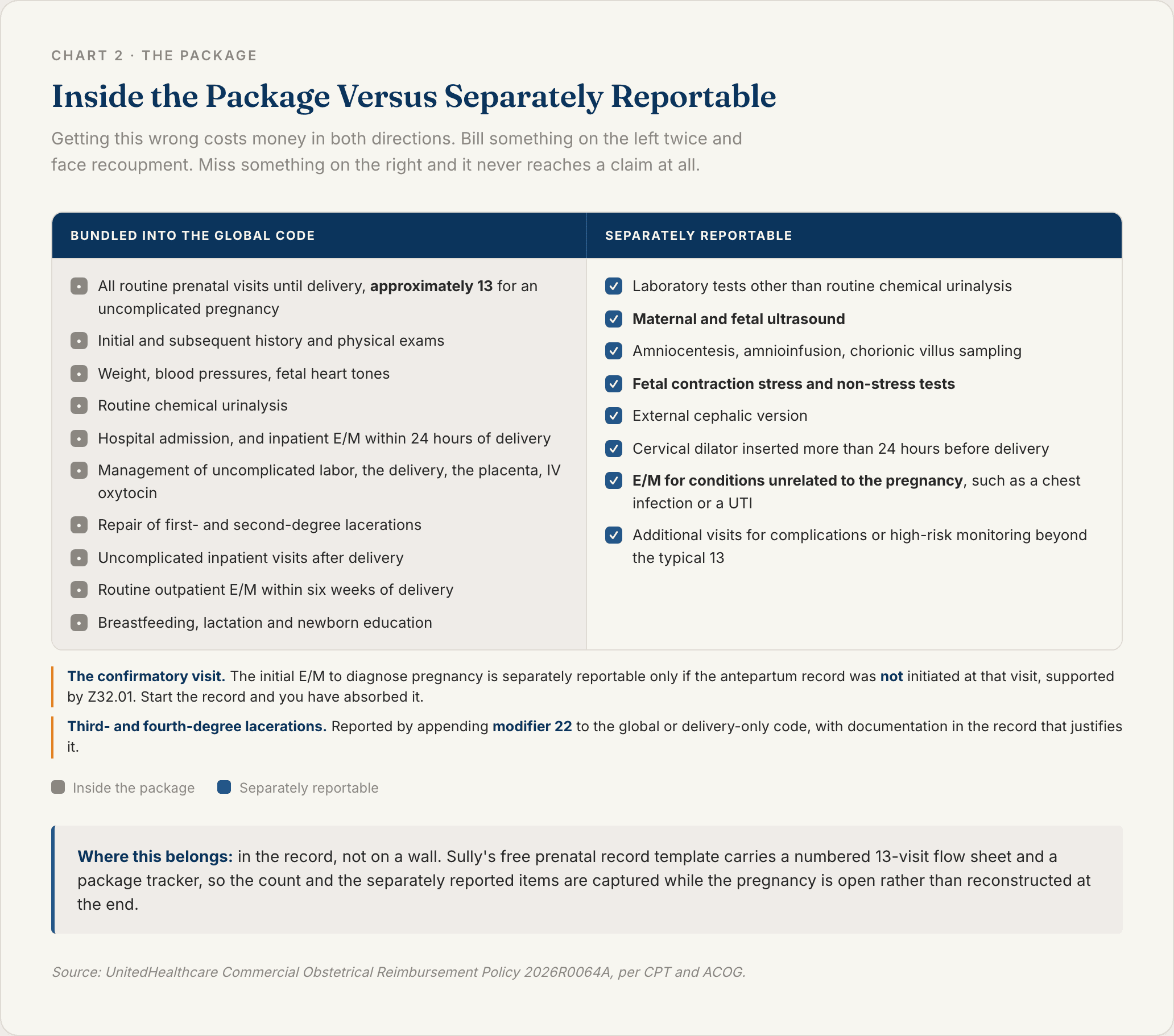
The initial E/M to diagnose pregnancy is excluded from the package and separately reportable, but only if the antepartum record was not initiated at that visit, supported by diagnosis code Z32.01 [1].
Start the record at the confirmatory visit and you have absorbed it. That is a decision made by a front-desk workflow, not a clinical one.
What Is Bundled and Must Not Be Billed Twice
Inside the package: all routine prenatal visits, initial and subsequent history and physical exams, recording of weight, blood pressures and fetal heart tones, routine chemical urinalysis, hospital admission including history and physical, inpatient E/M within 24 hours of delivery, management of uncomplicated labor, the delivery and the placenta, administration of IV oxytocin, repair of first- and second-degree lacerations, simple removal of cerclage, uncomplicated inpatient visits after delivery, routine outpatient E/M within six weeks of delivery, and breastfeeding and newborn education [1].
What Sits Outside the Package
Separately reportable: laboratory tests other than routine chemical urinalysis, maternal and fetal ultrasound, amniocentesis, amnioinfusion, chorionic villus sampling, fetal contraction stress tests, fetal non-stress tests, external cephalic version, insertion of a cervical dilator more than 24 hours before delivery, E/M for conditions unrelated to the pregnancy, and additional visits for complications or high-risk monitoring beyond the typical 13 [1].
One more that gets missed. Third- and fourth-degree laceration repair is reported by appending modifier 22 to the global or delivery-only code, and the record has to contain documentation that justifies it [1].
Antepartum-Only Codes and the Visit Thresholds
59426 for seven or more antepartum visits. 59425 for four to six. Itemized E/M for one to three [1].
Which means the difference between two codes, and a real difference in payment, can come down to whether a patient attended a sixth or a seventh visit before moving away. If nobody counted, nobody knows.
Free OB-GYN Note Templates
Three templates for the documentation that decides the payment. Each carries the payer rules printed on the page.
Prenatal record template for the pregnancy as a whole, two pages covering the initial obstetric visit and a numbered 13-row flow sheet with a package tracker, because the count is what decides the code
Postpartum visit note template for the fourth trimester, with mood screening by named instrument and the long-term risk handoff most postpartum notes leave out
Well-woman annual exam template for the preventive visit, with screening recorded as a test and a next-due date rather than an assumed annual cadence
The Postpartum Window Your Patient Needs Is Not the One You Get Paid For
There is a gap here that nobody names out loud, and clinicians live inside it.
ACOG Wants Contact at Three Weeks and a Comprehensive Visit by Twelve
ACOG recommends contact with a maternal care clinician within the first three weeks after birth, ongoing care as needed, and a comprehensive postpartum visit no later than 12 weeks, covering physical, social, and psychological well-being [2].
That reframed postpartum care as a process rather than a single appointment.
Payers Still Define Postpartum as Six Weeks
Payer policy generally still treats the postpartum period as six weeks following delivery [1].
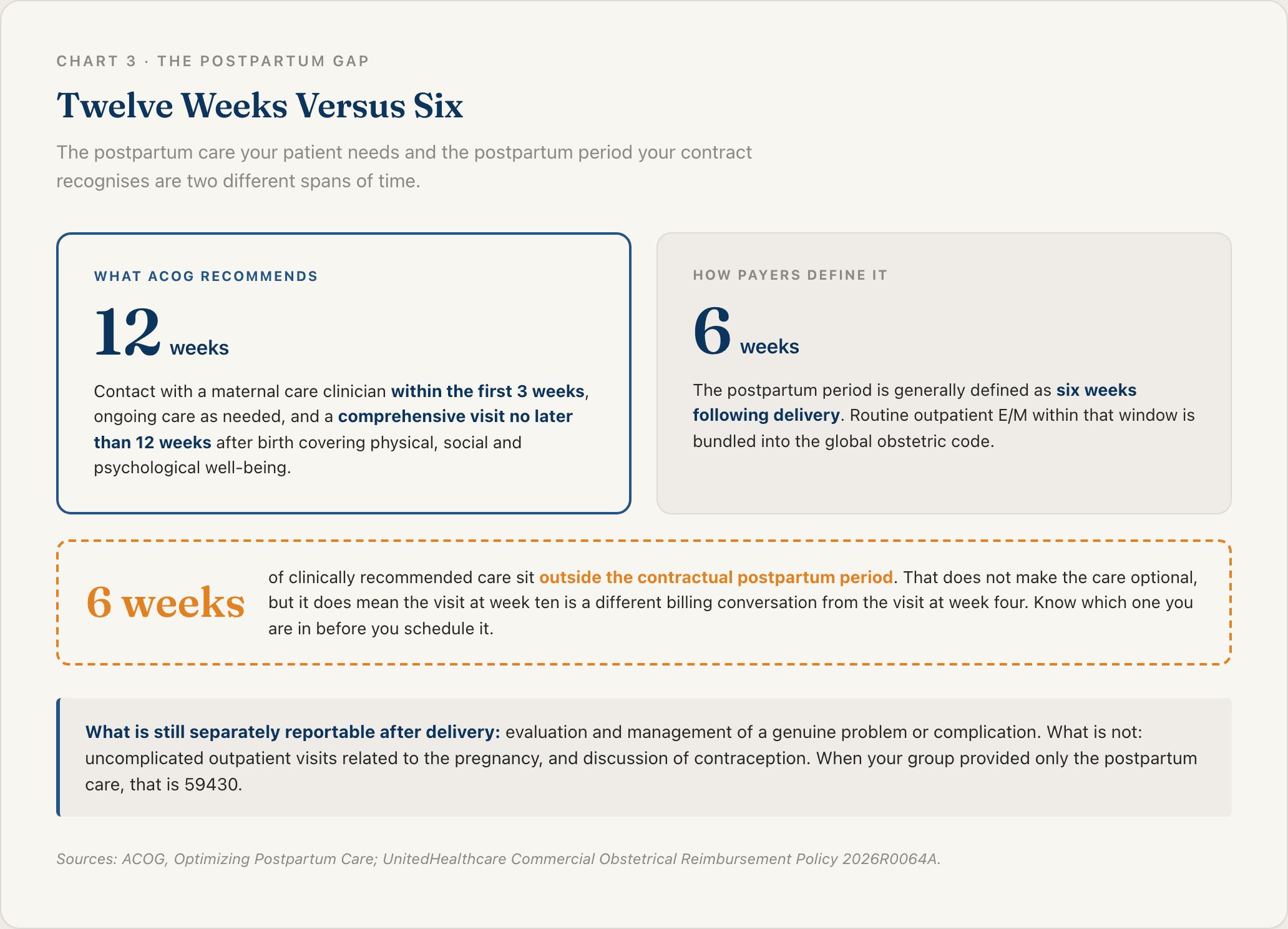
So the care your patient needs at ten weeks and the window your contract recognises are two different things. Worth knowing which one you are working in before you plan the visit.
What Is Separately Reportable After Delivery
Uncomplicated outpatient visits related to the pregnancy are bundled. So is discussion of contraception [1].
Evaluation and management of a genuine problem or complication is separately reportable [1]. And 59430 is the postpartum-care-only code, for when your group did not provide the rest of the package.
Cervical Cancer Screening Changed in 2026
This one matters because a lot of templates and a lot of habits are still running on the previous guidance.
The Current Intervals
ACOG's current statement recommends cytology alone every three years for ages 21 to 29, and clinician-collected primary hrHPV screening every five years for ages 30 to 65 [3].
That is the change. For the 30 to 65 band, primary hrHPV screening is now the recommended method rather than one of three equivalent options alongside cytology and co-testing. Routine screening stops after 65 for patients with adequate prior negative screening [3].
Record the Test and the Next Due Date
Because intervals now differ by test, the annual visit has stopped being the unit of screening.
The practical fix is small: record which test was performed and when it is next due, rather than relying on a remembered interval. That also means your record stays correct the next time guidance moves, which it will.
The Medicare Codes That Get Billed Wrong
G0101 is the screening pelvic and clinical breast examination. Q0091 is obtaining and conveying the screening Pap specimen [4].
Medicare covers them every 24 months at normal risk, and annually for patients at high risk and for patients of childbearing age who have had an abnormal Pap within the past three years [4][5].
Do not bill Q0091 separately when the specimen collection is already part of a preventive visit you are billing.
How to Evaluate an AI Scribe for an OB-GYN Practice
Four questions, in the order that matters.
Does It Know a Pregnancy Is One Record
Ask how it handles a longitudinal record rather than an encounter. If the demo is a single prenatal visit, you have not seen it do the job.
Does It Count Antepartum Visits
Ask directly whether anything in the workflow tells you how many antepartum visits this patient has had with your group. If the answer is that you would check the chart, that is the gap.
Does It Separate Bundled From Billable
Give it a prenatal visit that turns into treatment for a urinary tract infection. Check whether the output makes the unrelated problem separable, or writes one narrative.
Does It Reach the Claim
A note that stops at the chart has not helped assemble a claim built from eight months of visits.
Where Sully.ai Fits in an OB-GYN Practice
Sully's AI Scribe captures documentation during and after the visit and writes it into the EHR, on a single integration across Epic, Cerner, Meditech, Athenahealth, and ambulatory and specialty systems including ModMed, Elation, Practice Fusion, NextGen and AdvancedMD. Clinicians can save how they want a note structured, so a flow sheet stays a flow sheet rather than dissolving into prose.
The AI Coder then extracts the ICD-10 and CPT codes and submits the claim. That handoff matters more in obstetrics than anywhere else, because the claim is assembled from a year of visits rather than written at the end of one.
The AI Receptionist handles recall and outreach. In most specialties that is a care-gap tool. In obstetrics it has a direct billing consequence, because a missed visit can move a pregnancy from a global code to an antepartum-only one.
Sully operates across 5,000+ providers, has delivered 50M+ hours of AI work, and prices each AI role 80 to 90 percent below the human equivalent [6].
Book a demo and bring a pregnancy that transferred care at 20 weeks. That is the case that shows you what a tool actually understands.
FAQ
Q: What should an AI scribe for OB-GYN do that a general scribe does not? It has to treat the pregnancy as the record, not the visit. A prenatal note produces no claim on its own; it contributes to a global obstetric package billed once after delivery. So the tool has to help you track how many antepartum visits your group provided, keep bundled visits separate from separately reportable ones, and survive a transfer of care that changes how everything already documented gets billed [1]. Sully.ai's AI Scribe writes the note into the EHR and hands it to the AI Coder, which submits the coded claim.
Q: What is included in the global obstetric package? All routine prenatal visits until delivery, usually about 13 for an uncomplicated pregnancy, initial and subsequent history and physical exams, weight, blood pressure and fetal heart tones, routine chemical urinalysis, hospital admission, inpatient E/M within 24 hours of delivery, management of uncomplicated labor, the delivery and placenta, IV oxytocin, repair of first- and second-degree lacerations, uncomplicated inpatient visits after delivery, routine outpatient E/M within six weeks of delivery, and breastfeeding and newborn education [1].
Q: When do you bill 59425 or 59426 instead of a global code? When your group did not provide the whole package. 59426 covers seven or more antepartum visits, 59425 covers four to six, and you itemize each E/M if you provided only one to three. This comes up when a patient transfers into or out of the practice, is referred, delivers with a physician outside the group, terminates or miscarries, or changes insurer mid-pregnancy [1].
Q: How often should cervical cancer screening be done? ACOG's current statement recommends cytology alone every three years for ages 21 to 29, and clinician-collected primary hrHPV screening every five years for ages 30 to 65, which is a change from the previous three equivalent options for that age band. Routine screening stops after 65 with adequate prior negative screening [3]. Because intervals now differ by test, record the test performed and the next-due date rather than assuming an annual cadence.
Q: Do you have free OB-GYN note templates? Yes. Sully publishes three: a two-page prenatal record with a 13-visit flow sheet and package tracker, a fourth trimester postpartum visit note, and a well-woman annual exam updated for the current screening guidance. Each carries the payer rules printed on the page.
Sources
[1] UnitedHealthcare — Commercial and Individual Exchange Reimbursement Policy: Obstetrical Policy 2026R0064A [2] American College of Obstetricians and Gynecologists— Optimizing Postpartum Care[3] American College of Obstetricians and Gynecologists— Screening for Cervical Cancer[4] Centers for Medicare & Medicaid Services — Screening Pap Tests and Pelvic Examinations, MLN909032 [5] Centers for Medicare & Medicaid Services — National Coverage Determination 210.2: Screening Pap Smears and Pelvic Examinations [6] Sully.ai — The AI Workforce for Healthcare
TABLE OF CONTENTS
Hire your
Medical AI Team
Take a look at our Medical AI Team
AI Receptionist
Manages patient scheduling, communications, and front-desk operations across all channels.
AI Scribe
Documents clinical encounters and maintains accurate EHR/EMR records in real-time.
AI Medical Coder
Assigns and validates medical codes to ensure accurate billing and regulatory compliance.
AI Nurse
Assesses patient urgency and coordinates appropriate care pathways based on clinical needs.