"/><stop offset="1" stop-color="rgba(255, 255, 255, 0)"/></linearGradient><linearGradient id="WxV_IOPE7-2309410982-linear-gradient" x1="1" x2="0" y1="0.5951279047551217" y2="0.4048720952448783"><stop offset="0" stop-color="rgb(255, 255, 255)"/><stop offset="1" stop-color="rgba(255, 255, 255, 0)"/></linearGradient><linearGradient id="WwbAIQIz8-2309410982-linear-gradient" x1="0.43478742751482424" x2="0.6358595260107829" y1="0.26" y2="1"><stop offset="0" stop-color="rgb(255, 255, 255)"/><stop offset="1" stop-color="rgba(255, 255, 255, 0)"/></linearGradient><linearGradient id="ZWsVQcPfn-2309410982-linear-gradient" x1="0.9508213454678907" x2="0.04917865453210929" y1="0" y2="1"><stop offset="0" stop-color="rgb(255, 255, 255)"/><stop offset="1" stop-color="rgba(255, 255, 255, 0)"/></linearGradient><linearGradient id="lTyCGrzzP-2309410982-linear-gradient" x1="0.374937164194436" x2="0.625062835805564" y1="0" y2="1"><stop offset="0" stop-color="rgb(255, 255, 255)"/><stop offset="1" stop-color="rgba(255, 255, 255, 0)"/></linearGradient></defs><g d="M 658.002 1357.705 C 1020.321 1357.705 1314.04 1063.989 1314.04 701.667 C 1314.04 339.347 1020.321 45.626 658.002 45.626 C 295.681 45.626 1.96 339.347 1.96 701.667 L 0 701.667 C 0 338.263 294.598 43.665 658.002 43.665 C 1021.404 43.665 1316 338.263 1316 701.667 C 1316 1065.072 1021.404 1359.672 658.002 1359.672 C 294.598 1359.672 0 1065.072 0 701.667 L 1.96 701.667 C 1.96 1063.989 295.681 1357.705 658.002 1357.705 Z M 658.005 1265.053 C 969.154 1265.053 1221.392 1012.819 1221.392 701.667 C 1221.392 390.517 969.154 138.281 658.005 138.281 C 346.856 138.281 94.619 390.517 94.619 701.667 L 92.659 701.667 C 92.659 389.433 345.77 136.321 658.005 136.321 C 970.241 136.321 1223.352 389.433 1223.352 701.667 C 1223.352 1013.902 970.241 1267.017 658.005 1267.017 C 345.77 1267.017 92.659 1013.902 92.659 701.667 L 94.619 701.667 C 94.619 1012.819 346.856 1265.053 658.005 1265.053 Z M 658.002 1166.116 C 914.513 1166.116 1122.452 958.178 1122.452 701.667 C 1122.452 445.16 914.513 237.22 658.002 237.22 C 401.494 237.22 193.551 445.16 193.551 701.667 L 191.59 701.667 C 191.59 444.077 400.411 235.255 658.002 235.255 C 915.596 235.255 1124.412 444.077 1124.412 701.667 C 1124.412 959.261 915.596 1168.084 658.002 1168.084 C 400.411 1168.084 191.59 959.261 191.59 701.667 L 193.551 701.667 C 193.551 958.178 401.494 1166.116 658.002 1166.116 Z M 281.657 818.28 C 298.572 818.28 314.804 825.001 326.765 836.965 L 458.99 969.182 C 470.582 980.781 486.308 987.298 502.706 987.298 L 612.137 987.298 C 646.284 987.298 673.972 959.61 673.972 925.463 L 673.972 891.504 L 675.939 891.504 L 675.939 925.463 C 675.939 960.7 647.374 989.258 612.137 989.258 L 502.706 989.258 C 485.788 989.258 469.562 982.537 457.599 970.573 L 325.378 838.356 C 313.785 826.757 298.056 820.242 281.657 820.244 L 1.173 820.244 L 1.173 818.28 Z M 746.64 888.714 L 1053.046 888.714 C 1069.967 888.714 1086.194 895.435 1098.16 907.398 L 1259.381 1068.619 L 1257.99 1070.007 L 1096.772 908.79 C 1085.175 897.193 1069.446 890.679 1053.046 890.681 L 746.64 890.681 C 729.724 890.681 713.493 883.957 701.533 871.993 L 685.377 855.845 L 686.769 854.453 L 702.917 870.605 C 714.513 882.201 730.241 888.715 746.64 888.714 Z M 667.685 552 L 512.316 396.894 C 494.66 379.264 484.741 355.356 484.739 330.426 L 484.739 0 L 487.632 0 L 487.632 330.426 C 487.632 354.592 497.248 377.763 514.369 394.851 L 669.739 549.957 Z M 782.851 700.491 C 816.998 700.491 844.686 672.804 844.686 638.655 L 844.686 516.468 C 844.687 499.547 851.409 483.32 863.374 471.355 L 1177.508 157.22 L 1178.896 158.607 L 864.762 472.742 C 853.162 484.337 846.646 500.067 846.646 516.468 L 846.646 638.655 C 846.646 673.89 818.088 702.455 782.851 702.455 L 700.405 702.455 L 700.405 700.491 Z M 130.338 534.223 L 213.07 534.223 C 256.112 534.223 291.003 569.114 291.003 612.156 L 291.003 694.888 C 291.003 711.29 297.514 727.017 309.113 738.611 L 472.887 902.378 L 471.496 903.769 L 307.726 739.995 C 295.761 728.033 289.038 711.807 289.038 694.888 L 289.038 612.156 C 289.038 570.198 255.028 536.188 213.07 536.188 L 130.338 536.188 C 113.419 536.187 97.193 529.465 85.23 517.5 L 77.071 509.345 C 65.107 497.381 58.386 481.153 58.388 464.233 L 58.388 199.526 L 60.348 199.526 L 60.348 464.233 C 60.349 480.631 66.863 496.358 78.458 507.954 L 86.617 516.113 C 98.213 527.709 113.94 534.223 130.338 534.223 Z" fill="transparent" height="1359.6717183844698px" id="DcyumyANr" transform="translate(0 -43.665)" width="1316px"><g opacity="0.5"><path d="M 658.002 1314.039 C 1020.321 1314.039 1314.04 1020.324 1314.04 658.001 C 1314.04 295.681 1020.321 1.961 658.002 1.961 C 295.681 1.961 1.96 295.682 1.96 658.001 L 0 658.001 C 0 294.598 294.598 0 658.002 0 C 1021.404 0 1316 294.598 1316 658.001 C 1316 1021.407 1021.404 1316.007 658.002 1316.007 C 294.598 1316.007 0 1021.407 0 658.001 L 1.96 658.001 C 1.96 1020.324 295.681 1314.039 658.002 1314.039 Z" fill="rgb(255, 255, 255)" height="1316.0065114752902px" id="dxf13D52Y" transform="translate(0 43.665)" width="1316px"/></g><g opacity="0.3"><path d="M 565.347 1128.732 C 876.496 1128.732 1128.733 876.498 1128.733 565.346 C 1128.733 254.196 876.496 1.961 565.347 1.961 C 254.197 1.961 1.961 254.196 1.961 565.346 L 0 565.346 C 0 253.112 253.111 0 565.347 0 C 877.582 0 1130.693 253.112 1130.693 565.346 C 1130.693 877.581 877.582 1130.696 565.347 1130.696 C 253.111 1130.696 0 877.581 0 565.346 L 1.961 565.346 C 1.961 876.498 254.197 1128.732 565.347 1128.732 Z" fill="rgb(255, 255, 255)" height="1130.6960934794101px" id="if1BmYw1S" transform="translate(92.659 136.321)" width="1130.693351805604px"/></g><g opacity="0.15"><path d="M 466.412 930.861 C 722.923 930.861 930.862 722.922 930.862 466.411 C 930.862 209.905 722.923 1.965 466.412 1.965 C 209.904 1.965 1.961 209.905 1.961 466.411 L 0 466.411 C 0 208.822 208.821 0 466.412 0 C 724.006 0 932.822 208.822 932.822 466.411 C 932.822 724.005 724.006 932.828 466.412 932.828 C 208.821 932.828 0 724.005 0 466.411 L 1.961 466.411 C 1.961 722.922 209.904 930.861 466.412 930.861 Z" fill="rgb(255, 255, 255)" height="932.8284667407987px" id="ef75NsYf6" transform="translate(191.59 235.255)" width="932.8219552655086px"/></g><g opacity="0.5"><path d="M 280.484 0 C 297.399 0 313.63 6.721 325.592 18.685 L 457.817 150.902 C 469.408 162.501 485.135 169.018 501.533 169.017 L 610.964 169.017 C 645.111 169.017 672.799 141.33 672.799 107.182 L 672.799 73.223 L 674.766 73.223 L 674.766 107.182 C 674.766 142.42 646.201 170.978 610.964 170.978 L 501.533 170.978 C 484.614 170.978 468.389 164.257 456.426 152.293 L 324.205 20.076 C 312.611 8.477 296.883 1.961 280.484 1.964 L 0 1.964 L 0 0 Z" fill="url(%23cQ4xRdUtr-2309410982-linear-gradient)" height="170.97763275969464px" id="cQ4xRdUtr" transform="translate(1.173 818.28)" width="674.7656780356198px"/></g><g opacity="0.5"><path d="M 61.263 34.261 L 367.669 34.261 C 384.589 34.261 400.817 40.982 412.783 52.945 L 574.004 214.166 L 572.612 215.554 L 411.395 54.337 C 399.798 42.74 384.069 36.226 367.669 36.228 L 61.263 36.228 C 44.347 36.228 28.116 29.504 16.155 17.54 L 0 1.391 L 1.391 0 L 17.54 16.152 C 29.136 27.747 44.864 34.261 61.263 34.261 Z" fill="url(%23WxV_IOPE7-2309410982-linear-gradient)" height="215.55382175474415px" id="WxV_IOPE7" transform="translate(685.377 854.453)" width="574.0036823012563px"/></g><g opacity="0.5"><path d="M 182.946 552 L 27.577 396.894 C 9.921 379.264 0.002 355.356 0 330.426 L 0 0 L 2.893 0 L 2.893 330.426 C 2.893 354.592 12.509 377.763 29.63 394.851 L 185 549.957 Z" fill="url(%23WwbAIQIz8-2309410982-linear-gradient)" height="552px" id="WwbAIQIz8" transform="translate(484.739 0)" width="185px"/></g><g opacity="0.5"><path d="M 82.446 543.271 C 116.593 543.271 144.281 515.583 144.281 481.435 L 144.281 359.248 C 144.282 342.327 151.004 326.1 162.969 314.135 L 477.103 0 L 478.491 1.387 L 164.356 315.522 C 152.757 327.117 146.241 342.846 146.241 359.248 L 146.241 481.435 C 146.241 516.67 117.683 545.235 82.446 545.235 L 0 545.235 L 0 543.271 Z" fill="url(%23ZWsVQcPfn-2309410982-linear-gradient)" height="545.2346136318063px" id="ZWsVQcPfn" transform="translate(700.405 157.22)" width="478.4906210693257px"/></g><g opacity="0.5"><path d="M 71.95 334.696 L 154.682 334.696 C 197.724 334.696 232.616 369.588 232.616 412.63 L 232.616 495.362 C 232.616 511.764 239.126 527.491 250.725 539.084 L 414.5 702.851 L 413.108 704.243 L 249.338 540.469 C 237.373 528.507 230.651 512.281 230.651 495.362 L 230.651 412.63 C 230.651 370.672 196.64 336.661 154.682 336.661 L 71.95 336.661 C 55.031 336.661 38.805 329.939 26.843 317.974 L 18.683 309.819 C 6.719 297.854 -0.001 281.627 0 264.707 L 0 0 L 1.961 0 L 1.961 264.707 C 1.961 281.105 8.475 296.832 20.07 308.428 L 28.229 316.587 C 39.825 328.182 55.552 334.697 71.95 334.696 Z" fill="url(%23lTyCGrzzP-2309410982-linear-gradient)" height="704.2427839655832px" id="lTyCGrzzP" transform="translate(58.388 199.526)" width="414.49961191971533px"/></g></g></svg>)
Most clinicians decide between 99213 and 99214 by feel. How sick did the patient seem. How long did the visit run. Whether it felt like a "real" visit or a quick one.
The table that actually decides the code asks neither question.
It asks whether two of three elements reached a moderate level, and it publishes exactly what moderate means. Once you read the criteria, a large share of visits that get billed as 99213 turn out to clear the bar for 99214 without anything extra being done.
Here is what the note has to carry, the shortest honest route to the code, and the wording that separates a defensible 99214 from a refill in disguise.
Key Takeaway: CPT code 99214 is an office or other outpatient visit for an established patient that requires a medically appropriate history and examination plus a moderate level of medical decision making, or 30 to 39 minutes of total time on the date of the encounter [1]. Medical decision making has three elements: the number and complexity of problems addressed, the amount and complexity of data reviewed, and the risk of complications from patient management. You need two of the three at moderate, not all three [2][3]. Two of the most common ways to get there are two or more stable chronic illnesses under the problems element and prescription drug management under the risk element, which together support the code with no data review at all [2]. Sully.ai's AI Scribe captures those elements during the visit, and the AI Coder reads the finished note and assigns the code the documentation supports.
What CPT Code 99214 Covers
99214 is an office or other outpatient visit for an established patient. The descriptor asks for a medically appropriate history and examination, and a moderate level of medical decision making [1].
The history and examination part matters less than it used to. Since the 2021 revision to office visit coding, and the 2023 extension to hospital, emergency and consultation visits, history and exam are documented because they are clinically appropriate, not because they set the level [4].
What sets the level is decision making, or time.
The Established Patient Requirement
Established means the patient has been seen by you, or by a colleague of the same specialty in the same group practice, within the past three years.
If nobody in the group has seen them in that window, the visit is a new patient visit and the code range is 99202 to 99205 instead. Same MDM table, different code numbers.
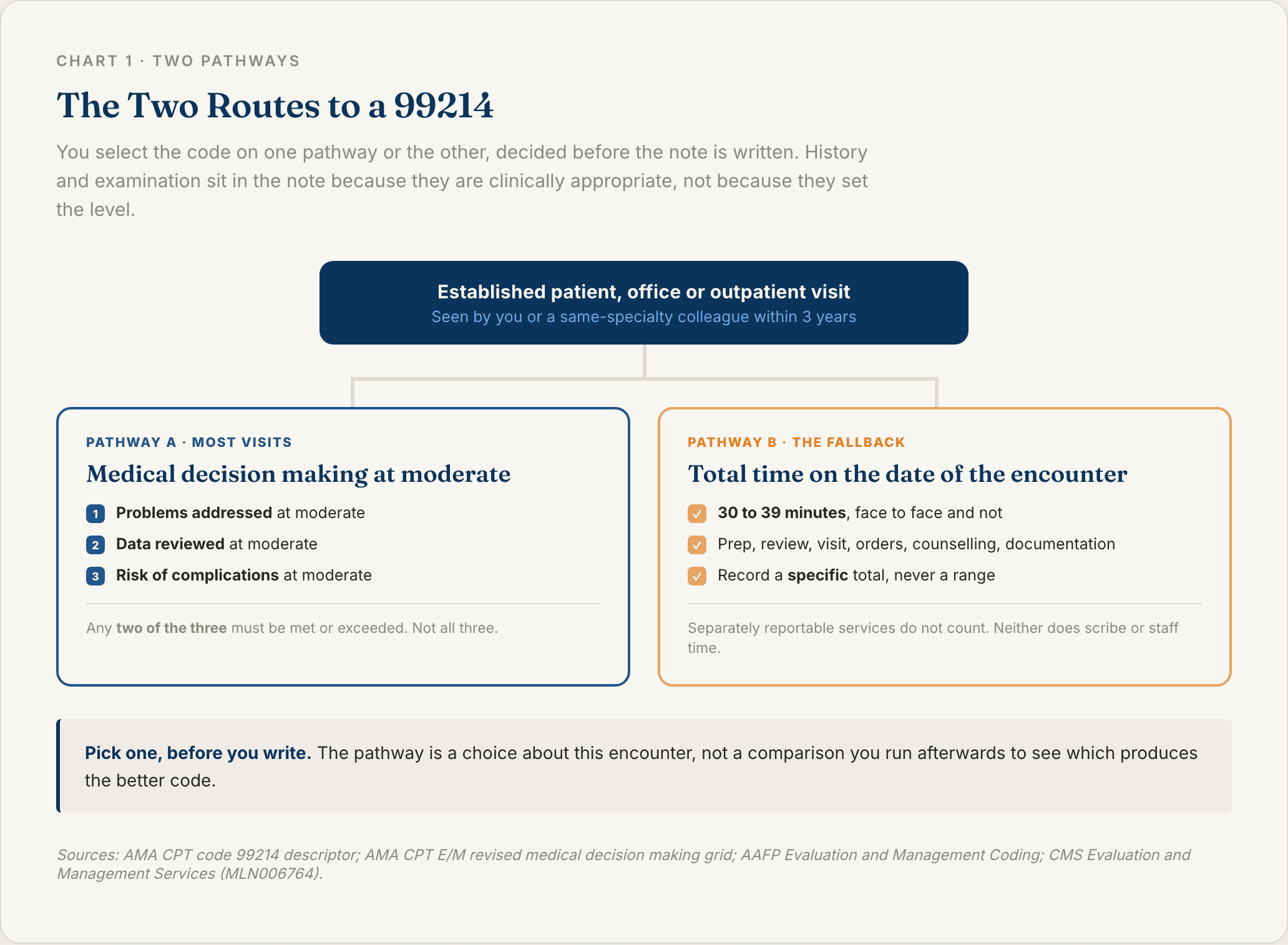
Two Ways to Get There, Time or Decision Making
You pick one pathway. Not both, and not the better of the two after the fact.
Most visits qualify on medical decision making. Time is the fallback for the visit that ran long without especially complex decisions, the one where you spent 35 minutes on counseling, coordination and documentation.
The Two of Three Rule That Decides the Level
Medical decision making has three elements, and the level is set by the highest level reached in two of them. AAFP states it directly: to qualify for a level of MDM, two of the three elements for that level must be met or exceeded [3].
That single sentence is the most consequential thing on this page, because most people document as though all three have to line up.
The three elements are the number and complexity of problems addressed, the amount and complexity of data reviewed and analyzed, and the risk of complications or morbidity from patient management [2].
Problems Addressed at Moderate
The problems element reaches moderate with any one of these [2]:
One or more chronic illnesses with exacerbation, progression, or side effects of treatment
Two or more stable chronic illnesses
One undiagnosed new problem with uncertain prognosis
One acute illness with systemic symptoms
One acute complicated injury
The second one is the line people skip past. The illnesses do not have to be flaring. Two stable chronic conditions, addressed at the visit, put this element at moderate on their own.
Addressed is the operative word. A condition listed in the chart but not evaluated or managed at this encounter does not count. AAFP publishes a companion list of presenting problems and procedures that commonly reach this level, which is a useful sanity check against your own panel [5].
Data Reviewed at Moderate
Data reaches moderate by meeting at least one of three categories [2]:
Category 1: any combination of three from reviewing prior external notes from each unique source, reviewing the result of each unique test, ordering each unique test, or an assessment requiring an independent historian
Category 2: independent interpretation of a test performed by someone else, when you are not separately billing for that interpretation
Category 3: discussion of management or test interpretation with an external physician or other qualified health professional, again not separately reported
Data is the element most routine visits do not reach, and the good news is that they do not need to.
Risk at Moderate
Risk reaches moderate at a moderate risk of morbidity from additional diagnostic testing or treatment. The AMA lists examples [2]:
Prescription drug management
A decision regarding minor surgery with identified patient or procedure risk factors
A decision regarding elective major surgery without identified risk factors
Diagnosis or treatment significantly limited by social determinants of health
Prescription drug management is the one that appears in ordinary primary care every day.
Now the limit, because this is where the code gets abused in the other direction. Prescription drug management means a management decision you made and recorded. Starting, stopping, adjusting, choosing between options, or continuing a drug for a documented reason with a monitoring plan. Reprinting a refill with no assessment behind it is not management, and coding it as such is exactly the exposure an auditor is looking for.
The Shortest Defensible Path to 99214
Put the two elements together and the picture gets simple.
Two or more stable chronic illnesses puts problems at moderate. Prescription drug management puts risk at moderate. That is two of three, and the code is supported without touching the data element at all [2].
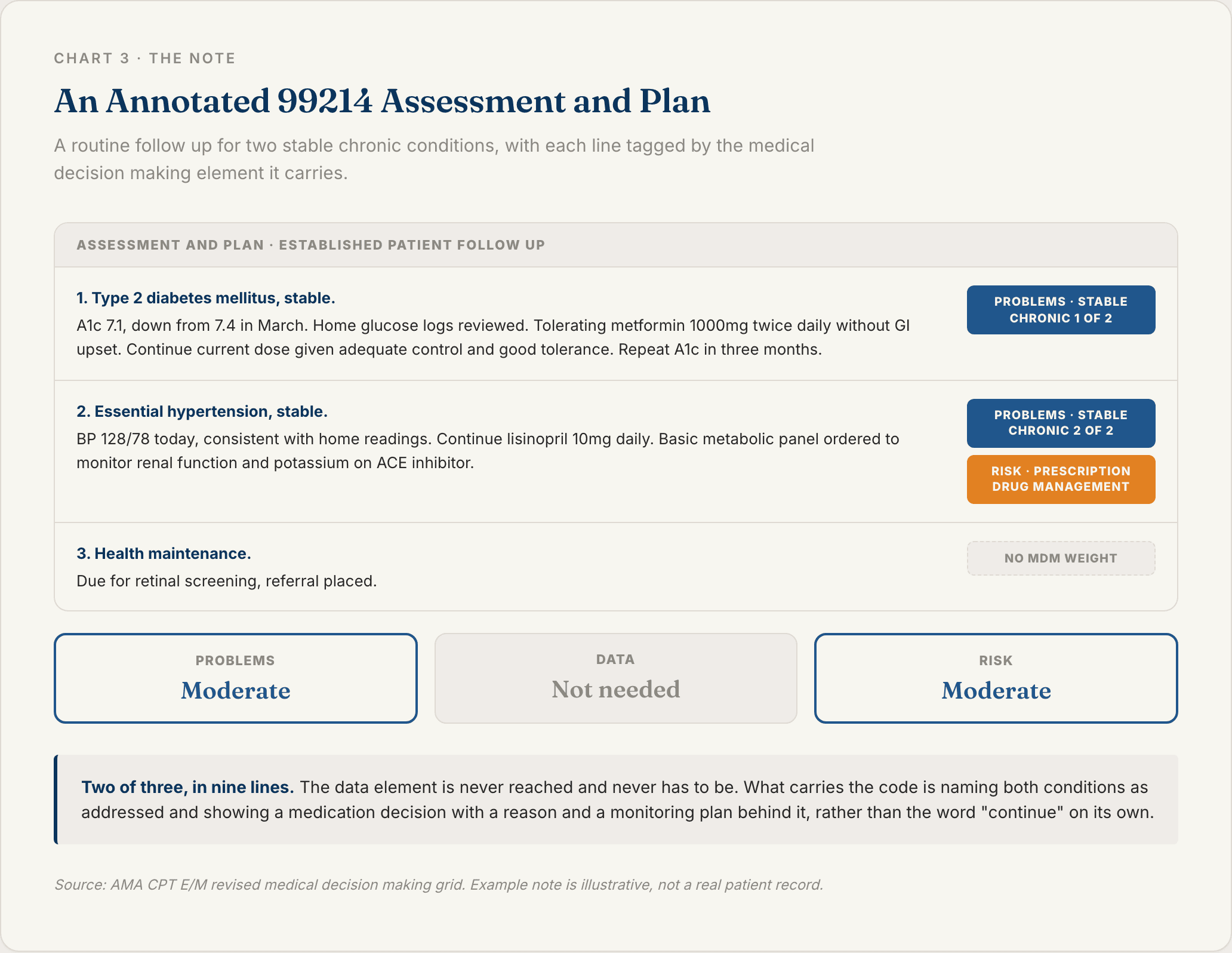
A patient with hypertension and type 2 diabetes, both stable, whose medications you review and manage, is a 99214 by the table. Not an aggressive read of the table. The table.
A Worked Note That Supports the Code
Here is what that looks like written out. It is short on purpose.
Assessment and Plan
1. Type 2 diabetes mellitus, stable. A1c 7.1, down from 7.4 in March. Home glucose logs reviewed, fasting values 110 to 135. Tolerating metformin 1000mg twice daily without GI upset. Continue current dose given adequate control and good tolerance. Repeat A1c in three months.
2. Essential hypertension, stable. BP 128/78 today, consistent with home readings. Continue lisinopril 10mg daily. Discussed sodium intake. Basic metabolic panel ordered to monitor renal function and potassium on ACE inhibitor.
3. Health maintenance. Due for retinal screening, referral placed.
Two stable chronic illnesses, both addressed, gives problems at moderate. Two medications continued with a documented reason and a monitoring plan gives prescription drug management, so risk is moderate. Two of three, and the note is nine lines long.
Wording That Turns a Refill Into Management
The difference between a supported 99214 and a downcoded one is usually a clause, not a paragraph.
Instead of: "Continue lisinopril 10mg."Write: "Continue lisinopril 10mg daily, BP at goal on current dose. BMP ordered to monitor potassium and renal function."
Instead of: "Metformin refilled." Write:"Continue metformin 1000mg twice daily. A1c improved to 7.1 and tolerating without GI side effects, so no dose change indicated."
Instead of: "Stable, continue meds."Write: "Both conditions stable on current therapy. Reviewed home glucose and BP logs, no adjustment needed. Recheck in three months."
None of these takes longer to say. Each one shows a decision instead of an outcome, and the decision is the thing being coded.
Where Sully.ai Fits in Coding a 99214
The elements that decide the level happen during the visit. The problem is that they have to survive into the note, in language a coder or an auditor can read back.
Sully.ai's AI Scribe captures the assessment and plan as you work through it, including the reasoning behind a medication decision rather than just the medication. Clinicians can save how they want their notes structured, so the assessment comes back in the same shape every visit. It runs on a single integration across Epic, Cerner, Meditech and Athenahealth.
The AI Coder then reads the finished note and assigns the code the documentation supports, then takes it through to a clean claim.
Two things worth being straight about. Sully does not turn a 99213 into a 99214. It surfaces the level the note already supports, which cuts both directions and is the only version of this that survives an audit. And for the time pathway specifically, only the clinician's own time counts, so a scribe of any kind does not add to it [3].
Sully operates across 5,000+ providers, has delivered 50M+ hours of AI work, and prices each AI role 80 to 90 percent below the human equivalent [6].
99213 Versus 99214
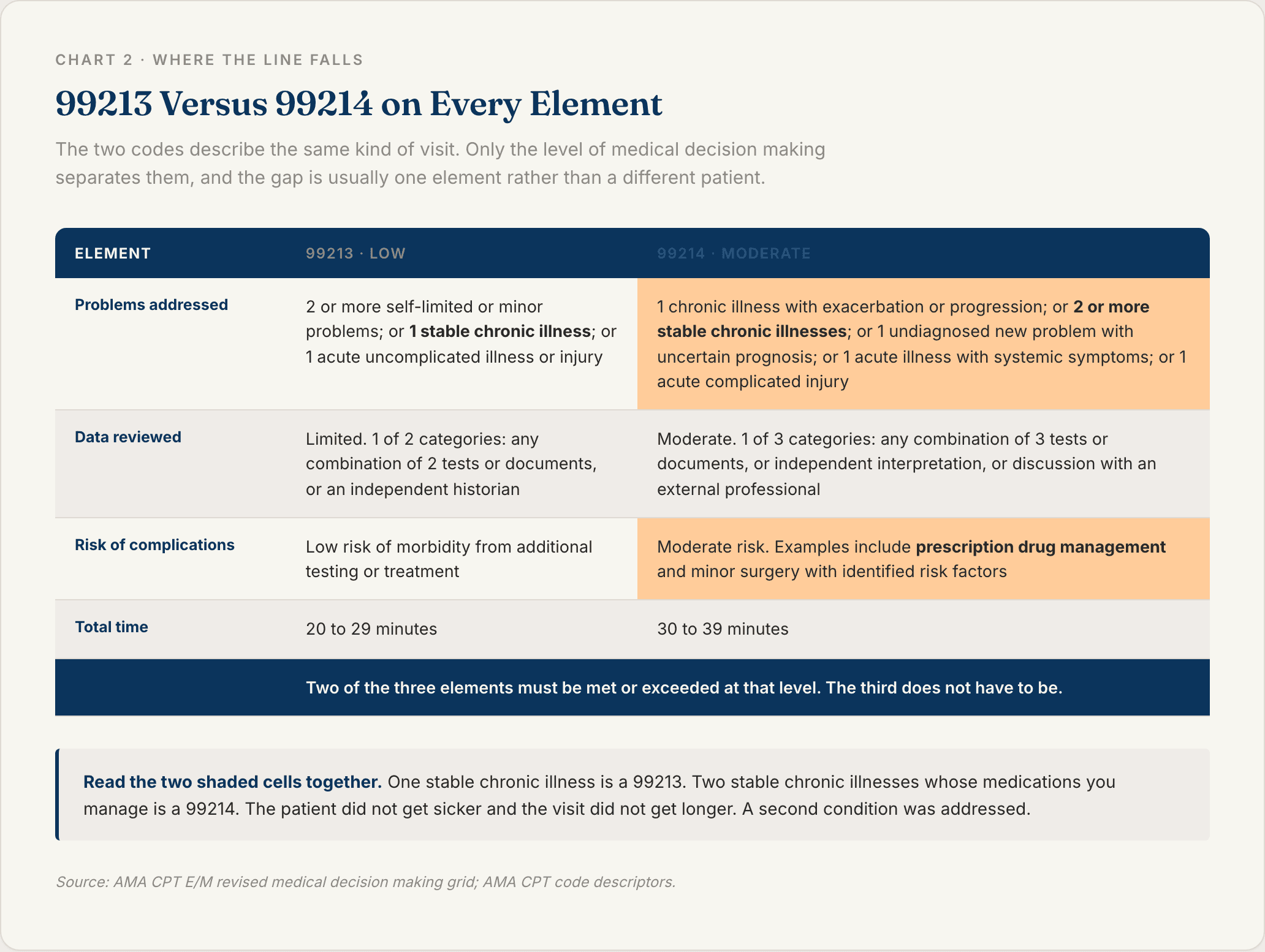
Both codes describe an established patient office visit. The only thing separating them is the level of medical decision making, low versus moderate [2].
Where the Line Actually Falls
99213 sits at low complexity. The problems element reaches low with two or more self-limited or minor problems, one stable chronic illness, or one acute uncomplicated illness or injury [2].
Read that against the moderate criteria and the gap is narrow. One stable chronic illness is a 99213. Two stable chronic illnesses is a 99214. The patient did not get sicker, and the visit did not get longer. A second condition was addressed.
Risk works the same way. Low risk of morbidity from additional testing or treatment is a 99213. Prescription drug management is moderate, which is a 99214 [2].
Most of the time the jump between these two codes is one element, not a different kind of visit.
Why Downcoding Costs More Than It Protects
Under-coding gets treated as the cautious option. It is not, it is just a different kind of inaccurate record.
A note that supports a 99214 and gets billed as a 99213 misstates the work the same way over-coding does, and it does it systematically, on every similar visit, for as long as the habit lasts. AAFP treats downcoding as its own problem with its own guidance rather than as a safe default [3].
The fix is not to code more aggressively. It is to read the note against the table and bill what the documentation actually supports, which is the same discipline behind the primary care notes that decide what gets paid.
Using Time Instead of Medical Decision Making
If the visit does not reach moderate decision making, time is the other route. For 99214 that is 30 to 39 minutes of total time on the date of the encounter [1].
What Counts Toward Total Time
Total time covers what you spent on that patient on that calendar day, face to face and not [4]. Preparing to see the patient, reviewing prior records and test results, the visit itself, counselling, ordering medications and tests, referring and communicating with other professionals, and documenting the encounter.
Services that are separately reportable do not count [3]. If you bill something separately, its time cannot also be counted toward the visit level.
Two Rules That Catch People Out
Document a specific total time, not a range. AAFP is explicit that clinicians should avoid documenting time ranges and should record the specific total time spent on the date of the encounter [3]. "30 to 39 minutes" in the note is the code range, not documentation. "34 minutes" is documentation.
Only your own time counts.Time spent by a scribe, human or otherwise, does not count toward total time, and neither does time spent by clinical staff [3]. This catches practices out constantly, because the scribe is often the one who feels like they spent the longest on the note.
Book a demo and bring a week of your 99213s. The interesting question is how many of them the notes already support at a higher level.
FAQ
Q: What is CPT code 99214? It is an office or other outpatient visit for an established patient that requires a medically appropriate history and examination and a moderate level of medical decision making. It can also be selected on 30 to 39 minutes of total time on the date of the encounter [1].
Q: What are the documentation requirements for 99214? The note has to support a moderate level of medical decision making in two of the three elements: problems addressed, data reviewed, and risk of complications from management [2][3]. In practice that usually means documenting the chronic conditions you addressed and the management decisions you made about them, including any prescription drug management, in enough detail that a reviewer can see the decision and not only the outcome.
Q: What is the difference between 99213 and 99214? The level of medical decision making. 99213 is low complexity and 99214 is moderate. One stable chronic illness sits at low, two or more stable chronic illnesses sit at moderate, and prescription drug management sits at moderate risk [2]. The jump is usually one element rather than an entirely different kind of visit.
Q: How many minutes is a 99214? 30 to 39 minutes of total time on the date of the encounter, if you are selecting the code on time rather than on decision making [1]. Record the specific total time rather than a range, and count only the time you personally spent [3].
Q: Can an AI scribe help with 99214 coding? It helps with the documentation the code depends on. Sully.ai's AI Scribe captures the assessment and the management decisions during the visit, and the AI Coder reads the finished note and assigns the codes the documentation supports. The clinical judgment and the coding responsibility stay with the clinician, and scribe time does not count toward the time pathway [3].
Sources
[1] American Medical Association — CPT Code 99214: Established Patient Office Visit, 30-39 Minutes [2] American Medical Association — CPT E/M Revised Medical Decision Making Grid [3] American Academy of Family Physicians — Evaluation and Management Coding [4] Centers for Medicare & Medicaid Services — Evaluation and Management Services, MLN006764 [5] American Academy of Family Physicians — Think 99214 If You See These Problems or Procedures [6] Sully.ai — The AI Workforce for Healthcare
TABLE OF CONTENTS
Hire your
Medical AI Team
Take a look at our Medical AI Team
AI Receptionist
Manages patient scheduling, communications, and front-desk operations across all channels.
AI Scribe
Documents clinical encounters and maintains accurate EHR/EMR records in real-time.
AI Medical Coder
Assigns and validates medical codes to ensure accurate billing and regulatory compliance.
AI Nurse
Assesses patient urgency and coordinates appropriate care pathways based on clinical needs.