"/><stop offset="1" stop-color="rgba(255, 255, 255, 0)"/></linearGradient><linearGradient id="WxV_IOPE7-2309410982-linear-gradient" x1="1" x2="0" y1="0.5951279047551217" y2="0.4048720952448783"><stop offset="0" stop-color="rgb(255, 255, 255)"/><stop offset="1" stop-color="rgba(255, 255, 255, 0)"/></linearGradient><linearGradient id="WwbAIQIz8-2309410982-linear-gradient" x1="0.43478742751482424" x2="0.6358595260107829" y1="0.26" y2="1"><stop offset="0" stop-color="rgb(255, 255, 255)"/><stop offset="1" stop-color="rgba(255, 255, 255, 0)"/></linearGradient><linearGradient id="ZWsVQcPfn-2309410982-linear-gradient" x1="0.9508213454678907" x2="0.04917865453210929" y1="0" y2="1"><stop offset="0" stop-color="rgb(255, 255, 255)"/><stop offset="1" stop-color="rgba(255, 255, 255, 0)"/></linearGradient><linearGradient id="lTyCGrzzP-2309410982-linear-gradient" x1="0.374937164194436" x2="0.625062835805564" y1="0" y2="1"><stop offset="0" stop-color="rgb(255, 255, 255)"/><stop offset="1" stop-color="rgba(255, 255, 255, 0)"/></linearGradient></defs><g d="M 658.002 1357.705 C 1020.321 1357.705 1314.04 1063.989 1314.04 701.667 C 1314.04 339.347 1020.321 45.626 658.002 45.626 C 295.681 45.626 1.96 339.347 1.96 701.667 L 0 701.667 C 0 338.263 294.598 43.665 658.002 43.665 C 1021.404 43.665 1316 338.263 1316 701.667 C 1316 1065.072 1021.404 1359.672 658.002 1359.672 C 294.598 1359.672 0 1065.072 0 701.667 L 1.96 701.667 C 1.96 1063.989 295.681 1357.705 658.002 1357.705 Z M 658.005 1265.053 C 969.154 1265.053 1221.392 1012.819 1221.392 701.667 C 1221.392 390.517 969.154 138.281 658.005 138.281 C 346.856 138.281 94.619 390.517 94.619 701.667 L 92.659 701.667 C 92.659 389.433 345.77 136.321 658.005 136.321 C 970.241 136.321 1223.352 389.433 1223.352 701.667 C 1223.352 1013.902 970.241 1267.017 658.005 1267.017 C 345.77 1267.017 92.659 1013.902 92.659 701.667 L 94.619 701.667 C 94.619 1012.819 346.856 1265.053 658.005 1265.053 Z M 658.002 1166.116 C 914.513 1166.116 1122.452 958.178 1122.452 701.667 C 1122.452 445.16 914.513 237.22 658.002 237.22 C 401.494 237.22 193.551 445.16 193.551 701.667 L 191.59 701.667 C 191.59 444.077 400.411 235.255 658.002 235.255 C 915.596 235.255 1124.412 444.077 1124.412 701.667 C 1124.412 959.261 915.596 1168.084 658.002 1168.084 C 400.411 1168.084 191.59 959.261 191.59 701.667 L 193.551 701.667 C 193.551 958.178 401.494 1166.116 658.002 1166.116 Z M 281.657 818.28 C 298.572 818.28 314.804 825.001 326.765 836.965 L 458.99 969.182 C 470.582 980.781 486.308 987.298 502.706 987.298 L 612.137 987.298 C 646.284 987.298 673.972 959.61 673.972 925.463 L 673.972 891.504 L 675.939 891.504 L 675.939 925.463 C 675.939 960.7 647.374 989.258 612.137 989.258 L 502.706 989.258 C 485.788 989.258 469.562 982.537 457.599 970.573 L 325.378 838.356 C 313.785 826.757 298.056 820.242 281.657 820.244 L 1.173 820.244 L 1.173 818.28 Z M 746.64 888.714 L 1053.046 888.714 C 1069.967 888.714 1086.194 895.435 1098.16 907.398 L 1259.381 1068.619 L 1257.99 1070.007 L 1096.772 908.79 C 1085.175 897.193 1069.446 890.679 1053.046 890.681 L 746.64 890.681 C 729.724 890.681 713.493 883.957 701.533 871.993 L 685.377 855.845 L 686.769 854.453 L 702.917 870.605 C 714.513 882.201 730.241 888.715 746.64 888.714 Z M 667.685 552 L 512.316 396.894 C 494.66 379.264 484.741 355.356 484.739 330.426 L 484.739 0 L 487.632 0 L 487.632 330.426 C 487.632 354.592 497.248 377.763 514.369 394.851 L 669.739 549.957 Z M 782.851 700.491 C 816.998 700.491 844.686 672.804 844.686 638.655 L 844.686 516.468 C 844.687 499.547 851.409 483.32 863.374 471.355 L 1177.508 157.22 L 1178.896 158.607 L 864.762 472.742 C 853.162 484.337 846.646 500.067 846.646 516.468 L 846.646 638.655 C 846.646 673.89 818.088 702.455 782.851 702.455 L 700.405 702.455 L 700.405 700.491 Z M 130.338 534.223 L 213.07 534.223 C 256.112 534.223 291.003 569.114 291.003 612.156 L 291.003 694.888 C 291.003 711.29 297.514 727.017 309.113 738.611 L 472.887 902.378 L 471.496 903.769 L 307.726 739.995 C 295.761 728.033 289.038 711.807 289.038 694.888 L 289.038 612.156 C 289.038 570.198 255.028 536.188 213.07 536.188 L 130.338 536.188 C 113.419 536.187 97.193 529.465 85.23 517.5 L 77.071 509.345 C 65.107 497.381 58.386 481.153 58.388 464.233 L 58.388 199.526 L 60.348 199.526 L 60.348 464.233 C 60.349 480.631 66.863 496.358 78.458 507.954 L 86.617 516.113 C 98.213 527.709 113.94 534.223 130.338 534.223 Z" fill="transparent" height="1359.6717183844698px" id="DcyumyANr" transform="translate(0 -43.665)" width="1316px"><g opacity="0.5"><path d="M 658.002 1314.039 C 1020.321 1314.039 1314.04 1020.324 1314.04 658.001 C 1314.04 295.681 1020.321 1.961 658.002 1.961 C 295.681 1.961 1.96 295.682 1.96 658.001 L 0 658.001 C 0 294.598 294.598 0 658.002 0 C 1021.404 0 1316 294.598 1316 658.001 C 1316 1021.407 1021.404 1316.007 658.002 1316.007 C 294.598 1316.007 0 1021.407 0 658.001 L 1.96 658.001 C 1.96 1020.324 295.681 1314.039 658.002 1314.039 Z" fill="rgb(255, 255, 255)" height="1316.0065114752902px" id="dxf13D52Y" transform="translate(0 43.665)" width="1316px"/></g><g opacity="0.3"><path d="M 565.347 1128.732 C 876.496 1128.732 1128.733 876.498 1128.733 565.346 C 1128.733 254.196 876.496 1.961 565.347 1.961 C 254.197 1.961 1.961 254.196 1.961 565.346 L 0 565.346 C 0 253.112 253.111 0 565.347 0 C 877.582 0 1130.693 253.112 1130.693 565.346 C 1130.693 877.581 877.582 1130.696 565.347 1130.696 C 253.111 1130.696 0 877.581 0 565.346 L 1.961 565.346 C 1.961 876.498 254.197 1128.732 565.347 1128.732 Z" fill="rgb(255, 255, 255)" height="1130.6960934794101px" id="if1BmYw1S" transform="translate(92.659 136.321)" width="1130.693351805604px"/></g><g opacity="0.15"><path d="M 466.412 930.861 C 722.923 930.861 930.862 722.922 930.862 466.411 C 930.862 209.905 722.923 1.965 466.412 1.965 C 209.904 1.965 1.961 209.905 1.961 466.411 L 0 466.411 C 0 208.822 208.821 0 466.412 0 C 724.006 0 932.822 208.822 932.822 466.411 C 932.822 724.005 724.006 932.828 466.412 932.828 C 208.821 932.828 0 724.005 0 466.411 L 1.961 466.411 C 1.961 722.922 209.904 930.861 466.412 930.861 Z" fill="rgb(255, 255, 255)" height="932.8284667407987px" id="ef75NsYf6" transform="translate(191.59 235.255)" width="932.8219552655086px"/></g><g opacity="0.5"><path d="M 280.484 0 C 297.399 0 313.63 6.721 325.592 18.685 L 457.817 150.902 C 469.408 162.501 485.135 169.018 501.533 169.017 L 610.964 169.017 C 645.111 169.017 672.799 141.33 672.799 107.182 L 672.799 73.223 L 674.766 73.223 L 674.766 107.182 C 674.766 142.42 646.201 170.978 610.964 170.978 L 501.533 170.978 C 484.614 170.978 468.389 164.257 456.426 152.293 L 324.205 20.076 C 312.611 8.477 296.883 1.961 280.484 1.964 L 0 1.964 L 0 0 Z" fill="url(%23cQ4xRdUtr-2309410982-linear-gradient)" height="170.97763275969464px" id="cQ4xRdUtr" transform="translate(1.173 818.28)" width="674.7656780356198px"/></g><g opacity="0.5"><path d="M 61.263 34.261 L 367.669 34.261 C 384.589 34.261 400.817 40.982 412.783 52.945 L 574.004 214.166 L 572.612 215.554 L 411.395 54.337 C 399.798 42.74 384.069 36.226 367.669 36.228 L 61.263 36.228 C 44.347 36.228 28.116 29.504 16.155 17.54 L 0 1.391 L 1.391 0 L 17.54 16.152 C 29.136 27.747 44.864 34.261 61.263 34.261 Z" fill="url(%23WxV_IOPE7-2309410982-linear-gradient)" height="215.55382175474415px" id="WxV_IOPE7" transform="translate(685.377 854.453)" width="574.0036823012563px"/></g><g opacity="0.5"><path d="M 182.946 552 L 27.577 396.894 C 9.921 379.264 0.002 355.356 0 330.426 L 0 0 L 2.893 0 L 2.893 330.426 C 2.893 354.592 12.509 377.763 29.63 394.851 L 185 549.957 Z" fill="url(%23WwbAIQIz8-2309410982-linear-gradient)" height="552px" id="WwbAIQIz8" transform="translate(484.739 0)" width="185px"/></g><g opacity="0.5"><path d="M 82.446 543.271 C 116.593 543.271 144.281 515.583 144.281 481.435 L 144.281 359.248 C 144.282 342.327 151.004 326.1 162.969 314.135 L 477.103 0 L 478.491 1.387 L 164.356 315.522 C 152.757 327.117 146.241 342.846 146.241 359.248 L 146.241 481.435 C 146.241 516.67 117.683 545.235 82.446 545.235 L 0 545.235 L 0 543.271 Z" fill="url(%23ZWsVQcPfn-2309410982-linear-gradient)" height="545.2346136318063px" id="ZWsVQcPfn" transform="translate(700.405 157.22)" width="478.4906210693257px"/></g><g opacity="0.5"><path d="M 71.95 334.696 L 154.682 334.696 C 197.724 334.696 232.616 369.588 232.616 412.63 L 232.616 495.362 C 232.616 511.764 239.126 527.491 250.725 539.084 L 414.5 702.851 L 413.108 704.243 L 249.338 540.469 C 237.373 528.507 230.651 512.281 230.651 495.362 L 230.651 412.63 C 230.651 370.672 196.64 336.661 154.682 336.661 L 71.95 336.661 C 55.031 336.661 38.805 329.939 26.843 317.974 L 18.683 309.819 C 6.719 297.854 -0.001 281.627 0 264.707 L 0 0 L 1.961 0 L 1.961 264.707 C 1.961 281.105 8.475 296.832 20.07 308.428 L 28.229 316.587 C 39.825 328.182 55.552 334.697 71.95 334.696 Z" fill="url(%23lTyCGrzzP-2309410982-linear-gradient)" height="704.2427839655832px" id="lTyCGrzzP" transform="translate(58.388 199.526)" width="414.49961191971533px"/></g></g></svg>)
A 67 minute office visit is paid exactly the same as a 54 minute one.
That is not an opinion about the fee schedule. It falls out of Medicare's own table. A 99215 covers 40 to 54 minutes of total time, and the first unit of prolonged services does not begin until 69 minutes [1]. Everything between is fourteen minutes that carry no additional payment.
Almost nothing written about this code mentions it. Here is what 99215 is, what high medical decision making actually requires, where the line sits against 99214, what happens past 54 minutes, what the visit pays, and a documentation template with two worked examples.
Key Takeaway: CPT code 99215 is the office or other outpatient visit for an established patient at a high level of medical decision making, or 40 to 54 minutes of total time on the date of the encounter [1]. Above 54 minutes, Medicare's prolonged services add-on does not begin until 69 minutes, leaving fourteen minutes that carry no additional payment [1]. Medicare uses HCPCS add-on code G2212for prolonged office visit time rather than the CPT prolonged services code, so a practice billing both Medicare and commercial payers is applying two different rulebooks to the same minutes [1]. What the visit pays is not one number. Medicare computes the fee schedule amount as the relative value units (RVUs) for the service, multiplied by the geographic adjustment factor (GAF) for your fee schedule area, multiplied by the conversion factor (CF) [2], with a non-participating supplier paid 95 percent of the participating amount [2]. Sully.ai drafts the note with the detail that supports the level you actually delivered.
What CPT Code 99215 Is
99215 is the office or other outpatient visit for an established patient at a high level of medical decision making, or 40 to 54 minutes of total time on the date of the encounter [1].
It is the top of the established patient range. 99213 sits at low decision making, 99214 at moderate, 99215 at high. Above it there is no higher office visit code, only prolonged services added on top.
High Medical Decision Making, and What High Actually Means
This is the element people read least carefully, because most clinicians carry an impression that 99215 means a visit that was unusually long or unusually dramatic. It does not. High is a defined bar, and it is reached by two of the three decision making elements, not all three.
Under problems addressed, high is reached by one or more chronic illnesses with severe exacerbation or progression, or by an acute or chronic illness or injury that poses a threat to life or bodily function.
Under risk, the recognized examples include drug therapy requiring intensive monitoring for toxicity, a decision regarding hospitalization, and a decision regarding de-escalation of care.
Data has its own extensive bar, which most 99215 visits do not need to rely on, because the other two are usually where the level is made.
Read those against a real clinic and something becomes obvious. A patient whose heart failure has decompensated, where you weighed admission and decided against it with a same-day plan, has met two of three. The visit may not have felt like a crisis. It still meets the criteria, and a note that records "heart failure, adjusted medication" instead of what actually happened does not.
The full framework, including what two of three means across all four levels, is laid out in the 99214 article rather than repeated here.
The Two Routes to 99215
You need one route, not both. Either 40 to 54 minutes of total time on the date of the encounter, or a high level of medical decision making [1].
Worth noticing: the 99215 time band is 15 minutes wide, where 99214's is 10. The bands are not uniform, which is one reason guessing from habit goes wrong.
What Happens After 54 Minutes
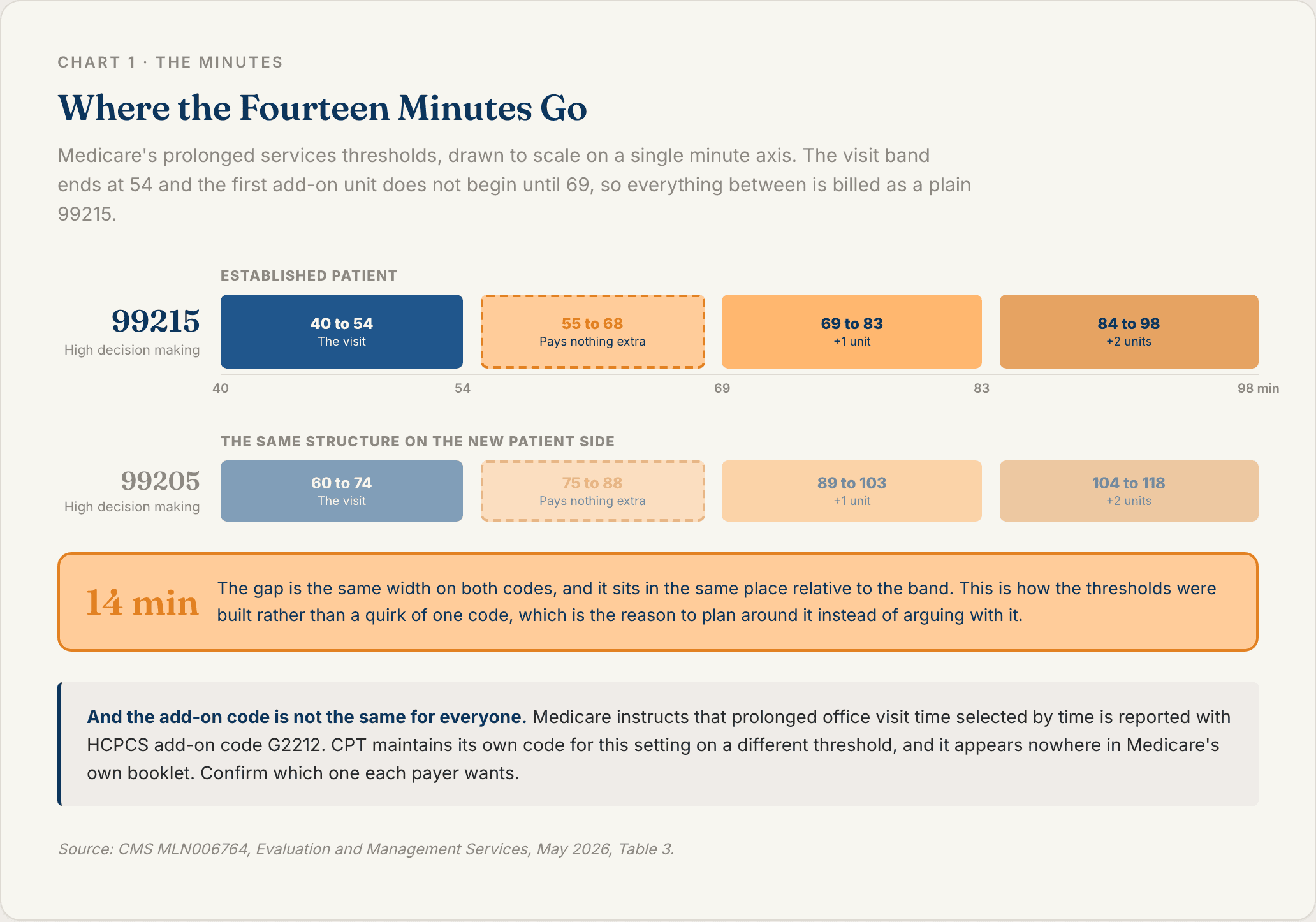
The Fourteen Minutes That Pay Nothing
Medicare publishes the thresholds as a table. For 99215 [1]:
99215 alone: 40 to 54 minutes
99215 plus one unit of prolonged services:69 to 83 minutes
99215 plus two units:84 to 98 minutes
99 minutes or more:three or more units
Look at the first two lines together. The visit ends at 54. The next threshold starts at 69. A visit of 55 to 68 minutes is billed exactly as a 54 minute visit.
Before anyone treats that as an error worth working around, look at the new patient side of the same table. 99205 alone is 60 to 74 minutes, and its first prolonged unit begins at 89 [1]. Fourteen minutes again, in the same place relative to the band.
The gap is structural. It is how the thresholds were built, not a quirk of one code, and that is exactly why it is worth knowing rather than fighting.
Medicare Says G2212, and CPT Says Something Else
Here is a second thing the same booklet settles, which practices routinely get wrong.
Medicare's instruction is direct: when you select the office or outpatient visit level using time, report the prolonged visit time using HCPCS add-on code G2212 [1].
CPT maintains its own prolonged services add-on for this setting, and it has not historically used the same time threshold that Medicare uses. The clearest evidence of the divergence is negative: the CPT prolonged services code for this setting does not appear anywhere in Medicare's own evaluation and management booklet [1].
The practical consequence is not subtle. A practice seeing Medicare patients and commercial patients is applying two different codes, with two different thresholds, to the same minutes. There is no version of this where one habit covers both.
The only safe move is to confirm which code and which threshold each payer wants, in writing, rather than carrying one rule across the whole schedule. This article deliberately does not print the CPT-side threshold figure, because it is the kind of number that changes and the kind of number that is dangerous to half-remember.
What to Do With a 60 Minute Visit
Three things, and none of them is padding the clock.
Check the decision making route first. If the visit reaches high on two of three elements, the time question is moot. The code stands on the other route and the note should make that case explicitly rather than leaning on a minute count that does not help.
Record the actual total time anyway. A documented 63 minutes supports the 99215 without any ambiguity. The payment is the same as 54, but the record is accurate, and an accurate record is the thing being graded if anyone ever reads it back.
Know where the next threshold is. A visit genuinely running toward 69 minutes should not be recorded as "about an hour" out of habit, because that phrasing loses a real threshold that the actual figure would have crossed.
What none of this justifies is adjusting the number. The minutes are what they are. The gap is a feature of the schedule, not a problem to engineer around, and a time entry that drifts upward to clear a threshold is the single easiest thing to find in a record.
99214 or 99215
This is the comparison people actually search for, more than any other question about this code.
Code | Medical decision making | Total time on the date of the encounter |
|---|---|---|
99214 | Moderate | 30 to 39 minutes |
99215 | High | 40 to 54 minutes |
Source [1].
What moves a visit from moderate to high is severity and the kind of decision, not duration. A chronic illness in severe exacerbation rather than a stable one. A decision about hospitalization rather than a medication adjustment. Drug therapy requiring intensive monitoring for toxicity rather than routine prescription management.
The observation worth carrying out of this section: the two routes are independent, and you only need one. A visit can run 50 minutes and still be a 99214, because nothing in it reached high decision making. A visit can be a 99215 at 25 minutes, because the decision making did. Neither of those is a contradiction, and expecting time and complexity to agree is the assumption that produces most of the errors on this code.

What 99215 Actually Pays
There is no single national figure, which is the same answer that holds for every code in this range.
Under 42 CFR 414.20, the fee schedule amount for a participating supplier is computed as the RVUs for the service, multiplied by the GAF for the fee schedule area, multiplied by the CF [2]. Two of those three move: the geographic adjustment factor differs in every fee schedule area, and the conversion factor is set annually and revised most years.
RVUs are established separately for physician work, practice expense and malpractice insurance [3], and the practice expense component is lower in a facility than in an office. A non-participating supplier is paid 95 percent of the participating amount [2].
Get your own figure from the CMS Physician Fee Schedule Look-Up Tool [4]: the year, the code, your Medicare Administrative Contractor (MAC) locality, and facility or non-facility. Commercial payers set their own rates separately.
If you are asking what the visit is worth to you as an employed physician rather than to the practice, that is a different question with a different answer. The work RVU, and why it does not move with your locality, is covered in the 99204 article.
Why a 99215 Gets Scrutinized
99215 is the top of the range, so the note gets read more carefully than it would at 99213. That is the whole mechanism. What follows is what a reviewer looks for, not a claim about what any payer's system flags.
Which route the note says it used. State it. A reviewer should not have to infer whether you are making a time case or a decision making case.
If decision making, whether the severity is stated rather than implied. This is where most 99215 notes fail. "Diabetes" is not "diabetes with severe hyperglycemia requiring same-day intervention". The first describes a diagnosis. The second describes a problem addressed at high. The visit may have been identical.
If time, whether the figure is qualified. Stated as total time on the date of the encounter, and counting only the reporting clinician [1]. A bare number is not evidence of either.
Whether the plan matches the severity the assessment claims. An assessment describing a high-risk decision followed by a routine plan does not agree with itself, and that disagreement is visible to anyone reading the note end to end.
One honest note to close on, and it runs opposite to the rest of this family. On 99213 and 99203, the common error is coding below what the work supported. On 99215, caution about over-coding is reasonable, because this is the code where the gap between what a visit felt like and what it met is widest in both directions. The answer is still the same: read the note against the criteria rather than defaulting in either direction.

The 99215 Documentation Template
One block, complete as written. Paste it straight into a chart, or start from the progress note template and add the two lines this code needs.
OFFICE VISIT, ESTABLISHED PATIENT, HIGH COMPLEXITY
Patient, date of service: (and the rendering clinician)
Established patient confirmation: (date of the most recent prior visit with you or a same-specialty colleague in the group)
Chief complaint: "(in the patient's words)"
History relevant to today: (what has changed, with the change stated)
Examination: (findings relevant to the problems addressed, with values)
Problems addressed today, with severity: (each problem named, and its status stated as stable, progressing, or in severe exacerbation; severity is what sets the element)
Data reviewed: (labs, imaging, outside records, independent interpretation, discussion with another clinician, or "none")
Risk of management selected: (the decision made, and what makes it high risk; name it, for example a decision regarding hospitalization)
Route used: (time, or medical decision making; state which)
If time: (total time on the date of the encounter, stated in those words, counting only this clinician, and what it comprised)
Prolonged services check: (if total time is 69 minutes or more, confirm the add-on code and threshold this payer uses)
Assessment and plan, per problem: (each problem gets its own assessment and plan, and the plan has to match the severity the assessment claims)
Signature, credentials, date: (the clinician who performed the service)
Two lines here do not appear in the templates for the lower codes. "Problems addressed today, with severity"carries the decision making case, because severity is the element and a bare diagnosis list does not state it. "Prolonged services check" exists so that a long visit prompts the question rather than quietly defaulting to a plain 99215.
Where Sully.ai Fits in a Long Visit
A 99215 visit is long, complicated, or both. It is also the visit most likely to be documented late, and the one where the most gets lost between the room and the note.
What gets lost is specific: the severity you observed and acted on, the decision you weighed and rejected, the outside record you read beforehand, the reasoning behind the plan. Those are the three decision making elements, and all three were spoken aloud.
Sully.ai's AI scribe drafts the note from the visit, so the problems addressed and their stated severity, the data reviewed and the risk are on the page rather than reconstructed later. It runs on a single integration across Epic, Cerner, Meditech and Athenahealth.
Two boundaries, and both are refusals.
Nothing should choose the code. Code selection is your attestation, it is what a reviewer examines, and it carries liability belonging to the person who saw the patient. That matters more at the top of the range than anywhere else.
No documentation tool adds to your clock. Only the reporting clinician's own time counts toward the time route [1]. A scribe of any kind does not help a visit reach 40 minutes, and it does not help it reach 69. In an article that is largely about minute thresholds, that boundary needs saying without any hedging.
Sully operates across 5,000+ providers, has delivered 50M+ hours of work, and prices each role 80 to 90 percent below the human equivalent [5].
Two Worked Examples
A Visit That Is Clearly 99215
Established patient, seen 6 weeks ago. 47 minutes total time on the date of the encounter.
Established patient confirmation: Seen by this clinician 6 weeks ago for routine heart failure follow-up.
Chief complaint:"I can't lie flat anymore and my legs have blown up again."
History relevant to today:71 year old man, heart failure with reduced ejection fraction, ejection fraction 30 percent on echocardiogram 4 months ago. Previously stable on carvedilol, sacubitril-valsartan and furosemide 40mg daily. Over the past 9 days, progressive orthopnea now requiring three pillows, paroxysmal nocturnal dyspnea twice this week, and weight up 9 pounds from his recorded dry weight. Reports adding salt back to his diet after a family event. No chest pain. No syncope.
Examination: Blood pressure 104/62, heart rate 96 regular. Oxygen saturation 94 percent on room air. Jugular venous pressure elevated to the angle of the jaw. Bibasilar crackles to mid zones. Pitting edema to mid shin bilaterally. Weight 213 pounds, up from 204.
Problems addressed today, with severity: Heart failure with reduced ejection fraction, in severe exacerbation, with progressive orthopnea, paroxysmal nocturnal dyspnea and 9 pounds of fluid gain over 9 days.
Data reviewed: Basic metabolic panel drawn today, creatinine 1.6 up from 1.2, potassium 4.1. B-type natriuretic peptide 1,840, up from 410 four months ago. Chest radiograph ordered and personally reviewed, showing pulmonary vascular congestion without consolidation. Echocardiogram report from 4 months ago re-reviewed.
Risk of management selected: Decision regarding hospitalization. Admission considered and discussed with the patient given the degree of congestion and the rising creatinine. Decided on intensified outpatient management with a same-day plan and 48 hour review, on the condition that he has support at home and can return immediately if symptoms worsen. Furosemide increased with renal function monitoring, which requires close surveillance for toxicity.
Route used: Medical decision making. Time also documented.
If time: Total time on the date of the encounter, counting only this clinician: 47 minutes, comprising review of prior records and the previous echocardiogram before the visit, the encounter itself, ordering and personally interpreting the radiograph and labs, the admission discussion, and documentation.
Assessment and plan: Heart failure with reduced ejection fraction in severe exacerbation, volume overloaded, with early cardiorenal change. Furosemide increased to 80mg twice daily for 3 days, then reassess. Strict daily weights with written thresholds for calling. Fluid restriction 1.5 liters daily and salt counseling repeated with his daughter present. Basic metabolic panel in 48 hours, in person, to check creatinine and potassium. Return immediately or present to the emergency department if weight rises further, if breathlessness worsens, or if he cannot keep fluids down. Review in 48 hours.
Why this is a 99215. Problems addressed reaches high: one chronic illness in severe exacerbation. Risk reaches high: a decision regarding hospitalization, plus drug therapy requiring close monitoring for toxicity. That is two of three elements at high, which is the bar. Data is also substantial, but it was not needed.
The visit also clears 40 minutes, so both routes support the code. The note says which one it used.
A Long Visit That Is Still a 99214
Same clinic, a different established patient. 58 minutes total time.
Established patient confirmation: Seen by a colleague in this group 4 months ago.
Chief complaint: "I keep forgetting the tablets and I don't know what to do about my mother."
History relevant to today: 58 year old woman, type 2 diabetes diagnosed 2019 and essential hypertension diagnosed 2016, both previously stable. HbA1c 7.4 percent three weeks ago, up from 7.1. Blood pressure readings at home averaging 136/84. She has become the full-time carer for her mother, who has advancing dementia, and describes missing her evening metformin perhaps three nights a week. No hypoglycemic episodes. No chest pain, no visual change, no neuropathic symptoms. No new complaints.
Examination: Blood pressure 138/86, repeated 134/82. Heart rate 74 regular. Weight stable. Feet examined, sensation intact with monofilament, no ulceration, pedal pulses present.
Problems addressed today, with severity: Type 2 diabetes, stable with mild deterioration in control, not in exacerbation. Essential hypertension, stable, at target on current therapy. Carer strain affecting medication adherence.
Data reviewed: HbA1c from three weeks ago. Home blood pressure log. No new tests ordered today.
Risk of management selected: Simplifying the existing regimen to a morning-only schedule to match her routine. No new agent started, no dose increase. Moderate risk: prescription drug management.No decision regarding hospitalization, no therapy requiring intensive monitoring for toxicity.
Route used: Medical decision making.
If time: Total time on the date of the encounter, counting only this clinician: 58 minutes, comprising record review, the encounter, extended discussion of carer support and adherence, a referral to social services, and documentation.
Assessment and plan: Type 2 diabetes with mild loss of control, attributable to missed evening doses rather than disease progression. Switching metformin to the extended release preparation, 1g once daily in the morning, to remove the evening dose entirely. Hypertension at target, continue current therapy unchanged. Referral to adult social services for a carer assessment, with her consent. HbA1c in 3 months. Review in 6 weeks.
Why this is a 99214 and not a 99215. Problems addressed reaches moderate, not high: two stable chronic illnesses, neither in severe exacerbation and neither threatening life or bodily function. Risk reaches moderate: prescription drug management. Nothing reaches the high bar on any element.
And the time route does not rescue it. 58 minutes sits above the 99215 band of 40 to 54 and below Medicare's first prolonged services threshold of 69[1]. It is squarely inside the fourteen minute gap this article opened on.
The visit genuinely took 58 minutes. Most of that was the conversation that mattered most to the patient. The note records the time accurately, the code is a 99214, and none of that is a failure. Knowing it in advance is simply better than finding out from a denial, and it is the reason the prolonged services line belongs in the template.
FAQ
What is CPT code 99215?
The office or other outpatient visit for an established patient at a high level of medical decision making, or 40 to 54 minutes of total time on the date of the encounter [1].
How many minutes is a 99215 visit?
40 to 54 minutes of total time on the date of the encounter [1]. Above 54 minutes, Medicare's prolonged services add-on does not begin until 69 minutes, so a visit of 55 to 68 minutes carries no additional payment and is billed as a plain 99215 [1].
What is the difference in reimbursement between CPT codes 99214 and 99215?
There is no single national figure for either, so there is no single national gap. Medicare computes each as the RVUs for the service multiplied by the geographic adjustment factor for your area and the conversion factor [2], which means both amounts, and the difference between them, vary by locality and by year. Get both figures for your own locality from the CMS Physician Fee Schedule Look-Up Tool [4]. Commercial payers set their own rates separately.
What is the difference between CPT code 99213 and 99215?
Two levels apart. 99213 is low medical decision making, or 20 to 29 minutes of total time. 99215 is high, or 40 to 54 minutes [1]. 99214, at moderate or 30 to 39 minutes, sits between them.
How much does a 99215 cost?
It depends on your locality, the year, whether the service was provided in a facility or an office, and the payer. The CMS Physician Fee Schedule Look-Up Tool returns the Medicare figure for your area [4]. The evaluation and management framework the codes sit in is published by the AMA [6].
Sources
[1] Centers for Medicare & Medicaid Services — Evaluation and Management Services, MLN006764, May 2026. https://www.cms.gov/outreach-and-education/medicare-learning-network-mln/mlnproducts/downloads/eval-mgmt-serv-guide-icn006764.pdf
[2] U.S. Government Publishing Office — 42 CFR 414.20, Formula for computing fee schedule amounts. https://www.govinfo.gov/content/pkg/CFR-2023-title42-vol3/xml/CFR-2023-title42-vol3-sec414-20.xml
[3] U.S. Government Publishing Office — 42 CFR 414.22, Relative value units (RVUs). https://www.govinfo.gov/content/pkg/CFR-2023-title42-vol3/xml/CFR-2023-title42-vol3-sec414-22.xml
[4] Centers for Medicare & Medicaid Services — Physician Fee Schedule Look-Up Tool. https://www.cms.gov/medicare/physician-fee-schedule/search
[5] Sully.ai — AI Medical Scribe. https://www.sully.ai/medical-scribe
[6] American Medical Association — CPT Evaluation and Management. https://www.ama-assn.org/practice-management/cpt/cpt-evaluation-and-management
TABLE OF CONTENTS
Hire your
Medical AI Team
Take a look at our Medical AI Team
AI Receptionist
Manages patient scheduling, communications, and front-desk operations across all channels.
AI Scribe
Documents clinical encounters and maintains accurate EHR/EMR records in real-time.
AI Medical Coder
Assigns and validates medical codes to ensure accurate billing and regulatory compliance.
AI Nurse
Assesses patient urgency and coordinates appropriate care pathways based on clinical needs.