Article
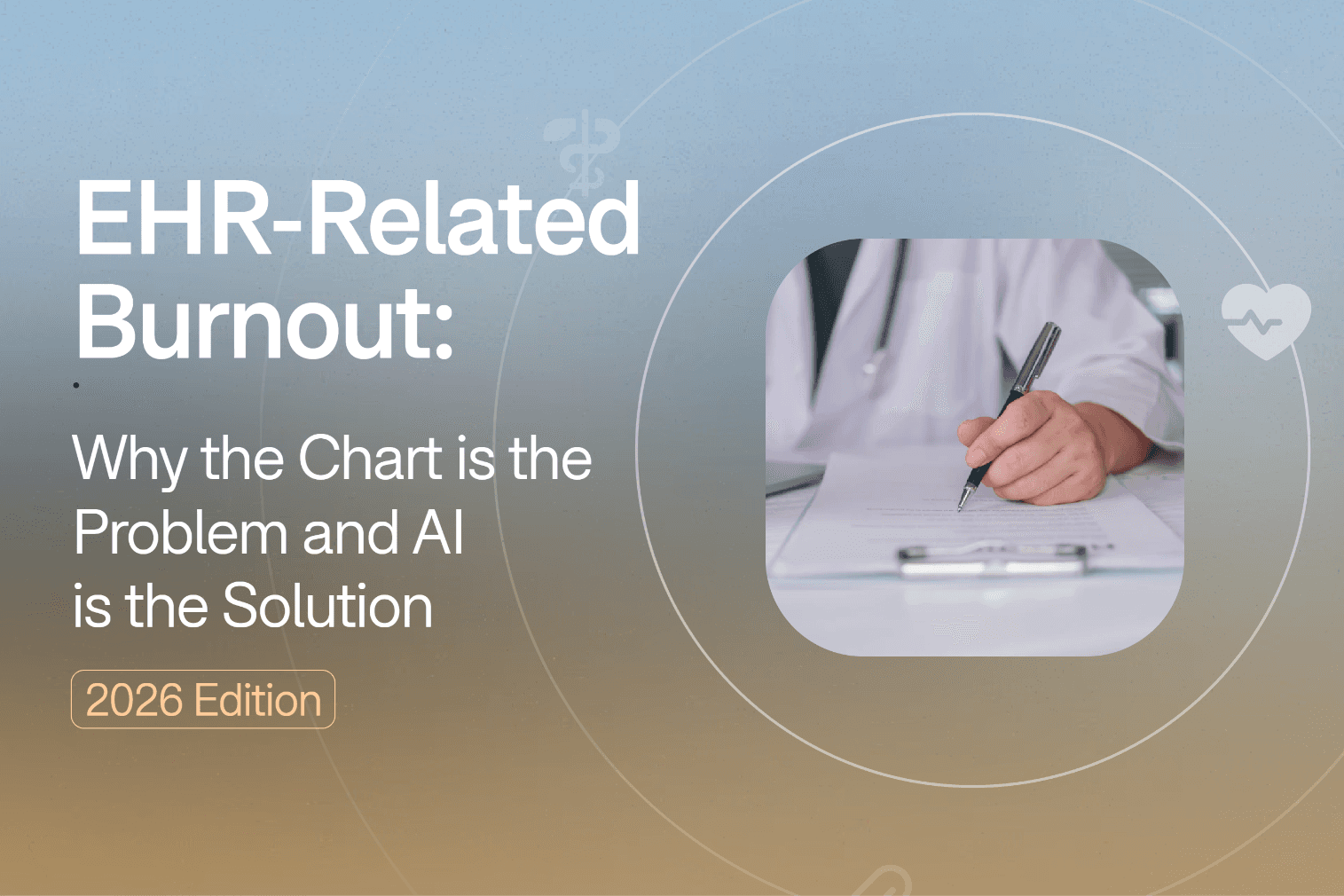

Every physician knows the feeling. The last patient of the day has gone home, the exam rooms are quiet, and the actual work still waits. Electronic health records were introduced as a tool to improve care coordination, reduce medical errors, and streamline clinical practice. Most physicians working today have produced the opposite effect. The chart has become one of the most contested spaces in modern medicine, and the EHR documentation burden it creates is now a primary driver of physician departure, reduced clinical capacity, and deteriorating care quality across every specialty. This post examines the drivers of EHR burnout and how AI is fundamentally changing the relationship between physicians and their documentation.
The Scale of EHR-Related Burnout in American Medicine
How Much Time Physicians Really Spend in the EHR
The numbers are difficult to rationalize. Research found that physicians spend roughly nine minutes in their EHR for every 15 minutes they spend with a patient. Over a full workweek, that ratio means outpatient physicians spend up to twice as much time interacting with the EHR as they do interacting directly with their patients. The average workweek runs 57.8 hours, with 13 hours dedicated to indirect patient care and only 27.2 hours spent in direct patient contact. The chart has grown into a second job that runs parallel to clinical care and rarely ends when the clinic does.

Burnout Rates Tied to Documentation Overload
Physician burnout EHR research has consistently identified documentation and clerical burden as the top contributors to clinician distress across specialties. A 2024 meta-analysis found that up to 75% of physicians who report burnout symptoms attribute them to their EHR system. In 2024, 43.2% of physicians reported experiencing at least one burnout symptom - a figure that, while improved from 53% in 2022, still represents hundreds of thousands of clinicians operating under sustained distress.
Electronic health record burnout is consistently present across primary care, specialty medicine, and hospital settings. The pattern is not confined to high-volume practices or underresourced environments. It is a structural feature of how contemporary EHR systems place demands on clinical time.
The Financial Cost to Healthcare Organizations
The EHR documentation burden carries a price tag that extends well beyond the individual clinician. Physician burnout costs the U.S. healthcare system approximately $5.6 billion annually, driven by turnover, reduced productivity, early retirement, and downstream effects on the quality of patient care. Replacing a single physician costs a health system between $500,000 and $1 million when recruitment, onboarding, and lost revenue are included. Organizations that treat documentation-driven burnout as an administrative inconvenience rather than a strategic risk tend to encounter that cost later in exit interviews and chronic vacancy rates.
How the Chart Became the Enemy of Clinical Care
The Original Promise of EHRs vs. the Reality Physicians Face Today
When the Health Information Technology for Economic and Clinical Health Act accelerated EHR adoption in 2009, the premise was straightforward: digitize the record, improve care coordination, reduce errors, and streamline billing. The vision was clinically sound. The execution produced systems designed primarily around billing requirements and regulatory compliance rather than clinical usability. By the time EHRs became the standard across American medicine, they had accumulated layers of documentation requirements, billing prompts, compliance checkboxes, and alert systems that transformed clinical notes into bureaucratic exercises. The chart grew longer, the time required to complete it grew with it, and the clinician's presence in the EHR grew to fill both.
Documentation Requirements That Outgrew Their Purpose
The EHR time burden physicians experience today is largely the product of documentation requirements that escalated far beyond their original clinical intent. Meaningful Use incentives, quality reporting mandates, and payer-specific documentation standards layered requirement upon requirement into clinical workflows until a routine office visit note can span several pages of structured fields, dropdown selections, and templated text.
Physicians frequently describe the modern EHR note as a document written for auditors and insurers rather than for the next clinician who reads it. When documentation serves compliance more than clinical communication, both the medical record and the physician who produces it are diminished.
The regulatory requirements that have most significantly expanded the modern EHR note are consistent across the peer-reviewed literature. The following sources reflect the mandates that have added the most documentation volume to the average clinical encounter:
Meaningful Use Certification Requirements. Beginning in 2009, Meaningful Use incentive programs required physicians to document an expanding set of structured data elements in the EHR to qualify for financial incentives. Each certification stage added documentation requirements that persisted in clinical workflows long after the incentive programs themselves concluded.
Quality Measure Reporting for Value-Based Programs. Quality reporting programs tied to Medicare reimbursement require documentation of specific clinical activities, patient education, and care coordination steps within each encounter note. These requirements added structured fields, checkboxes, and templated text to notes that previously only needed to accurately reflect the clinical encounter.
Payer-Specific Prior Authorization Documentation. Commercial and government payers frequently require documentation of specific clinical criteria, prior treatment failures, and medical necessity justifications before authorizing referrals, imaging, and certain medications. Meeting these requirements necessitates additional documentation in the clinical note to support payer approval, rather than clinical communication.
Medical Liability and Defensive Documentation Practices. Risk management guidance has historically encouraged physicians to document clinical reasoning, patient counseling, and the rationale for decisions in sufficient detail to support legal defense. This culture of defensive documentation adds narrative content to every note that is clinically redundant but legally protective.
Each of these demands was introduced for legitimate purposes. Cumulatively, they have produced a documentation environment in which the average clinical note serves four separate masters: the clinician, the payer, the regulator, and the legal record, and satisfies none of them as well as a note written for one purpose alone would.
The Cognitive Weight of a Modern Clinical Note
The clinical documentation burden is a matter of cognitive effort. Each note requires a physician to simultaneously recall clinical details from the encounter, translate their reasoning into billable language, navigate a system built for data entry rather than clinical thought, and review what the EHR auto-populated for accuracy. That cognitive switching cost accumulates across a full clinic day and contributes to EHR fatigue in ways that time-tracking alone fails to capture. There are documented measurable increases in cognitive load associated with EHR use, particularly in settings where documentation templates do not align with the clinical structure of the encounter.
"Pajama Time" and the After-Hours Documentation Crisis
What Happens When Charting Follows Physicians' Homes
"Pajama time" refers to the hours physicians spend completing documentation at home after clinic hours, in the evenings, on weekends, and during personal time, never intended to be part of the workday. Studies tracking EHR usage patterns find that physicians average 1.2 hours of after-hours EHR work on clinic days and 1.3 hours on weekends. The American Medical Association has documented this pattern extensively, noting that EHR systems routinely follow physicians into personal hours in ways that most professional tools do not.
After-hours documentation is associated with higher burnout scores, lower job satisfaction, and reduced intention to remain in clinical practice. Three outcomes that converge into the physician turnover crisis that health systems are actively trying to address.
Weekend Documentation and the Erosion of Work-Life Balance
Weekend charting eliminates the recovery time physicians need to sustain clinical performance across a career. A physician who spends Saturday morning finishing Friday's notes has not separated from the workweek, and over months and years, that compression accumulates into the chronic exhaustion that precedes burnout. Physician documentation overload is most visible in weekend charting data. Healthcare organizations that treat physician wellness as a strategic priority have begun measuring after-hours EHR activity as a leading indicator of burnout risk, using this data to calibrate intervention timing before burnout reaches a critical stage.
Inbox Overload as a Secondary EHR Burden
Documentation is one dimension of EHR-related pressure. The physician's inbox has become a significant time sink, with physicians spending meaningful hours each day managing communications that require clinical judgment but generate no billable encounter. The inbox problem compounds the note problem. Together, they form a cycle in which time saved in one area is often absorbed by the other unless both are addressed with dedicated tools simultaneously.

EHR Design Problems That Compound Clinician Frustration
Usability Failures Built Into Legacy EHR Systems
The leading EHR platforms in the United States were built in an era when the primary design goal was comprehensive data capture rather than clinician efficiency. The result is systems that are powerful in their data architecture and often cumbersome in their daily operation. Common usability complaints include excessive click burden, poor information hierarchy, and workflows that require multiple navigation steps for tasks clinicians expect to complete in a single action.
The Disconnect Between EHR Workflows and Clinical Reality
Clinical thinking does not follow the menu structure of a dropdown-driven interface. Physicians reason through differentials, weigh contextual information, and arrive at clinical conclusions through a fundamentally narrative process. EHRs, built around structured data fields and templated inputs, resist that narrative process and require physicians to translate their reasoning into a format the system can store.
Alert Fatigue, Notification Overload, and Decision Fatigue
Modern EHR systems generate a high volume of automated alerts per clinical hour, including drug interaction warnings, overdue preventive care prompts, and documentation reminders. When most alerts prove low-relevance, physicians begin overriding them by default rather than evaluating each one individually. That behavior, known as alert fatigue, is a well-documented patient safety risk that emerges directly from EHR design choices.
Processing hundreds of alerts per day, many of which are duplicative or irrelevant, contributes directly to the broader pattern of EHR fatigue and reduces the mental bandwidth physicians need for the clinical decisions that carry real consequences.
How AI Medical Scribes Reduce EHR Documentation Burden
An AI medical scribe operates as an ambient documentation tool. It listens to the clinical encounter, processes the conversation in real time, and generates a structured clinical note ready for physician review within seconds of the visit ending. The physician speaks naturally with the patient, and the AI extracts relevant clinical content, organizes it according to the practice's note format, and populates the appropriate EHR fields directly. The result is a note that emerges as a byproduct of the conversation rather than as a separate task following it. For a specialty like primary care, where a physician may see 20 or more patients per day, that shift in workflow has measurable effects on both time and cognitive load across the full clinic day.
The clinical value of an AI scribe is directly proportional to how cleanly it connects with the EHR systems a practice already uses. AI EHR integration determines whether a physician can review and sign a note within the EHR workflow they know - or whether they must toggle between a separate documentation platform and their primary system, a friction point that reduces adoption and negates efficiency gains.
Modern medical scribe software built for clinical settings integrates directly with Epic, Cerner, Athenahealth, and more than 50 other EHR platforms, placing the AI-generated note into the appropriate template within the system the practice already uses. Sully's AI Scribe is designed around this integration-first model, ensuring that documentation reaches the EHR without manual transfer steps between platforms.
The clinical evidence supporting AI to reduce physician burnout is growing and consistent. Ambient AI scribes meaningfully reduced physician burnout and returned clinician focus to the patient encounter. Research from Mass General Brigham found that clinicians using ambient clinical documentation spent 8.5% less total time in the EHR than matched controls, with a more than 15% reduction in time spent composing notes specifically.
A quality improvement study spanning six health systems found that after 30 days of AI scribe use, burnout prevalence among ambulatory clinicians dropped from 51.9% to 38.8% - a 13-percentage-point reduction in one month. Across more than 2.5 million patient encounters tracked over one year, AI scribes saved physicians an estimated 15,791 hours of documentation time.
The Broader AI Toolkit for EHR Burden Relief
AI for Medical Charting
AI tools integrated into clinical workflows assist with order-entry suggestions, after-visit summary generation, and the automated population of structured data fields that would otherwise require manual input. Each of these capabilities targets a specific component of the documentation load that contributes to after-hours charting time. When physicians spend less time on note construction, order entry, and patient-facing summaries, the total EHR burden per encounter drops substantially - and that reduction plays out across every patient in a full clinic day.
AI for Doctor Notes
AI-assisted inbox management addresses the secondary burden that often absorbs the time physicians save on charting. AI tools can triage incoming patient messages, draft responses to routine inquiries, flag urgent communications for immediate attention, and automate prescription renewal workflows - reducing the daily inbox volume that physicians currently process manually.
AI medical notes generated for patient portal messages and after-visit communications also reduce the time physicians spend on documentation that falls outside the billable encounter but still demands clinical judgment. Sully's full suite of AI agents is designed to address the complete administrative surface area physicians face, from the clinical note to the patient message and every workflow in between.
Medical Scribe Software
The most important selection criterion for any medical scribe software is integration depth. A tool that generates an accurate note but requires manual transfer into the EHR has relocated the documentation problem rather than solved it. Practices evaluating AI documentation solutions should prioritize vendors whose AI EHR integration is direct, bidirectional, and compatible with their specific EHR version and template configuration. Sully's integrations span more than 50 EHR systems without requiring the physician to leave the EHR environment.
Measuring Progress After AI Adoption
Key Metrics That Indicate AI Is Reducing EHR Burden
Implementing AI in healthcare documentation without measuring its impact leaves organizations unable to demonstrate ROI or identify adoption gaps. The following metrics are the most reliable indicators that an AI documentation tool is delivering genuine reductions in EHR burden:
After-Hours Documentation Time Per Physician. Track the average minutes each physician spends in the EHR outside scheduled clinic hours on clinic days and weekends. This metric captures the pajama time problem directly and typically shows the earliest measurable improvement after AI scribe adoption - often within the first two to three weeks of consistent use.
Average Note Completion Time Per Encounter. Measure the time elapsed between the end of a patient encounter and the filing of a signed clinical note. Reductions here indicate the AI scribe is generating notes that require minimal physician editing, which is the primary mechanism through which AI documentation tools produce meaningful time savings per day.
Total Daily EHR Active Time. Track the total minutes each physician spends actively working within the EHR on a clinical day. This aggregate measure captures improvements across note writing, order entry, inbox management, and alert review simultaneously, providing a single productivity metric that reflects the full scope of EHR burden reduction.
Validated Burnout Score at 30, 60, and 90 Days. Administer a validated burnout instrument such as the Mini-Z or Maslach Burnout Inventory before deployment and at regular intervals after. Changes in burnout scores over time link AI adoption to physician wellness outcomes in terms meaningful to both clinical leadership and health system administrators.
Organizations that track all four of these metrics before and after deployment build a compelling internal case for AI adoption. One grounded in their own clinical data rather than vendor-supplied benchmarks.
Sustaining Long-Term Adoption
The most accurate AI documentation tool will fail to reduce EHR documentation time meaningfully if physicians do not use it consistently. Adoption is not primarily a technology problem. It is a change management challenge. Physicians who are initially skeptical of artificial intelligence in healthcare documentation tools often become advocates once they experience firsthand the reduction in after-hours charting and the return of genuine eye contact with their patients during visits.

Successful adoption strategies typically begin with early adopters in high-volume, documentation-heavy roles, build an internal case study from their experience, and then expand to the broader clinical staff with that evidence in hand. Sully's AI medical scribe platform is designed to support organizations through this rollout process, from initial configuration through ongoing training and performance monitoring.
AI medical scribing and the broader ecosystem of AI in healthcare documentation tools represent the most credible path to reversing that burden at scale. The research is consistent, the technology is maturing, and the organizations that move earliest will hold a measurable advantage in physician retention, care throughput, and clinical quality. The chart does not have to be the enemy of clinical care, and with the right AI in place, it no longer has to be.
Sources
American Medical Association. (2024). AI scribes save 15,000 hours - and restore the human side of medicine. Ama-assnAI scribes save 15,000 hours—and restore the human side of medicine
American Medical Association. (2023). Doctors work fewer hours, but the EHR still follows them home. Ama-assnDoctors work fewer hours, but the EHR still follows them home
Liang, J., Gou, Y., Zhao, J., & Zhang, J. (2024). Evaluating the prevalence of burnout among health care professionals related to electronic health record use: Systematic review and meta-analysis. JMIR Medical Informatics, 12, e54811. Evaluating the Prevalence of Burnout Among Health Care Professionals Related to Electronic Health Record Use: Systematic Review and Meta-Analysis
Mass General Brigham. (2024). AI scribes are linked to modest reductions in electronic health record use and clinical documentation time. MassgeneralbrighamAI Scribes Linked to Modest Reductions in Electronic Health Record Use and Clinical Documentation Time | Mass General Brigham
Melnick, E. R., Dyrbye, L. N., Sinsky, C. A., Trockel, M., West, C. P., Nedelec, L., Tutty, M. A., & Shanafelt, T. (2020). The association between perceived electronic health record usability and professional burnout among U.S. physicians. Mayo Clinic Proceedings, 95(3), 476-487. Doidoi.org/10.1016/j.mayocp.2019.09.024
Shanafelt, T. D., West, C. P., Dyrbye, L. N., Trockel, M., Tutty, M., Wang, H., Carlasare, L. E., & Sinsky, C. (2022). Changes in burnout and satisfaction with work-life integration in physicians during the first 2 years of the COVID-19 pandemic. Mayo Clinic Proceedings, 97(12), 2248-2258. Doidoi.org/10.1016/j.mayocp.2022.09.002
Shanafelt, T. D., Dyrbye, L. N., Sinsky, C., Hasan, O., Satele, D., Sloan, J., & West, C. P. (2016). Relationship between clerical burden and characteristics of the electronic environment with physician burnout and professional satisfaction. Mayo Clinic Proceedings, 91(7), 836-848. Doidoi.org/10.1016/j.mayocp.2016.05.007
Yale School of Medicine. (2024). AI scribes reduce physician burnout and return focus to the patient. YaleAI Scribes Reduce Physician Burnout and Return Focus to the Patient


Article

Keep reading
Article
/
How to Add an AI Receptionist to athenahealth
TCM starts with a call within 2 business days—miss it and the code is unbillable. See 99495 vs 99496, the face-to-face window, and two worked examples.

Article
/
Why Sully.ai Is the Leading Ambience Healthcare Alternative for Health Systems
Ambience is elite in Epic—but Epic-only and stops before claim submission. Sully.ai runs a full AI workforce across Epic, Cerner, Meditech, and Athenahealth.

Article
/
Why Sully.ai Is the Leading DeepScribe Alternative for Health Systems
DeepScribe is strong for oncology—but limited to one specialty and stops before claim submission. Sully.ai covers every specialty with a full AI workforce.
