Article


You run on Jane App, the allied-health practice-management and EMR platform, whether you are a solo physiotherapist, chiropractor, or massage therapist, or a multidisciplinary clinic billing insurance across many provider types. Documentation weighs on all of it. Physicians spend close to two hours on the EHR and deskwork for every hour of direct patient care [1], and clinicians across settings log about 86 minutes of nightly "pajama time" finishing charts [2].
Here is the fact worth knowing up front: Jane already ships its own native AI Scribe. So the real decision is no longer whether to add a scribe. It is whether the native scribe covers everything you need, or whether clean claims across a multidisciplinary clinic and the other systems you run need more. This guide covers that honestly.
Key Takeaway
Jane App already has a native AI Scribe, built in-house to draft SOAP notes into the chart at low cost, so for allied-health documentation it covers a lot, especially for solo and small practices. Where it stops is clean claims across a multidisciplinary clinic and coverage across other systems. A clinical workforce platform adds that. Sully.ai integrates with Jane and adds an AI Coder that submits clean claims, plus intake and follow-up, across Jane and more than 20 other EHRs.
What an AI Scribe Adds to the Jane App Workflow
An AI scribe listens to the appointment and turns the conversation into a structured note. The practitioner stays present with the patient. The scribe drafts the note in seconds, and the practitioner reviews it instead of typing it.
Jane's users span two kinds of work: cash-pay wellness like massage and some mental health, and insurance-billed care like physiotherapy and chiropractic. The numbers below are the burden a scribe is meant to remove.
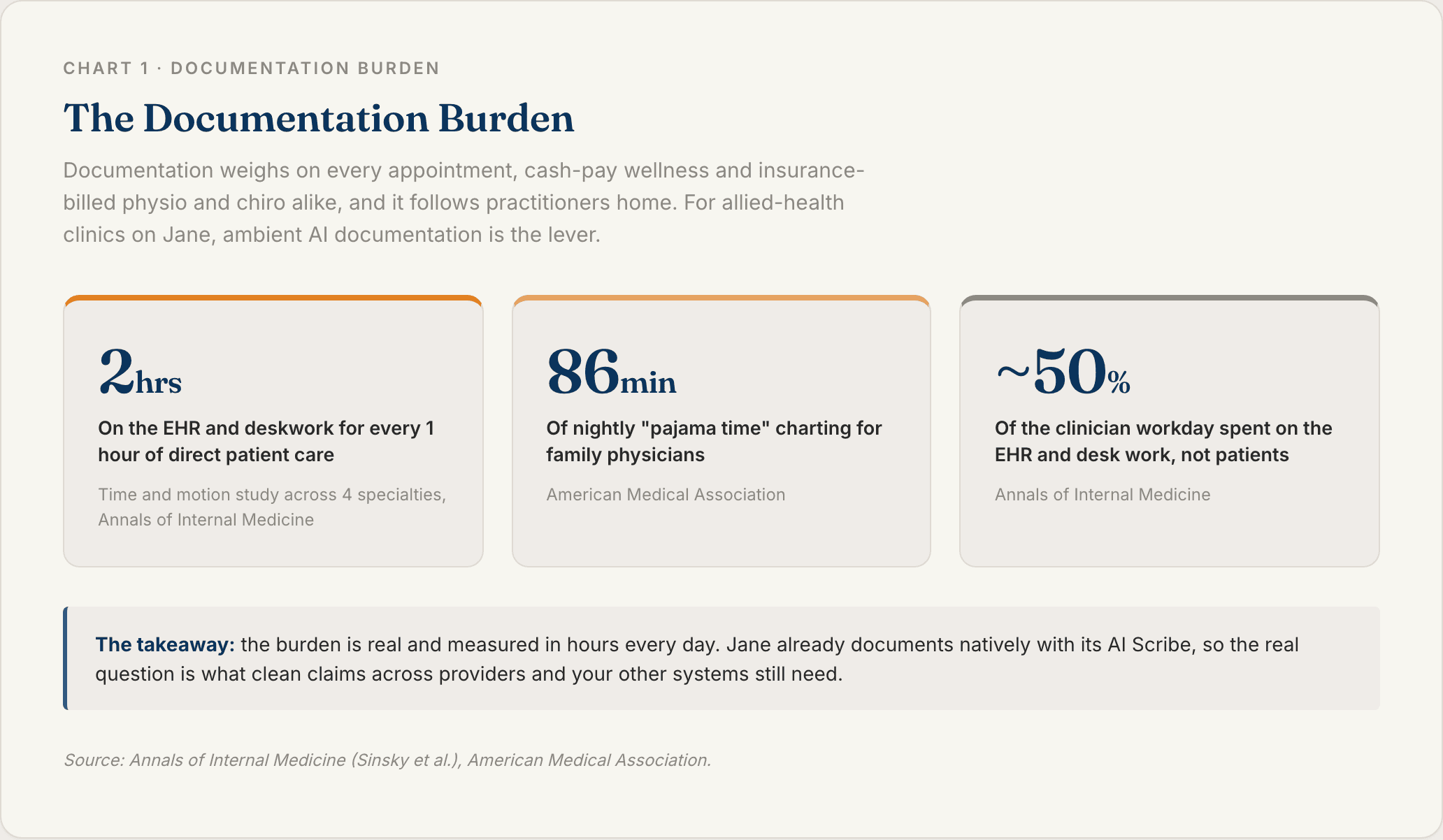
The difference on Jane is that a native AI Scribe already exists. So the decision shifts from "do we add a scribe" to "does the native scribe cover everything, or do clean claims across providers, and the other systems we run, need more."
Ambient Documentation Versus Manual Charting
The old flow is typing SOAP notes in Jane after each appointment. Either way the practitioner is still doing data entry.
The ambient flow is listen, draft, review, sign, and ambient scribes have cut documentation time in multi-site studies [8]. The split that matters here is payer mix: massage and wellness are often cash-pay, while physiotherapy and chiropractic are insurance-billed and coding-sensitive, so on that side the note has to feed a clean claim.
Jane Ships Its Own AI Scribe, So the Question Is Claims and Scale
Jane offers a native AI Scribe, built in-house, that listens ambiently and drafts SOAP or progress notes into the chart. It is HIPAA and PIPEDA compliant and offered as a low-cost add-on at about $15 per practitioner per month with a free tier [3][4].
That is a strong allied-health-native tool, and Jane also owns scheduling, booking, and billing. So the decision is not native versus nothing. It is whether clean claims across a multidisciplinary clinic, and coverage across other systems, needs more than a documentation scribe is built for. That framing drives the rest of this guide.
How AI Scribes Connect to Jane App
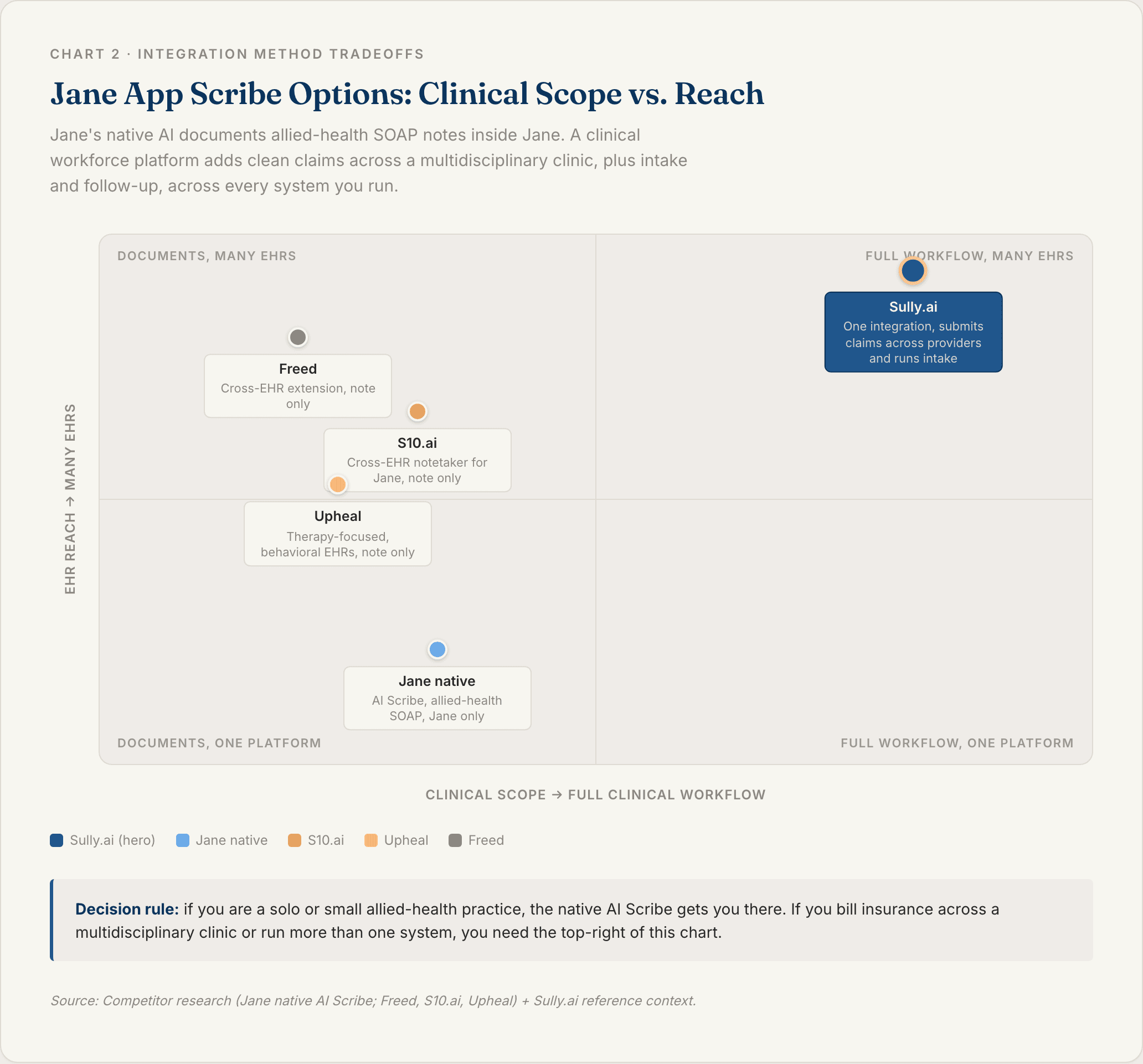
There are three routes: Jane's native AI Scribe, a third-party scribe, or a clinical workforce platform. The depth decides how much of the work around the note a tool removes.
The key distinction: documenting the visit and submitting insurance claims across a multidisciplinary clinic are different jobs, and a scribe only does the first.
Integration type | Documents the visit | Beyond the note | Insurance claims, across providers | EHR reach |
|---|---|---|---|---|
Native (Jane AI Scribe) | Yes, in-workflow | Native scheduling and billing | No claim submission | Jane only |
Third-party scribe | Yes | None | No | Jane or many EHRs |
Clinical workforce platform | Yes | Claims, intake, follow-up | Yes, submits claims | Jane plus 20 more |
The Native Option, Jane AI Scribe
Jane's own AI documents the visit with a scribe built in-house, listening ambiently and drafting SOAP notes into the Jane chart. It is HIPAA and PIPEDA compliant, low-cost, and saves 2 to 5 hours per week, and Jane also owns scheduling, booking, and billing [3][4].
This is a strong allied-health-native fit, with nothing to integrate. The honest limit is scope: the scribe documents, and it is not a coder that submits insurance claims across a multidisciplinary clinic.
Third-Party Scribes
Freed and S10.ai market AI scribes for Jane, and Upheal is a therapy-focused option often compared with Jane for mental-health practices [5][6][7].
These document well. The tradeoff is that they are documentation tools, and they stop at the note.
Clinical Workforce Platforms
The broadest tier. A clinical workforce platform integrates with Jane and adds agents across the visit and the work around it.
Sully.ai integrates with Jane once, and then its agents share that connection: the AI Scribe documents, the AI Coder submits clean claims, the AI Receptionist supports scheduling and rebooking, and the AI Triage Nurse runs intake and follow-up. This is the option that adds claim submission across provider types and coverage across systems.
How to Add an AI Scribe to Jane App Step by Step
Five steps take you from decision to a validated note in the chart.
1. Confirm Your Jane Setup and Payer Mix
Confirm your Jane setup, whether you have enabled the native AI Scribe, your disciplines, and your payer mix, cash-pay wellness versus insurance-billed physiotherapy and chiropractic. Decide what you want: SOAP documentation, which the native scribe may already cover, or clean claims across providers plus intake and follow-up, which points to a clinical workforce platform.
That payer mix determines the route.
2. Choose Your Integration Method
Map the methods to that goal. The native scribe gives you an in-workflow SOAP note. A third-party scribe documents. A clinical workforce platform handles documentation, clean claims, and intake through one integration.
The decision rule: if you are a solo or small allied-health practice, the native AI Scribe gets you there. If you bill insurance across a multidisciplinary clinic or run more than one system, you need a clinical workforce platform.
3. Connect the Scribe
For the native option, enable the AI Scribe in Jane [3]. For a third-party or workforce tool, have the vendor integrate with your Jane environment [5][6].
Whichever route you pick, two things are non-negotiable before any session audio is recorded: a signed BAA and HIPAA-compliant data handling, plus client consent for recording.
4. Map Notes and Coding to Jane
Configure how SOAP notes land in the right Jane fields, and for physiotherapy and chiropractic how codes attach. The native scribe documents; a clinical workforce platform writes coded, claim-ready data and submits it.
Verify it on an insurance-billed physio or chiro visit, not just a cash-pay wellness session, since that is where coding and claims actually matter.
5. Pilot Across Disciplines, Measure, and Scale
Pilot across a cash-pay wellness session and an insurance-billed physio or chiro visit, since they end differently. The insurance visit is the one that reveals whether coding and claims hold up.
Confirm notes land correctly, measure the time saved [3], and on the insurance side measure whether claims come out clean. Validate consent and governance before a clinic-wide rollout.
What to Look For in a Jane App AI Scribe
Four criteria separate the options on the shortlist.
Allied-Health Fit Versus Claims Across Providers
Jane's native AI Scribe is built for allied-health SOAP notes at low cost [3]. The question is whether you also need clean claims across a multidisciplinary clinic and intake and follow-up at scale, which the native scribe is not built for.
Match the tool to your disciplines and payer mix, not just the single visit.
Clean Claims for Physio and Chiro
Physiotherapy and chiropractic are insurance-billed and coding-sensitive, and a multidisciplinary clinic bills across provider types. A scribe documents; submitting the claim is a separate job.
This is where a busy clinic wins or loses revenue. Sully's AI Coder extracts every ICD-10 and CPT code and submits clean claims through one integration.
Coverage Across Locations and Systems
Multi-location and mixed clinics often run Jane plus other systems. Native tools cover only Jane.
A workforce platform that integrates with Jane and more than 20 other EHRs covers them all through one approach. Weigh coverage against the systems you actually run.
Security, Consent, and HIPAA Compliance
The non-negotiables: HIPAA compliance, a signed BAA, encryption and de-identified PHI handling, MFA, SSO, role-based access, and clear retention controls.
Add client consent for recording sessions. Ask where audio is processed, how long it is retained, and who can access transcripts before the pilot starts.
Best AI Scribes for Jane App
Five options worth shortlisting. Jane has a strong native AI Scribe, so it earns a place on the list, credited for what it does.

1. Sully.ai
Sully.ai starts as a strong ambient scribe and extends into a coordinated AI workforce that integrates with Jane through a single integration. The AI Scribe documents the visit, then the AI Coder submits clean claims across provider types, the AI Receptionist supports scheduling and rebooking, and the AI Triage Nurse runs intake and follow-up.
Against a low-cost allied-health-native scribe, the honest differentiators are specific. First, it submits clean claims across a multidisciplinary clinic, which a documentation scribe is not built to do, and where a busy clinic wins or loses revenue. Second, it adds intake and follow-up at scale, rebooking care plans and reactivation. Third, it covers Jane plus Epic, Cerner, Meditech, Athenahealth, and more than 20 other EHRs, which matters for multi-location groups, across 5,000+ providers and 50M+ hours of AI work delivered. Each AI role costs 80 to 90% less than the equivalent human role.
Best fit: multidisciplinary and multi-location clinics on Jane that bill insurance or run more than one system.
2. Jane native AI Scribe
Jane's own AI: a native ambient scribe built in-house that drafts SOAP notes into the chart, HIPAA and PIPEDA compliant and low-cost, alongside Jane's native scheduling, booking, and billing [3][4].
Standout: allied-health-native documentation at low cost with nothing to integrate. Best fit: solo and small practices that want fast SOAP notes inside Jane and do not need claim submission across providers. The honest limit is scope: it documents.
3. Freed
A popular lightweight ambient scribe that markets an option for Jane and pushes chart-ready notes into the EHR [5].
Standout: clinician-loved and low-friction. Best fit: small practices that want a simple scribe, after confirming Jane fit.
4. S10.ai
A cross-EHR ambient scribe that markets a progress-note taker for Jane [6].
Standout: broad EHR support. Best fit: practices wanting a cross-EHR scribe, after confirming Jane fit.
5. Upheal
A therapy-focused AI EHR and scribe, often compared with Jane for mental-health practices [7].
Standout: behavioral-health depth. Best fit: therapy practices, after confirming Jane fit.
Move From a Single Scribe to a Full AI Workforce
Jane already documents the visit natively with its AI Scribe at low cost, which is genuinely strong for allied health. But a multidisciplinary clinic is a different scale of problem.
A clinic bills insurance across physiotherapy, chiropractic, and more, and coding into a clean claim plus intake and follow-up is a different job a documentation scribe is not built for. The average hospital already runs on about 800 different software tools, and point-solution AI just adds more silos instead of a workforce.
Sully takes the connected path. One integration with Jane, then a team of AI employees, the AI Scribe, the AI Coder, the AI Receptionist, and the AI Triage Nurse, sharing context across the visit. The Scribe writes the note, the AI Coder extracts every ICD-10 and CPT code and submits a clean claim across providers, and the AI Receptionist handles rebooking while the AI Triage Nurse runs intake, across Jane and any other system the clinic runs. Each AI role costs 80 to 90% less than the equivalent human role, proven across 5,000+ providers and 50M+ hours of AI work.
If you are weighing an AI scribe for Jane, it is worth seeing what the full team looks like in action.
FAQ
Q: What is a Jane App AI scribe?
A Jane App AI scribe is an ambient documentation tool that listens to the appointment and drafts a SOAP or progress note into the Jane chart, so the practitioner reviews and signs instead of typing. Jane offers a native AI Scribe, and platforms like Sully.ai integrate with Jane to add clean claim submission across provider types and intake and follow-up on top of documentation.
Q: Does Jane App have its own AI scribe?
Yes. Jane ships a native AI Scribe, built in-house, that drafts SOAP notes into the chart, HIPAA and PIPEDA compliant, as a low-cost add-on that saves 2 to 5 hours per week [3][4]. It documents allied-health visits well. It does not submit insurance claims across a multidisciplinary clinic or run intake at scale, which is where a clinical workforce platform adds value.
Q: How do I add an AI scribe to Jane App?
Decide whether the native scribe covers your needs or claims and scale need more. For SOAP documentation, enable the native AI Scribe [3]. For clean claims across providers and intake and follow-up, integrate a clinical workforce platform such as Sully.ai, confirm your Jane setup and payer mix, and pilot on an insurance-billed visit before scaling.
Q: Does a Jane App AI scribe handle insurance claims and coding?
Jane's native AI Scribe documents, and Jane has its own billing features, but the scribe is built for SOAP notes, not clean claim submission across a multidisciplinary clinic [3]. For physiotherapy and chiropractic billing across provider types, you need coding-to-claim, which a clinical workforce platform provides. Sully.ai's AI Coder extracts every ICD-10 and CPT code and submits clean claims through one integration with Jane.
Q: Should we use the native Jane scribe or add a platform?
Use the native AI Scribe if you are a solo or small allied-health practice that wants fast SOAP notes inside Jane at low cost [3]. Add a clinical workforce platform if you are a multidisciplinary clinic billing insurance or running more than one system. Sully.ai integrates with Jane and adds clean claims and intake across providers.
Sources
[1] Annals of Internal Medicine (Sinsky et al.)— Allocation of Physician Time in Ambulatory Practice: A Time and Motion Study in 4 Specialties. https://pmc.ncbi.nlm.nih.gov/articles/PMC5593724/
[2] American Medical Association (AMA) — Family doctors spend 86 minutes of "pajama time" with EHRs nightly. https://www.ama-assn.org/practice-management/digital-health/family-doctors-spend-86-minutes-pajama-time-ehrs-nightly
[3] Jane App — AI Scribe (charting and transcription). https://jane.app/features/charting-ai-scribe
[4] Jane App — AI Scribe guide and pricing. https://jane.app/guide/ai-scribe
[5] Freed — Best AI Scribe for Jane. https://www.getfreed.ai/resources/jane-ai-scribe
[6] S10.ai — AI medical scribe and progress notetaker for Jane. https://s10.ai/blog/ai-medical-scribe-progress-notetaker-for-jane
[7] Upheal — Upheal vs Jane App (therapy AI EHR). https://www.upheal.io/comparisons/upheal-vs-jane-app
[8] JAMA Network (ambient AI scribe randomized study) — Ambient AI Scribes in Clinical Practice. https://pmc.ncbi.nlm.nih.gov/articles/PMC12768499/


Article

Keep reading

Article
/
How to Add an AI Receptionist to NextGen and Why the Native AI Does Not Answer the Phone
The AWV is not a physical—Medicare prohibits billing both on the same day without a modifier. See what the visit must include, the fee, and worked examples.

Article
/
How to Add an AI Receptionist to eClinicalWorks and the 23 Percent That Still Reaches a Human
CCM requires 20 minutes of non-face-to-face time and a care plan—but the clock stops the moment the patient is in the room. See billing rules and examples.

Article
/
Dental Answering Service: What It Costs, and Where Missed Calls End Up
What a dental answering service costs, how after-hours dental calls are handled, and where the calls you miss actually end up, with federal ED data.
