Article


Most articles about adding a voice assistant to an EHR start by describing a problem the EHR has not solved yet.
That is not the situation on eClinicalWorks, and pretending otherwise would waste your time. eClinicalWorks already ships one. healow Genie is live, integrated with the EHR, multilingual, and in September 2026 eClinicalWorks published a customer case study with a specific number attached: 77 percent of business-hours calls automated at a Maryland family practice [1].
So the useful question for an eCW practice is not whether to automate the phone. It is what is left after you do, and whether the leftover matters to you.
Key Takeaway: eClinicalWorks has a native AI contact center, healow Genie, already in production. At Goodtime Family Care it handled more than 8,800 patient calls, managed 77 percent of calls received during business hours, answered 100 percent of after-hours calls, scheduled more than 700 appointments in four months, and saved staff two to three hours a day [1]. eClinicalWorks states that Genie escalates to a human when a query "requires a more in-depth answer or review and approval by a physician" [2]. That escalation rule is the shape of the residual. For many eCW practices Genie will be the whole answer.The practices it will not answer are the ones whose remaining calls are clinical, multi-step, or need to reach past the phone into the rest of the chart. Sully.ai answers the phone, books into the chart, and runs intake on the same connection that handles notes and coding.
What eClinicalWorks Already Has
healow Genie, and What It Does
healow Genie is described by eClinicalWorks as an EHR-agnostic, AI-powered contact center offering 24/7 access by voice call, text or chatbot [1].
On the voice side, its own product page lists what patients can do: manage appointments, pay bills, ask for a referral, request a medication refill, and get answers to quick questions such as whether the practice is open, when their appointment is, whether they can change it, and what their balance is [2].
Two things are worth noting because they shape everything below.
It is integrated with the EHR rather than bolted beside it. That is eClinicalWorks' own framing, and in the published case study it was the deciding factor for the customer [1].
It is EHR-agnostic. Genie is not an eCW-only product [1]. That matters if you are comparing it against third-party options, because the integration advantage it claims is not automatically exclusive.
The Published Numbers, and What They Actually Say
From the September 2026 case study on Goodtime Family Care, a family medicine practice in the Baltimore area [1]:
More than 8,800 patient callshandled since adoption
77 percentof calls received during business hours managed by Genie
100 percent of after-hours calls answered
More than 700 appointmentsscheduled in the first four months, averaging over 170 a month
Two to three staff hours saved each day
The practice's 8 a.m. call surgemanaged
10 out of 10patient sentiment scores across many self-service scheduling interactions
Multilingual support in English, Spanish, Mandarin and Portuguese
These are the vendor's published figures for one named practice, not an independent study, and one practice is not a benchmark. But they are specific, attributed and checkable, which is more than most of this category offers.

The 23 Percent
Why After-Hours Is 100 and Daytime Is 77
This is the most informative thing in the whole case study, and it is easy to read past.
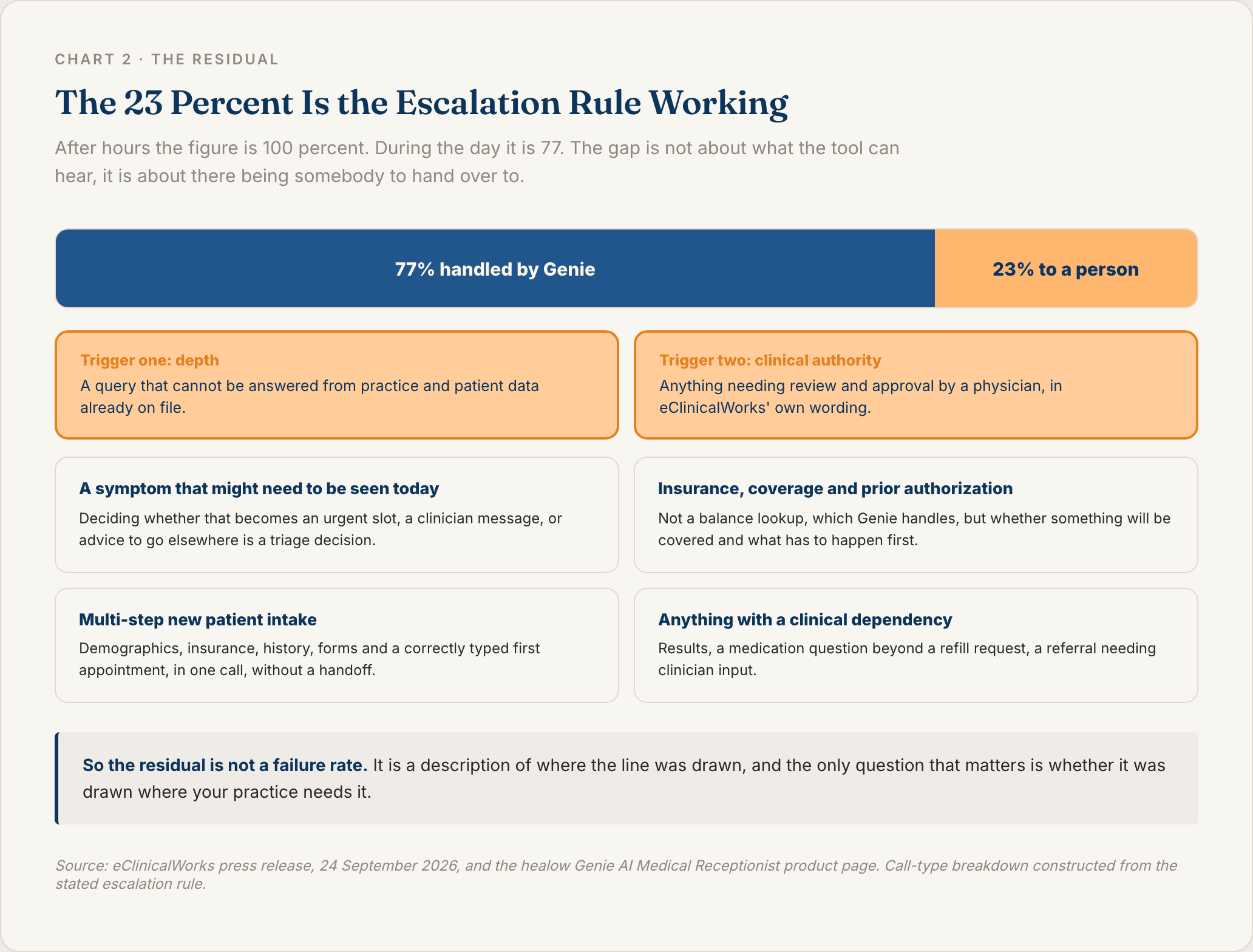
After hours, Genie answers everything. During business hours, it handles 77 percent [1].
If the limitation were capability, both numbers would be similar. They are not. The gap exists because after hours there is nobody to escalate to, and during the day there is. The residual is not a measure of what the tool cannot hear. It is a measure of what it correctly decided to hand over.
That reframes the 23 percent. It is not failure. It is the escalation rule doing its job, and the question for your practice is whether that rule lands where you want it.
What eClinicalWorks Says Escalates
You do not have to guess, because eClinicalWorks states the rule. Genie escalates to a human agent when a patient query "requires a more in-depth answer or review and approval by a physician" [2].
Read that as two separate triggers.
Depth. Anything that cannot be answered from practice and patient data already on file.
Clinical authority. Anything needing a clinician to decide, not just to be informed.
Those are sensible places to draw a line. They are also, for some practices, a large share of the phone.
What Tends to Land in the Residual
Working from that escalation rule rather than from guesswork, four call types reliably fall on the human side.
A symptom that might need to be seen today. The caller is describing something clinical. Deciding whether that becomes an urgent slot, a message to a clinician, or advice to go elsewhere is a triage decision.
Insurance, coverage and prior authorization. Not a balance lookup, which Genie handles [2], but a question about whether something will be covered and what has to happen first.
Multi-step intake for a new patient. Demographics, insurance capture, history, forms and a correctly typed first appointment, in one call, without a handoff.
Anything with a clinical dependency. Results, a medication question beyond a refill request, a referral that needs a clinician's input rather than a request logged.
So Do You Actually Need Anything Else?
Here is the part most vendor content on this topic avoids, so let me be direct.
The customer in the published case study had already tried third-party options and moved away from them. eClinicalWorks reports that Goodtime Family Care had "unsuccessful experiences with offshore virtual receptionists and a previous AI receptionist solution" before adopting Genie, and that "a key reason for selecting healow Genie was its EHR integration, which the practice viewed as a significant advantage over competing solutions" [1].
That is a real result and it deserves to be taken at face value rather than argued with. For a single-site family practice whose phone is mostly scheduling, refills, balances and hours, the native product is very likely the right answer, and adding a second vendor would be solving a problem you do not have.
The cases where something else earns its place are narrower and more specific:
Your residual is clinical rather than administrative. If most of what reaches your staff is triage and symptom calls, the escalation rule is working exactly as designed and the native tool is not the thing that will change it.
You want the phone connected to the rest of the chart. Genie is a contact center, and an EHR-agnostic one [1]. If what you want is the call, the note and the coded visit sharing one connection rather than three, that is a different architecture, not a better phone assistant.
You run more than eClinicalWorks. A multi-site group on mixed systems has a different problem from a single practice, and "integrated with the EHR" means less when there are several.
You need call types Genie routes to a human and you cannot staff them. This is the honest version of the question, and it is answerable with your own data rather than anyone's marketing.
How to Decide, Using Numbers You Already Have
Three steps, and none of them require a vendor conversation.
1. Find Your Own Residual
If you already run Genie, you have the equivalent of the 77 percent figure for your own practice. If you do not, your phone system has abandoned-call and after-hours data.
The number itself is less useful than what is in it.
2. Classify What Reaches a Human
Take two weeks of escalated calls and sort them into four buckets: scheduling, administrative (balance, hours, forms, refill requests), clinical or triage, and multi-step intake.
This is the whole exercise. A residual that is mostly scheduling and administrative means something is misconfigured and the fix is configuration. A residual that is mostly clinical and intake means the tool is behaving correctly and you are looking at a staffing question, not a software one.
3. Price the Residual Before Shopping
Multiply the calls you cannot absorb by what they cost you, in staff time or in lost bookings. If that number is small, stop here. The native product is doing its job and you have your answer.

How to Connect Something to eClinicalWorks, If You Do
Three depths, same as any EHR, with the eCW specifics.
Native. healow Genie, integrated with the EHR, voice, text and chatbot, multilingual, escalating per the rule above [1][2]. Fastest path, no second vendor, and the one the published case study is about.
Marketplace or partner. Several voice vendors publish eClinicalWorks integrations. What varies, and what you have to ask about by name, is whether the tool reads your live schedule and writes a real appointment back, or whether it collects a request for staff to enter. Both get called "integrated".
Bi-directional API. A connection that reads the schedule, applies your booking rules, and writes the appointment into eClinicalWorks as a real appointment, with the context to resolve the call rather than log it.
The question that separates them is not whether a vendor says it integrates with eClinicalWorks. It is whether an appointment booked on the phone appears in the chart without anyone retyping it.
What to Look For
Does it write a real appointment into eClinicalWorks? Ask it as a specific question, not as a feature check.
What does it do with the call types Genie escalates? This is the only comparison that matters here, because the native tool already handles the rest. A vendor who cannot answer this specifically is selling you the 77 percent you already have.
Does it work across every system you run? If you are multi-site on mixed EHRs, ask about the others before the demo.
Security and compliance. A signed business associate agreement, HIPAA-compliant handling, and a clear answer on where call recordings and transcripts live and for how long.
Best AI Receptionists for eClinicalWorks
1. healow Genie. The native option, and the default recommendation for a single-site eCW practice whose phone is mostly administrative. Integrated with the EHR, multilingual, and the subject of eClinicalWorks' own published case study [1][2]. Start here, and only look further if your residual tells you to.
2. Sully.ai. Answers the phone, books and reschedules into the chart, runs intake and routes what needs a person, on the same connection that handles notes and coding. The case for it over a contact center is architectural rather than conversational: one integration behind the phone, the note and the coded visit. There is a recording library of real call types if you want to hear it first.
3. Assort Health. Voice automation for scheduling and referrals with published EHR integrations. A direct comparison with Sully is here.
4. MedPhone. Publishes an eClinicalWorks-specific phone agent integration.
5. ClinicFlow. Publishes an eClinicalWorks integration focused on phone answering and scheduling.
Shortlist on one question: which of these handles the calls that currently reach your staff, and which of them is selling you coverage you already have.
Where Sully.ai Fits in an eClinicalWorks Practice
The honest position, given everything above.
If your phone problem is volume and availability, eClinicalWorks has already built the answer and it has a published number behind it. Sully is not a better version of that, and claiming otherwise would not survive a week of your own call logs.
Where Sully is a different proposition is when the phone needs to reach further than the phone. A call that creates an appointment, a visit that creates a note, and a note that becomes a coded claim are three things most practices integrate three times. Sully.ai runs them on one connection across Epic, Cerner, Meditech and Athenahealth as well as eClinicalWorks, which matters most to groups running more than one system.
Two boundaries, and both are refusals.
Nothing should make a clinical decision on the phone. Triage calls get routed to a person with context, not resolved by a voice assistant. Anything that decides whether a patient is seen today belongs with a clinician.
No tool fixes a misconfigured escalation rule by replacing it. If your residual is full of scheduling calls, that is a configuration problem, and buying a second system on top of the first will hide it rather than solve it.
Sully operates across 5,000+ providers, has delivered 50M+ hours of work, and prices each role 80 to 90 percent below the human equivalent [3].
FAQ
Does eClinicalWorks have its own AI receptionist?
Yes. healow Genie is eClinicalWorks' AI-powered contact center, offering 24/7 patient access by voice call, text and chatbot, with multilingual support. It is already in production: in September 2026 eClinicalWorks published a case study reporting that it managed 77 percent of business-hours calls and 100 percent of after-hours calls at a Maryland family practice [1].
What does healow Genie handle, and what does it pass to staff?
It handles appointment management, bill payment, referral requests, medication refill requests and quick questions such as practice hours, appointment times and balances [2]. eClinicalWorks states that it escalates to a human when a query requires a more in-depth answer or review and approval by a physician [2].
What is the 23 percent?
In the published case study, 77 percent of business-hours calls were managed by Genie, so roughly a quarter reached a person [1]. Based on the stated escalation rule, that residual is weighted toward calls needing depth or clinical authority: triage and symptom calls, coverage and prior authorization questions, multi-step new patient intake, and anything with a clinical dependency. Note that after hours the figure is 100 percent [1], which suggests the gap is about having somebody to escalate to rather than about capability.
Do I need a third-party AI receptionist if I run eClinicalWorks?
Often no. For a single-site practice whose calls are mostly scheduling, refills and balances, the native product is likely sufficient, and the practice in eClinicalWorks' own case study chose it over third-party alternatives specifically for its EHR integration [1]. The cases where something else earns its place are a residual that is clinical rather than administrative, a need for the phone to connect to notes and coding, or running more than one EHR.
How is this different from adding an AI scribe to eClinicalWorks?
Different problem and a different competitive picture. The scribe version of this guide is here.
Sources
[1] eClinicalWorks— eClinicalWorks and healow Genie Assist Goodtime Family Care Automate 77% of their Total Patient Calls and Deliver 24/7 Access to Patient Care, press release, 24 September 2026. https://www.eclinicalworks.com/eclinicalworks-and-healow-genie-assist-goodtime-family-care-automate-77-of-their-total-patient-calls-and-deliver-24-7-access-to-patient-care/
[2] healow Genie — AI Medical Receptionist Agent, product page. https://genie.healow.com/ai-agent/
[3] Sully.ai — Receptionist. https://www.sully.ai/receptionist


Article

Keep reading

Article
/
Dental Answering Service: What It Costs, and Where Missed Calls End Up
What a dental answering service costs, how after-hours dental calls are handled, and where the calls you miss actually end up, with federal ED data.

Article
/
After-Hours Medical Answering Service: Coverage Models and On-Call Routing
What happens to your patients' calls after 5pm, the four coverage models compared, and how to design on-call routing that does not end at the emergency department.

Article
/
Medical Office Answering Service: What It Costs, and What It Doesn't Solve
A medical answering service costs about $1.30 per minute and hands you a message. Managed AI costs about the same and books the appointment. The full comparison.
