Research


Introduction
Healthcare is one of the most complex and high-stakes environments for AI systems.Large Language Models (LLMs) now demonstrate impressive reasoning and generation capabilities, but their reliability depends heavily on clinical grounding, structured context, and rigorous evaluation.
Sully conducts continuous, large-scale benchmarking of LLMs across three core domains:
Medical Q&A & Diagnostic Reasoning
Clinical Note Generation Quality
Medical Coding & Structured Benchmarking
Our evaluations span multiple datasets, modalities, and clinical tasks to ensure that model performance is not only high, but also clinically valid, safe, and explainable.
This page summarizes findings from these ongoing efforts and highlights how retrieval-augmented systems—especially for medical coding—significantly outperform unguided generation approaches.
Medical benchmarks: QnA and diagnostic reasoning
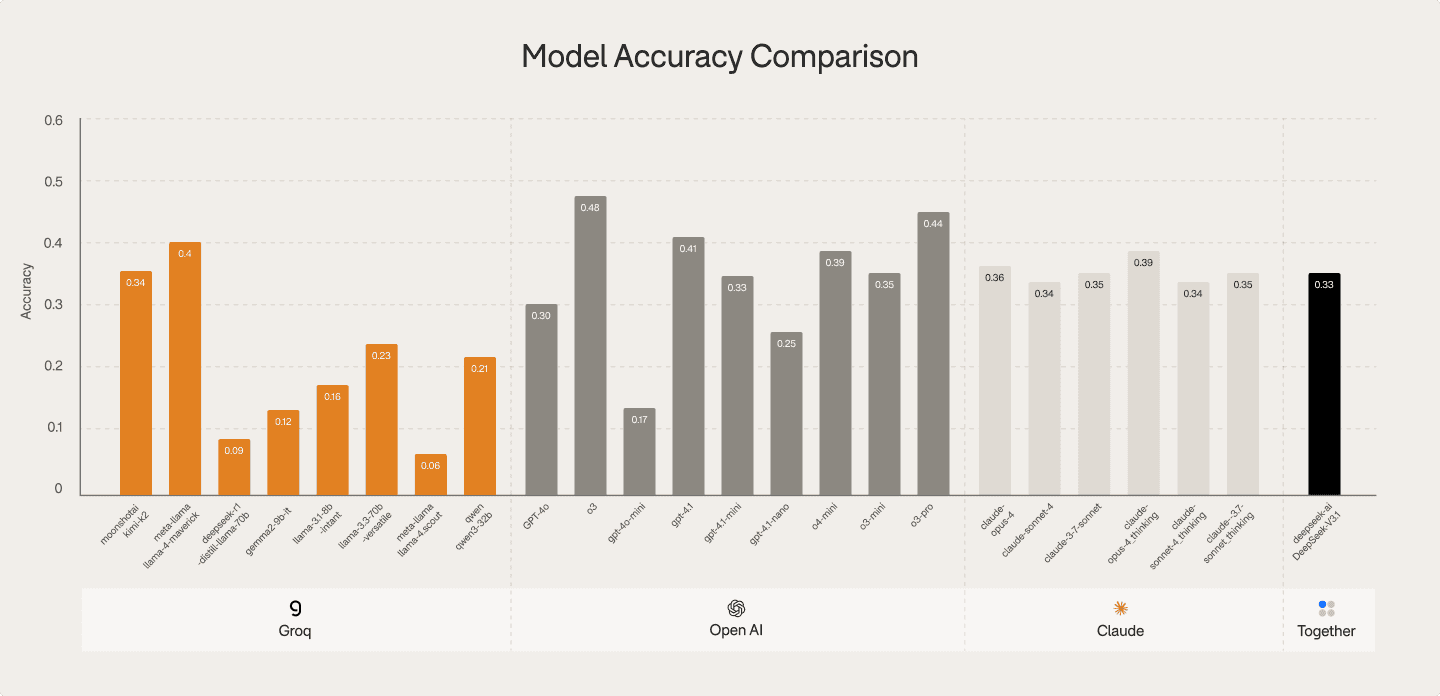
This section evaluates LLMs on clinical knowledge, differential diagnosis, and reasoning tasks.
What We Measure
Clinical knowledge accuracy
Diagnostic reasoning strength
Logical validity and hallucination rates
Safety and guideline adherence
Medical note generation quality
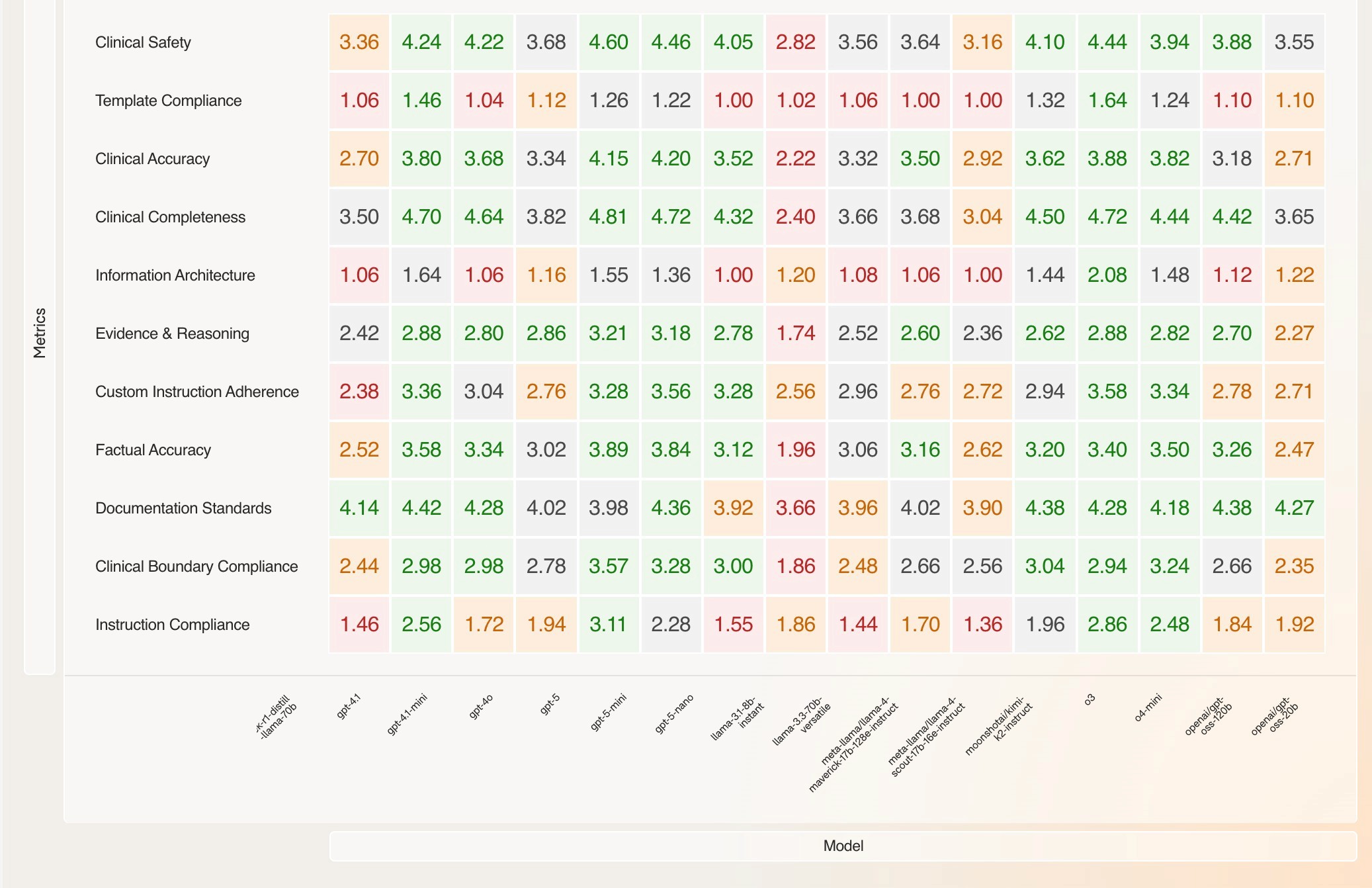
Evaluating model ability to generate clinically accurate and comprehensive documentation.
Metrics Assessed
Completeness of medical content
Logical consistency and absence of hallucinations
Clinical validity
Adherence to note structure
Physician usability
Model performance across all evaluation metrics
Medical coding & structured benchmarks
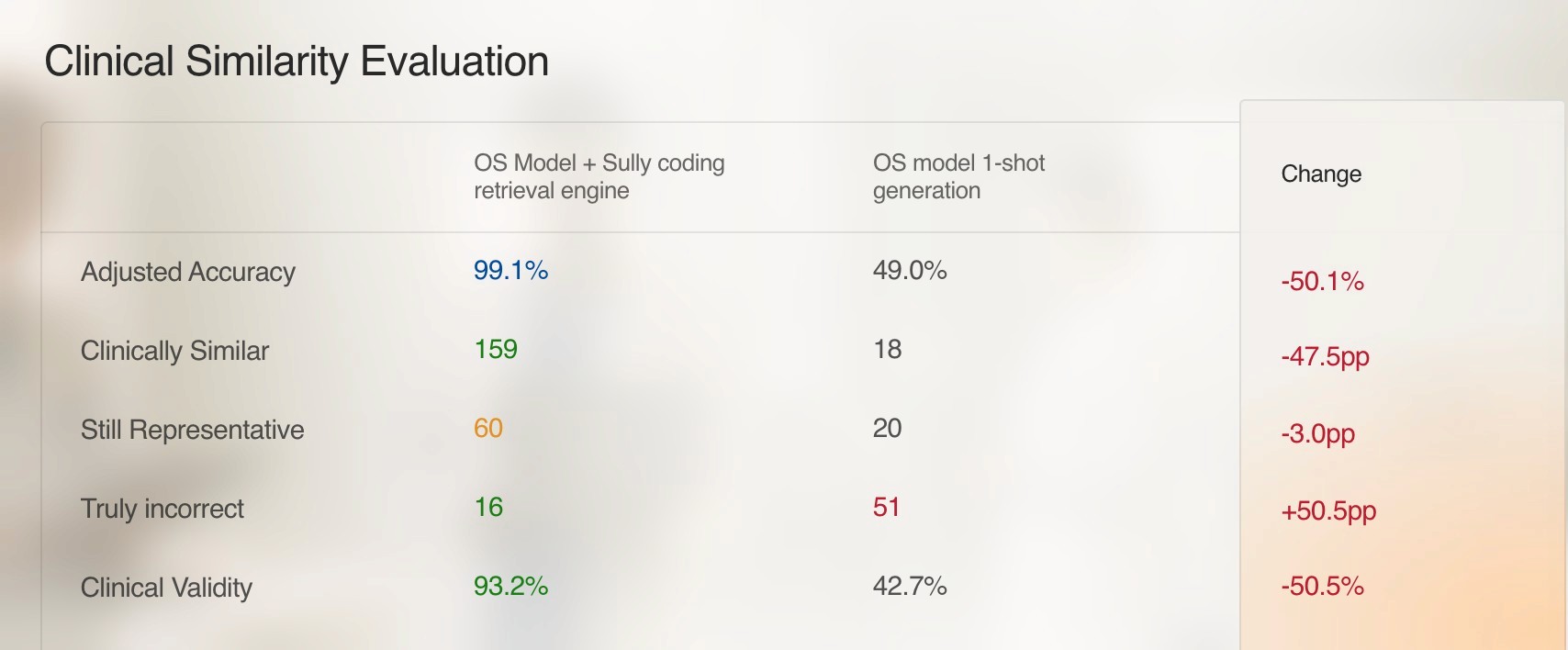
Medical coding requires precision small errors can cause billing, legal, and clinical safety issues. Our evaluations demonstrate the dramatic impact of code retrieval context on accuracy.
Medical Coding: Including ICD-10 code context in prompts dramatically improves performance. Without code lists, adjusted accuracy drops from 99.1% to just 49.0%, and truly incorrect predictions increase from 6.8% to 57.3%. This demonstrates that providing relevant code options is essential for reliable clinical coding.
Medical Coding Benchmarks: Using Sully's proprietary coding retrieval algorithm and engine, coding accuracy reaches 99.1% with adjusted metrics. In contrast, one-shot generation by open-source and foundational models without code context achieves only 49.0% adjusted accuracy, with truly incorrect predictions rising to 57.3% compared to Sully's 6.8% (of non-exact codes). This demonstrates that Sully's intelligent code retrieval system is essential for reliable clinical coding.

Conclusion
As LLMs become increasingly integrated into healthcare workflows, rigorous evaluation is critical.
Our ongoing analyses show:
Retrieval dramatically improves reliability across tasks—especially coding.
Unguided generation is unsafe for high-precision clinical domains.
Continuous benchmarking allows models and systems to improve over time.
Clinical validity must remain the primary measure—not just accuracy or similarity.
Sully will continue to expand these datasets, refine our evaluation pipelines, and release updated results.
Our goal is to ensure that AI systems deployed in healthcare are not only powerful, but trustworthy, clinically safe, and aligned with real-world needs.


Research

Whitepaper

Keep reading



Research
/
Context Engineering Over Iteration
Your LLM pipeline is slow because your agents do too much. How decomposing note generation into focused, parallel components made the first pass reliable and cut latency from 37 to 7.5 seconds.


Research
/
The Consensus Mechanism
Second opinion matters: towards adaptive clinical AI via the consensus of expert model ensemble. How Sully built a multi-expert system that outperforms single frontier models at clinical reasoning.


Research
/
Model strengths vary by medical domains
A cross-specialty benchmark analysis showing how leading large language models differ in accuracy, reasoning, and specialization across medical tasks and body systems.
