Research


Introduction
Medical AI models do not perform uniformly across clinical domains. Each model exhibits distinct strengths depending on the specialty area, task type, and underlying medical complexity.
This page compiles a comprehensive view of model performance across medical tasks, body systems, and question types, based on Sully’s benchmarking of leading LLMs.
Why domain level variation exists
Even state-of-the-art models show substantial variability across specialties due to differences in:
Depth of domain-specific medical knowledge
Requirements for multi-step reasoning vs. factual recall
Model design (generalist vs. domain-trained)
Variances in training corpora and clinical content familiarity
Performance
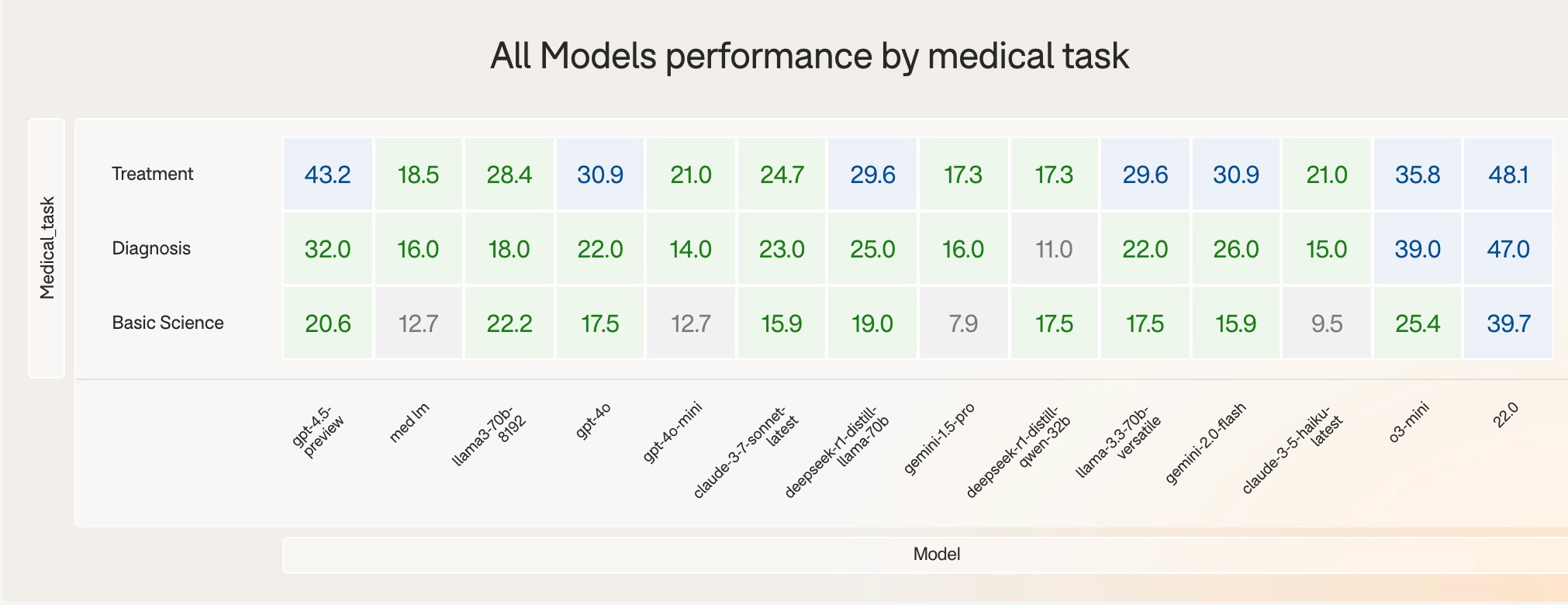
By medical task (Diagnosis, treatment, basic science)
Benchmarks reveal significant differences across task types:
Diagnosis: Best handled by O1 and O3-MINI
Treatment: GPT-4.5-PREVIEW shows specialty strength
Basic Science: Few models exceed 30% accuracy; tasks remain the hardest
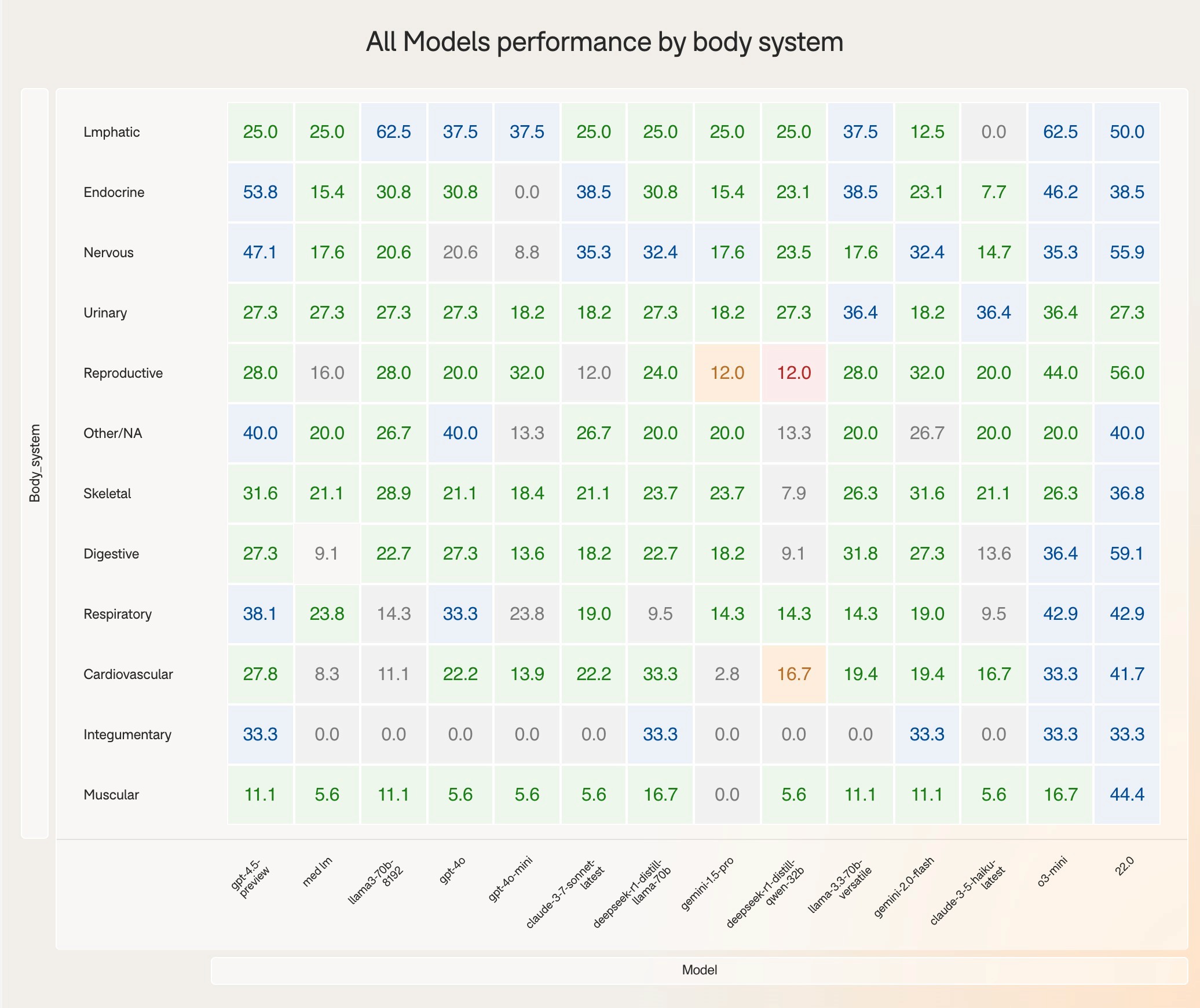
By body system
Model strengths diverge sharply depending on the clinical system involved.
Examples:
Lymphatic: O3-MINI reaches 62.5% (top model result)
Digestive: O1 peaks at 59.09% (best system for O1)
Endocrine: GPT-4.5-PREVIEW achieves 53.85%
Respiratory: O3-MINI at 42.9%
Standout specialty-specific wins
Some combinations reach exceptional accuracy (>90th percentile)

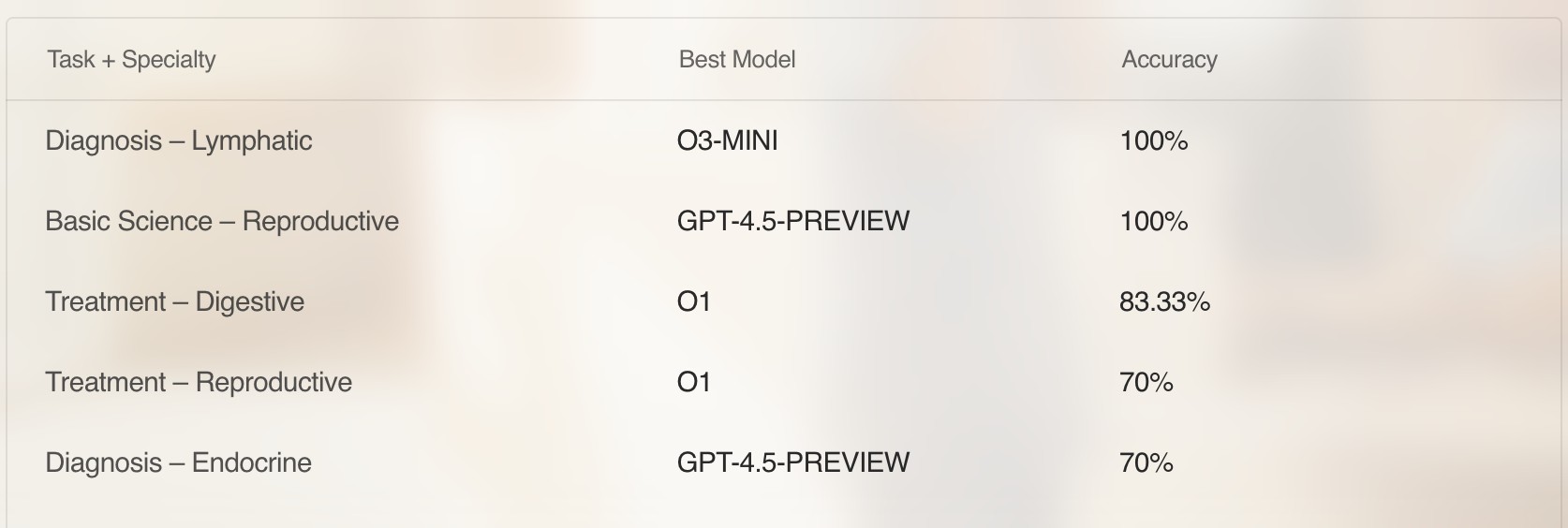
This illustrates how specialist-focused models or ensembles can outperform generalized models in meaningful clinical niches.
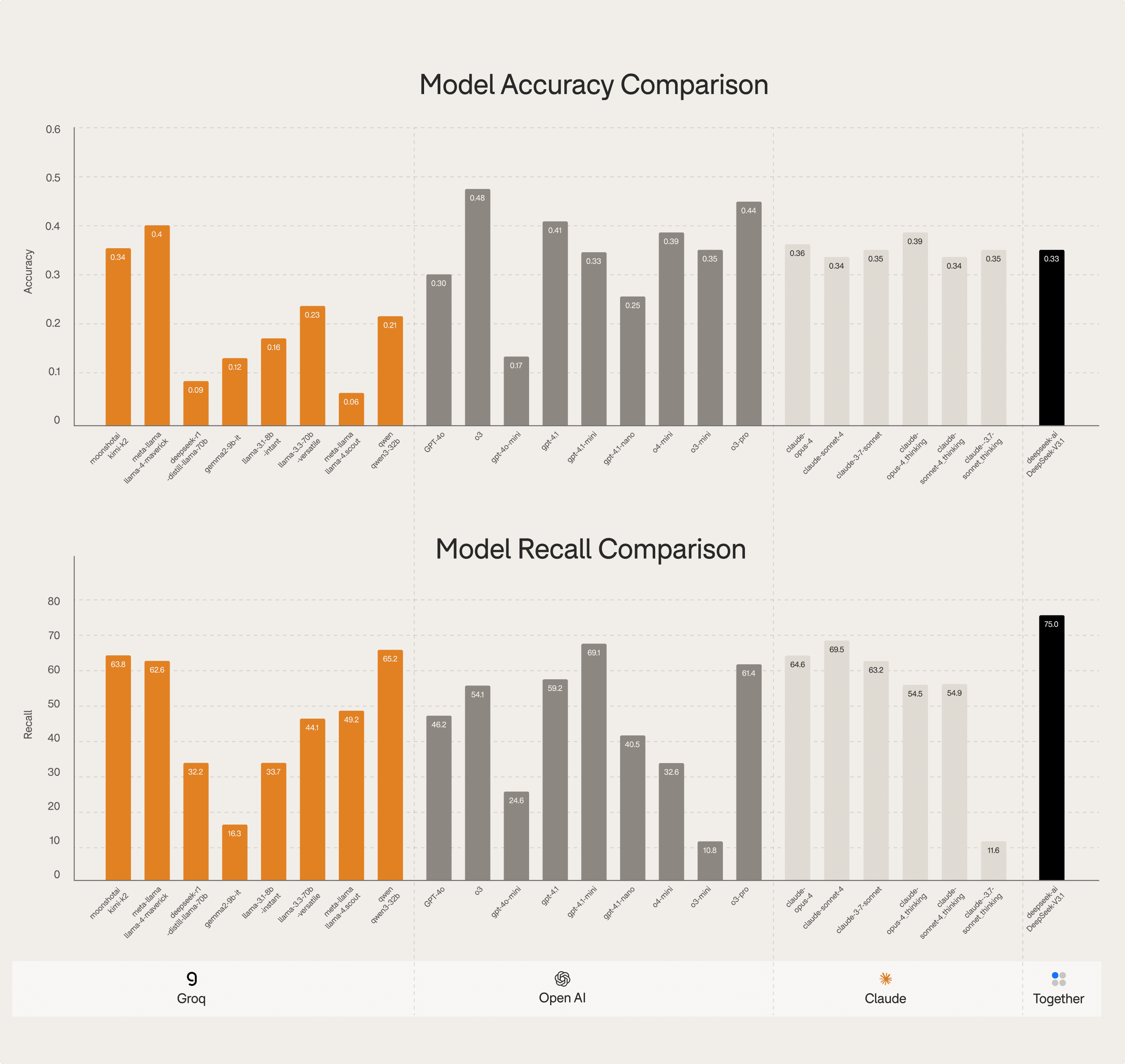
Cross-vendor comparison
Groq models show competitive recall
OpenAI models demonstrate strong accuracy in higher-tier models
Claude models display consistent but mid-range performance
Together (Deepseek-distill) peaks well in recall in limited contexts
Key takeaways
No model is universally strong specialty strengths vary widely.
Consensus ensembles outperform single models in specialized.
Basic science knowledge is a shared weakness across models.
Confidence is not equal to accuracy calibration is still a major challenge.
Vendor performance varies leaving major clinical


Research

Benchmark analysis

Keep reading



Research
/
Context Engineering Over Iteration
Your LLM pipeline is slow because your agents do too much. How decomposing note generation into focused, parallel components made the first pass reliable and cut latency from 37 to 7.5 seconds.


Research
/
The Consensus Mechanism
Second opinion matters: towards adaptive clinical AI via the consensus of expert model ensemble. How Sully built a multi-expert system that outperforms single frontier models at clinical reasoning.


Research
/
Large-scale analysis of LLMs in healthcare
A continuously evolving benchmark of medical AI performance across clinical reasoning, documentation, and coding tasks.
