Templates


Search for an SBAR template and most of what you find is sold as a handoff tool. Nurse SBAR handover sheets, shift report templates, end-of-shift forms.
SBAR was built for something narrower than that, and the difference matters more than it sounds.
It was designed for the moment you need to interrupt someone. A patient is going the wrong way, you need a decision now, and you have about twenty seconds of a busy physician's attention.
Here is the blank template, three worked examples in the words people actually use, and an honest account of where SBAR stops being the right tool.
Key Takeaway:SBAR stands for Situation, Background, Assessment, and Recommendation, sometimes written as Request. It is a structured way to raise a concern that needs immediate attention, developed by Michael Leonard, Doug Bonacum and Suzanne Graham at Kaiser Permanente of Colorado [1]. AHRQ's TeamSTEPPS curriculum treats SBAR as a tool for speaking up about a patient whose condition is deteriorating [2], and lists Handoff as a separate tool, because a handoff transfers authority and responsibility as well as information and has to carry contingency plans, which SBAR has no field for [3]. Research comparing the two found I-PASS transferred information more accurately, took less time, and was preferred by most participants for handoffs [4]. Sully.ai's AI Scribe captures the clinical detail those fields depend on during the visit and writes it into the note, so the structure gets filled in rather than reconstructed from memory.
What SBAR Stands For
Four letters, four questions. That is the whole tool.
Situation, Background, Assessment, Recommendation. AHRQ writes the last one as Recommendation or Request, which is a useful distinction: sometimes you are proposing a plan, and sometimes you are asking for something specific [2].
Situation, Background, Assessment, Recommendation
Each field answers one question, and the order is deliberate. You lead with what is happening so the listener knows why their phone rang, then give them just enough history to follow you.
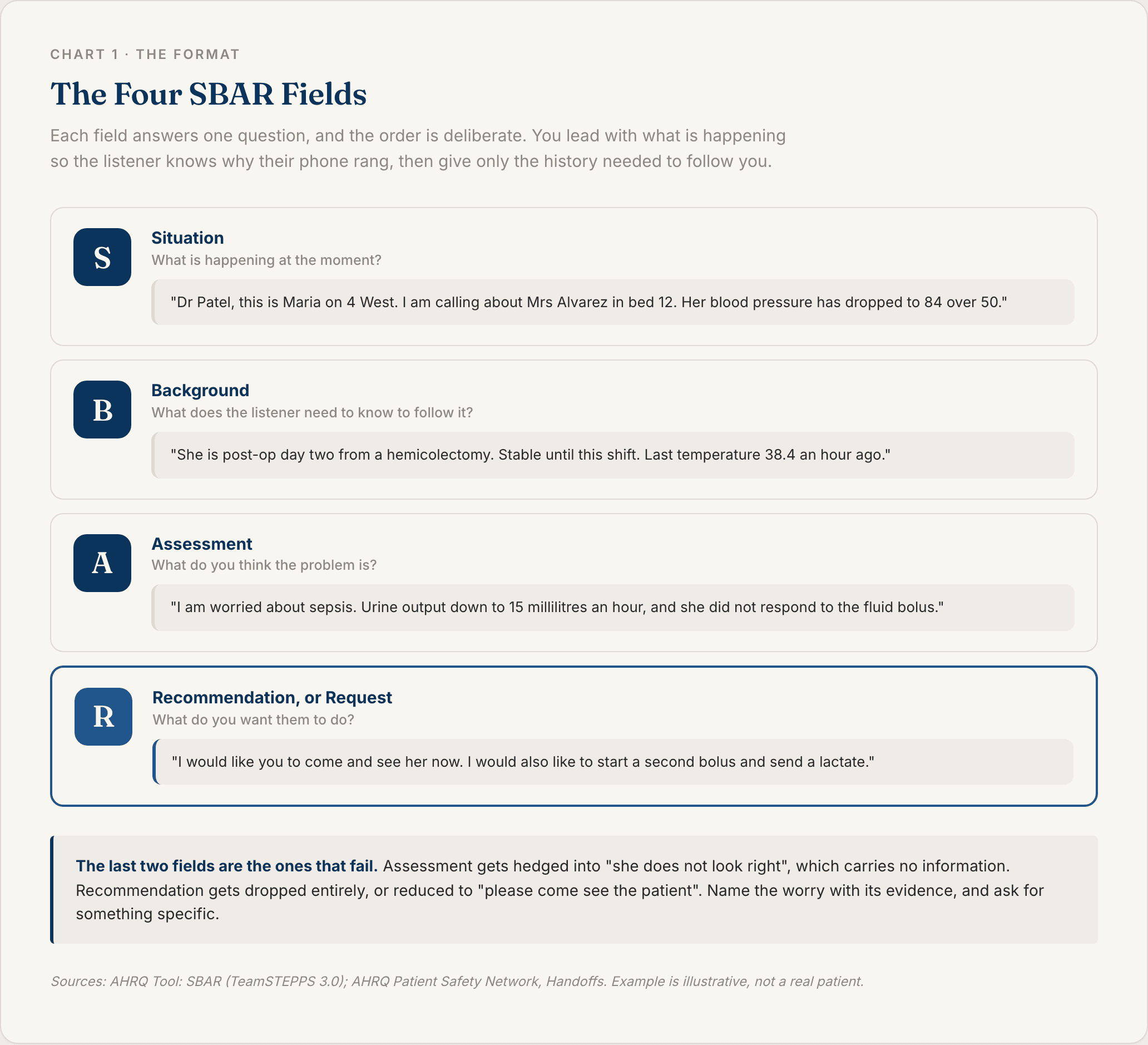
The two fields people get wrong are the last two. Assessment gets hedged into nothing, and Recommendation gets dropped entirely. Both are covered below.
Where SBAR Came From
SBAR was developed by Michael Leonard, a physician leader for patient safety, with colleagues Doug Bonacum and Suzanne Graham at Kaiser Permanente of Colorado, and spread widely after the Institute for Healthcare Improvement published it as a tool [1].
You will also see it described as a technique borrowed from the US Navy's nuclear submarine programme. That story is common and it is not what IHI says, so it is worth being careful with.
IHI frames the purpose broadly: a concrete mechanism for framing any conversation, especially critical ones requiring immediate attention and action, and a way to build a culture of patient safety [1]. Research since has looked at its effect on interprofessional communication and on staff experience, including job satisfaction and engagement [5].
The SBAR Template
Copy this. Cut what you do not need.
The Blank Template to Copy
S. Situation Who you are, who the patient is, where they are, and what is happening right now. One or two sentences.
B. Background The relevant history only. Admission diagnosis, day of stay, the pertinent medications, the trend that led here.
A. Assessment What you think is going on, and what you are worried about.
R. Recommendation or Request What you want to happen, and by when.
The Question Each Field Answers
Field | The question it answers |
|---|---|
Situation | What is happening at the moment? |
Background | What does the listener need to know to follow it? |
Assessment | What do you think the problem is? |
Recommendation or Request | What do you want them to do? |
AHRQ's own phrasing for Assessment is "what do you think the problem is" [4]. That wording is the source of most of the trouble with this tool.
Why the Assessment Line Is the Hard One
"What do you think the problem is" sounds like a request for a diagnosis, and plenty of nurses have been trained to stay well clear of that word. So the field gets softened into "patient does not look right", which carries no information.
The reframe that fixes it: an assessment is a concern with a reason attached. Not a diagnosis.
Compare these two.
Weak: "She just does not look right to me." Strong: "I am worried about sepsis. Her lactate is up, she is tachycardic at 118, and she has not responded to the fluid bolus."
The second one names the worry and shows the evidence behind it. Nobody has diagnosed anything, and the physician on the other end of the phone now knows exactly what to think about.
SBAR Examples
Three calls, written out as speech rather than as filled-in forms. The wording is the part that transfers.
Escalating a Deteriorating Patient
Situation. "Dr Patel, this is Maria on 4 West. I am calling about Mrs Alvarez in bed 12. Her blood pressure has dropped to 84 over 50 and her heart rate is up to 118."
Background. "She is post-op day two from a hemicolectomy. She has been stable until this shift. Her last temperature was 38.4 an hour ago."
Assessment. "I am worried about sepsis. Her urine output is down to about 15 millilitres an hour over the last three hours and she did not respond much to the 500 millilitre bolus I gave at four o'clock."
Recommendation. "I would like you to come and see her now. I would also like to start a second bolus and send a lactate and blood cultures while you are on your way."
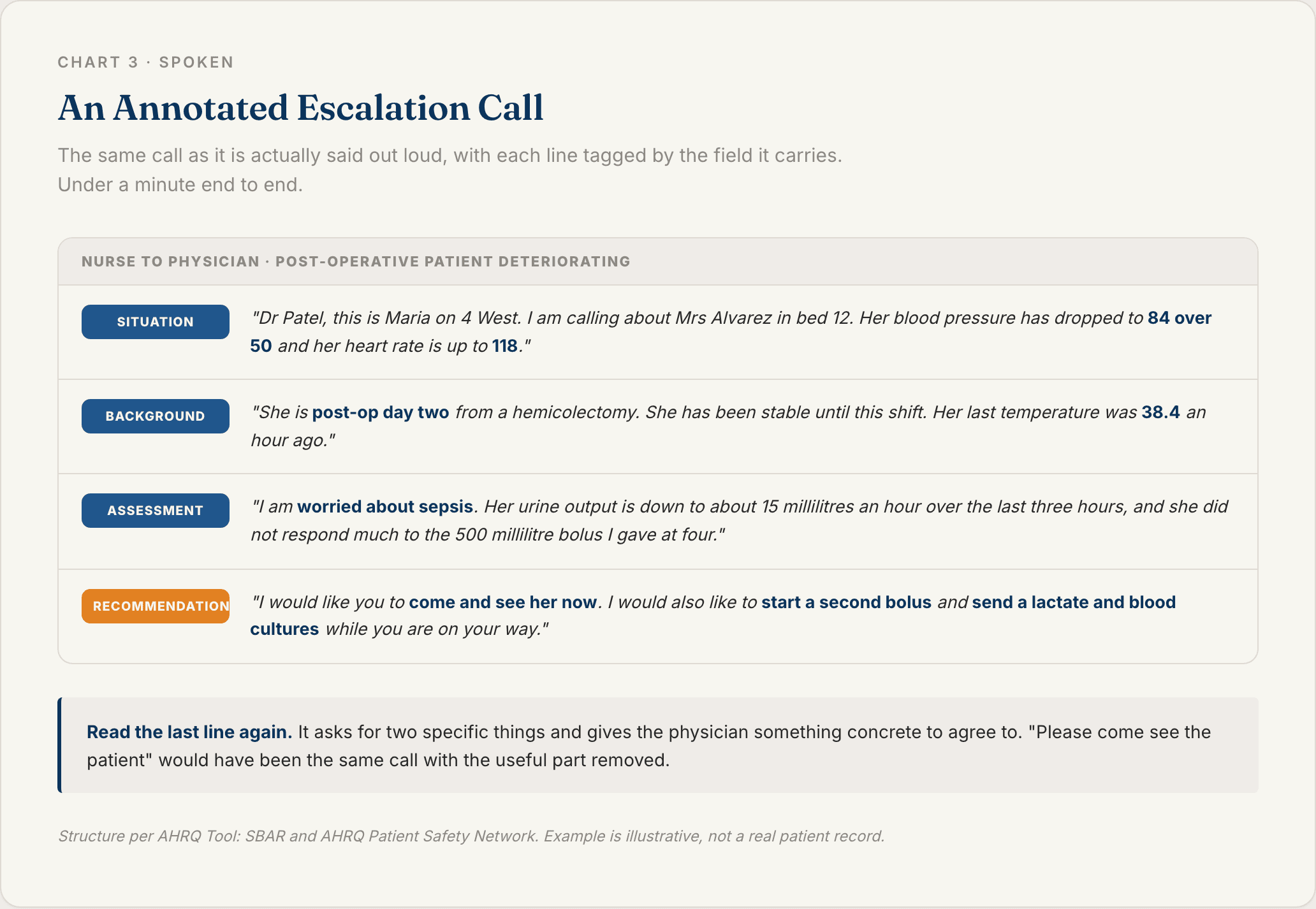
Notice the Recommendation asks for two specific things and gives the physician something to agree to. "Please come see the patient" would have been the weak version of the same call.
Calling a Physician Overnight
Situation. "Dr Okafor, it is Sam on the medical floor. Mr Whitfield in 22 has become acutely confused in the last two hours. He is trying to climb out of bed."
Background. "He is 81, admitted three days ago with a urinary tract infection, on ceftriaxone. He was oriented and settled at handover at eleven."
Assessment. "This is new tonight. I am thinking delirium and I want to rule out hypoxia and hypoglycaemia first. His oxygen saturation is 94 percent on room air and his glucose is 6.1."
Recommendation. "Can you review him tonight? In the meantime I would like an order for a bladder scan, and I would like to know whether you want a repeat urine culture."
Overnight calls reward specificity. Naming what you have already ruled out saves the physician from asking.
Raising a Medication Concern
SBAR also works sideways, between peers. AHRQ describes it as a vehicle for individuals to speak up and express concern [2], and that includes concerns about a colleague's order or a pharmacy dispense.
Situation. "I want to check an order with you before I give it. Mr Doyle in 8 has enoxaparin 80 milligrams twice daily written up."
Background. "He weighs 62 kilos and his creatinine came back at 168 this morning."
Assessment. "That dose looks high to me for his weight and his renal function."
Recommendation. "Can we get pharmacy to review the dose before the evening administration?"
Where Sully.ai Fits in SBAR Documentation
Worth being precise about this one, because SBAR is a spoken tool and nothing writes the call for you.
What breaks an SBAR at 2am is not the format. It is the Background and Assessment fields, which depend on knowing what happened earlier in the admission. If the notes from the last two shifts are thin, you are reconstructing the trend from memory while someone waits on the phone.
Sully.ai's AI Scribe captures the clinical detail during the encounter and writes it into the note, so the history and the trend are already in the chart when someone needs to escalate. Clinicians can save how they want notes structured, so the same fields come back the same way every shift. It runs on a single integration across Epic, Cerner, Meditech and Athenahealth.
The AI Triage Nurse covers the adjacent piece, pre-visit intake and follow-up tracking, so the chart is populated before anyone walks into the room.
To be clear about the boundary: the escalation call is yours. Sully does not make it, and it does not generate an SBAR for you. What it removes is the retyping and the gaps that make the Background field hard to fill.
Sully operates across 5,000+ providers, has delivered 50M+ hours of AI work, and prices each AI role 80 to 90 percent below the human equivalent [6].
SBAR in Nursing
Most SBAR calls are a nurse escalating to a physician, and that is not an accident of who happens to be nearest the phone.
Nurse to Physician Escalation
The reason a format helps here is partly social. Interrupting a senior clinician to say you are worried is difficult, and a script makes it easier to do quickly and without apologising for it.
AHRQ is direct that SBAR exists to give individuals a vehicle to speak up and express concern in a concise way, and that it is useful for conversations requiring a team's immediate attention, such as a patient deteriorating rapidly [2]. It also works with clinicians outside your own team, such as a remote consultant [2].
Nurse to Nurse Communication
Between nurses, SBAR earns its place in the same escalation moment. Flagging a patient you are worried about to the charge nurse, or asking a colleague to double-check something before you act on it.
Where it fits less cleanly is the full shift report, which is a different job with different requirements. If your question is what a shift note has to contain rather than how to raise a concern, that is covered in what shift documentation actually needs, and the nursing template pack has the formats for it: a narrative shift note, a SOAPIE note, and a DAR focus note.
SBAR Versus a Shift Handoff
This is the part the template pages get wrong, and it is worth knowing before you build your unit's handoff around SBAR.
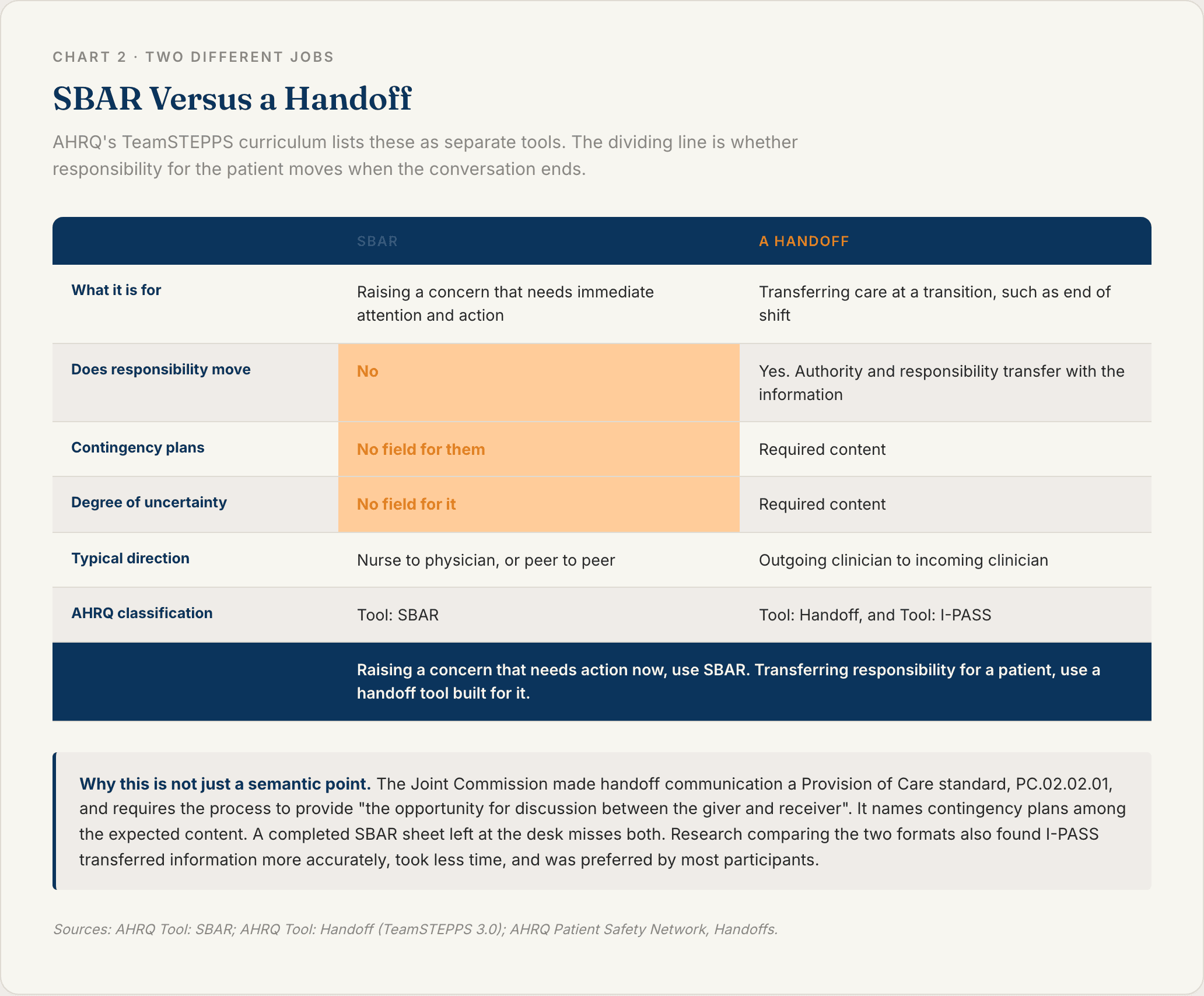
AHRQ's TeamSTEPPS curriculum lists SBAR and Handoff as two separate tools. SBAR is for framing a conversation that needs immediate attention and action [2]. A handoff is "a standardized method for transferring information, along with authority and responsibility, during transitions in patient care" [3].
That phrase does the work. A handoff moves responsibility. An SBAR does not.
What a Handoff Has to Transfer That SBAR Does Not
AHRQ specifies what a handoff has to carry: the degree of uncertainty, including uncertainty about the diagnosis, the response to treatment, recent changes in condition and circumstances, and the plan, including contingencies [3].
Read that against the four SBAR fields. There is no slot for contingencies, and no slot for who is responsible after the conversation ends. Those are the two things a handoff exists to move, and the format has nowhere to put them.
What the Joint Commission Requires
Handoff communication has been an accreditation matter for twenty years. The Joint Commission established a National Patient Safety Goal covering handoffs in 2006 and made it a Provision of Care standard, PC.02.02.01, in 2010. A Sentinel Event Alert followed in 2017 [4].
The standard requires that the organisation's handoff process "provides for the opportunity for discussion between the giver and receiver" of patient information [4]. The Joint Commission does not mandate a particular tool, but it does name the content it expects: illness assessment, patient summary, a to-do action list, and contingency plans, delivered face to face wherever possible [4].
So a completed SBAR sheet left at the desk fails on two counts. There was no discussion, and there were no contingencies, because the form has no field for them.
When Another Tool Fits Better
To be fair to SBAR, AHRQ's own patient safety network does list it among structured handoff tools [4]. This is not a case of a tool being misused into uselessness.
It is a case of a better option existing for one specific job. The research on I-PASS found it transferred information more accurately, took less time to use, and was preferred by the majority of study participants compared with SBAR [4].
The practical rule is simple enough to keep in your head. If you are raising a concern that needs action now, use SBAR. If you are transferring responsibility for a patient to someone else, use a handoff tool built for it, and make sure contingencies and uncertainty are in there.
Book a demo and bring a night shift. The interesting question is how much of the Background field is already in the chart by the time someone needs it.
FAQ
Q: What does SBAR stand for? Situation, Background, Assessment, and Recommendation. AHRQ writes the last one as Recommendation or Request, since sometimes you are asking for something specific rather than proposing a plan [2].
Q: What is an SBAR used for? Raising a concern that needs someone's immediate attention, most often a patient whose condition is deteriorating. AHRQ describes it as a vehicle for individuals to speak up and express concern concisely, and notes it also works with clinicians outside your core team such as remote consultants [2].
Q: Is SBAR the same as a handoff? Not quite, though it often gets used that way. A handoff transfers authority and responsibility along with information, and has to include the degree of uncertainty and the plan with contingencies [3]. SBAR has four fields and none of them covers contingencies or who is now responsible. Research comparing the two found I-PASS transferred information more accurately, took less time, and was preferred by most participants [4].
Q: Who created SBAR? Michael Leonard, Doug Bonacum and Suzanne Graham at Kaiser Permanente of Colorado, and it spread after the Institute for Healthcare Improvement published it as a tool [1].
Q: Do you have a free SBAR template? Yes. The blank four-field template is on this page as a copy-paste block, with the question each field answers and three worked examples written out as speech. Sully.ai's AI Scribe can also capture the clinical detail the Background and Assessment fields depend on during the visit and write it into the note, so it is on hand when you need to escalate.
Sources
[1] Institute for Healthcare Improvement — SBAR Tool: Situation-Background-Assessment-Recommendation [2] Agency for Healthcare Research and Quality — Tool: SBAR, TeamSTEPPS 3.0 [3] Agency for Healthcare Research and Quality — Tool: Handoff, TeamSTEPPS 3.0 [4] AHRQ Patient Safety Network — Handoffs [5] National Library of Medicine — SBAR Method for Improving Well-Being in the Internal Medicine Unit[6] Sully.ai — The AI Workforce for Healthcare


Templates

Keep reading

Templates
/
AI Front Desk for Medical Practices: What It Changes Beyond Answering the Phone
The front desk is a revenue gate, not a phone. What an AI front desk actually does, what claim-denial data shows it should fix, and what it costs.

Templates
/
CPT Code 99202 With Examples and Why 99201 Is Gone
99202 is the lowest billable new patient code—and most practices skip straight to 99203. See when it's correct, the MDM floor, and two worked examples.

Templates
/
CPT Code 99212 With Examples and When a Visit Really Is This Small
99212 has the highest denial rate of any E/M code—most visits that reach it qualify for 99213. See the MDM floor, fee formula, and two worked examples.
