Research


Introduction
Healthcare AI faces a fundamental challenge: clinical environments are inherently complex, requiring systems that can adapt to diverse specialties, workflows, and data modalities. Traditional monolithic AI solutions struggle to scale across these varied demands while maintaining the reliability and accuracy that healthcare requires.
At Sully, we've developed an architectural approach that addresses this challenge through modular, purpose-built AI agents that work together seamlessly. This whitepaper outlines the core principles behind our scalable healthcare AI infrastructure.
Core Architectural Principles
Modular Agent Design
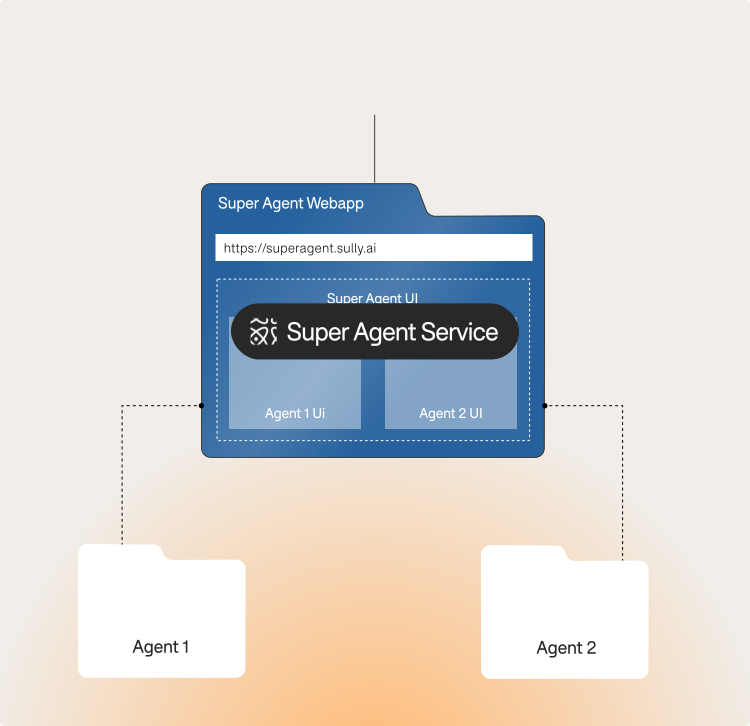
Rather than building a single, all-encompassing AI system, we architect discrete Agent packages—specialized AI modules designed for specific clinical functions. Each agent is built to excel at its designated task while communicating fluidly with other agents in the ecosystem.
This modular approach offers several advantages:
Focused expertise: Each agent can be optimized for its specific domain
Independent scaling: High-demand agents can scale without affecting others
Graceful evolution: Components can be updated or replaced without system-wide disruption
Reduced complexity: Smaller, well-defined modules are easier to maintain and improve
Multi-Modal Accessibility
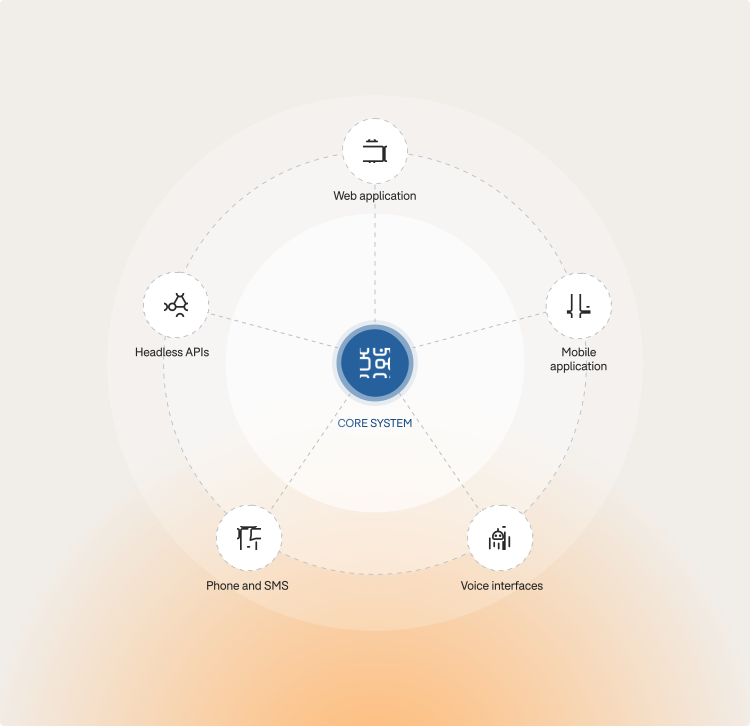
Modern healthcare delivery spans multiple channels. Our architecture is designed from the ground up to support diverse interfaces:
Web applications for desktop clinical workflows
Mobile applications for on-the-go access
Voice interfaces for hands-free operation during procedures
Phone and SMS for patient communication and accessibility
Headless APIs for system-to-system integration
This multi-modal foundation ensures that AI capabilities can meet clinicians and patients wherever they are.
Unified Communication Layer
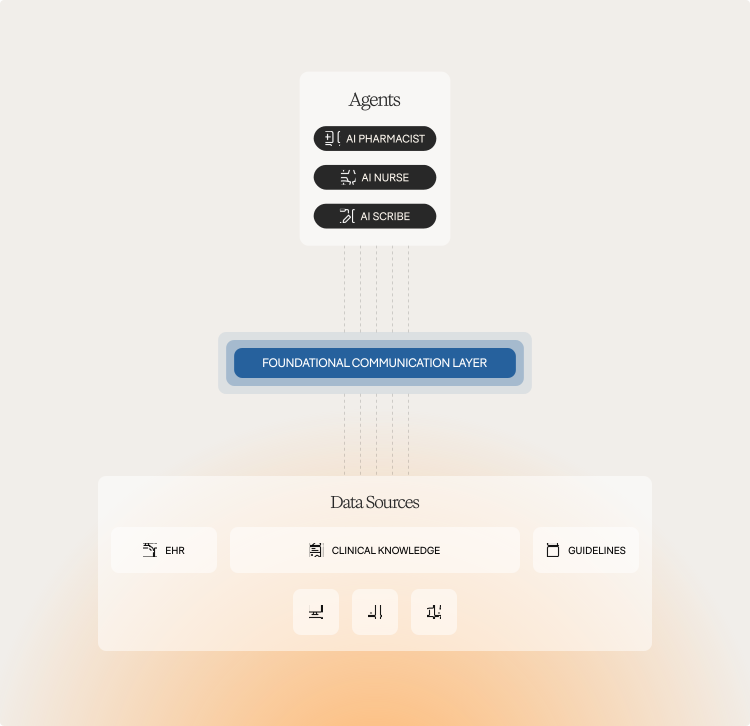
At the heart of our architecture is a foundational communication layer that serves as the connective tissue between all agents and data sources. This layer provides:
Secure EHR integration through standardized proxies
Access to clinical knowledge bases including peer-reviewed research and clinical guidelines
Cross-agent communication enabling collaborative AI workflows
Consistent data handling across all modalities and agents
Architecture in Action: Clinical Decision Support
To illustrate how these principles work in practice, consider our approach to clinical decision support.
Rather than relying on a single model to handle all aspects of clinical reasoning, our Decision Support Agent orchestrates insights from multiple specialized sources.


Looking Ahead
Our research and development continues to push the boundaries of what's possible in healthcare AI
Dynamic knowledge representation that evolves with each patient interaction
Expanded specialty coverage through new specialized agents and expert models
Real-time predictive capabilities integrated directly into clinical workflows
Conclusion
Building AI for healthcare requires more than powerful models—it demands an architecture designed for the realities of clinical practice. Our modular, multi-modal, and interconnected approach provides the foundation for AI that can scale to meet healthcare's diverse and evolving needs.


Research

Whitepaper

Keep reading



Research
/
Context Engineering Over Iteration
Your LLM pipeline is slow because your agents do too much. How decomposing note generation into focused, parallel components made the first pass reliable and cut latency from 37 to 7.5 seconds.


Research
/
The Consensus Mechanism
Second opinion matters: towards adaptive clinical AI via the consensus of expert model ensemble. How Sully built a multi-expert system that outperforms single frontier models at clinical reasoning.


Research
/
Model strengths vary by medical domains
A cross-specialty benchmark analysis showing how leading large language models differ in accuracy, reasoning, and specialization across medical tasks and body systems.
