"/><stop offset="1" stop-color="rgba(255, 255, 255, 0)"/></linearGradient><linearGradient id="WxV_IOPE7-2309410982-linear-gradient" x1="1" x2="0" y1="0.5951279047551217" y2="0.4048720952448783"><stop offset="0" stop-color="rgb(255, 255, 255)"/><stop offset="1" stop-color="rgba(255, 255, 255, 0)"/></linearGradient><linearGradient id="WwbAIQIz8-2309410982-linear-gradient" x1="0.43478742751482424" x2="0.6358595260107829" y1="0.26" y2="1"><stop offset="0" stop-color="rgb(255, 255, 255)"/><stop offset="1" stop-color="rgba(255, 255, 255, 0)"/></linearGradient><linearGradient id="ZWsVQcPfn-2309410982-linear-gradient" x1="0.9508213454678907" x2="0.04917865453210929" y1="0" y2="1"><stop offset="0" stop-color="rgb(255, 255, 255)"/><stop offset="1" stop-color="rgba(255, 255, 255, 0)"/></linearGradient><linearGradient id="lTyCGrzzP-2309410982-linear-gradient" x1="0.374937164194436" x2="0.625062835805564" y1="0" y2="1"><stop offset="0" stop-color="rgb(255, 255, 255)"/><stop offset="1" stop-color="rgba(255, 255, 255, 0)"/></linearGradient></defs><g d="M 658.002 1357.705 C 1020.321 1357.705 1314.04 1063.989 1314.04 701.667 C 1314.04 339.347 1020.321 45.626 658.002 45.626 C 295.681 45.626 1.96 339.347 1.96 701.667 L 0 701.667 C 0 338.263 294.598 43.665 658.002 43.665 C 1021.404 43.665 1316 338.263 1316 701.667 C 1316 1065.072 1021.404 1359.672 658.002 1359.672 C 294.598 1359.672 0 1065.072 0 701.667 L 1.96 701.667 C 1.96 1063.989 295.681 1357.705 658.002 1357.705 Z M 658.005 1265.053 C 969.154 1265.053 1221.392 1012.819 1221.392 701.667 C 1221.392 390.517 969.154 138.281 658.005 138.281 C 346.856 138.281 94.619 390.517 94.619 701.667 L 92.659 701.667 C 92.659 389.433 345.77 136.321 658.005 136.321 C 970.241 136.321 1223.352 389.433 1223.352 701.667 C 1223.352 1013.902 970.241 1267.017 658.005 1267.017 C 345.77 1267.017 92.659 1013.902 92.659 701.667 L 94.619 701.667 C 94.619 1012.819 346.856 1265.053 658.005 1265.053 Z M 658.002 1166.116 C 914.513 1166.116 1122.452 958.178 1122.452 701.667 C 1122.452 445.16 914.513 237.22 658.002 237.22 C 401.494 237.22 193.551 445.16 193.551 701.667 L 191.59 701.667 C 191.59 444.077 400.411 235.255 658.002 235.255 C 915.596 235.255 1124.412 444.077 1124.412 701.667 C 1124.412 959.261 915.596 1168.084 658.002 1168.084 C 400.411 1168.084 191.59 959.261 191.59 701.667 L 193.551 701.667 C 193.551 958.178 401.494 1166.116 658.002 1166.116 Z M 281.657 818.28 C 298.572 818.28 314.804 825.001 326.765 836.965 L 458.99 969.182 C 470.582 980.781 486.308 987.298 502.706 987.298 L 612.137 987.298 C 646.284 987.298 673.972 959.61 673.972 925.463 L 673.972 891.504 L 675.939 891.504 L 675.939 925.463 C 675.939 960.7 647.374 989.258 612.137 989.258 L 502.706 989.258 C 485.788 989.258 469.562 982.537 457.599 970.573 L 325.378 838.356 C 313.785 826.757 298.056 820.242 281.657 820.244 L 1.173 820.244 L 1.173 818.28 Z M 746.64 888.714 L 1053.046 888.714 C 1069.967 888.714 1086.194 895.435 1098.16 907.398 L 1259.381 1068.619 L 1257.99 1070.007 L 1096.772 908.79 C 1085.175 897.193 1069.446 890.679 1053.046 890.681 L 746.64 890.681 C 729.724 890.681 713.493 883.957 701.533 871.993 L 685.377 855.845 L 686.769 854.453 L 702.917 870.605 C 714.513 882.201 730.241 888.715 746.64 888.714 Z M 667.685 552 L 512.316 396.894 C 494.66 379.264 484.741 355.356 484.739 330.426 L 484.739 0 L 487.632 0 L 487.632 330.426 C 487.632 354.592 497.248 377.763 514.369 394.851 L 669.739 549.957 Z M 782.851 700.491 C 816.998 700.491 844.686 672.804 844.686 638.655 L 844.686 516.468 C 844.687 499.547 851.409 483.32 863.374 471.355 L 1177.508 157.22 L 1178.896 158.607 L 864.762 472.742 C 853.162 484.337 846.646 500.067 846.646 516.468 L 846.646 638.655 C 846.646 673.89 818.088 702.455 782.851 702.455 L 700.405 702.455 L 700.405 700.491 Z M 130.338 534.223 L 213.07 534.223 C 256.112 534.223 291.003 569.114 291.003 612.156 L 291.003 694.888 C 291.003 711.29 297.514 727.017 309.113 738.611 L 472.887 902.378 L 471.496 903.769 L 307.726 739.995 C 295.761 728.033 289.038 711.807 289.038 694.888 L 289.038 612.156 C 289.038 570.198 255.028 536.188 213.07 536.188 L 130.338 536.188 C 113.419 536.187 97.193 529.465 85.23 517.5 L 77.071 509.345 C 65.107 497.381 58.386 481.153 58.388 464.233 L 58.388 199.526 L 60.348 199.526 L 60.348 464.233 C 60.349 480.631 66.863 496.358 78.458 507.954 L 86.617 516.113 C 98.213 527.709 113.94 534.223 130.338 534.223 Z" fill="transparent" height="1359.6717183844698px" id="DcyumyANr" transform="translate(0 -43.665)" width="1316px"><g opacity="0.5"><path d="M 658.002 1314.039 C 1020.321 1314.039 1314.04 1020.324 1314.04 658.001 C 1314.04 295.681 1020.321 1.961 658.002 1.961 C 295.681 1.961 1.96 295.682 1.96 658.001 L 0 658.001 C 0 294.598 294.598 0 658.002 0 C 1021.404 0 1316 294.598 1316 658.001 C 1316 1021.407 1021.404 1316.007 658.002 1316.007 C 294.598 1316.007 0 1021.407 0 658.001 L 1.96 658.001 C 1.96 1020.324 295.681 1314.039 658.002 1314.039 Z" fill="rgb(255, 255, 255)" height="1316.0065114752902px" id="dxf13D52Y" transform="translate(0 43.665)" width="1316px"/></g><g opacity="0.3"><path d="M 565.347 1128.732 C 876.496 1128.732 1128.733 876.498 1128.733 565.346 C 1128.733 254.196 876.496 1.961 565.347 1.961 C 254.197 1.961 1.961 254.196 1.961 565.346 L 0 565.346 C 0 253.112 253.111 0 565.347 0 C 877.582 0 1130.693 253.112 1130.693 565.346 C 1130.693 877.581 877.582 1130.696 565.347 1130.696 C 253.111 1130.696 0 877.581 0 565.346 L 1.961 565.346 C 1.961 876.498 254.197 1128.732 565.347 1128.732 Z" fill="rgb(255, 255, 255)" height="1130.6960934794101px" id="if1BmYw1S" transform="translate(92.659 136.321)" width="1130.693351805604px"/></g><g opacity="0.15"><path d="M 466.412 930.861 C 722.923 930.861 930.862 722.922 930.862 466.411 C 930.862 209.905 722.923 1.965 466.412 1.965 C 209.904 1.965 1.961 209.905 1.961 466.411 L 0 466.411 C 0 208.822 208.821 0 466.412 0 C 724.006 0 932.822 208.822 932.822 466.411 C 932.822 724.005 724.006 932.828 466.412 932.828 C 208.821 932.828 0 724.005 0 466.411 L 1.961 466.411 C 1.961 722.922 209.904 930.861 466.412 930.861 Z" fill="rgb(255, 255, 255)" height="932.8284667407987px" id="ef75NsYf6" transform="translate(191.59 235.255)" width="932.8219552655086px"/></g><g opacity="0.5"><path d="M 280.484 0 C 297.399 0 313.63 6.721 325.592 18.685 L 457.817 150.902 C 469.408 162.501 485.135 169.018 501.533 169.017 L 610.964 169.017 C 645.111 169.017 672.799 141.33 672.799 107.182 L 672.799 73.223 L 674.766 73.223 L 674.766 107.182 C 674.766 142.42 646.201 170.978 610.964 170.978 L 501.533 170.978 C 484.614 170.978 468.389 164.257 456.426 152.293 L 324.205 20.076 C 312.611 8.477 296.883 1.961 280.484 1.964 L 0 1.964 L 0 0 Z" fill="url(%23cQ4xRdUtr-2309410982-linear-gradient)" height="170.97763275969464px" id="cQ4xRdUtr" transform="translate(1.173 818.28)" width="674.7656780356198px"/></g><g opacity="0.5"><path d="M 61.263 34.261 L 367.669 34.261 C 384.589 34.261 400.817 40.982 412.783 52.945 L 574.004 214.166 L 572.612 215.554 L 411.395 54.337 C 399.798 42.74 384.069 36.226 367.669 36.228 L 61.263 36.228 C 44.347 36.228 28.116 29.504 16.155 17.54 L 0 1.391 L 1.391 0 L 17.54 16.152 C 29.136 27.747 44.864 34.261 61.263 34.261 Z" fill="url(%23WxV_IOPE7-2309410982-linear-gradient)" height="215.55382175474415px" id="WxV_IOPE7" transform="translate(685.377 854.453)" width="574.0036823012563px"/></g><g opacity="0.5"><path d="M 182.946 552 L 27.577 396.894 C 9.921 379.264 0.002 355.356 0 330.426 L 0 0 L 2.893 0 L 2.893 330.426 C 2.893 354.592 12.509 377.763 29.63 394.851 L 185 549.957 Z" fill="url(%23WwbAIQIz8-2309410982-linear-gradient)" height="552px" id="WwbAIQIz8" transform="translate(484.739 0)" width="185px"/></g><g opacity="0.5"><path d="M 82.446 543.271 C 116.593 543.271 144.281 515.583 144.281 481.435 L 144.281 359.248 C 144.282 342.327 151.004 326.1 162.969 314.135 L 477.103 0 L 478.491 1.387 L 164.356 315.522 C 152.757 327.117 146.241 342.846 146.241 359.248 L 146.241 481.435 C 146.241 516.67 117.683 545.235 82.446 545.235 L 0 545.235 L 0 543.271 Z" fill="url(%23ZWsVQcPfn-2309410982-linear-gradient)" height="545.2346136318063px" id="ZWsVQcPfn" transform="translate(700.405 157.22)" width="478.4906210693257px"/></g><g opacity="0.5"><path d="M 71.95 334.696 L 154.682 334.696 C 197.724 334.696 232.616 369.588 232.616 412.63 L 232.616 495.362 C 232.616 511.764 239.126 527.491 250.725 539.084 L 414.5 702.851 L 413.108 704.243 L 249.338 540.469 C 237.373 528.507 230.651 512.281 230.651 495.362 L 230.651 412.63 C 230.651 370.672 196.64 336.661 154.682 336.661 L 71.95 336.661 C 55.031 336.661 38.805 329.939 26.843 317.974 L 18.683 309.819 C 6.719 297.854 -0.001 281.627 0 264.707 L 0 0 L 1.961 0 L 1.961 264.707 C 1.961 281.105 8.475 296.832 20.07 308.428 L 28.229 316.587 C 39.825 328.182 55.552 334.697 71.95 334.696 Z" fill="url(%23lTyCGrzzP-2309410982-linear-gradient)" height="704.2427839655832px" id="lTyCGrzzP" transform="translate(58.388 199.526)" width="414.49961191971533px"/></g></g></svg>)
The average patient juggles four or more provider portals, calls a practice 2.4 times to book a single appointment, and 30% give up before they ever see a clinician. The digital front door is how health systems stop that bleeding.
It is not a single product. It is the connected entry point patients walk through when they search for care, book a visit, fill out intake, message their provider, pay a bill, or jump on a video visit.
Get it right and patients stop dropping off. Staff stop drowning in phone calls. The whole organization starts to feel less like a fax machine and more like the apps patients already use every day.
This guide covers what the digital front door is, why it matters in 2026, the components every health system needs, where most projects fail, and how to build one that actually works.
Key Takeaway
The digital front door in healthcare is the unified set of digital tools, including scheduling, intake, messaging, telehealth, payments, and AI-powered triage, that gives patients a single connected entry point to a health system. Done right, it cuts no-show rates by up to 38% [13], reclaims the staff hours lost to phone tag, and lifts patient acquisition by replacing the legacy patient portal with always-on, conversational access. The strongest digital front doors in 2026 are powered by AI agents that handle scheduling, triage, and follow-up around the clock. Not chatbots. Coordinated AI employees working alongside human staff.
What Is a Digital Front Door in Healthcare?
A digital front door is the collection of patient-facing digital tools that work together as one experience. Website. Online scheduling. Intake forms. Two-way texting. Telehealth. Patient portal. Payments. AI agents that pick up the phone or the chat thread.
The term came out of the late 2010s as health systems realized their websites and portals were not actually serving patients [1]. Patients wanted what they already had with their bank, their airline, and their grocery delivery. One place to go. Everything connected.
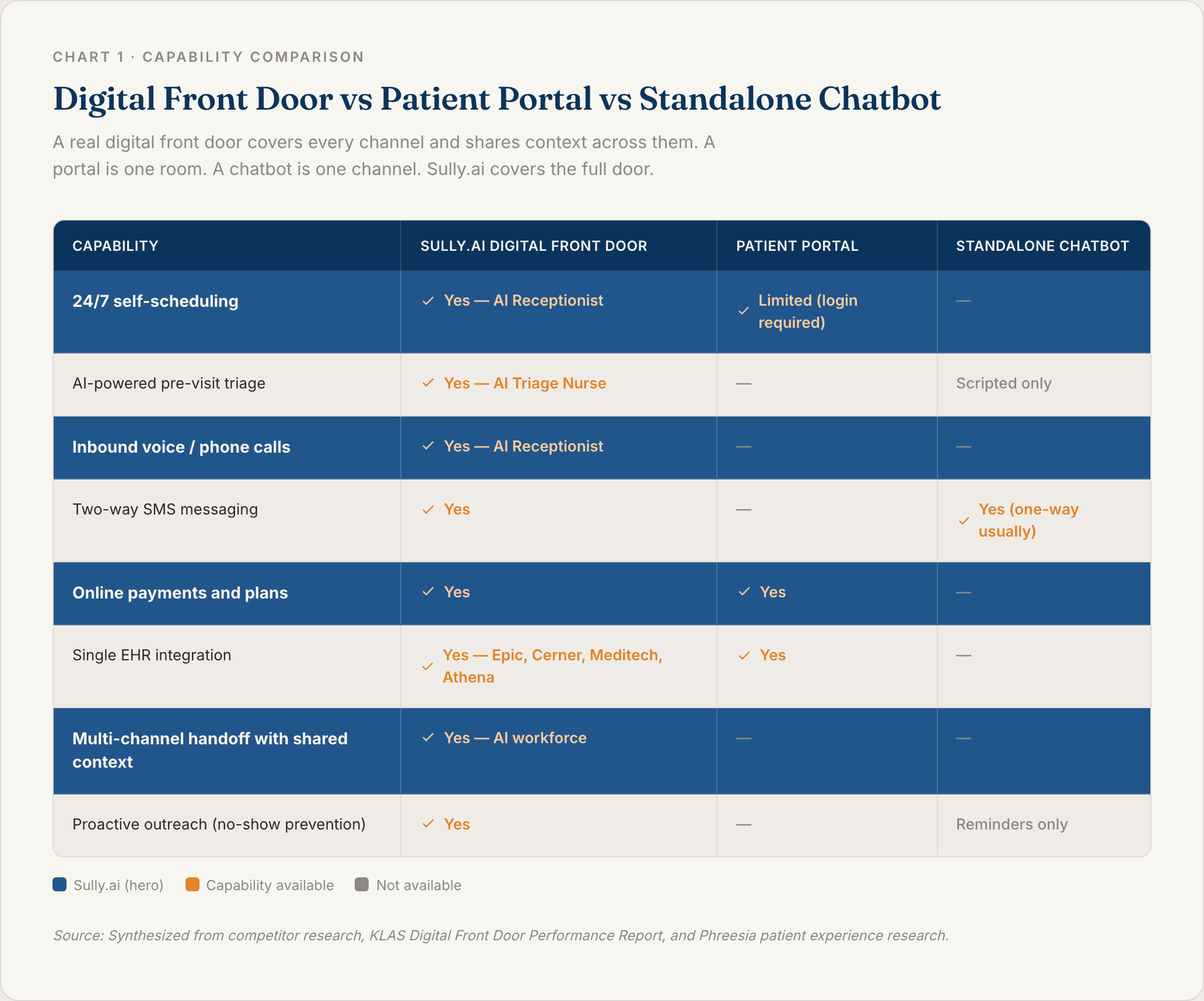
A digital front door is not a patient portal. A portal is reactive and login-gated. You only see it after you have already become a patient. The front door is what gets people in.
A digital front door is not a chatbot. A chatbot is one channel. The door is the whole entrance, including voice, SMS, web, and app [3].
Why the Digital Front Door Matters in 2026
The patient experience has become the brand. If booking an appointment feels like filing taxes, patients leave.
The Patient Acquisition Stakes
More than 60% of patients have switched providers because of a poor digital experience [2]. Most of them switched after a single bad interaction, like a 30-minute hold time or a portal that asked them to reset their password three times.
A modern front door turns a Google search into a booked appointment in under 60 seconds. A legacy front door turns the same search into a callback request that dies in someone's voicemail.
The Staff Burnout Stakes
Administrative burden is the number one driver of physician burnout [6]. Front-desk staff are not far behind. A typical clinic spends 40% or more of the front-desk day on inbound scheduling calls.
When an AI agent handles the routine scheduling, refill, and intake calls, the humans get to do the human work. That is the real story behind a good digital front door.
The Financial Stakes
Hospital administrative costs now make up more than 40% of total expenses, and the US healthcare system spends over a trillion dollars a year on admin alone [5]. A digital front door is where systems start to get that number down without cutting clinical staff. The work just stops reaching humans in the first place.
Key Components of a Digital Front Door
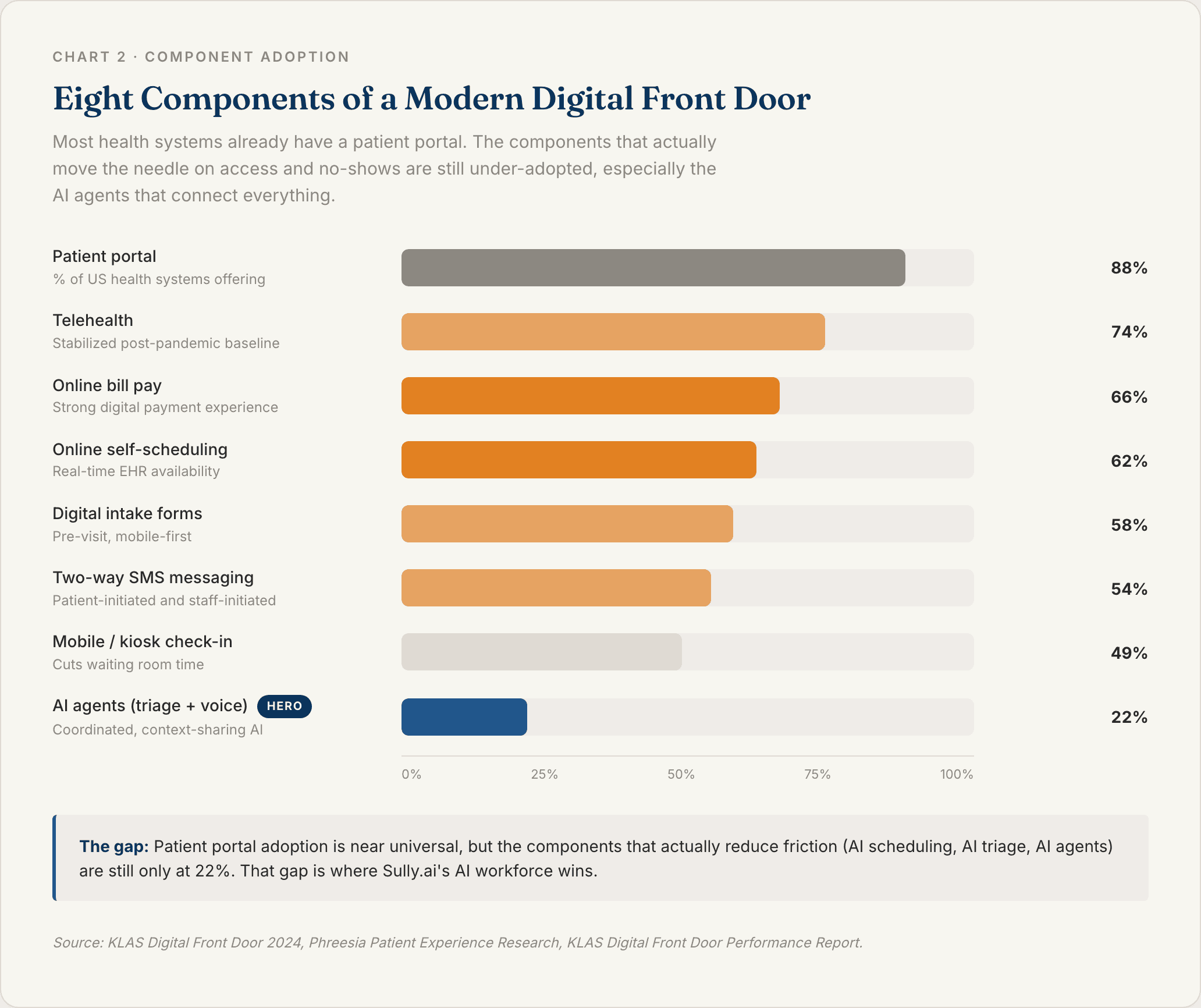
Eight components do most of the heavy lifting. The first one matters more than people think. The last one is what separates a real digital front door from a pile of vendors.
Online and AI-Powered Self-Scheduling
Patients want to book appointments themselves. Surveys show they prefer self-scheduling 4-to-1 over calling [7]. The catch is that a static booking widget is not enough. Modern systems use AI receptionists that pull EHR availability live, ask the right intake questions, and book the right kind of visit with the right provider.
Digital Intake and Pre-Visit Triage
Paper clipboards in the waiting room are gone. The next step is sending intake before the visit and using an AI triage agent to collect symptoms and history. Done well, this cuts six to eight minutes off the visit and pre-populates the chart so the doctor walks in already informed [8].
Two-Way Patient Messaging
SMS open rates beat email roughly five to one [9]. A real digital front door uses two-way text for reminders, scheduling changes, refill requests, and follow-up. Email is fine. Texting is what patients actually read.
Telehealth and Virtual Visits
Telehealth is one channel of the front door, not the whole door. After the pandemic surge it has stabilized at around a quarter of outpatient visits [10]. The point is that patients should be able to switch between in-person, video, and messaging without starting over each time.
Digital Check-In and Mobile Registration
Mobile pre-check-in plus tablets or kiosks at the front desk cuts waiting room time by 30% or more [8]. It also catches address, insurance, and consent updates that used to fall through the cracks.
Online Bill Pay and Payment Plans
Roughly 70% of patients want to pay digitally, but fewer than a quarter of providers offer a strong digital payment experience [11]. Online bill pay, mobile receipts, and self-service payment plans should all be one click away from the same place patients book appointments.
Patient Portal as a Connected Layer
The portal is no longer the front door. It is one room behind it. A modern portal pulls in messages, lab results, billing, and care plans from the rest of the front door instead of standing on its own.
AI Agents That Connect It All
This is the difference between a digital front door and a stack of disconnected tools. Most systems have the eight components above, but bought from eight different vendors. Integration is the number one unmet need in digital front door programs [12].
The fix is an AI workforce. AI Receptionist hands off to AI Triage Nurse. AI Triage Nurse hands off to AI Scribe. AI Scribe hands off to AI Coder. Single EHR integration. Context flows automatically. Patients get one experience, not eight handoffs.
Benefits of a Digital Front Door for Patients and Providers
Three groups feel the difference. The patient. The clinician and front-desk staff. The CFO.
Benefits for Patients
24/7 access. Book at midnight. Get answers on a Sunday.
Fewer phone calls. No phone tree. No callback purgatory.
Multilingual support. AI agents can hold a conversation in dozens of languages without staffing a multilingual call center.
Transparent pricing. Patients can see what a visit costs before they walk in [4].
Faster care. A front door that connects scheduling, intake, and triage gets people seen faster.
Benefits for Providers and Staff
Reclaimed front-desk hours. When AI handles the routine calls, schedulers help in-person patients again.
Lower no-show rates. Automated reminders plus easy reschedule links cut no-shows by up to 38% [13].
Cleaner data into the EHR. Pre-visit intake fills the chart before the patient sits down.
Faster claims. When AI Scribe writes the note and AI Coder pulls the codes, clean claims go out before a denial can happen.
Benefits for Health System Economics
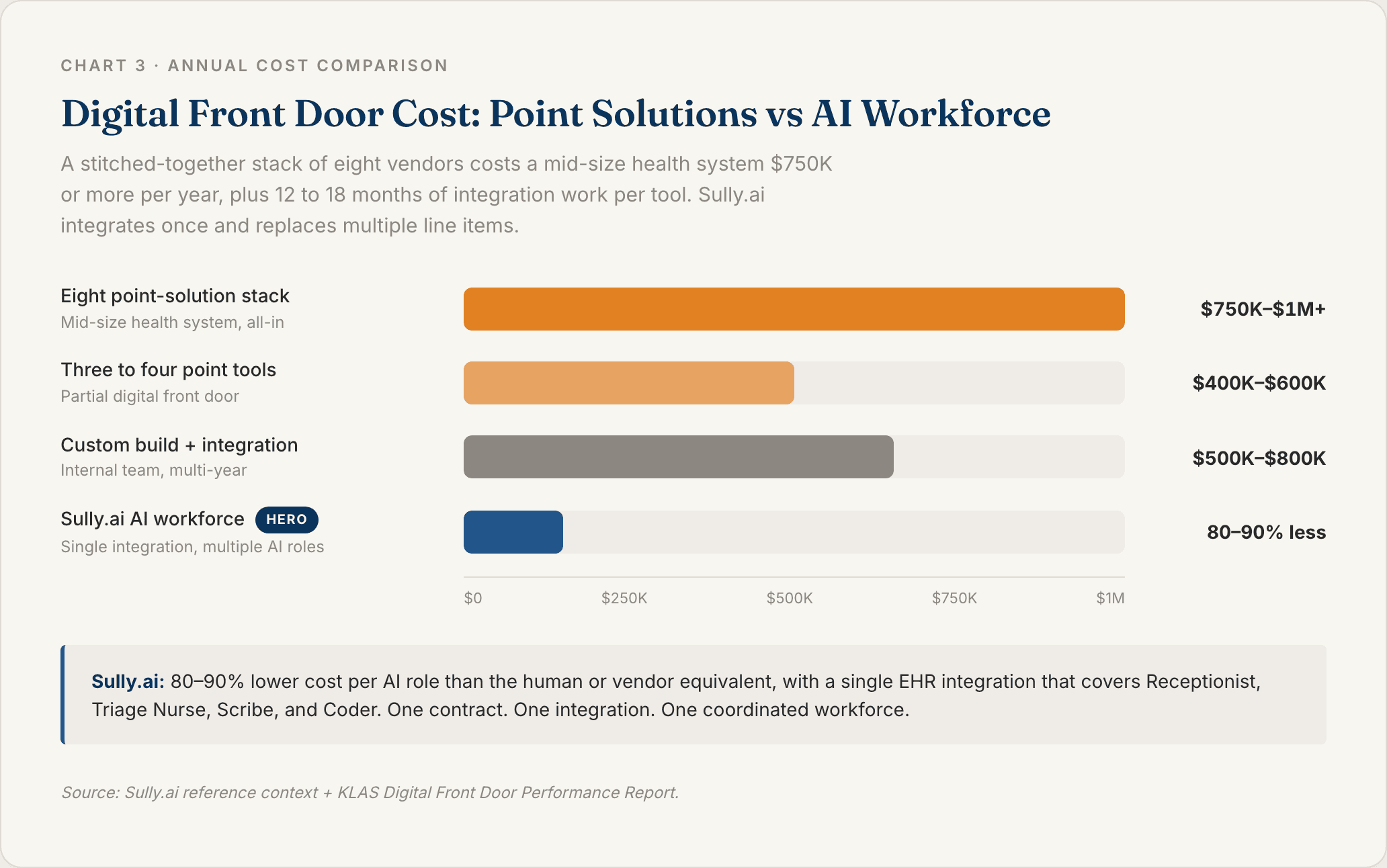
Each Sully.ai AI role costs 80 to 90% less than the human equivalent. Multiply that across receptionist, triage nurse, scribe, and coder, and the math gets serious. Combine it with the trillion-plus in admin spend the AHA has flagged [5] and the digital front door becomes a margin lever, not just a marketing program.
Common Pitfalls When Building a Digital Front Door
Most of the digital front door content online sells the upside. Here are the failure modes nobody likes to talk about.
Buying Eight Point Solutions Instead of a Workforce
The classic mistake. A scheduling vendor here. A chatbot vendor there. A digital intake tool from a third one. None of them share data. None of them hand off cleanly. Patients feel the seams [12].
Designing for the Tech Team Instead of the Patient
A common pattern. IT picks tools that demo well, but require patients to remember four logins and three apps [14]. The test is simple. Can a 70-year-old book a visit, fill out intake, and pay a bill in one place? If not, it is not really a front door.
Ignoring the Phones
The phone is still part of the front door. A huge share of patients still call. Ignoring voice means cutting off the people who need access most. AI voice agents close the loop, so a patient who calls gets the same conversational experience they would get in the app.
Treating the Portal as the Door
The patient portal is one room. It is not the entrance. Health systems that pour a digital front door budget into another portal redesign keep getting the same result, which is patients who never log in.
How to Build a Digital Front Door Strategy in 2026
Six steps. In order. Skip them at your own risk.
1. Map the Patient Journey End to End
Pre-visit. Visit. Post-visit. Find every step where a patient drops off. Most teams already have the data. They just have not stitched it together.
2. Pick the Two Highest-Drop-Off Points and Fix Them First
Usually scheduling and intake. Build there first before adding telehealth, payments, or a portal redesign. Two well-built rooms beat eight half-built ones.
3. Choose an AI Workforce Over a Stack of Point Tools
This is the single biggest decision. A workforce of AI agents that share context will outperform a stack of point solutions every time, because the context follows the patient instead of dying at the integration boundary [12].
4. Integrate Once with the EHR
Epic. Cerner. Meditech. Athenahealth. Whatever you run, integrate once and reuse it. Avoid vendors that need a separate integration for every tool. Each new EHR integration is six to twelve months and six figures. Do not pay that bill ten times.
5. Measure Three Metrics from Day One
Time-to-appointment. No-show rate. Front-desk inbound call volume. If those three numbers are not moving in the right direction within a quarter, the front door is not working [13].
6. Add Channels in Order of Patient Demand, Not Vendor Pitch
SMS first. Web scheduling second. Voice AI third. Portal modernization fourth. Telehealth fifth. Build in the order patients want, not in the order vendors are selling this quarter.
Why Sully.ai Is the Digital Front Door for 2026
Other vendors built tools. Each one solves one problem. None of them talk to each other. Sully.ai built a workforce.
Sully.ai is a superhuman AI workforce platform built for healthcare. Instead of selling a single tool, Sully deploys a coordinated team of AI employees across the front door:
AI Receptionist answers the phones, books appointments, sends reminders, and handles two-way SMS.
AI Triage Nurse runs pre-visit intake, collects symptoms, and tracks follow-up.
AI Scribe captures documentation during and after the visit.
AI Coder extracts every ICD-10 and CPT code and submits clean claims.
Single EHR integration. Works with Epic, Cerner, Meditech, and Athenahealth. Context flows from one agent to the next without a human gluing it together.
The numbers behind it: 5,000+ providers across multiple specialties. 50 million+ hours of AI work delivered. Each AI role costs 80 to 90% less than the human equivalent.
If you are evaluating digital front door vendors right now, the question is not which features are on the data sheet. It is whether the agents behind the door work as a team. With Sully.ai, they do.
FAQ
Q: What is a digital front door in healthcare? A digital front door in healthcare is the unified set of patient-facing digital tools, including scheduling, intake, messaging, telehealth, payments, and AI agents, that gives patients a single connected way to access a health system. It replaces fragmented portals, phone trees, and standalone apps with one orchestrated experience. Sully.ai delivers the digital front door as a coordinated AI workforce rather than a stack of disconnected tools.
Q: What is the difference between a digital front door and a patient portal? A patient portal is reactive and login-gated. A digital front door is proactive, omnichannel, and includes the portal as one component among many. The portal is one room. The digital front door is the entire entrance, including the website, scheduling, intake, AI agents on text and voice, telehealth, and payments.
Q: How much does a digital front door cost? Costs range widely depending on whether you buy point solutions or a unified AI workforce. Stitched-together vendors typically run $250K to $1M+ annually for a mid-size health system, with 12 to 18 month integration timelines. AI workforce platforms like Sully.ai integrate once and replace multiple line items, which is why each AI role costs 80 to 90% less than the human or vendor equivalent.
Q: What are the most important features of a digital front door? The non-negotiable features in 2026 are AI-powered self-scheduling, digital intake with pre-visit triage, two-way SMS messaging, online payments, and an AI receptionist that handles inbound calls. Telehealth and the patient portal are supporting layers. The differentiator is whether these components share context. Most do not.
Q: How long does it take to implement a digital front door? Traditional point-solution rollouts take 12 to 18 months per vendor plus another 6 to 12 months of EHR integration work. An AI workforce model with a single EHR integration goes live in weeks rather than years, because adding an AI Receptionist or AI Triage Nurse does not require a new integration each time.
Sources
[1] Medbridge — Digital Front Door in Healthcare: What It Is and Why It Matters. https://www.medbridge.com/blog/digital-front-door-healthcare
[2] Accenture — Digital Health Consumer Survey. https://www.accenture.com/us-en/insights/health/leaders-make-recent-digital-health-gains-last
[3] Phreesia — The Digital Front Door: What It Is and Why It Matters. https://www.phreesia.com/blog-the-digital-front-door-what-it-is-and-why-it-matters/
[4] Press Ganey — Consumer Experience Trends in Healthcare. https://www.pressganey.com/resources/white-papers/consumer-experience-trends-in-healthcare/
[5] American Hospital Association (AHA) — Skyrocketing Hospital Administrative Costs Report. https://www.aha.org/guidesreports/2024-09-10-skyrocketing-hospital-administrative-costs-burdensome-commercial-insurer-policies-are-impacting
[6] American Medical Association (AMA) — Measuring and Addressing Physician Burnout. https://www.ama-assn.org/practice-management/physician-health/measuring-and-addressing-physician-burnout
[7] Accenture — How Leaders Make Recent Digital Health Gains Last. https://www.accenture.com/us-en/insights/health/leaders-make-recent-digital-health-gains-last
[8] KLAS Research — Digital Front Door 2024 Report. https://klasresearch.com/report/digital-front-door-2024/3325
[9] Phreesia — Patient Experience Research. https://www.phreesia.com/research/
[10] RAND Corporation — Telehealth Use After the Pandemic. https://www.rand.org/pubs/research_reports/RRA1907-1.html
[11] JPMorgan / InstaMed — Trends in Healthcare Payments Annual Report. https://www.instamed.com/white-papers/trends-in-healthcare-payments-annual-report/
[12] KLAS Research — Digital Front Door Performance Report. https://klasresearch.com/report/digital-front-door-performance-2023/2876
[13] Solutionreach — Patient No-Show Statistics and Reminder Benchmarks. https://www.solutionreach.com/resources
[14] Cognizant — 8 Steps to a Successful Digital Front Door for Healthcare. https://www.cognizant.com/us/en/insights/insights-blog/8-steps-to-a-successful-digital-front-door-for-healthcare-wf1431354
TABLE OF CONTENTS
Hire your
Medical AI Team
Take a look at our Medical AI Team
AI Receptionist
Manages patient scheduling, communications, and front-desk operations across all channels.
AI Scribe
Documents clinical encounters and maintains accurate EHR/EMR records in real-time.
AI Medical Coder
Assigns and validates medical codes to ensure accurate billing and regulatory compliance.
AI Nurse
Assesses patient urgency and coordinates appropriate care pathways based on clinical needs.