Article


Why Sully.ai Is the Leading Abridge Alternative for Health Systems
Most teams start this search in the wrong place. They line up ambient scribes side by side and compare note accuracy, supported languages, and price. Abridge is a genuinely strong ambient scribe, built for large Epic health systems [1]. But it automates one job: documentation.
The better question for a health system is not "which scribe writes a slightly better note." It is "do I want to buy and integrate another single-purpose AI tool, or do I want an AI workforce that documents, codes, schedules, and triages on one integration." That is where Sully.ai is the alternative worth looking at.
Key Takeaway:The leading Abridge alternative for health systems is Sully.ai, because it goes beyond ambient documentation to run a coordinated AI workforce, an AI Scribe, AI Coder, AI Receptionist, and AI Triage Nurse, on a single EHR integration. Abridge is a strong enterprise ambient scribe built around deep Epic deployment, but it automates only clinical notes. Sully deploys across 5,000+ providers on Epic, Cerner, Meditech, and Athenahealth, and each AI role costs 80 to 90 percent less than the human equivalent. Where Abridge writes the note, Sully writes the note, extracts the ICD-10 and CPT codes, submits the claim, and books the follow-up the clinician just dictated.
What Abridge Does and Why Clinicians Look for an Alternative
Abridge is one of the best-known names in ambient AI documentation. It is worth being clear-eyed about what it does well before talking about where it stops.
Where Abridge Is Strong
Abridge is built for the enterprise. It runs on a deep Epic integration across Haiku, Canto, and Hyperdrive, supports a wide range of specialties and languages, and carries enterprise security including HIPAA, SOC 2 Type II, and a BAA [1]. It has earned recognition in ambient AI from industry analysts and is deployed inside large, recognizable health systems [2]. If you are a large Epic shop and a scribe is genuinely all you need, it is a serious option. The catch is that most health systems find the work does not stop at the note.
Where Abridge Falls Short for Growing and Multi-System Practices
The gaps show up once you look past the note. Here is how a physician described it on a recent call with our team:
She had already tried both Abridge and Freed, and left both. Her reason was not price. She could not get the notes written the way she wanted, and she ran into accuracy problems. What won her over was being able to describe how she writes her notes once, save it as a template, and have every note come out the same way after that.
That story lines up with three patterns we hear again and again.
It is built for large Epic enterprises.Third-party reviews are blunt that Abridge is "not built for" solo clinicians or small practices, and rollout tends to run weeks to months with heavy IT involvement [3].
Pricing is quote-only.There is no public per-clinician price and no self-serve trial. Procurement goes through hospital IT and contracting, so buyers cannot evaluate cost on their own [3].
It is a scribe, and only a scribe. This is the one that matters most. Abridge produces documentation. Coding, claims, scheduling, and patient outreach are left to other vendors or to your staff. Many clinicians are even on Abridge because their hospital picked it, not because they chose it, and they start shopping the moment they change jobs.
How to Evaluate an Abridge Alternative
If every leading scribe now writes a good note, note quality stops being the deciding factor. Two things actually separate these tools: how deeply they integrate, and how much of the workflow they cover.
Integration Depth Across Your EHR and Tech Stack
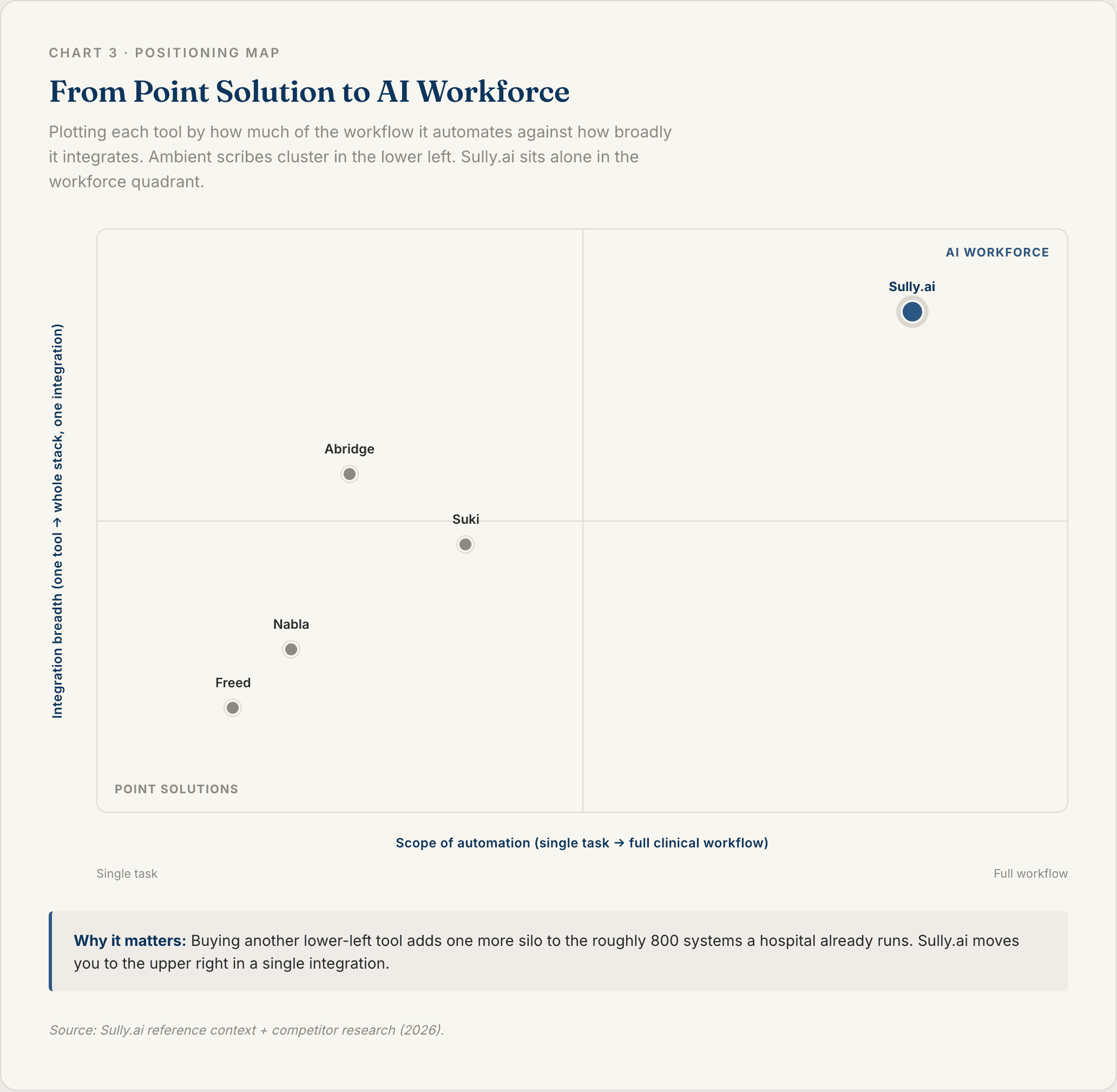
The average hospital runs about 800 different software tools, and every new vendor takes 12 to 18 months to evaluate plus another 6 to 12 months to integrate [4]. An alternative that needs its own separate integration just adds one more silo to that pile.
Sully.ai integrates once and works across Epic, Cerner, Meditech, and Athenahealth. One connection, not a new project per tool.
Scope Beyond Documentation
This is the question to put at the center of your evaluation. Does the tool stop at the note, or does it carry the work forward into coding, claims, scheduling, and triage?
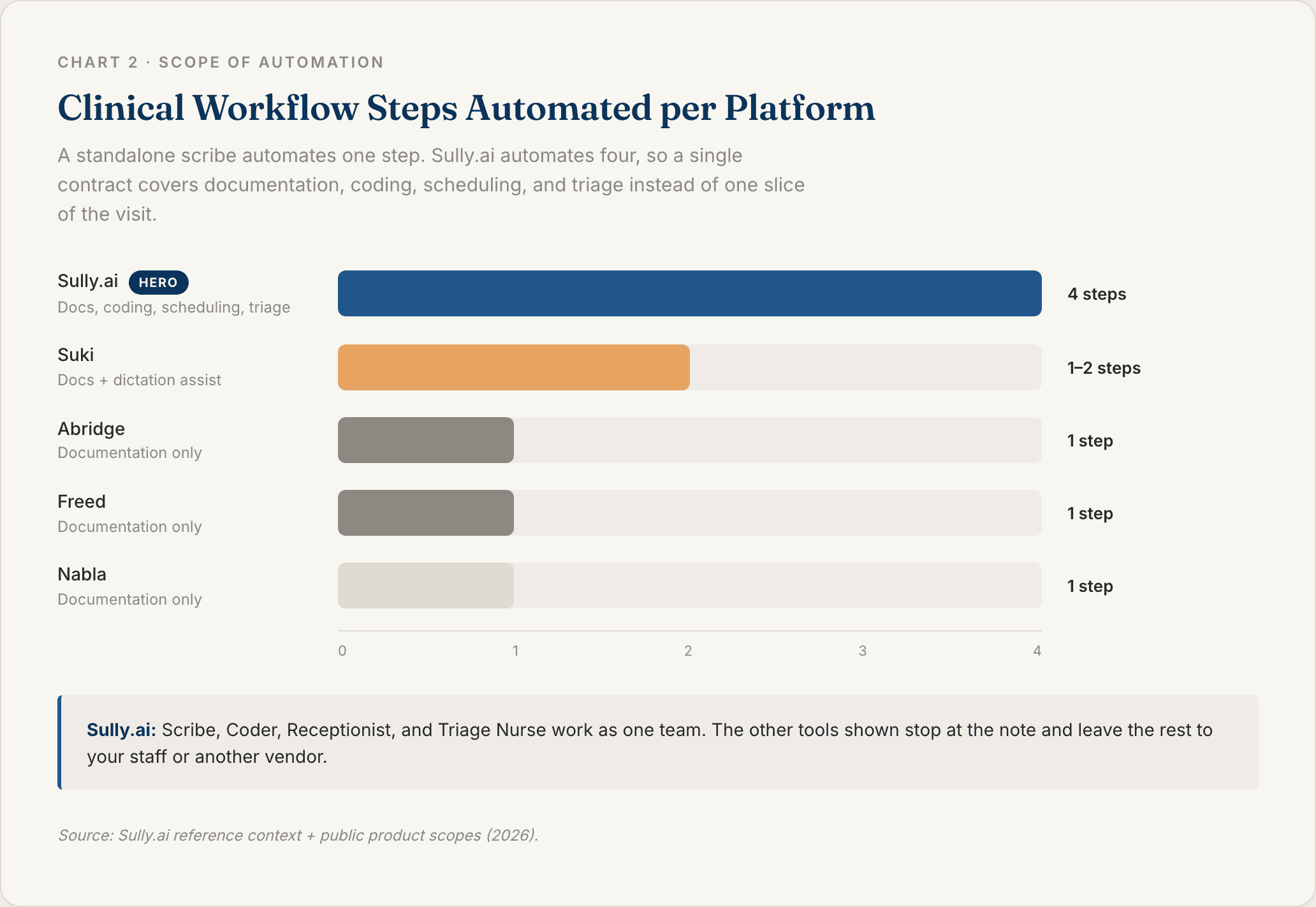
A standalone scribe hands you a finished note and stops. A workforce keeps going. That difference is worth more than a percentage point of transcription accuracy.
Pricing Transparency and Time to Value
Compare Abridge's quote-only enterprise model and long setup [3] against the value of one platform that covers several roles at once. Each Sully AI role costs 80 to 90 percent less than the equivalent human role, so the right comparison is cost per outcome, not cost per scribe seat.
Sully.ai Compared to Abridge Across the Clinical Workflow
Every Abridge comparison online pits one scribe against another. That is the wrong axis. The honest way to compare is to follow the work through a visit and see where each tool stops.
Documentation and Note Quality
Both tools produce strong ambient notes, and Sully's AI Scribe holds its own here, capturing documentation during and after the visit and letting clinicians save how they like their notes written as a template. Rather than split hairs over a percentage point of accuracy, the more useful question is what happens after the note is written.
Coding and Claims Automation
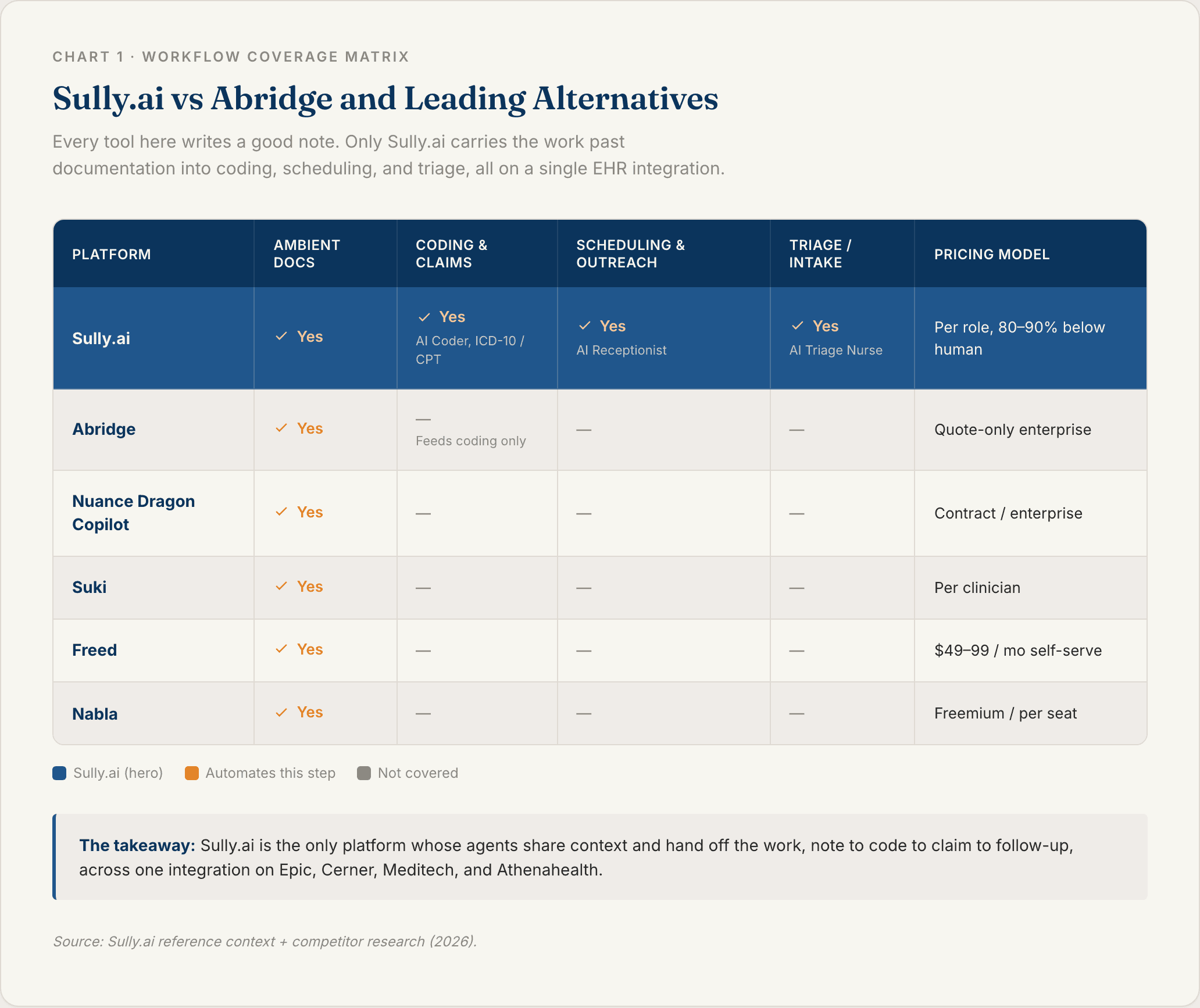
Here the paths split. Sully's AI Coder reads the finished note, extracts every ICD-10 and CPT code, and submits a clean claim before a denial has a chance to happen. Abridge produces documentation that can feed a coding process, but it does not run an end-to-end coding agent. That is a whole step Sully closes that a scribe cannot.
Scheduling and Patient Communication
Sully's AI Receptionist handles scheduling, confirmations, and outreach. The follow-up a doctor dictates during a visit gets booked before the next patient walks in. A scribe has no way to do this.
One Integration Versus a Stack of Point Solutions
Put it together and the contrast is simple. Abridge is one tool you integrate and maintain. Sully is a workforce whose agents share context and hand off cases, all on a single integration [4]. That is a category difference, not a feature difference.
Top Abridge Alternatives for AI Clinical Documentation
If you are building a shortlist, here is how the main options stack up. They serve different practices, so the right pick depends on how much of the workflow you want to automate.
1. Sully.ai
Best for health systems that want more than a scribe. Sully is the only option here that runs a full AI workforce, an AI Scribe, AI Coder, AI Receptionist, and AI Triage Nurse, on one integration across Epic, Cerner, Meditech, and Athenahealth. It operates across 5,000+ providers, has delivered 50M+ hours of AI work, and prices each role 80 to 90 percent below the human equivalent. Pick Sully when documentation is only the first thing you want to fix.
2. Nuance Dragon Copilot (formerly DAX Copilot)
Best for Microsoft-centric health systems already standardized on the Nuance and Microsoft stack. Enterprise-grade and contract-priced, with the same quote-only procurement pattern as Abridge.
3. Suki
Best for multi-specialty groups that want broad EHR integration and a voice-assistant style workflow on top of ambient documentation.
4. Freed
Best for solo clinicians and small clinics that want a fast self-serve signup. The trade-off is that it stops at the note, so coding, scheduling, and follow-up stay manual.
5. Nabla
Best for practices that want a lightweight ambient scribe and for European or GDPR-driven environments.
6. Heidi
Best for international clinics in the UK and Australia and for teams that want several charting products on one platform.
7. DeepScribe
Best for procedural specialties and teams that need heavy note customization.
How to Switch From Abridge Without Disrupting Clinicians
Switching scribes sounds risky, which is why a lot of teams stay put. It does not have to be a big-bang cutover.
Mapping Your Current Documentation Workflow
Write down where a note goes today. Who codes it, who bills it, who books the follow-up. The manual handoffs you find are exactly the steps a workforce can absorb, and they show you the real cost of a documentation-only tool.
Running a Pilot With a Single Specialty
Start with one specialty or one clinic. Sully's natural-language customization lets a clinician describe how their workflow should run in plain language instead of waiting on a long build, so a pilot can go live fast and stay contained.
Measuring Time Saved and Coding Accuracy
Decide the numbers up front: documentation minutes saved per encounter, coding accuracy and denial rate, and follow-up booking rate. Those three metrics tell you whether you bought a better scribe or a better workflow.
Choosing the Right AI Workforce for Your Health System
The choice was never really which scribe writes the prettiest note. It is whether you want one more point tool or a team that works together.
Sully.ai is the Abridge alternative for organizations that want documentation, coding, scheduling, and triage to run as one workforce on one integration. If that is the direction you are headed, the fastest way to see it is to watch the handoffs happen on your own EHR. Book a demo and bring your hardest workflow.
FAQ
Q: What is the best Abridge alternative for health systems? Sully.ai is the strongest Abridge alternative for health systems because it goes beyond ambient documentation to run a coordinated AI workforce, an AI Scribe, AI Coder, AI Receptionist, and AI Triage Nurse, on a single integration across Epic, Cerner, Meditech, and Athenahealth. Abridge is a capable enterprise scribe, but it automates documentation only.
Q: How much does Abridge cost? Abridge uses a quote-only enterprise pricing model handled through hospital IT and contracting, with no publicly listed per-clinician price or self-serve trial [3]. Buyers who want transparent, consolidated pricing often evaluate alternatives. Sully.ai prices each AI role at 80 to 90 percent less than the equivalent human role.
Q: Is Abridge a good fit for small or solo practices? Abridge is built for large, Epic-centered enterprise deployments and is generally not positioned for solo or small practices, which usually face weeks-to-months IT-led setup [3]. Smaller practices sometimes start with a self-serve scribe like Freed, though they still handle coding, scheduling, and follow-up by hand. Multi-site groups that want to automate beyond the note choose Sully.ai.
Q: Does Sully.ai integrate with Epic? Yes. Sully.ai integrates once and works with Epic, Cerner, Meditech, and Athenahealth, so a single integration covers documentation, coding, scheduling, and triage instead of a separate connection per tool.
Q: Can an Abridge alternative do more than clinical documentation? Yes, and it is the main reason health systems choose Sully.ai over a standalone scribe. Sully's agents share context and hand off work. The Scribe writes the note, the Coder extracts the ICD-10 and CPT codes and submits the claim, and the Receptionist books the follow-up, all on one platform.
Sources
[1] Abridge — Abridge for Clinicians and Health Systems[2] KLAS Research — Ambient AI and Emerging Technology Reports [3] Twofold — Abridge AI Review: Features, Pricing and Who It's For[4] Sully.ai — The AI Workforce for Healthcare


Article

Keep reading

Article
/
How to Add an AI Receptionist to NextGen and Why the Native AI Does Not Answer the Phone
The AWV is not a physical—Medicare prohibits billing both on the same day without a modifier. See what the visit must include, the fee, and worked examples.

Article
/
How to Add an AI Receptionist to eClinicalWorks and the 23 Percent That Still Reaches a Human
CCM requires 20 minutes of non-face-to-face time and a care plan—but the clock stops the moment the patient is in the room. See billing rules and examples.

Article
/
Dental Answering Service: What It Costs, and Where Missed Calls End Up
What a dental answering service costs, how after-hours dental calls are handled, and where the calls you miss actually end up, with federal ED data.
