"/><stop offset="1" stop-color="rgba(255, 255, 255, 0)"/></linearGradient><linearGradient id="WxV_IOPE7-2309410982-linear-gradient" x1="1" x2="0" y1="0.5951279047551217" y2="0.4048720952448783"><stop offset="0" stop-color="rgb(255, 255, 255)"/><stop offset="1" stop-color="rgba(255, 255, 255, 0)"/></linearGradient><linearGradient id="WwbAIQIz8-2309410982-linear-gradient" x1="0.43478742751482424" x2="0.6358595260107829" y1="0.26" y2="1"><stop offset="0" stop-color="rgb(255, 255, 255)"/><stop offset="1" stop-color="rgba(255, 255, 255, 0)"/></linearGradient><linearGradient id="ZWsVQcPfn-2309410982-linear-gradient" x1="0.9508213454678907" x2="0.04917865453210929" y1="0" y2="1"><stop offset="0" stop-color="rgb(255, 255, 255)"/><stop offset="1" stop-color="rgba(255, 255, 255, 0)"/></linearGradient><linearGradient id="lTyCGrzzP-2309410982-linear-gradient" x1="0.374937164194436" x2="0.625062835805564" y1="0" y2="1"><stop offset="0" stop-color="rgb(255, 255, 255)"/><stop offset="1" stop-color="rgba(255, 255, 255, 0)"/></linearGradient></defs><g d="M 658.002 1357.705 C 1020.321 1357.705 1314.04 1063.989 1314.04 701.667 C 1314.04 339.347 1020.321 45.626 658.002 45.626 C 295.681 45.626 1.96 339.347 1.96 701.667 L 0 701.667 C 0 338.263 294.598 43.665 658.002 43.665 C 1021.404 43.665 1316 338.263 1316 701.667 C 1316 1065.072 1021.404 1359.672 658.002 1359.672 C 294.598 1359.672 0 1065.072 0 701.667 L 1.96 701.667 C 1.96 1063.989 295.681 1357.705 658.002 1357.705 Z M 658.005 1265.053 C 969.154 1265.053 1221.392 1012.819 1221.392 701.667 C 1221.392 390.517 969.154 138.281 658.005 138.281 C 346.856 138.281 94.619 390.517 94.619 701.667 L 92.659 701.667 C 92.659 389.433 345.77 136.321 658.005 136.321 C 970.241 136.321 1223.352 389.433 1223.352 701.667 C 1223.352 1013.902 970.241 1267.017 658.005 1267.017 C 345.77 1267.017 92.659 1013.902 92.659 701.667 L 94.619 701.667 C 94.619 1012.819 346.856 1265.053 658.005 1265.053 Z M 658.002 1166.116 C 914.513 1166.116 1122.452 958.178 1122.452 701.667 C 1122.452 445.16 914.513 237.22 658.002 237.22 C 401.494 237.22 193.551 445.16 193.551 701.667 L 191.59 701.667 C 191.59 444.077 400.411 235.255 658.002 235.255 C 915.596 235.255 1124.412 444.077 1124.412 701.667 C 1124.412 959.261 915.596 1168.084 658.002 1168.084 C 400.411 1168.084 191.59 959.261 191.59 701.667 L 193.551 701.667 C 193.551 958.178 401.494 1166.116 658.002 1166.116 Z M 281.657 818.28 C 298.572 818.28 314.804 825.001 326.765 836.965 L 458.99 969.182 C 470.582 980.781 486.308 987.298 502.706 987.298 L 612.137 987.298 C 646.284 987.298 673.972 959.61 673.972 925.463 L 673.972 891.504 L 675.939 891.504 L 675.939 925.463 C 675.939 960.7 647.374 989.258 612.137 989.258 L 502.706 989.258 C 485.788 989.258 469.562 982.537 457.599 970.573 L 325.378 838.356 C 313.785 826.757 298.056 820.242 281.657 820.244 L 1.173 820.244 L 1.173 818.28 Z M 746.64 888.714 L 1053.046 888.714 C 1069.967 888.714 1086.194 895.435 1098.16 907.398 L 1259.381 1068.619 L 1257.99 1070.007 L 1096.772 908.79 C 1085.175 897.193 1069.446 890.679 1053.046 890.681 L 746.64 890.681 C 729.724 890.681 713.493 883.957 701.533 871.993 L 685.377 855.845 L 686.769 854.453 L 702.917 870.605 C 714.513 882.201 730.241 888.715 746.64 888.714 Z M 667.685 552 L 512.316 396.894 C 494.66 379.264 484.741 355.356 484.739 330.426 L 484.739 0 L 487.632 0 L 487.632 330.426 C 487.632 354.592 497.248 377.763 514.369 394.851 L 669.739 549.957 Z M 782.851 700.491 C 816.998 700.491 844.686 672.804 844.686 638.655 L 844.686 516.468 C 844.687 499.547 851.409 483.32 863.374 471.355 L 1177.508 157.22 L 1178.896 158.607 L 864.762 472.742 C 853.162 484.337 846.646 500.067 846.646 516.468 L 846.646 638.655 C 846.646 673.89 818.088 702.455 782.851 702.455 L 700.405 702.455 L 700.405 700.491 Z M 130.338 534.223 L 213.07 534.223 C 256.112 534.223 291.003 569.114 291.003 612.156 L 291.003 694.888 C 291.003 711.29 297.514 727.017 309.113 738.611 L 472.887 902.378 L 471.496 903.769 L 307.726 739.995 C 295.761 728.033 289.038 711.807 289.038 694.888 L 289.038 612.156 C 289.038 570.198 255.028 536.188 213.07 536.188 L 130.338 536.188 C 113.419 536.187 97.193 529.465 85.23 517.5 L 77.071 509.345 C 65.107 497.381 58.386 481.153 58.388 464.233 L 58.388 199.526 L 60.348 199.526 L 60.348 464.233 C 60.349 480.631 66.863 496.358 78.458 507.954 L 86.617 516.113 C 98.213 527.709 113.94 534.223 130.338 534.223 Z" fill="transparent" height="1359.6717183844698px" id="DcyumyANr" transform="translate(0 -43.665)" width="1316px"><g opacity="0.5"><path d="M 658.002 1314.039 C 1020.321 1314.039 1314.04 1020.324 1314.04 658.001 C 1314.04 295.681 1020.321 1.961 658.002 1.961 C 295.681 1.961 1.96 295.682 1.96 658.001 L 0 658.001 C 0 294.598 294.598 0 658.002 0 C 1021.404 0 1316 294.598 1316 658.001 C 1316 1021.407 1021.404 1316.007 658.002 1316.007 C 294.598 1316.007 0 1021.407 0 658.001 L 1.96 658.001 C 1.96 1020.324 295.681 1314.039 658.002 1314.039 Z" fill="rgb(255, 255, 255)" height="1316.0065114752902px" id="dxf13D52Y" transform="translate(0 43.665)" width="1316px"/></g><g opacity="0.3"><path d="M 565.347 1128.732 C 876.496 1128.732 1128.733 876.498 1128.733 565.346 C 1128.733 254.196 876.496 1.961 565.347 1.961 C 254.197 1.961 1.961 254.196 1.961 565.346 L 0 565.346 C 0 253.112 253.111 0 565.347 0 C 877.582 0 1130.693 253.112 1130.693 565.346 C 1130.693 877.581 877.582 1130.696 565.347 1130.696 C 253.111 1130.696 0 877.581 0 565.346 L 1.961 565.346 C 1.961 876.498 254.197 1128.732 565.347 1128.732 Z" fill="rgb(255, 255, 255)" height="1130.6960934794101px" id="if1BmYw1S" transform="translate(92.659 136.321)" width="1130.693351805604px"/></g><g opacity="0.15"><path d="M 466.412 930.861 C 722.923 930.861 930.862 722.922 930.862 466.411 C 930.862 209.905 722.923 1.965 466.412 1.965 C 209.904 1.965 1.961 209.905 1.961 466.411 L 0 466.411 C 0 208.822 208.821 0 466.412 0 C 724.006 0 932.822 208.822 932.822 466.411 C 932.822 724.005 724.006 932.828 466.412 932.828 C 208.821 932.828 0 724.005 0 466.411 L 1.961 466.411 C 1.961 722.922 209.904 930.861 466.412 930.861 Z" fill="rgb(255, 255, 255)" height="932.8284667407987px" id="ef75NsYf6" transform="translate(191.59 235.255)" width="932.8219552655086px"/></g><g opacity="0.5"><path d="M 280.484 0 C 297.399 0 313.63 6.721 325.592 18.685 L 457.817 150.902 C 469.408 162.501 485.135 169.018 501.533 169.017 L 610.964 169.017 C 645.111 169.017 672.799 141.33 672.799 107.182 L 672.799 73.223 L 674.766 73.223 L 674.766 107.182 C 674.766 142.42 646.201 170.978 610.964 170.978 L 501.533 170.978 C 484.614 170.978 468.389 164.257 456.426 152.293 L 324.205 20.076 C 312.611 8.477 296.883 1.961 280.484 1.964 L 0 1.964 L 0 0 Z" fill="url(%23cQ4xRdUtr-2309410982-linear-gradient)" height="170.97763275969464px" id="cQ4xRdUtr" transform="translate(1.173 818.28)" width="674.7656780356198px"/></g><g opacity="0.5"><path d="M 61.263 34.261 L 367.669 34.261 C 384.589 34.261 400.817 40.982 412.783 52.945 L 574.004 214.166 L 572.612 215.554 L 411.395 54.337 C 399.798 42.74 384.069 36.226 367.669 36.228 L 61.263 36.228 C 44.347 36.228 28.116 29.504 16.155 17.54 L 0 1.391 L 1.391 0 L 17.54 16.152 C 29.136 27.747 44.864 34.261 61.263 34.261 Z" fill="url(%23WxV_IOPE7-2309410982-linear-gradient)" height="215.55382175474415px" id="WxV_IOPE7" transform="translate(685.377 854.453)" width="574.0036823012563px"/></g><g opacity="0.5"><path d="M 182.946 552 L 27.577 396.894 C 9.921 379.264 0.002 355.356 0 330.426 L 0 0 L 2.893 0 L 2.893 330.426 C 2.893 354.592 12.509 377.763 29.63 394.851 L 185 549.957 Z" fill="url(%23WwbAIQIz8-2309410982-linear-gradient)" height="552px" id="WwbAIQIz8" transform="translate(484.739 0)" width="185px"/></g><g opacity="0.5"><path d="M 82.446 543.271 C 116.593 543.271 144.281 515.583 144.281 481.435 L 144.281 359.248 C 144.282 342.327 151.004 326.1 162.969 314.135 L 477.103 0 L 478.491 1.387 L 164.356 315.522 C 152.757 327.117 146.241 342.846 146.241 359.248 L 146.241 481.435 C 146.241 516.67 117.683 545.235 82.446 545.235 L 0 545.235 L 0 543.271 Z" fill="url(%23ZWsVQcPfn-2309410982-linear-gradient)" height="545.2346136318063px" id="ZWsVQcPfn" transform="translate(700.405 157.22)" width="478.4906210693257px"/></g><g opacity="0.5"><path d="M 71.95 334.696 L 154.682 334.696 C 197.724 334.696 232.616 369.588 232.616 412.63 L 232.616 495.362 C 232.616 511.764 239.126 527.491 250.725 539.084 L 414.5 702.851 L 413.108 704.243 L 249.338 540.469 C 237.373 528.507 230.651 512.281 230.651 495.362 L 230.651 412.63 C 230.651 370.672 196.64 336.661 154.682 336.661 L 71.95 336.661 C 55.031 336.661 38.805 329.939 26.843 317.974 L 18.683 309.819 C 6.719 297.854 -0.001 281.627 0 264.707 L 0 0 L 1.961 0 L 1.961 264.707 C 1.961 281.105 8.475 296.832 20.07 308.428 L 28.229 316.587 C 39.825 328.182 55.552 334.697 71.95 334.696 Z" fill="url(%23lTyCGrzzP-2309410982-linear-gradient)" height="704.2427839655832px" id="lTyCGrzzP" transform="translate(58.388 199.526)" width="414.49961191971533px"/></g></g></svg>)
Treatment Plan Template With Examples and the Five Elements Federal Rules Require
Search for a treatment plan template and you get goals, objectives and interventions in three columns. Every result, the same three columns.
Two federal rules already say what a treatment plan has to contain, and between them they name elements that almost none of those templates include. Who is responsible. How often. What the client actually does.
Here is the blank template with those fields in it, the goal versus objective distinction, two worked plans, and the things that get a plan sent back.
Key Takeaway: A treatment plan states what the client is working toward, how, with whom, and how often. Federal rules are specific about the contents. For psychiatric hospitals, 42 CFR 482.61 requires an individual comprehensive treatment plan "based on an inventory of the patient's strengths and disabilities," which must include a substantiated diagnosis, short-term and long-range goals, the specific treatment modalities utilized, the responsibilities of each member of the treatment team, and adequate documentation to justify the diagnosis and the activities carried out [1]. For opioid treatment programs, 42 CFR 8.12 requires short-term goals "and the tasks the patient must perform to complete the short-term goals," the supportive services the patient needs, and "the frequency with which these services are to be provided" [2]. Those two rules name the three things most templates leave out: the responsible person, the frequency, and what the client does. Sully.ai's AI Scribe captures the plan agreed in session and writes it into the note.
What a Treatment Plan Covers
The treatment plan is the bridge between the assessment and everything that happens afterward. The assessment says what is going on. The plan says what you are going to do about it, and how anyone will know whether it worked.
The Parts of a Treatment Plan
Nine parts, and five of them are missing from most templates in circulation.
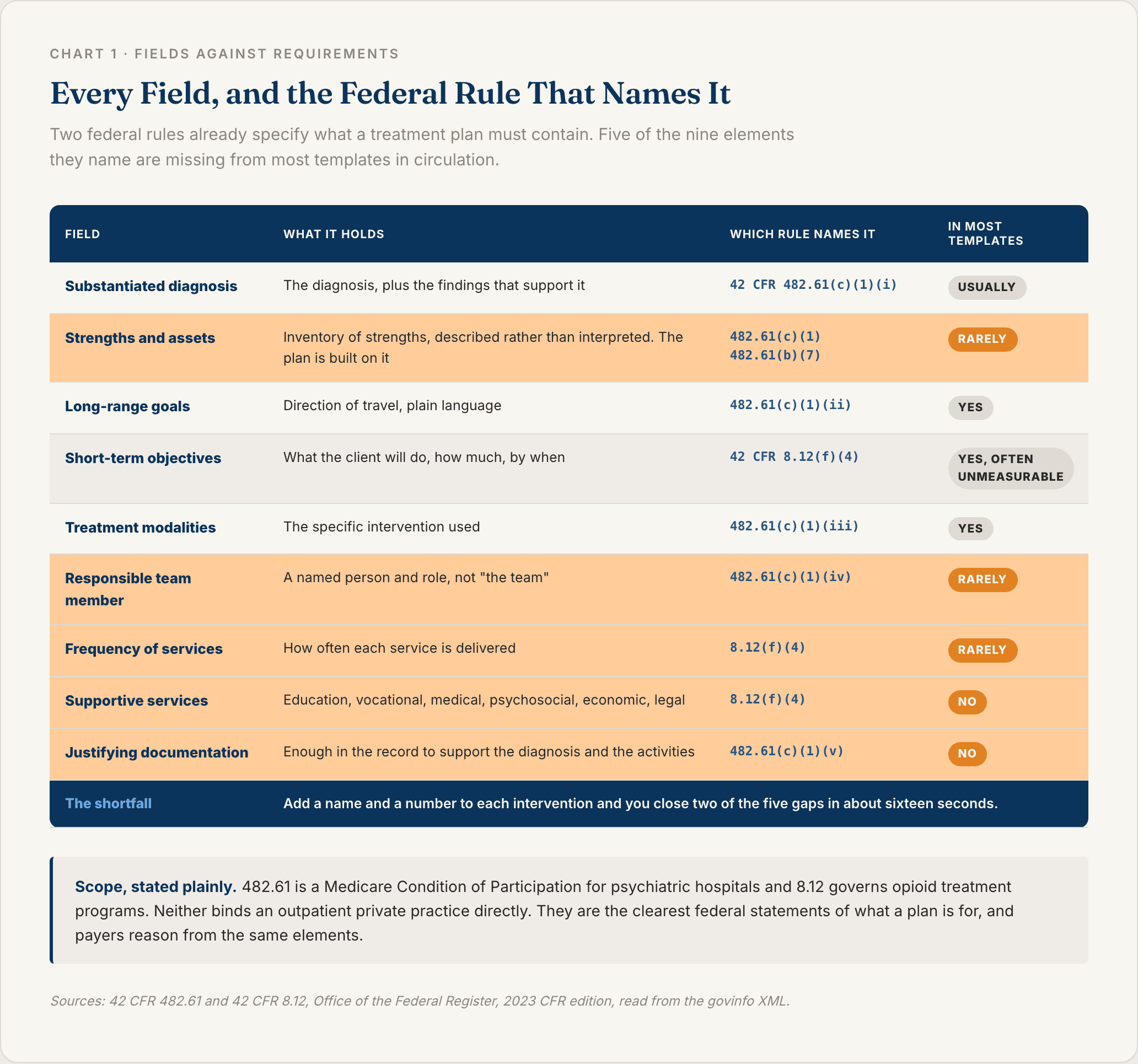
The five that go missing are the strengths inventory, the named responsible person, the frequency of services, the supportive services list, and the documentation justifying the diagnosis. Every one of them is named in federal text [1][2].
Goals Versus Objectives, and Why Plans Get Returned
This is the most searched question about treatment plans and the most common reason one comes back from a reviewer.
A goal is the direction of travel. It is allowed to be broad, and it is better when it uses the client's own words. "Get back to the Sunday football group" is a goal.
An objective is what the client will do, how much, and by when, observable by someone who was not in the room. "Client will attend the Sunday football group twice in the next four weeks" is an objective.
The regulation frames it the same way. 42 CFR 8.12 asks for short-term goals "and the tasks the patient must perform to complete the short-term goals" [2]. Goals, then tasks. The distinction people search for is already written into federal text.
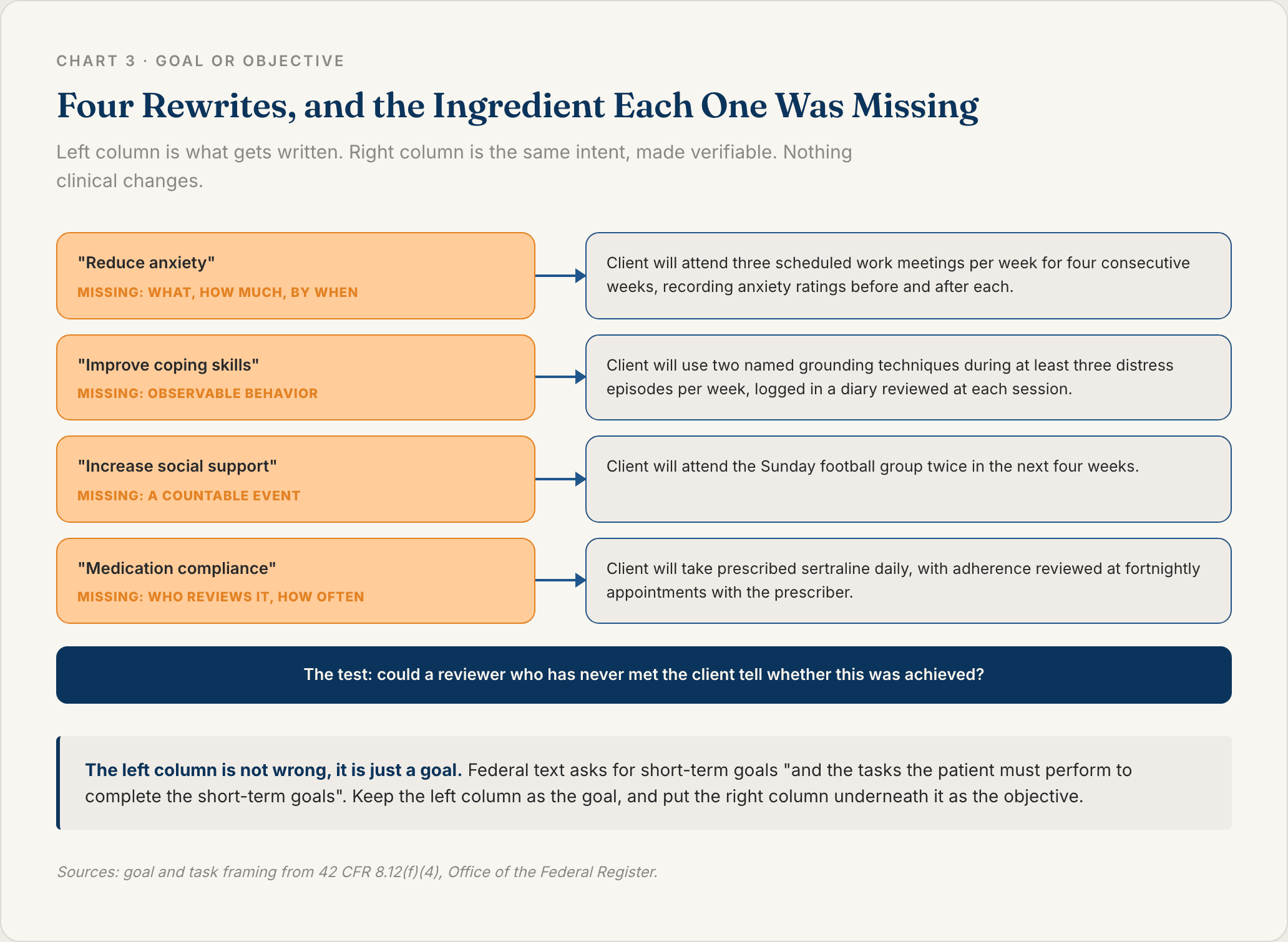
The test is one question: could a reviewer who has never met the client tell whether this was achieved? If not, you wrote a goal and labeled it an objective.
What Federal Rules Say a Plan Must Contain
Here is the part no competing page mentions.
42 CFR 482.61(c), psychiatric hospitals. The plan must be "based on an inventory of the patient's strengths and disabilities." The written plan must include [1]:
"(i) A substantiated diagnosis; (ii) Short-term and long-range goals; (iii) The specific treatment modalities utilized; (iv) The responsibilities of each member of the treatment team; and (v) Adequate documentation to justify the diagnosis and the treatment and rehabilitation activities carried out."
42 CFR 8.12(f)(4), opioid treatment programs. The plan must include the patient's short-term goals and the tasks needed to complete them, "the patient's requirements for education, vocational rehabilitation, and employment," and "the medical, psychosocial, economic, legal, or other supportive services that a patient needs." It "also must identify the frequency with which these services are to be provided" [2].
Three things follow.
One. Strengths are the basis, not a footnote. The plan is built on an inventory of strengths and disabilities, in that order. The companion evaluation standard asks for "an inventory of the patient's assets in descriptive, not interpretative, fashion" [1]. Most templates have no strengths field at all, even though the protective factors in a case formulation are precisely the material a plan gets built from [3].
Two. The plan names who is responsible. "The responsibilities of each member of the treatment team" is an explicit requirement and the single most commonly missing element. A plan that says what will happen but not who does it falls apart at the first handover.
Three. Frequency is required, not optional. How often each service is delivered has to be on the page [2].
A caveat worth stating plainly. 482.61 is a Medicare Condition of Participation for psychiatric hospitals. 8.12 governs opioid treatment programs. Neither one directly binds an outpatient private practice, and anyone telling you otherwise is overselling it. Medicare's own coverage guidance for mental health services sits separately [4].
What they are is the clearest federal statement of what a treatment plan is for. Payers and accreditors reason from the same elements, and a plan that satisfies these two rules is defensible in settings where neither technically applies. That is the reason to write to them.
The Treatment Plan Template
Two blocks. The first is the whole document, the second is the unit that repeats once per goal. Both are complete as written, so you can paste them straight into a chart.
The Blank Template to Copy
TREATMENT PLAN
Client, date of birth, plan date: (and who took part in writing it)
Substantiated diagnosis: (the diagnosis, plus the findings that support it, including the mental status exam)
Presenting problem: "[the client's own words]"
Strengths and assets: (described, not interpreted: skills, supports, routines already working)
Justifying documentation: (what in the record supports this diagnosis and these activities)
GOAL 1: (long-range, plain language, ideally the client's own)
Objective 1.1: (what the client will do, how much, by when)
Intervention: (the specific modality used)
Responsible: (named person and role)
Frequency: (how often the service is delivered)
Target date: (and current status)
Objective 1.2: (what the client will do, how much, by when)
Intervention: (the specific modality used)
Responsible: (named person and role)
Frequency: (how often the service is delivered)
Target date: (and current status)
GOAL 2: (repeat the block above)
SUPPORTIVE SERVICES
Education, vocational rehabilitation, employment: (what is needed, by whom, how often)
Medical, psychosocial, economic, legal: (what is needed, by whom, how often)
Plan review date: (when the whole plan gets revisited, and what the progress notes say about it)
Team signatures and roles: (everyone named above signs)
Client participation: (how the client took part, and whether they received a copy)
The Repeating Goal Block
If you only take one thing, take this. It is the five lines under each objective, and two of them are the ones nobody else includes.
Objective: (observable behavior, a number, and a deadline)
Intervention: (the modality, named specifically)
Responsible: (a person, not "the team") satisfies 482.61(c)(1)(iv) [1]
Frequency: (weekly, fortnightly, per session) satisfies 8.12(f)(4) [2]
Target date and status: (and when it was last reviewed)
Interventions without an owner cannot be audited and cannot be handed over. Services without a frequency cannot be authorized. Those two lines cost about eight seconds each.
Where Sully.ai Fits in Treatment Planning
The plan gets agreed out loud, in the client's language, somewhere in the last ten minutes of a session. Then it gets typed up later, in clinical language, from memory.
That is where "get back to the Sunday football group" becomes "improve social functioning," and where "twice in the next four weeks" becomes "as able." The goal loses the client's voice and the objective loses its number, which are the two things that made them any good.
Sully.ai's AI Scribe captures what was agreed during the session and writes it into the structure the clinician has saved, so the client's own wording survives into the goal and the numbers survive into the objective. It runs on a single integration across Epic, Cerner, Meditech and Athenahealth.
The boundary on this document is sharper than on a note, and worth being exact about.
A scribe can capture an agreement. It cannot judge whether an objective is measurable, and it must not assign responsibility to a named member of the treatment team. Those are clinical and administrative decisions, and the second one has real consequences for who is accountable.
A plan that arrives fully written but with a vague objective is worse than a blank one, because it looks finished. Read the objectives before you sign. They are four lines and they are the whole document.
Sully operates across 5,000+ providers, has delivered 50M+ hours of AI work, and prices each AI role 80 to 90 percent below the human equivalent [5].
Treatment Plan Examples Written Out
Two plans. Both carry the responsible party and the frequency, because that is the point.
A Mental Health Treatment Plan
42 year old, outpatient, depression with alcohol use. This is the same client whose intake appears in the biopsychosocial assessment, so the plan below is built on that formulation.
Substantiated diagnosis: Major depressive disorder, moderate, recurrent. Alcohol use disorder, moderate. Supported by 10 month history of low mood following shift change, PHQ-9 of 17 at intake, 6 to 8 standard drinks daily for 8 months with first drink within an hour of getting home.
Presenting problem: "I'm flat all the time and I know the drinking is doing it, but it's the only hour of the day that's mine."
Strengths and assets: Nine years of stable employment. Protects a morning dog walk without prompting. Names one friend he would call in a crisis. Already connects his mood and his drinking without being led there.
GOAL 1: Have an hour in the day that is his and does not involve drinking.
Objective 1.1: Client will attend the Sunday football group twice in the next four weeks.
Intervention: Behavioral activation, with the group identified as the target activity.
Responsible: Therapist, J. Okafor, LCSW.
Frequency: Weekly 50 minute individual sessions.
Target date: 13 October 2026. Status: not started.
Objective 1.2: Client will record drinks per evening in a diary on at least five evenings per week for four consecutive weeks.
Intervention: Self-monitoring, reviewed in session.
Responsible: Therapist, J. Okafor, LCSW.
Frequency: Reviewed at each weekly session.
Target date: 13 October 2026. Status: not started.
GOAL 2: Stop missing care because of the shift rota.
Objective 2.1: Client will attend four of the next four scheduled appointments, with appointments booked against the published rota rather than a fixed weekday.
Intervention: Scheduling adjustment, and a standing reminder two days ahead.
Responsible: Care coordinator, M. Silva.
Frequency: Rota reviewed monthly when the new one is published.
Target date: 13 October 2026. Status: in progress.
Supportive services: Primary care review of metformin adherence during night-shift weeks, referred, to be seen within six weeks.
Plan review date: 13 October 2026. Team signatures and roles: J. Okafor LCSW, therapist. M. Silva, care coordinator. Client participation: Goals drafted with the client in session, goal one is in his own words. Copy provided.
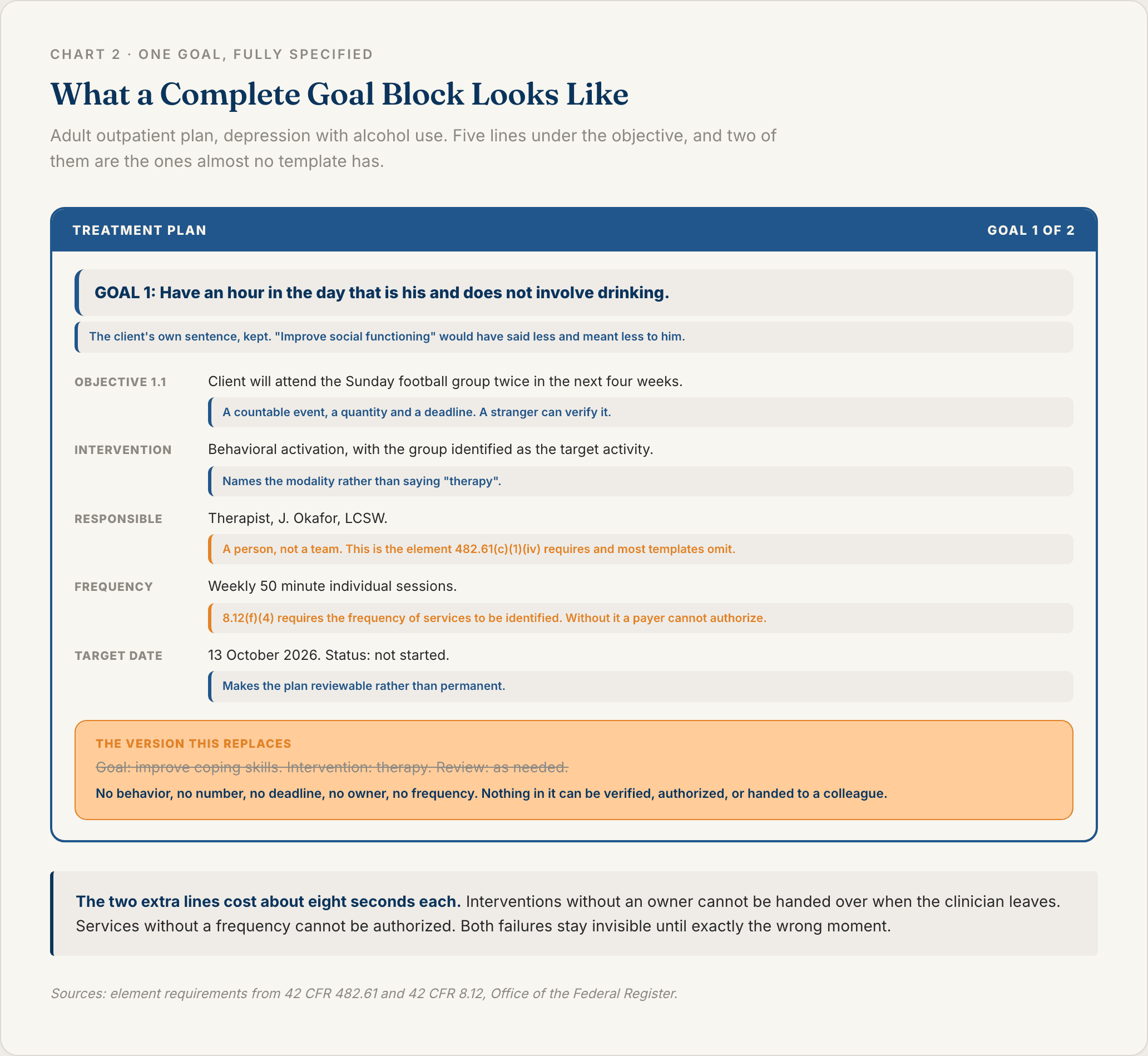
Notice goal one. It is the client's sentence, not a clinical category, and the objective underneath it is countable. A reviewer who has never met him can tell whether "attended twice in four weeks" happened.
A Substance Use Treatment Plan
Opioid treatment program, where 8.12 applies directly rather than by analogy [2]. This is behavioral health documentation at its most regulated. The structure is the same, but the supportive services section does real work here rather than sitting empty.
GOAL 1: Stable on buprenorphine and back in work.
Objective 1.1: Client will attend all scheduled dosing appointments for four consecutive weeks.
Intervention: Medication for opioid use disorder, buprenorphine-naloxone.
Responsible: Program physician, Dr. A. Reyes. Frequency: Daily observed dosing, reducing to weekly take-home on four weeks of attendance.
Target date: 13 October 2026.
Objective 1.2: Client will complete two sessions with the vocational rehabilitation service and produce an updated resume.
Intervention: Vocational rehabilitation referral.
Responsible: Counselor, T. Nowak, CADC. Frequency: Fortnightly counseling sessions, vocational sessions as scheduled by that service.
Target date: 27 October 2026.
Supportive services, each with a frequency, as 8.12 requires [2]:
Education and vocational: Vocational rehabilitation intake, once, then fortnightly.
Medical: Hepatitis C follow-up with primary care, once within 30 days.
Psychosocial: Weekly group counseling.
Economic: Benefits advice appointment, once, referral made.
Legal: Assistance with an outstanding license matter, referral to legal aid, once.
Those five categories come straight out of the regulation, and they map cleanly onto the five domains of social determinants of health used in the intake [6]. The plan is where the social section of the assessment turns into appointments.
What Gets a Treatment Plan Returned
Objectives Nobody Can Measure
"Client will improve coping skills."
Nothing in that can be verified by anyone. Compare with "client will use two named grounding techniques during at least three distress episodes per week, logged in a diary reviewed at each session."
The rewrite adds a countable behavior, a frequency and a review point. It takes one extra line and it is the difference between a plan that can be audited and one that cannot.
No Named Responsible Party and No Frequency
These are the two fields the federal rules name and the templates omit [1][2].
A plan with interventions and no owner cannot be handed over when the clinician leaves, and a service with no stated frequency cannot be authorized by a payer. Both failures are invisible while the same person holds the case, and both surface at exactly the worst moment.
Add a name and a number. That is the whole fix.
Book a demo and bring three current plans. The question worth asking is how many objectives on them a stranger could verify.
FAQ
Q: What are the major components of a treatment plan? A substantiated diagnosis, the client's strengths, long-range goals, short-term measurable objectives, the specific treatment modalities used, the responsibilities of each member of the treatment team, the frequency of services, target dates and a review date. The first five are named in 42 CFR 482.61 for psychiatric hospitals [1], and the frequency and task requirements come from 42 CFR 8.12 for opioid treatment programs [2].
Q: What is a typical treatment plan? One to three long-range goals, each with two or three short-term objectives underneath, each objective attached to an intervention, a named responsible person, a frequency and a target date, plus a review date for the whole plan. The blank template on this page follows that shape, with worked plans for mental health and substance use.
Q: What is the difference between a goal and an objective in a treatment plan? A goal is the direction of travel and can be broad, such as "return to work." An objective is what the client will do, how much and by when, observable by someone who was not in the room. Federal text frames it the same way, requiring short-term goals "and the tasks the patient must perform to complete the short-term goals" [2]. If a reviewer cannot tell whether an objective was met, it is a goal wearing an objective's label.
Q: What are the four main types of treatment plans? There is no single official taxonomy and sources disagree, so treat any list of four with caution. In practice plans are grouped by setting, which is what determines the rules that apply: mental health, substance use, inpatient psychiatric and rehabilitation. This page covers mental health and substance use, which is where the federal text is most explicit [1][2].
Q: Do you have a free treatment plan template? Yes. The blank template and the repeating goal block are both on this page as copy-paste blocks, with two worked plans. Sully.ai's AI Scribe can also capture the plan agreed in session and write it into the structure you have saved.
Sources
[1] Office of the Federal Register — 42 CFR 482.61, Special medical record requirements for psychiatric hospitals [2] Office of the Federal Register — 42 CFR 8.12, Federal opioid treatment standards [3] Journal of Substance Use and Addiction Treatment — Living with chronic structural vulnerability, a biopsychosocial-structural formulation [4] Centers for Medicare & Medicaid Services — Medicare and Mental Health Coverage, MLN1986542 [5] Sully.ai — The AI Workforce for Healthcare [6] Healthy People 2030, Office of Disease Prevention and Health Promotion — Social Determinants of Health
TABLE OF CONTENTS
Hire your
Medical AI Team
Take a look at our Medical AI Team
AI Receptionist
Manages patient scheduling, communications, and front-desk operations across all channels.
AI Scribe
Documents clinical encounters and maintains accurate EHR/EMR records in real-time.
AI Medical Coder
Assigns and validates medical codes to ensure accurate billing and regulatory compliance.
AI Nurse
Assesses patient urgency and coordinates appropriate care pathways based on clinical needs.