"/><stop offset="1" stop-color="rgba(255, 255, 255, 0)"/></linearGradient><linearGradient id="WxV_IOPE7-2309410982-linear-gradient" x1="1" x2="0" y1="0.5951279047551217" y2="0.4048720952448783"><stop offset="0" stop-color="rgb(255, 255, 255)"/><stop offset="1" stop-color="rgba(255, 255, 255, 0)"/></linearGradient><linearGradient id="WwbAIQIz8-2309410982-linear-gradient" x1="0.43478742751482424" x2="0.6358595260107829" y1="0.26" y2="1"><stop offset="0" stop-color="rgb(255, 255, 255)"/><stop offset="1" stop-color="rgba(255, 255, 255, 0)"/></linearGradient><linearGradient id="ZWsVQcPfn-2309410982-linear-gradient" x1="0.9508213454678907" x2="0.04917865453210929" y1="0" y2="1"><stop offset="0" stop-color="rgb(255, 255, 255)"/><stop offset="1" stop-color="rgba(255, 255, 255, 0)"/></linearGradient><linearGradient id="lTyCGrzzP-2309410982-linear-gradient" x1="0.374937164194436" x2="0.625062835805564" y1="0" y2="1"><stop offset="0" stop-color="rgb(255, 255, 255)"/><stop offset="1" stop-color="rgba(255, 255, 255, 0)"/></linearGradient></defs><g d="M 658.002 1357.705 C 1020.321 1357.705 1314.04 1063.989 1314.04 701.667 C 1314.04 339.347 1020.321 45.626 658.002 45.626 C 295.681 45.626 1.96 339.347 1.96 701.667 L 0 701.667 C 0 338.263 294.598 43.665 658.002 43.665 C 1021.404 43.665 1316 338.263 1316 701.667 C 1316 1065.072 1021.404 1359.672 658.002 1359.672 C 294.598 1359.672 0 1065.072 0 701.667 L 1.96 701.667 C 1.96 1063.989 295.681 1357.705 658.002 1357.705 Z M 658.005 1265.053 C 969.154 1265.053 1221.392 1012.819 1221.392 701.667 C 1221.392 390.517 969.154 138.281 658.005 138.281 C 346.856 138.281 94.619 390.517 94.619 701.667 L 92.659 701.667 C 92.659 389.433 345.77 136.321 658.005 136.321 C 970.241 136.321 1223.352 389.433 1223.352 701.667 C 1223.352 1013.902 970.241 1267.017 658.005 1267.017 C 345.77 1267.017 92.659 1013.902 92.659 701.667 L 94.619 701.667 C 94.619 1012.819 346.856 1265.053 658.005 1265.053 Z M 658.002 1166.116 C 914.513 1166.116 1122.452 958.178 1122.452 701.667 C 1122.452 445.16 914.513 237.22 658.002 237.22 C 401.494 237.22 193.551 445.16 193.551 701.667 L 191.59 701.667 C 191.59 444.077 400.411 235.255 658.002 235.255 C 915.596 235.255 1124.412 444.077 1124.412 701.667 C 1124.412 959.261 915.596 1168.084 658.002 1168.084 C 400.411 1168.084 191.59 959.261 191.59 701.667 L 193.551 701.667 C 193.551 958.178 401.494 1166.116 658.002 1166.116 Z M 281.657 818.28 C 298.572 818.28 314.804 825.001 326.765 836.965 L 458.99 969.182 C 470.582 980.781 486.308 987.298 502.706 987.298 L 612.137 987.298 C 646.284 987.298 673.972 959.61 673.972 925.463 L 673.972 891.504 L 675.939 891.504 L 675.939 925.463 C 675.939 960.7 647.374 989.258 612.137 989.258 L 502.706 989.258 C 485.788 989.258 469.562 982.537 457.599 970.573 L 325.378 838.356 C 313.785 826.757 298.056 820.242 281.657 820.244 L 1.173 820.244 L 1.173 818.28 Z M 746.64 888.714 L 1053.046 888.714 C 1069.967 888.714 1086.194 895.435 1098.16 907.398 L 1259.381 1068.619 L 1257.99 1070.007 L 1096.772 908.79 C 1085.175 897.193 1069.446 890.679 1053.046 890.681 L 746.64 890.681 C 729.724 890.681 713.493 883.957 701.533 871.993 L 685.377 855.845 L 686.769 854.453 L 702.917 870.605 C 714.513 882.201 730.241 888.715 746.64 888.714 Z M 667.685 552 L 512.316 396.894 C 494.66 379.264 484.741 355.356 484.739 330.426 L 484.739 0 L 487.632 0 L 487.632 330.426 C 487.632 354.592 497.248 377.763 514.369 394.851 L 669.739 549.957 Z M 782.851 700.491 C 816.998 700.491 844.686 672.804 844.686 638.655 L 844.686 516.468 C 844.687 499.547 851.409 483.32 863.374 471.355 L 1177.508 157.22 L 1178.896 158.607 L 864.762 472.742 C 853.162 484.337 846.646 500.067 846.646 516.468 L 846.646 638.655 C 846.646 673.89 818.088 702.455 782.851 702.455 L 700.405 702.455 L 700.405 700.491 Z M 130.338 534.223 L 213.07 534.223 C 256.112 534.223 291.003 569.114 291.003 612.156 L 291.003 694.888 C 291.003 711.29 297.514 727.017 309.113 738.611 L 472.887 902.378 L 471.496 903.769 L 307.726 739.995 C 295.761 728.033 289.038 711.807 289.038 694.888 L 289.038 612.156 C 289.038 570.198 255.028 536.188 213.07 536.188 L 130.338 536.188 C 113.419 536.187 97.193 529.465 85.23 517.5 L 77.071 509.345 C 65.107 497.381 58.386 481.153 58.388 464.233 L 58.388 199.526 L 60.348 199.526 L 60.348 464.233 C 60.349 480.631 66.863 496.358 78.458 507.954 L 86.617 516.113 C 98.213 527.709 113.94 534.223 130.338 534.223 Z" fill="transparent" height="1359.6717183844698px" id="DcyumyANr" transform="translate(0 -43.665)" width="1316px"><g opacity="0.5"><path d="M 658.002 1314.039 C 1020.321 1314.039 1314.04 1020.324 1314.04 658.001 C 1314.04 295.681 1020.321 1.961 658.002 1.961 C 295.681 1.961 1.96 295.682 1.96 658.001 L 0 658.001 C 0 294.598 294.598 0 658.002 0 C 1021.404 0 1316 294.598 1316 658.001 C 1316 1021.407 1021.404 1316.007 658.002 1316.007 C 294.598 1316.007 0 1021.407 0 658.001 L 1.96 658.001 C 1.96 1020.324 295.681 1314.039 658.002 1314.039 Z" fill="rgb(255, 255, 255)" height="1316.0065114752902px" id="dxf13D52Y" transform="translate(0 43.665)" width="1316px"/></g><g opacity="0.3"><path d="M 565.347 1128.732 C 876.496 1128.732 1128.733 876.498 1128.733 565.346 C 1128.733 254.196 876.496 1.961 565.347 1.961 C 254.197 1.961 1.961 254.196 1.961 565.346 L 0 565.346 C 0 253.112 253.111 0 565.347 0 C 877.582 0 1130.693 253.112 1130.693 565.346 C 1130.693 877.581 877.582 1130.696 565.347 1130.696 C 253.111 1130.696 0 877.581 0 565.346 L 1.961 565.346 C 1.961 876.498 254.197 1128.732 565.347 1128.732 Z" fill="rgb(255, 255, 255)" height="1130.6960934794101px" id="if1BmYw1S" transform="translate(92.659 136.321)" width="1130.693351805604px"/></g><g opacity="0.15"><path d="M 466.412 930.861 C 722.923 930.861 930.862 722.922 930.862 466.411 C 930.862 209.905 722.923 1.965 466.412 1.965 C 209.904 1.965 1.961 209.905 1.961 466.411 L 0 466.411 C 0 208.822 208.821 0 466.412 0 C 724.006 0 932.822 208.822 932.822 466.411 C 932.822 724.005 724.006 932.828 466.412 932.828 C 208.821 932.828 0 724.005 0 466.411 L 1.961 466.411 C 1.961 722.922 209.904 930.861 466.412 930.861 Z" fill="rgb(255, 255, 255)" height="932.8284667407987px" id="ef75NsYf6" transform="translate(191.59 235.255)" width="932.8219552655086px"/></g><g opacity="0.5"><path d="M 280.484 0 C 297.399 0 313.63 6.721 325.592 18.685 L 457.817 150.902 C 469.408 162.501 485.135 169.018 501.533 169.017 L 610.964 169.017 C 645.111 169.017 672.799 141.33 672.799 107.182 L 672.799 73.223 L 674.766 73.223 L 674.766 107.182 C 674.766 142.42 646.201 170.978 610.964 170.978 L 501.533 170.978 C 484.614 170.978 468.389 164.257 456.426 152.293 L 324.205 20.076 C 312.611 8.477 296.883 1.961 280.484 1.964 L 0 1.964 L 0 0 Z" fill="url(%23cQ4xRdUtr-2309410982-linear-gradient)" height="170.97763275969464px" id="cQ4xRdUtr" transform="translate(1.173 818.28)" width="674.7656780356198px"/></g><g opacity="0.5"><path d="M 61.263 34.261 L 367.669 34.261 C 384.589 34.261 400.817 40.982 412.783 52.945 L 574.004 214.166 L 572.612 215.554 L 411.395 54.337 C 399.798 42.74 384.069 36.226 367.669 36.228 L 61.263 36.228 C 44.347 36.228 28.116 29.504 16.155 17.54 L 0 1.391 L 1.391 0 L 17.54 16.152 C 29.136 27.747 44.864 34.261 61.263 34.261 Z" fill="url(%23WxV_IOPE7-2309410982-linear-gradient)" height="215.55382175474415px" id="WxV_IOPE7" transform="translate(685.377 854.453)" width="574.0036823012563px"/></g><g opacity="0.5"><path d="M 182.946 552 L 27.577 396.894 C 9.921 379.264 0.002 355.356 0 330.426 L 0 0 L 2.893 0 L 2.893 330.426 C 2.893 354.592 12.509 377.763 29.63 394.851 L 185 549.957 Z" fill="url(%23WwbAIQIz8-2309410982-linear-gradient)" height="552px" id="WwbAIQIz8" transform="translate(484.739 0)" width="185px"/></g><g opacity="0.5"><path d="M 82.446 543.271 C 116.593 543.271 144.281 515.583 144.281 481.435 L 144.281 359.248 C 144.282 342.327 151.004 326.1 162.969 314.135 L 477.103 0 L 478.491 1.387 L 164.356 315.522 C 152.757 327.117 146.241 342.846 146.241 359.248 L 146.241 481.435 C 146.241 516.67 117.683 545.235 82.446 545.235 L 0 545.235 L 0 543.271 Z" fill="url(%23ZWsVQcPfn-2309410982-linear-gradient)" height="545.2346136318063px" id="ZWsVQcPfn" transform="translate(700.405 157.22)" width="478.4906210693257px"/></g><g opacity="0.5"><path d="M 71.95 334.696 L 154.682 334.696 C 197.724 334.696 232.616 369.588 232.616 412.63 L 232.616 495.362 C 232.616 511.764 239.126 527.491 250.725 539.084 L 414.5 702.851 L 413.108 704.243 L 249.338 540.469 C 237.373 528.507 230.651 512.281 230.651 495.362 L 230.651 412.63 C 230.651 370.672 196.64 336.661 154.682 336.661 L 71.95 336.661 C 55.031 336.661 38.805 329.939 26.843 317.974 L 18.683 309.819 C 6.719 297.854 -0.001 281.627 0 264.707 L 0 0 L 1.961 0 L 1.961 264.707 C 1.961 281.105 8.475 296.832 20.07 308.428 L 28.229 316.587 C 39.825 328.182 55.552 334.697 71.95 334.696 Z" fill="url(%23lTyCGrzzP-2309410982-linear-gradient)" height="704.2427839655832px" id="lTyCGrzzP" transform="translate(58.388 199.526)" width="414.49961191971533px"/></g></g></svg>)
Every guide to nursing notes tells you what to write. Be objective. Be specific. Include the vital signs.
None of them tells you the five properties an entry has to have before it counts as a record at all. Two of those five are exactly where shift documentation fails, and one of them is not what most nurses would guess.
Here are worked examples in narrative, SOAPIE and DAR, the three blank templates, and the rules that decide whether an entry holds up when somebody reads it back a year later.
Key Takeaway: A nursing note records what you observed, what you did, and how the patient responded, across one shift or one event. Federal rules set five properties every entry must have. 42 CFR 482.24 requires that all patient medical record entries be "legible, complete, dated, timed, and authenticated in written or electronic form by the person responsible for providing or evaluating the service provided" [1]. Nurses write in three main formats, narrative, SOAPIE and DAR focus charting, and the format is a unit convention rather than a rule. The note also has to connect to the nursing care plan, which 42 CFR 482.23 requires nursing staff to develop and keep current for each patient, reflecting the patient's goals and the care to be provided [2]. Sully.ai's AI Scribe captures what you describe during the shift and writes it into the format your unit uses.
What a Nursing Note Records
Four things: what you observed, what you did, how the patient responded, and what you escalated.
The third one is where most notes stop short. "Repositioned patient" is half an entry. What happened next is the other half, and it is the difference between a nursing note and a task list.
What Goes in the Note
The shift note is not a transcript of everything that happened. It is the record of anything that changed, anything you did about it, and anything the next nurse needs.
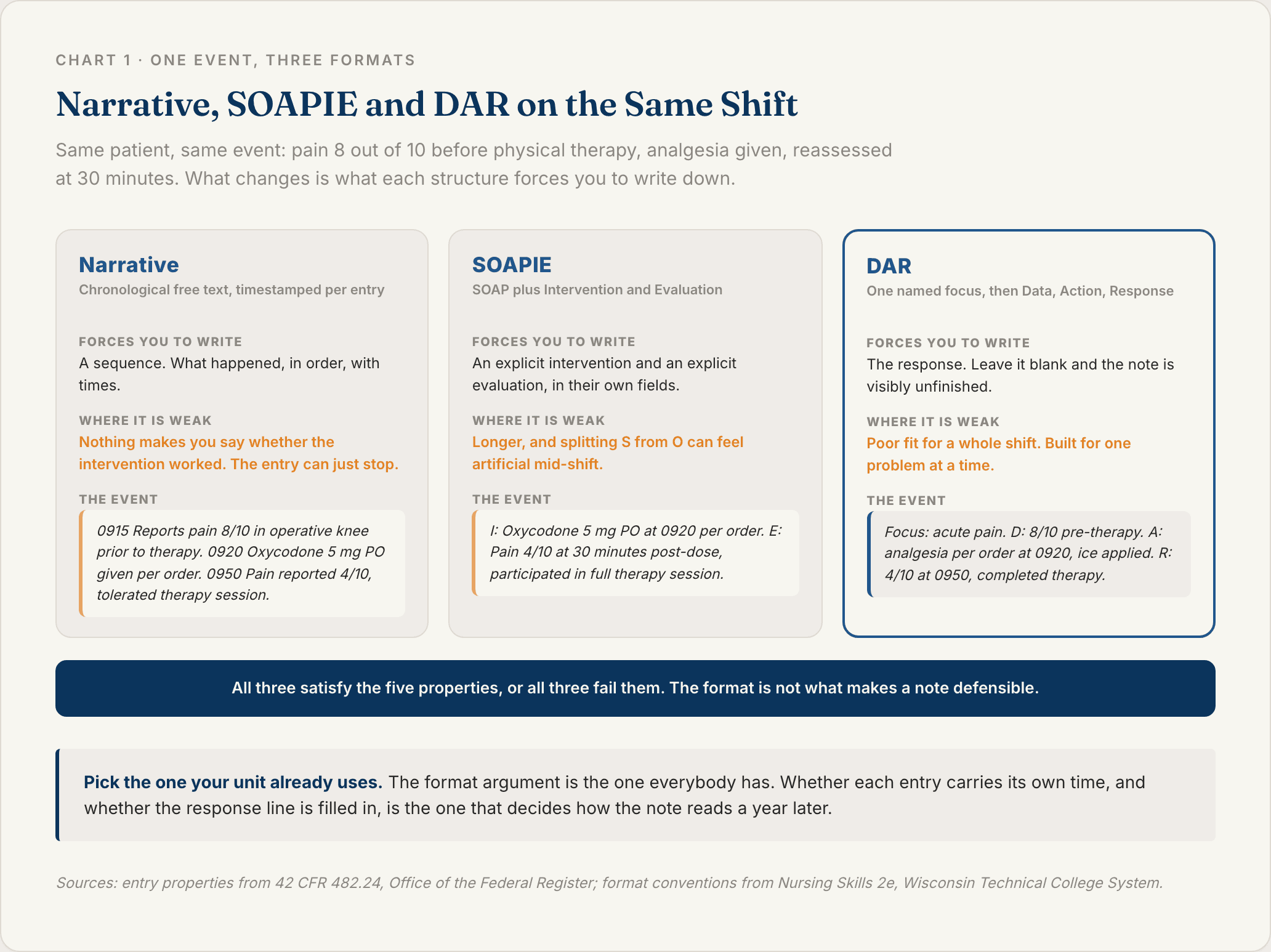
Pick the format your unit uses. The argument about which one is best is the argument everyone has, and it is the least important thing on this page.
The Five Properties Every Entry Must Have
Here is the part no competing page mentions.
42 CFR 482.24(c)(1)[1]:
"All patient medical record entries must be legible, complete, dated, timed, and authenticated in written or electronic form by the person responsible for providing or evaluating the service provided, consistent with hospital policies and procedures."
Legible, complete, dated, timed, authenticated.
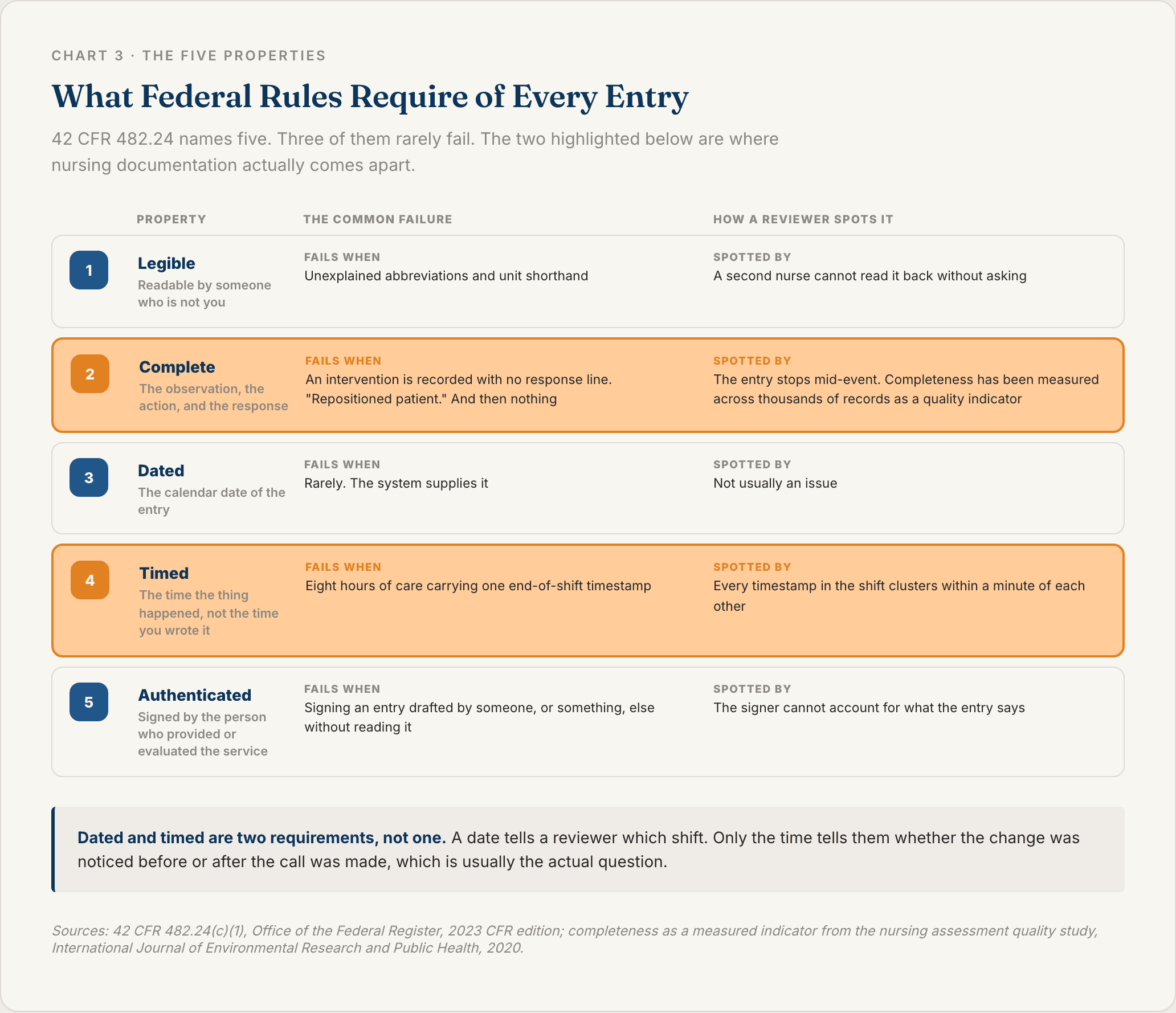
Three things follow from that list.
One. Timed is separate from dated, and it is the property nursing fails. A shift note whose entries all carry the same end-of-shift timestamp records when you typed, not when anything happened. Sequence is the whole clinical value of a nursing note. When the question a year later is whether the change was noticed before or after the call was made, the date tells nobody anything.
Two. Complete is measurable, not aspirational. A 2020 study examined completeness and accuracy in nursing assessment across more than 12,000 computerized nursing records at an Italian teaching hospital, treating documentation quality as a proxy for quality of care [3]. Incomplete is a finding somebody can count, not a style preference.
Three. The note has to connect to the care plan. 42 CFR 482.23(b)(4) requires nursing staff to develop and keep current "a nursing care plan for each patient that reflects the patient's goals and the nursing care to be provided to meet the patient's needs" [2]. A shift note that lists tasks and never reports against the care plan leaves the plan unevidenced.
A caveat worth stating. Both of those sections are Medicare Conditions of Participation for hospitals. They do not directly bind a school clinic, a private duty shift or a doctor's office. What they are is the clearest federal statement of what an entry has to be, and surveyors, malpractice reviewers and employers all reason from the same five properties.
Narrative, SOAPIE or DAR
Three formats, and the honest answer is that your unit has already decided.
Narrative is chronological free text with a timestamp on each entry. Best for end of shift summaries and for events, because a sequence is exactly what it is good at. Its weakness is that nothing in the structure forces you to say whether an intervention worked.
SOAPIE is SOAP plus the two letters nursing actually needs. Subjective, Objective, Assessment, Plan, Intervention, Evaluation. If you already know SOAP, SOAPIE is that with what you did and whether it helped bolted on the end.
DAR focus charting names one focus, then Data, Action, Response. It is the best of the three for a single event, because the Response line is not optional.
All three satisfy the five properties, or all three fail them, depending on how you fill them in. Open nursing curricula teach sample documentation in each [4].
The Nursing Note Templates
Three blocks. Each one is complete as written, so you can paste it straight into a chart.
The Narrative Shift Note Template
NARRATIVE NOTE
Patient, date, shift:(and the unit)
HHMM(time of the observation, not the time you are writing) (what you observed, in objective terms)
HHMM(what you did, including who you notified and when)
HHMM(how the patient responded, reassessment findings)
HHMM(handover items for the next shift)
Signature and credentials: (the person who provided or evaluated the care)
One line matters more than the rest. Each entry gets the time the thing happened, not the time you sat down. A full narrative shift note template is also available as a page you can open directly.
The SOAPIE Template
SOAPIE NOTE
S, Subjective:"(what the patient said, in their words)"
O, Objective:(vital signs, measurements, what you observed and assessed)
A, Assessment: (your nursing judgment about what is going on, not a medical diagnosis)
P, Plan:(what you intend to do, tied to the care plan)
I, Intervention: (what you actually did, with the time)
E, Evaluation:(whether it worked, with the reassessment time and finding)
The last two letters are the point. A SOAPIE note template without a filled-in E is a SOAP note with two empty boxes.
The DAR Focus Charting Template
FOCUS NOTE
Focus: (the one problem, symptom or event this note is about)
D, Data:(what you observed and measured, with the time)
A, Action:(what you did, who you notified, when)
R, Response:(how the patient responded, with the reassessment time)
Signature and credentials: (and the time you signed, if different from the events above)
The Response field is why DAR focus charting exists. If you leave it blank the note is visibly unfinished, which is the design working.
Where Sully.ai Fits in Shift Documentation
Start with the size of the problem, from a study rather than a brochure. A 2025 paper in Healthcare Informatics Research states that nursing documentation consumes approximately 30 percent of nurses' professional time, and tested a generative AI documentation system against traditional electronic nursing records with forty nurses [5].
Thirty percent of a twelve hour shift is nearly four hours.
Most of that gets spent at the end, in a batch, reconstructed from memory and from notes on a folded piece of paper. That is exactly where the times stop being real and the response lines go missing, which are two of the five properties.
Sully.ai's AI Scribe captures what you describe during the shift and writes it into the format your unit uses, so the time attaches to the observation rather than to the moment you finally sat down. It runs on a single integration across Epic, Cerner, Meditech and Athenahealth.
Now the boundary, and on a nursing floor it is a legal one rather than a preference.
That same study did not assume the AI-suggested entries were correct. It evaluated their accuracy [5]. Take the same posture. A scribe drafts. The nurse verifies. The nurse authenticates.
42 CFR 482.24 requires authentication by "the person responsible for providing or evaluating the service provided" [1]. That is you. It cannot be delegated to software, and signing an entry you have not read is the one failure mode a scribe makes easier rather than harder. Read the response lines before you sign, every time.
Sully operates across 5,000+ providers, has delivered 50M+ hours of AI work, and prices each AI role 80 to 90 percent below the human equivalent [6].
Nursing Notes Examples Written Out
Three examples. The first two are the same shift written two ways, so the formats can be compared directly rather than across unrelated patients.
An End of Shift Narrative Note
68 year old, day two of admission, community-acquired pneumonia. Day shift, 0700 to 1900.
0715 Patient awake, sitting upright. Head-to-toe assessment completed. Reports "I can get a breath now, yesterday I couldn't." Temp 37.8, HR 92, RR 22, BP 128/74, SpO2 91% on 2L nasal cannula. Productive cough, sputum thick and rust colored.
0740 Ambulated to bathroom with one assist, SpO2 dropped to 87% on exertion, recovered to 92% after two minutes seated. Patient reported no dizziness.
0745 Notified Dr. Adeyemi of exertional desaturation. Order received to increase to 3L and obtain ambulatory oximetry with physiotherapy.
0900 Oxygen increased to 3L per order. SpO2 94% at rest.
1120Physiotherapy session completed. Ambulated 20 meters with a frame, SpO2 nadir 90% on 3L, recovered to 94% within 60 seconds. Patient tolerated without distress.
1400 Temp 37.2, HR 84, RR 18, BP 124/70, SpO2 95% on 3L. Cough less frequent, sputum thinner and paler than this morning.
1830 Handover to night shift: currently 3L, target sats 92 to 96%, ambulatory oximetry recorded and in chart, physiotherapy booked 1000 tomorrow. Family visiting, updated by Dr. Adeyemi at 1600.
Signature: R. Mensah, RN.
Every entry carries its own time. That is the single thing separating this from a note written at 1845 that says "patient ambulated, desaturated, oxygen increased, tolerated well."
The Same Shift in SOAPIE
S, Subjective: "I can get a breath now, yesterday I couldn't." Denies chest pain and dizziness on exertion.
O, Objective:0715 temp 37.8, HR 92, RR 22, BP 128/74, SpO2 91% on 2L. Productive cough, sputum thick and rust colored. 0740 SpO2 87% on ambulation to bathroom, recovered to 92% seated within two minutes. 1400 temp 37.2, HR 84, RR 18, SpO2 95% on 3L, sputum thinner and paler.
A, Assessment:Respiratory status improving at rest but with exertional desaturation not present in yesterday's documentation. Secretions loosening. Oxygen requirement increased today rather than decreased, which is the finding worth flagging at handover.
P, Plan: Maintain target saturations 92 to 96%. Continue physiotherapy. Monitor oxygen requirement for a downward trend over the next 24 hours.
I, Intervention:0745 notified Dr. Adeyemi of exertional desaturation, order received. 0900 oxygen increased to 3L. 1120 physiotherapy session supported, ambulatory oximetry recorded.
E, Evaluation:Post-intervention SpO2 94% at rest and nadir 90% on ambulation with 60 second recovery, compared with 87% and a two minute recovery pre-intervention. Exertional tolerance improved within the shift.
Same shift, same facts. What the format added is the last paragraph. The narrative version could have ended at "oxygen increased" and nothing in its structure would have complained.
A Focus Note for a Single Event
Unwitnessed falls are the highest-stakes entry a nurse writes, and the one where all five properties get tested at once.
FOCUS NOTE
Focus:Unwitnessed fall.
D, Data: 0312 Patient found sitting on floor beside bed on entering room in response to call bell. Patient alert, oriented to person, place and time. States "I was trying to get to the bathroom." No loss of consciousness reported by patient. No visible head injury. Small skin tear 2 cm to left forearm, minimal bleeding. Reports pain 3 out of 10 left hip, no deformity, no shortening, no external rotation. Able to move all four limbs on command. Vital signs 0315: BP 132/78, HR 88, RR 18, temp 36.9, SpO2 96% on room air. Bed in low position, call bell within reach, non-slip socks on, floor dry.
A, Action: 0316 Assisted back to bed with two staff using a full assist. Neurological observations commenced per falls protocol. 0320 Dr. Chen notified, attended at 0335. 0340 Skin tear cleaned and dressed. Falls risk reassessed, score increased from 8 to 12. Bed alarm activated. 0350 Daughter notified by telephone, per patient's request. Incident report submitted.
R, Response: Patient settled and comfortable in bed by 0355, reports hip pain 2 out of 10. Neurological observations unchanged at 0400 and 0500. Hip x-ray ordered by Dr. Chen at 0345, performed 0520, no fracture reported. Patient slept from 0530. No further falls this shift.
Signature: R. Mensah, RN, 0610.
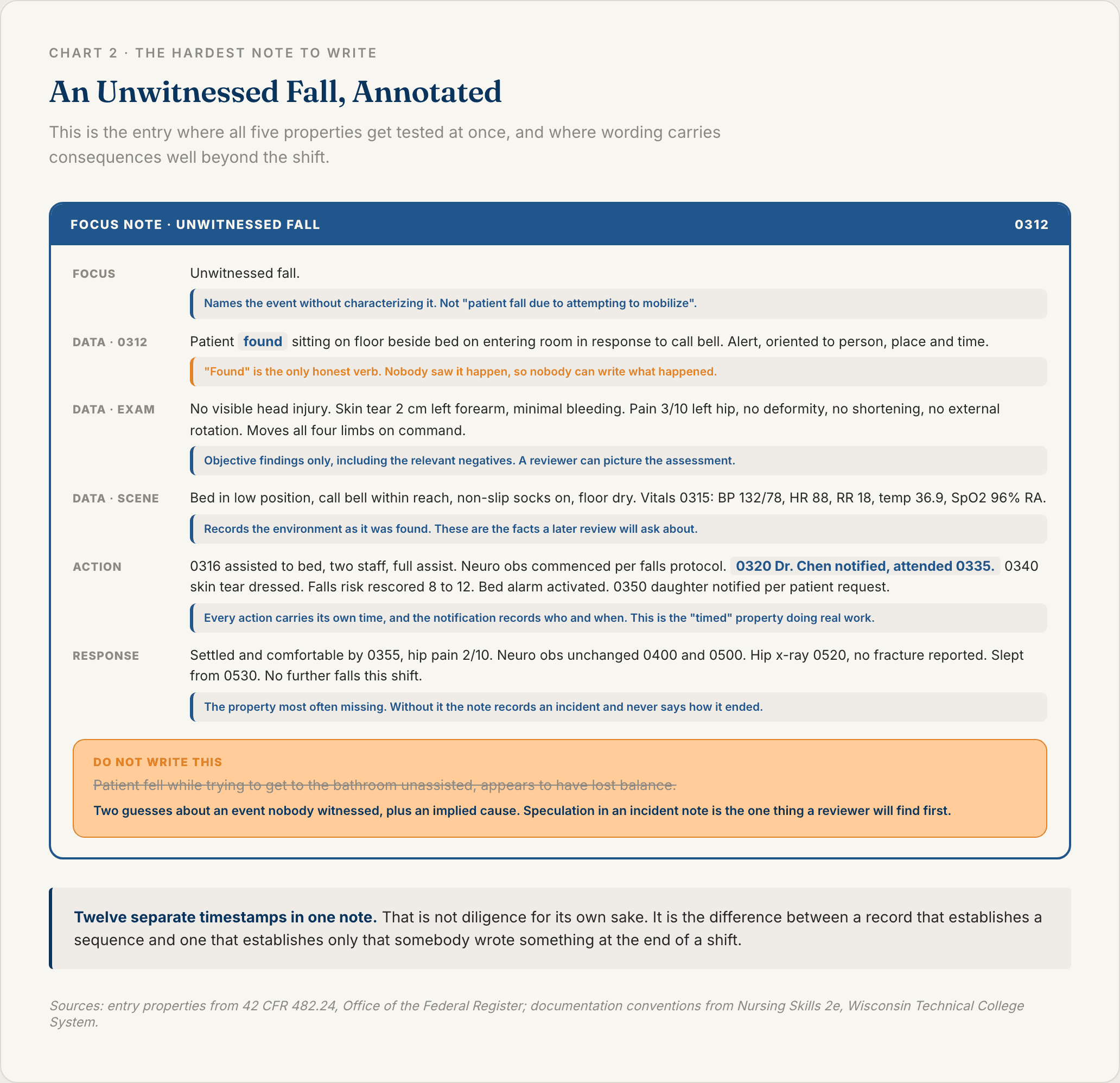
Note what is not in there. No cause, no mechanism, no "appears to have lost balance." The fall was unwitnessed, so the only honest word is found. Everything after that is an objective finding, a named action with a time, or a documented response.
What Gets a Nursing Note Questioned
A Time That Is Just the Time You Wrote It
Eight hours of care carrying one timestamp is the most common defect in shift documentation, and it fails a named federal property rather than a stylistic preference [1].
Time each observation to when it happened. If you are writing something up hours later, label it as a late entry rather than back-dating it to when you wish you had written it. Your employer's policy governs how that is recorded, which is what the regulation itself defers to.
Interventions With No Response Line
"Repositioned patient." "Analgesia administered." "Patient educated on incentive spirometry."
All three are half-entries. What happened next is the half that matters, and it is the half a reviewer looks for. DAR is built to force it, SOAPIE has a dedicated letter for it, and narrative notes have to remember [4].
The test: read your entry and ask whether anyone could tell, from the note alone, if the thing you did worked.
Book a demo and bring last night's shift notes. The question worth asking is how many different timestamps are on them.
FAQ
Q: How do you write a nursing note? Record what you observed, what you did, how the patient responded, and what you escalated, in the format your unit uses. Every entry has to be legible, complete, dated, timed and authenticated by the person who provided or evaluated the service [1]. There are three worked examples on this page in narrative, SOAPIE and DAR focus formats.
Q: What are some examples of nursing documentation? This page has three written out in full: an end of shift narrative note for a patient with pneumonia, the same shift in SOAPIE, and a DAR focus note for an unwitnessed fall. Each has its blank template above it.
Q: What is the difference between narrative, SOAPIE and DAR charting? Narrative is chronological time-stamped free text, good for shifts and events. SOAPIE adds Intervention and Evaluation to SOAP, so the note has to say what you did and whether it worked. DAR names one focus and records Data, Action and Response, which makes the response line mandatory. All three can satisfy the same requirements, so the format is a unit convention rather than a rule.
Q: How do you correct an error in a nursing note? Follow your employer's policy. That is not a dodge, it is what the federal rule does: entries must be authenticated "consistent with hospital policies and procedures" [1]. The general principle across policies is that a correction leaves the original entry readable rather than obliterated, and that a late entry is labeled as a late entry rather than back-timed. Check your own policy for the mechanics, and do not take a blog as your source for this one.
Q: Do you have a free nursing note template? Yes. Blank narrative, SOAPIE and DAR templates are all on this page as copy-paste blocks, with three worked examples. Sully.ai's AI Scribe can also capture what you describe during the shift and write it into whichever format your unit uses.
Sources
[1] Office of the Federal Register — 42 CFR 482.24, Condition of participation, Medical records[2] Office of the Federal Register — 42 CFR 482.23, Condition of participation, Nursing services[3] International Journal of Environmental Research and Public Health — Quality of Care, Ecological Study for the Evaluation of Completeness and Accuracy in Nursing Assessment [4] Wisconsin Technical College System, Nursing Skills 2e — Sample Documentation [5] Healthcare Informatics Research — Generative AI-Based Nursing Diagnosis and Documentation Recommendation Using Virtual Patient Electronic Nursing Record Data [6] Sully.ai— The AI Workforce for Healthcare
TABLE OF CONTENTS
Hire your
Medical AI Team
Take a look at our Medical AI Team
AI Receptionist
Manages patient scheduling, communications, and front-desk operations across all channels.
AI Scribe
Documents clinical encounters and maintains accurate EHR/EMR records in real-time.
AI Medical Coder
Assigns and validates medical codes to ensure accurate billing and regulatory compliance.
AI Nurse
Assesses patient urgency and coordinates appropriate care pathways based on clinical needs.