"/><stop offset="1" stop-color="rgba(255, 255, 255, 0)"/></linearGradient><linearGradient id="WxV_IOPE7-2309410982-linear-gradient" x1="1" x2="0" y1="0.5951279047551217" y2="0.4048720952448783"><stop offset="0" stop-color="rgb(255, 255, 255)"/><stop offset="1" stop-color="rgba(255, 255, 255, 0)"/></linearGradient><linearGradient id="WwbAIQIz8-2309410982-linear-gradient" x1="0.43478742751482424" x2="0.6358595260107829" y1="0.26" y2="1"><stop offset="0" stop-color="rgb(255, 255, 255)"/><stop offset="1" stop-color="rgba(255, 255, 255, 0)"/></linearGradient><linearGradient id="ZWsVQcPfn-2309410982-linear-gradient" x1="0.9508213454678907" x2="0.04917865453210929" y1="0" y2="1"><stop offset="0" stop-color="rgb(255, 255, 255)"/><stop offset="1" stop-color="rgba(255, 255, 255, 0)"/></linearGradient><linearGradient id="lTyCGrzzP-2309410982-linear-gradient" x1="0.374937164194436" x2="0.625062835805564" y1="0" y2="1"><stop offset="0" stop-color="rgb(255, 255, 255)"/><stop offset="1" stop-color="rgba(255, 255, 255, 0)"/></linearGradient></defs><g d="M 658.002 1357.705 C 1020.321 1357.705 1314.04 1063.989 1314.04 701.667 C 1314.04 339.347 1020.321 45.626 658.002 45.626 C 295.681 45.626 1.96 339.347 1.96 701.667 L 0 701.667 C 0 338.263 294.598 43.665 658.002 43.665 C 1021.404 43.665 1316 338.263 1316 701.667 C 1316 1065.072 1021.404 1359.672 658.002 1359.672 C 294.598 1359.672 0 1065.072 0 701.667 L 1.96 701.667 C 1.96 1063.989 295.681 1357.705 658.002 1357.705 Z M 658.005 1265.053 C 969.154 1265.053 1221.392 1012.819 1221.392 701.667 C 1221.392 390.517 969.154 138.281 658.005 138.281 C 346.856 138.281 94.619 390.517 94.619 701.667 L 92.659 701.667 C 92.659 389.433 345.77 136.321 658.005 136.321 C 970.241 136.321 1223.352 389.433 1223.352 701.667 C 1223.352 1013.902 970.241 1267.017 658.005 1267.017 C 345.77 1267.017 92.659 1013.902 92.659 701.667 L 94.619 701.667 C 94.619 1012.819 346.856 1265.053 658.005 1265.053 Z M 658.002 1166.116 C 914.513 1166.116 1122.452 958.178 1122.452 701.667 C 1122.452 445.16 914.513 237.22 658.002 237.22 C 401.494 237.22 193.551 445.16 193.551 701.667 L 191.59 701.667 C 191.59 444.077 400.411 235.255 658.002 235.255 C 915.596 235.255 1124.412 444.077 1124.412 701.667 C 1124.412 959.261 915.596 1168.084 658.002 1168.084 C 400.411 1168.084 191.59 959.261 191.59 701.667 L 193.551 701.667 C 193.551 958.178 401.494 1166.116 658.002 1166.116 Z M 281.657 818.28 C 298.572 818.28 314.804 825.001 326.765 836.965 L 458.99 969.182 C 470.582 980.781 486.308 987.298 502.706 987.298 L 612.137 987.298 C 646.284 987.298 673.972 959.61 673.972 925.463 L 673.972 891.504 L 675.939 891.504 L 675.939 925.463 C 675.939 960.7 647.374 989.258 612.137 989.258 L 502.706 989.258 C 485.788 989.258 469.562 982.537 457.599 970.573 L 325.378 838.356 C 313.785 826.757 298.056 820.242 281.657 820.244 L 1.173 820.244 L 1.173 818.28 Z M 746.64 888.714 L 1053.046 888.714 C 1069.967 888.714 1086.194 895.435 1098.16 907.398 L 1259.381 1068.619 L 1257.99 1070.007 L 1096.772 908.79 C 1085.175 897.193 1069.446 890.679 1053.046 890.681 L 746.64 890.681 C 729.724 890.681 713.493 883.957 701.533 871.993 L 685.377 855.845 L 686.769 854.453 L 702.917 870.605 C 714.513 882.201 730.241 888.715 746.64 888.714 Z M 667.685 552 L 512.316 396.894 C 494.66 379.264 484.741 355.356 484.739 330.426 L 484.739 0 L 487.632 0 L 487.632 330.426 C 487.632 354.592 497.248 377.763 514.369 394.851 L 669.739 549.957 Z M 782.851 700.491 C 816.998 700.491 844.686 672.804 844.686 638.655 L 844.686 516.468 C 844.687 499.547 851.409 483.32 863.374 471.355 L 1177.508 157.22 L 1178.896 158.607 L 864.762 472.742 C 853.162 484.337 846.646 500.067 846.646 516.468 L 846.646 638.655 C 846.646 673.89 818.088 702.455 782.851 702.455 L 700.405 702.455 L 700.405 700.491 Z M 130.338 534.223 L 213.07 534.223 C 256.112 534.223 291.003 569.114 291.003 612.156 L 291.003 694.888 C 291.003 711.29 297.514 727.017 309.113 738.611 L 472.887 902.378 L 471.496 903.769 L 307.726 739.995 C 295.761 728.033 289.038 711.807 289.038 694.888 L 289.038 612.156 C 289.038 570.198 255.028 536.188 213.07 536.188 L 130.338 536.188 C 113.419 536.187 97.193 529.465 85.23 517.5 L 77.071 509.345 C 65.107 497.381 58.386 481.153 58.388 464.233 L 58.388 199.526 L 60.348 199.526 L 60.348 464.233 C 60.349 480.631 66.863 496.358 78.458 507.954 L 86.617 516.113 C 98.213 527.709 113.94 534.223 130.338 534.223 Z" fill="transparent" height="1359.6717183844698px" id="DcyumyANr" transform="translate(0 -43.665)" width="1316px"><g opacity="0.5"><path d="M 658.002 1314.039 C 1020.321 1314.039 1314.04 1020.324 1314.04 658.001 C 1314.04 295.681 1020.321 1.961 658.002 1.961 C 295.681 1.961 1.96 295.682 1.96 658.001 L 0 658.001 C 0 294.598 294.598 0 658.002 0 C 1021.404 0 1316 294.598 1316 658.001 C 1316 1021.407 1021.404 1316.007 658.002 1316.007 C 294.598 1316.007 0 1021.407 0 658.001 L 1.96 658.001 C 1.96 1020.324 295.681 1314.039 658.002 1314.039 Z" fill="rgb(255, 255, 255)" height="1316.0065114752902px" id="dxf13D52Y" transform="translate(0 43.665)" width="1316px"/></g><g opacity="0.3"><path d="M 565.347 1128.732 C 876.496 1128.732 1128.733 876.498 1128.733 565.346 C 1128.733 254.196 876.496 1.961 565.347 1.961 C 254.197 1.961 1.961 254.196 1.961 565.346 L 0 565.346 C 0 253.112 253.111 0 565.347 0 C 877.582 0 1130.693 253.112 1130.693 565.346 C 1130.693 877.581 877.582 1130.696 565.347 1130.696 C 253.111 1130.696 0 877.581 0 565.346 L 1.961 565.346 C 1.961 876.498 254.197 1128.732 565.347 1128.732 Z" fill="rgb(255, 255, 255)" height="1130.6960934794101px" id="if1BmYw1S" transform="translate(92.659 136.321)" width="1130.693351805604px"/></g><g opacity="0.15"><path d="M 466.412 930.861 C 722.923 930.861 930.862 722.922 930.862 466.411 C 930.862 209.905 722.923 1.965 466.412 1.965 C 209.904 1.965 1.961 209.905 1.961 466.411 L 0 466.411 C 0 208.822 208.821 0 466.412 0 C 724.006 0 932.822 208.822 932.822 466.411 C 932.822 724.005 724.006 932.828 466.412 932.828 C 208.821 932.828 0 724.005 0 466.411 L 1.961 466.411 C 1.961 722.922 209.904 930.861 466.412 930.861 Z" fill="rgb(255, 255, 255)" height="932.8284667407987px" id="ef75NsYf6" transform="translate(191.59 235.255)" width="932.8219552655086px"/></g><g opacity="0.5"><path d="M 280.484 0 C 297.399 0 313.63 6.721 325.592 18.685 L 457.817 150.902 C 469.408 162.501 485.135 169.018 501.533 169.017 L 610.964 169.017 C 645.111 169.017 672.799 141.33 672.799 107.182 L 672.799 73.223 L 674.766 73.223 L 674.766 107.182 C 674.766 142.42 646.201 170.978 610.964 170.978 L 501.533 170.978 C 484.614 170.978 468.389 164.257 456.426 152.293 L 324.205 20.076 C 312.611 8.477 296.883 1.961 280.484 1.964 L 0 1.964 L 0 0 Z" fill="url(%23cQ4xRdUtr-2309410982-linear-gradient)" height="170.97763275969464px" id="cQ4xRdUtr" transform="translate(1.173 818.28)" width="674.7656780356198px"/></g><g opacity="0.5"><path d="M 61.263 34.261 L 367.669 34.261 C 384.589 34.261 400.817 40.982 412.783 52.945 L 574.004 214.166 L 572.612 215.554 L 411.395 54.337 C 399.798 42.74 384.069 36.226 367.669 36.228 L 61.263 36.228 C 44.347 36.228 28.116 29.504 16.155 17.54 L 0 1.391 L 1.391 0 L 17.54 16.152 C 29.136 27.747 44.864 34.261 61.263 34.261 Z" fill="url(%23WxV_IOPE7-2309410982-linear-gradient)" height="215.55382175474415px" id="WxV_IOPE7" transform="translate(685.377 854.453)" width="574.0036823012563px"/></g><g opacity="0.5"><path d="M 182.946 552 L 27.577 396.894 C 9.921 379.264 0.002 355.356 0 330.426 L 0 0 L 2.893 0 L 2.893 330.426 C 2.893 354.592 12.509 377.763 29.63 394.851 L 185 549.957 Z" fill="url(%23WwbAIQIz8-2309410982-linear-gradient)" height="552px" id="WwbAIQIz8" transform="translate(484.739 0)" width="185px"/></g><g opacity="0.5"><path d="M 82.446 543.271 C 116.593 543.271 144.281 515.583 144.281 481.435 L 144.281 359.248 C 144.282 342.327 151.004 326.1 162.969 314.135 L 477.103 0 L 478.491 1.387 L 164.356 315.522 C 152.757 327.117 146.241 342.846 146.241 359.248 L 146.241 481.435 C 146.241 516.67 117.683 545.235 82.446 545.235 L 0 545.235 L 0 543.271 Z" fill="url(%23ZWsVQcPfn-2309410982-linear-gradient)" height="545.2346136318063px" id="ZWsVQcPfn" transform="translate(700.405 157.22)" width="478.4906210693257px"/></g><g opacity="0.5"><path d="M 71.95 334.696 L 154.682 334.696 C 197.724 334.696 232.616 369.588 232.616 412.63 L 232.616 495.362 C 232.616 511.764 239.126 527.491 250.725 539.084 L 414.5 702.851 L 413.108 704.243 L 249.338 540.469 C 237.373 528.507 230.651 512.281 230.651 495.362 L 230.651 412.63 C 230.651 370.672 196.64 336.661 154.682 336.661 L 71.95 336.661 C 55.031 336.661 38.805 329.939 26.843 317.974 L 18.683 309.819 C 6.719 297.854 -0.001 281.627 0 264.707 L 0 0 L 1.961 0 L 1.961 264.707 C 1.961 281.105 8.475 296.832 20.07 308.428 L 28.229 316.587 C 39.825 328.182 55.552 334.697 71.95 334.696 Z" fill="url(%23lTyCGrzzP-2309410982-linear-gradient)" height="704.2427839655832px" id="lTyCGrzzP" transform="translate(58.388 199.526)" width="414.49961191971533px"/></g></g></svg>)
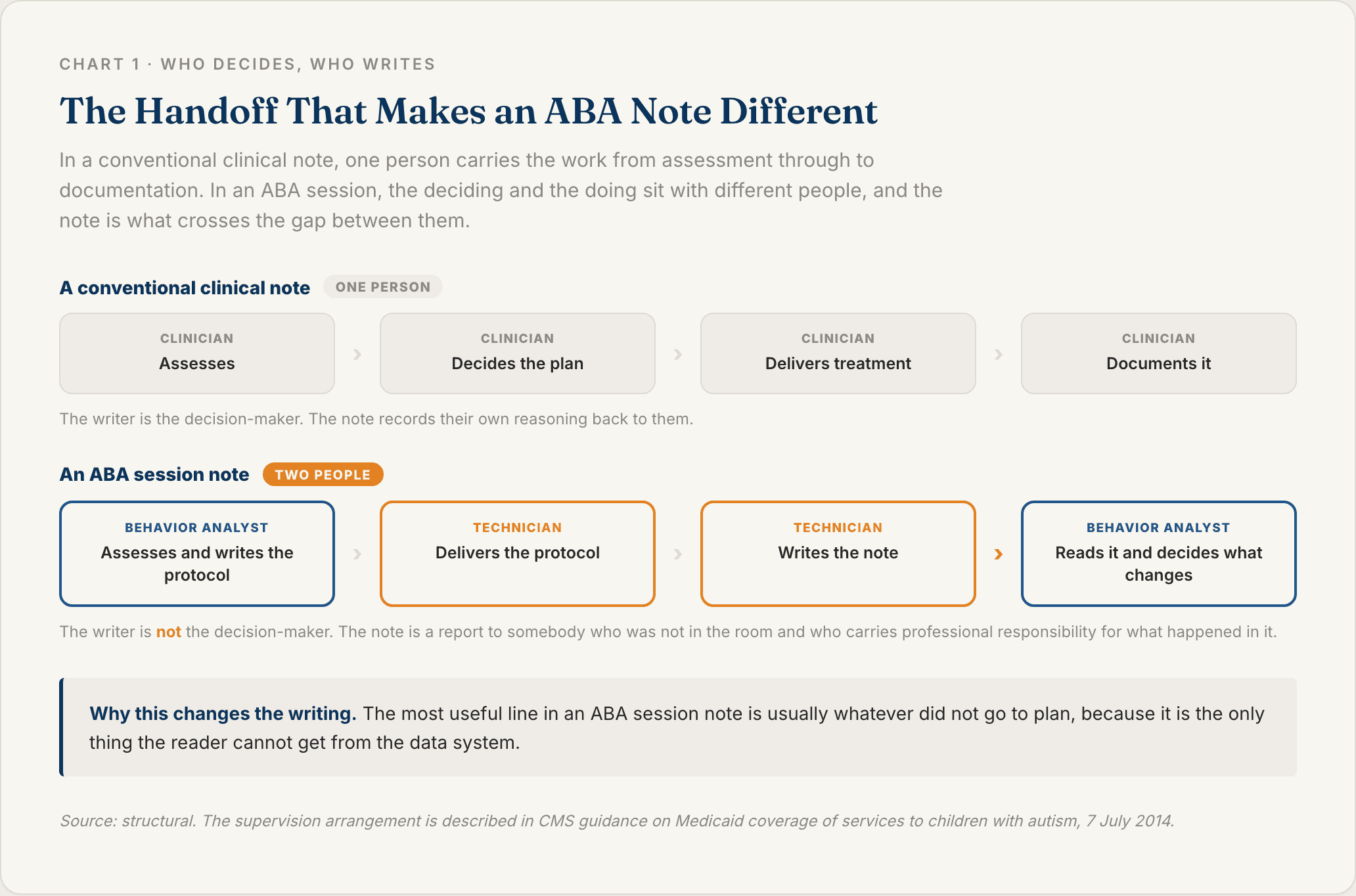
In almost every clinical note, the person writing it is the person who made the decisions. They assessed, they decided, they treated, and then they wrote it down.
An Applied Behavior Analysis (ABA) session note is not like that. The Registered Behavior Technician (RBT) writing it executed a protocol somebody else designed. They did not choose the programs, set the targets or write the plan.
That one difference changes what the note is for, and no guide to writing these notes mentions it. Here are three blank templates, three worked examples, an honest answer to the SOAP question, and the reason your note has a specific reader.
Key Takeaway: An ABA session note records what happened during a treatment session delivered by a Registered Behavior Technician under the direction of a supervising behavior analyst. It is structurally unlike other clinical notes because the writer did not design the treatment. Medicaid coverage for these services commonly runs through pathways where non-licensed practitioners furnish the service under supervision, and guidance from the Centers for Medicare & Medicaid Services (CMS) sets the condition that the state's scope of practice act requires the licensed practitioner to "assume professional responsibility for the patient and the service furnished by the unlicensed practitioner under their supervision" [1]. The session note is how that supervision actually happens. It should record whether the protocol ran as written, what deviated from it, and what the supervisor needs in order to decide something. Sully.ai drafts the session note from what the technician describes, so the context survives the drive home.
What an ABA Session Note Is For
The Note Has a Reader, and It Is Not the Chart
Here is the part no competing page states.
A physician's progress note is written by the person who decided the plan. If they want to know what they were thinking last visit, they read their own reasoning back.
An RBT session note is the opposite. The technician carried out a plan written by a Board Certified Behavior Analyst (BCBA) who was not in the room. The note is not a record of a decision. It is a report to the person who will make the next one.
Follow that through and it changes what matters in the note.
The most valuable sentence in an ABA session note is usually the one describing what did not go to plan. Not because problems matter more than progress, but because the deviation is the only thing the supervisor cannot get from anywhere else. The data system already tells them the trial percentages. It does not tell them the session ran in the kitchen because a sibling was ill in the living room.
Why the Data and the Note Are Different Documents
The second structural point, and the one costing technicians the most time.
Trial-by-trial responses, frequency counts, duration data, antecedent-behavior-consequence (ABC) records and percentage correct all live in the data system. They were entered during the session, on a tablet, as it happened.
The session note is not a second copy of that.
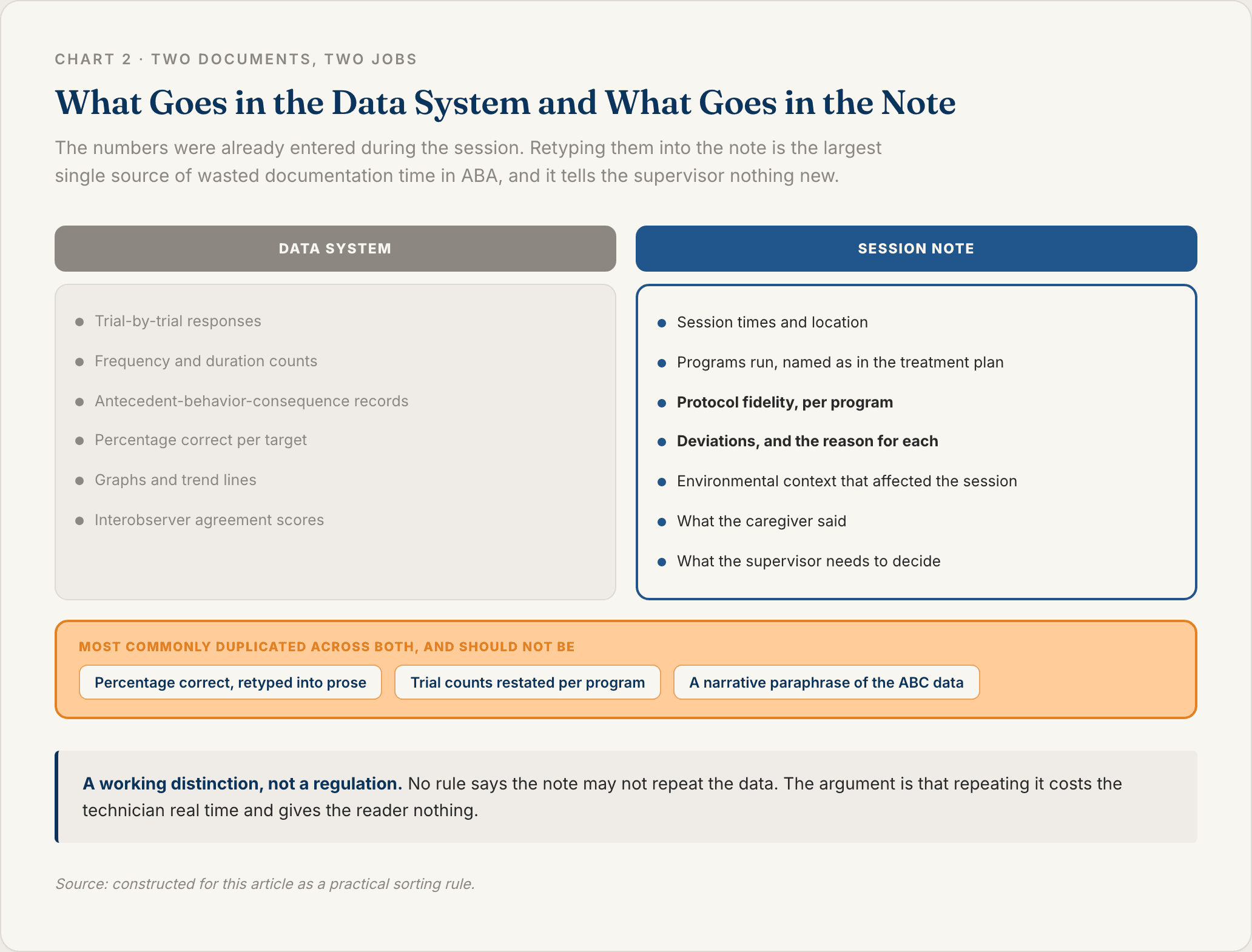
A note that paraphrases the data adds nothing a supervisor could not already see, and it takes twenty minutes per session to produce. That is the single biggest source of wasted documentation time in ABA, and it comes from nobody ever saying out loud that these are two documents with two jobs.
What the note carries instead is context the numbers cannot: what the environment was like, what the technician changed inside the protocol, what a caregiver mentioned on the way out, what the supervisor should look at before the next session.
Why SOAP Fits ABA Badly
This deserves a direct answer, because a lot of agencies mandate SOAP (Subjective, Objective, Assessment, Plan) and the people using it did not choose it.
SOAP was built for an autonomous clinician. They gather the subjective report, record objective findings, form an assessment, and write a plan. Each letter assumes the writer has the authority to do that step.
A technician has that authority for two of the four.
The Assessment field asks for a clinical judgment the technician is not the one making. The Plan field asks for a treatment plan that already exists and was written by the analyst. Filling those two boxes honestly is genuinely difficult, which is why so many ABA SOAP notes read as vague.
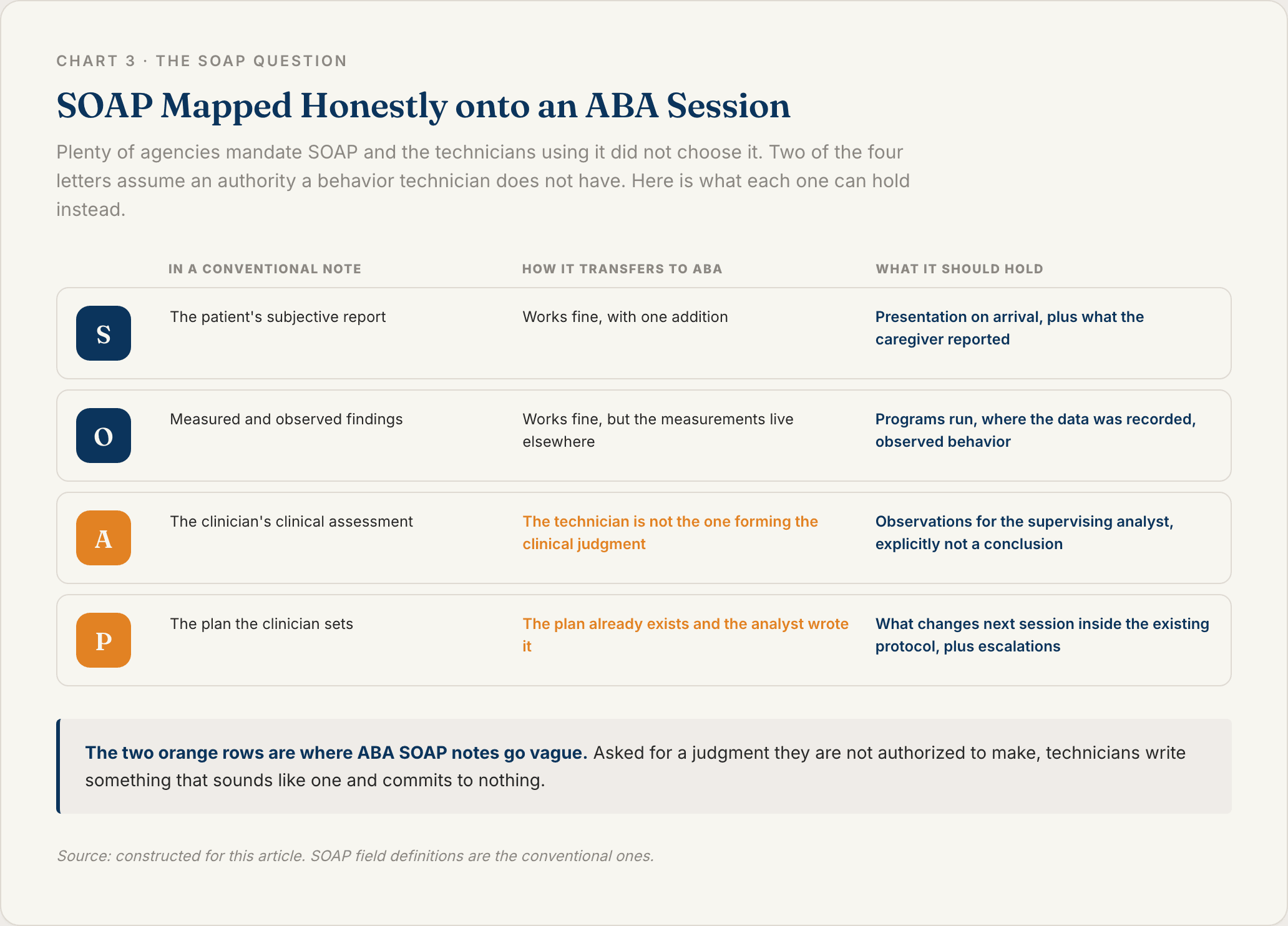
If your agency requires SOAP, map it rather than fight it.Subjective becomes presentation on arrival plus caregiver report. Objective becomes programs run, where the data sits, and observed behavior. Assessment becomes observations for the supervisor, explicitly not a clinical judgment. Plan becomes what you will do differently next session inside the existing protocol, plus anything escalated.
That mapping keeps the form your agency wants and puts the right content in it.
What Governs ABA Session Documentation
The Supervision Structure the Note Has to Serve
CMS guidance on Medicaid coverage of services to children with autism describes several pathways states use. One runs through Other Licensed Practitioner (OLP) services, defined at 42 CFR 440.60 as "any medical or remedial care or services, other than physicians' services, provided by licensed practitioners within the scope of practice as defined under State law" [2].
Under that pathway, services can be furnished by people who are not themselves licensed. CMS sets conditions, and one of them is the reason this article exists:
Services are furnished directly by non-licensed practitioners who work under the supervision of the licensed practitioners ... the state's Scope of Practice Act also requires the licensed practitioners to assume professional responsibility for the patient and the service furnished by the unlicensed practitioner under their supervision ... and the licensed practitioners bill for the service. [1]
Read the middle clause again. Somebody who was not in the room carries professional responsibility for what happened in it.
That is an unusual arrangement, and it is only workable if information travels reliably from the room to the responsible person. The session note is that instrument. It is not paperwork attached to the service. In this structure it is part of how the service is delivered safely.
What the Service Has to Be Doing
The service definitions CMS cites sit at 42 CFR 440.130. Preventive services are those recommended by a physician or other licensed practitioner "to prevent disease, disability, and other health conditions or their progression", to prolong life, and to promote physical and mental health and efficiency. Rehabilitative services are those recommended "for maximum reduction of physical or mental disability and restoration of a beneficiary to his best possible functional level" [3].
Every one of those definitions describes a change in direction.Progression prevented. Disability reduced. Function restored.
A session note listing activities without indicating direction of travel does not speak to that standard. It does not have to contain a progress claim on every line, and a single session often shows no measurable change at all. But across a run of notes, somebody should be able to see which way things are going.
A caveat worth stating plainly.Medicaid coverage pathways for these services vary by state, and which authority your agency bills under determines the precise documentation requirement. The principle above holds across them. The specifics are in your state plan, not in a blog post.
Where the Certification Standards Sit
The Behavior Analyst Certification Board (BACB) publishes the ethics codes governing behavior analysts and technicians [4], and the RBT Handbook covering certification and supervision requirements [5].
Both documents get revised. Rather than paraphrase their current contents here, the honest instruction is to read the version current for your certification cycle, because a session note has to satisfy the standard in force now rather than the one in force when a guide was written.
The ABA Session Note Templates
Three blocks. Each is complete as written, so you can paste it straight into a chart.
The RBT Session Note Template
RBT SESSION NOTE
Client, date, session times: (start and stop, plus total session minutes, recorded the way any timed clinical entry should be)
Location and who was present: (home, clinic, school, and which caregivers were there)
Programs run this session: (named exactly as they appear in the treatment plan, not paraphrased)
Data recorded in: (which system, so the supervisor can find it; do not copy the numbers here)
Protocol fidelity: (did each program run as written, stated per program)
Deviations and reason: (anything that did not run as written, and why, or "none")
Behaviors of concern: (what preceded it, what the behavior was, what followed, described without interpretation, using the same quote-the-client, observe-the-behavior discipline that keeps attribution clear)
Environmental context: (anything unusual about the setting that affected the session)
Caregiver contact: (what was discussed, and what the caregiver reported)
For the supervisor: (what you need them to decide, look at or change, or "nothing this session")
Signature and credentials: (the technician who delivered the session)
Two lines are doing the real work here. Protocol fidelityand deviationsare the fields that exist in no other note format in healthcare, and they are the fields your supervisor reads first.
The SOAP Mapped to ABA Template
For agencies that require SOAP. Same content, mapped honestly. The Assessment and Plan fields below are deliberately narrower than in a standard SOAP note, for the reasons given earlier.
ABA SESSION NOTE, SOAP FORMAT
Client, date, session times: (start and stop, plus total session minutes)
S, Subjective: (how the client presented on arrival, plus what the caregiver reported, in their words where useful)
O, Objective: (programs run as named in the treatment plan, where the data was recorded, and observed behavior)
A, Assessment: (your observations for the supervising analyst; this is not a clinical judgment and should not read like one)
P, Plan: (what you will do differently next session inside the existing protocol, plus anything escalated to the analyst)
Signature and credentials: (the technician who delivered the session)
If the A field tempts you to write a conclusion about why the client behaved as they did, that is the moment to write an observation and hand the conclusion to the analyst.
The Supervision and BCBA Session Note Template
For the supervising analyst's own sessions. This is what the technician notes feed into.
BCBA SESSION NOTE
Client, date, session times: (start and stop, plus total minutes)
Purpose of this session: (direct treatment, protocol modification, caregiver training, technician supervision, or a combination)
Observations of protocol implementation: (what you saw when the protocol was run, if you observed a session)
Treatment plan modifications: (what changed, and the clinical rationale for changing it)
Technician feedback delivered: (what you fed back, and how it was received)
Caregiver training provided: (what was taught, and what the caregiver demonstrated, recorded against the goals in the behavioral health record)
Next review date: (the date, and anything that would trigger an earlier review)
Signature and credentials: (the supervising analyst)
Where Sully.ai Fits in ABA Documentation
Technicians finish one session and frequently start the next immediately, or drive to the next home and write both notes at the end of the day.
What survives that gap is the data, because it was entered on a tablet during the session. What does not survive is precisely the material this article has argued the note is for: the environment, the improvisation inside the protocol, the thing the caregiver mentioned at the door.
Sully.ai's AI scribe for behavioral health teams drafts the session note from what the technician describes, so that context is captured while it is still accurate rather than reconstructed six hours later. It runs on a single integration across Epic, Cerner, Meditech and Athenahealth.
Two boundaries, and the second one matters more than the first.
It does not judge protocol fidelity.Whether a program ran as written is a technical judgment made by the person running it, against a protocol they were trained on. No tool reading a description makes that call.
It cannot tell you what would surprise your supervisor. The entire purpose of the note is to convey what the supervisor does not already know, and that is a judgment about someone else's state of knowledge. A drafted note that reads smoothly and contains no deviation is not evidence that nothing deviated. It may only be evidence that nobody said so out loud.
Sully operates across 5,000+ providers, has delivered 50M+ hours of work, and prices each role 80 to 90 percent below the human equivalent [6].
Three Worked Examples
A Routine In-Home Session
Everything ran to protocol. Notice how short this is.
Client A, 14 September, 1530 to 1730. Total 120 minutes. Home, mother present throughout.
Programs run: Manding for preferred items, Receptive identification of household objects, Tolerating delay of reinforcement, Independent hand washing.
Data recorded in: Agency data system, entered live during session.
Protocol fidelity: All four programs run as written.
Deviations and reason: None.
Behaviors of concern: None observed this session.
Environmental context: Session ran in the usual work area. No disruptions.
Caregiver contact: Mother reported the client used the mand for "outside" spontaneously twice at the weekend, which is the first time she has heard it outside of session.
For the supervisor: The spontaneous weekend manding may be worth a generalization target.
That caregiver line is the whole value of the note. It is not in the data system, it happened outside a session, and it may change the plan.
A Session Where the Protocol Did Not Run
Client B, 15 September, 0900 to 1100. Total 120 minutes. Clinic, no caregiver present.
Programs run: Matching to sample, Vocal imitation, Toilet training protocol. Fine motor program not run.
Data recorded in: Agency data system, entered live during session.
Protocol fidelity: Three of four programs run as written. Fine motor program not run.
Deviations and reason: Fine motor program requires the pincer grip materials, which were not in the clinic kit. Substituted additional matching to sample trials rather than introducing an untrained activity.
Behaviors of concern: None. Client was cooperative throughout.
Environmental context: Clinic room change to Room 3 because of a scheduling overlap. Client took roughly ten minutes to settle, longer than usual.
Caregiver contact: None, client transported by service.
For the supervisor: Fine motor materials need replacing in the clinic kit before Thursday. Also flagging that the room change cost about ten minutes of session time, in case that is worth planning around.
Two deviations, both ordinary, both recorded with a reason. The technician also stated what they did instead, which is the part most notes leave out and the part that shows a judgment was made rather than a program simply skipped.
A Session With a Behavioral Incident
Client C, 16 September, 1600 to 1800. Total 120 minutes. Home, father present in adjacent room.
Programs run: Tolerating transitions, Functional communication training, Joint attention.
Data recorded in: Agency data system. ABC data recorded for the incident below.
Protocol fidelity: All programs run as written until the incident at approximately 1705, after which the session moved to the behavior plan.
Deviations and reason: Joint attention program discontinued after the incident, per the behavior intervention plan, which directs a return to low-demand activity following escalation.
Behaviors of concern: At approximately 1705, following a transition instruction away from a preferred tablet activity, the client dropped to the floor, screamed for approximately 90 seconds, and struck the floor with an open hand four times. No contact with people or property. Behavior ceased following the planned response of neutral waiting with the tablet removed from view. Client accepted a break and returned to a low-demand activity within four minutes.
Environmental context: Session ran later than usual because of a schedule change. Father noted the client had not napped.
Caregiver contact: Informed the father immediately after the incident, described what happened and the response. He reported the same behavior twice at home this week, both times around transitions from the tablet.
For the supervisor: Two caregiver-reported instances at home this week, both tablet transitions. May warrant review of the transition protocol or a function check.
Note what the technician did not write. No sentence explaining why the client escalated. Antecedent, behavior and consequence, factually and in order, plus the caregiver report. The interpretation is the analyst's, and the note gives them what they need to make it.
What Gets an ABA Session Note Sent Back
A note that restates the data. If the supervisor can see it in the data system, it does not need retyping. Point at the data and spend the words on context.
No deviation recorded on a session where something clearly changed. If the room changed, the materials were missing or the session ran late, that is a deviation even when the programs still ran. Silence reads as either nothing happened or nothing was noticed.
Interpretation written by the technician. "The client was seeking attention" is a hypothesis about function. Describe what happened and let the analyst draw it.
No program named from the treatment plan. A note describing a session without naming the programs cannot be matched to the plan it was supposed to deliver.
FAQ
What should be included in RBT session notes?
Session times and location, the programs run as they are named in the treatment plan, where the data was recorded, whether each program ran as written, any deviation with its reason, behaviors of concern described without interpretation, caregiver contact, and anything the supervising analyst needs to act on. The note is a report to the supervisor, not a second copy of the data.
Do ABA session notes use SOAP format?
Some agencies require it and it can be made to work, but the fit is imperfect. SOAP assumes the writer assessed the client and then wrote a plan. A Registered Behavior Technician does neither, because the treatment plan was written by the supervising analyst. Mapped honestly, Assessment becomes observations for the supervisor and Plan becomes what changes next session inside the existing protocol.
Why do ABA session notes matter for billing?
Because somebody who was not in the room carries responsibility for what happened in it. CMS guidance on Medicaid coverage for children with autism describes pathways where non-licensed practitioners furnish services under supervision, with the licensed practitioner assuming professional responsibility for the service and billing for it [1]. The session note is the record that supervision relies on.
How long should an ABA session note be?
Shorter than most people write. A routine session where everything ran to protocol needs the times, the programs, a pointer to the data, and a line confirming fidelity. Length should track how much the supervisor does not already know, which on an uneventful day is very little.
Can an AI scribe write ABA session notes?
It can draft them from what the technician describes, and Sully.ai does exactly that. What it cannot do is judge whether a program ran as written, or know which detail would surprise the supervisor. A smooth note with no deviation in it is not evidence that nothing deviated.
Sources
[1] Centers for Medicare & Medicaid Services — CMCS Informational Bulletin, Clarification of Medicaid Coverage of Services to Children with Autism, 7 July 2014. https://www.medicaid.gov/federal-policy-guidance/downloads/cib-07-07-14.pdf
[2] U.S. Government Publishing Office — 42 CFR 440.60, Medical or other remedial care provided by licensed practitioners. https://www.govinfo.gov/content/pkg/CFR-2023-title42-vol4/xml/CFR-2023-title42-vol4-sec440-60.xml
[3] U.S. Government Publishing Office — 42 CFR 440.130, Diagnostic, screening, preventive, and rehabilitative services. https://www.govinfo.gov/content/pkg/CFR-2023-title42-vol4/xml/CFR-2023-title42-vol4-sec440-130.xml
[4] Behavior Analyst Certification Board — Ethics Codes. https://www.bacb.com/ethics-information/ethics-codes/
[5] Behavior Analyst Certification Board — RBT Handbook. https://www.bacb.com/rbt-handbook/
[6] Sully.ai — AI Medical Scribe. https://www.sully.ai/medical-scribe
TABLE OF CONTENTS
Hire your
Medical AI Team
Take a look at our Medical AI Team
AI Receptionist
Manages patient scheduling, communications, and front-desk operations across all channels.
AI Scribe
Documents clinical encounters and maintains accurate EHR/EMR records in real-time.
AI Medical Coder
Assigns and validates medical codes to ensure accurate billing and regulatory compliance.
AI Nurse
Assesses patient urgency and coordinates appropriate care pathways based on clinical needs.