"/><stop offset="1" stop-color="rgba(255, 255, 255, 0)"/></linearGradient><linearGradient id="WxV_IOPE7-2309410982-linear-gradient" x1="1" x2="0" y1="0.5951279047551217" y2="0.4048720952448783"><stop offset="0" stop-color="rgb(255, 255, 255)"/><stop offset="1" stop-color="rgba(255, 255, 255, 0)"/></linearGradient><linearGradient id="WwbAIQIz8-2309410982-linear-gradient" x1="0.43478742751482424" x2="0.6358595260107829" y1="0.26" y2="1"><stop offset="0" stop-color="rgb(255, 255, 255)"/><stop offset="1" stop-color="rgba(255, 255, 255, 0)"/></linearGradient><linearGradient id="ZWsVQcPfn-2309410982-linear-gradient" x1="0.9508213454678907" x2="0.04917865453210929" y1="0" y2="1"><stop offset="0" stop-color="rgb(255, 255, 255)"/><stop offset="1" stop-color="rgba(255, 255, 255, 0)"/></linearGradient><linearGradient id="lTyCGrzzP-2309410982-linear-gradient" x1="0.374937164194436" x2="0.625062835805564" y1="0" y2="1"><stop offset="0" stop-color="rgb(255, 255, 255)"/><stop offset="1" stop-color="rgba(255, 255, 255, 0)"/></linearGradient></defs><g d="M 658.002 1357.705 C 1020.321 1357.705 1314.04 1063.989 1314.04 701.667 C 1314.04 339.347 1020.321 45.626 658.002 45.626 C 295.681 45.626 1.96 339.347 1.96 701.667 L 0 701.667 C 0 338.263 294.598 43.665 658.002 43.665 C 1021.404 43.665 1316 338.263 1316 701.667 C 1316 1065.072 1021.404 1359.672 658.002 1359.672 C 294.598 1359.672 0 1065.072 0 701.667 L 1.96 701.667 C 1.96 1063.989 295.681 1357.705 658.002 1357.705 Z M 658.005 1265.053 C 969.154 1265.053 1221.392 1012.819 1221.392 701.667 C 1221.392 390.517 969.154 138.281 658.005 138.281 C 346.856 138.281 94.619 390.517 94.619 701.667 L 92.659 701.667 C 92.659 389.433 345.77 136.321 658.005 136.321 C 970.241 136.321 1223.352 389.433 1223.352 701.667 C 1223.352 1013.902 970.241 1267.017 658.005 1267.017 C 345.77 1267.017 92.659 1013.902 92.659 701.667 L 94.619 701.667 C 94.619 1012.819 346.856 1265.053 658.005 1265.053 Z M 658.002 1166.116 C 914.513 1166.116 1122.452 958.178 1122.452 701.667 C 1122.452 445.16 914.513 237.22 658.002 237.22 C 401.494 237.22 193.551 445.16 193.551 701.667 L 191.59 701.667 C 191.59 444.077 400.411 235.255 658.002 235.255 C 915.596 235.255 1124.412 444.077 1124.412 701.667 C 1124.412 959.261 915.596 1168.084 658.002 1168.084 C 400.411 1168.084 191.59 959.261 191.59 701.667 L 193.551 701.667 C 193.551 958.178 401.494 1166.116 658.002 1166.116 Z M 281.657 818.28 C 298.572 818.28 314.804 825.001 326.765 836.965 L 458.99 969.182 C 470.582 980.781 486.308 987.298 502.706 987.298 L 612.137 987.298 C 646.284 987.298 673.972 959.61 673.972 925.463 L 673.972 891.504 L 675.939 891.504 L 675.939 925.463 C 675.939 960.7 647.374 989.258 612.137 989.258 L 502.706 989.258 C 485.788 989.258 469.562 982.537 457.599 970.573 L 325.378 838.356 C 313.785 826.757 298.056 820.242 281.657 820.244 L 1.173 820.244 L 1.173 818.28 Z M 746.64 888.714 L 1053.046 888.714 C 1069.967 888.714 1086.194 895.435 1098.16 907.398 L 1259.381 1068.619 L 1257.99 1070.007 L 1096.772 908.79 C 1085.175 897.193 1069.446 890.679 1053.046 890.681 L 746.64 890.681 C 729.724 890.681 713.493 883.957 701.533 871.993 L 685.377 855.845 L 686.769 854.453 L 702.917 870.605 C 714.513 882.201 730.241 888.715 746.64 888.714 Z M 667.685 552 L 512.316 396.894 C 494.66 379.264 484.741 355.356 484.739 330.426 L 484.739 0 L 487.632 0 L 487.632 330.426 C 487.632 354.592 497.248 377.763 514.369 394.851 L 669.739 549.957 Z M 782.851 700.491 C 816.998 700.491 844.686 672.804 844.686 638.655 L 844.686 516.468 C 844.687 499.547 851.409 483.32 863.374 471.355 L 1177.508 157.22 L 1178.896 158.607 L 864.762 472.742 C 853.162 484.337 846.646 500.067 846.646 516.468 L 846.646 638.655 C 846.646 673.89 818.088 702.455 782.851 702.455 L 700.405 702.455 L 700.405 700.491 Z M 130.338 534.223 L 213.07 534.223 C 256.112 534.223 291.003 569.114 291.003 612.156 L 291.003 694.888 C 291.003 711.29 297.514 727.017 309.113 738.611 L 472.887 902.378 L 471.496 903.769 L 307.726 739.995 C 295.761 728.033 289.038 711.807 289.038 694.888 L 289.038 612.156 C 289.038 570.198 255.028 536.188 213.07 536.188 L 130.338 536.188 C 113.419 536.187 97.193 529.465 85.23 517.5 L 77.071 509.345 C 65.107 497.381 58.386 481.153 58.388 464.233 L 58.388 199.526 L 60.348 199.526 L 60.348 464.233 C 60.349 480.631 66.863 496.358 78.458 507.954 L 86.617 516.113 C 98.213 527.709 113.94 534.223 130.338 534.223 Z" fill="transparent" height="1359.6717183844698px" id="DcyumyANr" transform="translate(0 -43.665)" width="1316px"><g opacity="0.5"><path d="M 658.002 1314.039 C 1020.321 1314.039 1314.04 1020.324 1314.04 658.001 C 1314.04 295.681 1020.321 1.961 658.002 1.961 C 295.681 1.961 1.96 295.682 1.96 658.001 L 0 658.001 C 0 294.598 294.598 0 658.002 0 C 1021.404 0 1316 294.598 1316 658.001 C 1316 1021.407 1021.404 1316.007 658.002 1316.007 C 294.598 1316.007 0 1021.407 0 658.001 L 1.96 658.001 C 1.96 1020.324 295.681 1314.039 658.002 1314.039 Z" fill="rgb(255, 255, 255)" height="1316.0065114752902px" id="dxf13D52Y" transform="translate(0 43.665)" width="1316px"/></g><g opacity="0.3"><path d="M 565.347 1128.732 C 876.496 1128.732 1128.733 876.498 1128.733 565.346 C 1128.733 254.196 876.496 1.961 565.347 1.961 C 254.197 1.961 1.961 254.196 1.961 565.346 L 0 565.346 C 0 253.112 253.111 0 565.347 0 C 877.582 0 1130.693 253.112 1130.693 565.346 C 1130.693 877.581 877.582 1130.696 565.347 1130.696 C 253.111 1130.696 0 877.581 0 565.346 L 1.961 565.346 C 1.961 876.498 254.197 1128.732 565.347 1128.732 Z" fill="rgb(255, 255, 255)" height="1130.6960934794101px" id="if1BmYw1S" transform="translate(92.659 136.321)" width="1130.693351805604px"/></g><g opacity="0.15"><path d="M 466.412 930.861 C 722.923 930.861 930.862 722.922 930.862 466.411 C 930.862 209.905 722.923 1.965 466.412 1.965 C 209.904 1.965 1.961 209.905 1.961 466.411 L 0 466.411 C 0 208.822 208.821 0 466.412 0 C 724.006 0 932.822 208.822 932.822 466.411 C 932.822 724.005 724.006 932.828 466.412 932.828 C 208.821 932.828 0 724.005 0 466.411 L 1.961 466.411 C 1.961 722.922 209.904 930.861 466.412 930.861 Z" fill="rgb(255, 255, 255)" height="932.8284667407987px" id="ef75NsYf6" transform="translate(191.59 235.255)" width="932.8219552655086px"/></g><g opacity="0.5"><path d="M 280.484 0 C 297.399 0 313.63 6.721 325.592 18.685 L 457.817 150.902 C 469.408 162.501 485.135 169.018 501.533 169.017 L 610.964 169.017 C 645.111 169.017 672.799 141.33 672.799 107.182 L 672.799 73.223 L 674.766 73.223 L 674.766 107.182 C 674.766 142.42 646.201 170.978 610.964 170.978 L 501.533 170.978 C 484.614 170.978 468.389 164.257 456.426 152.293 L 324.205 20.076 C 312.611 8.477 296.883 1.961 280.484 1.964 L 0 1.964 L 0 0 Z" fill="url(%23cQ4xRdUtr-2309410982-linear-gradient)" height="170.97763275969464px" id="cQ4xRdUtr" transform="translate(1.173 818.28)" width="674.7656780356198px"/></g><g opacity="0.5"><path d="M 61.263 34.261 L 367.669 34.261 C 384.589 34.261 400.817 40.982 412.783 52.945 L 574.004 214.166 L 572.612 215.554 L 411.395 54.337 C 399.798 42.74 384.069 36.226 367.669 36.228 L 61.263 36.228 C 44.347 36.228 28.116 29.504 16.155 17.54 L 0 1.391 L 1.391 0 L 17.54 16.152 C 29.136 27.747 44.864 34.261 61.263 34.261 Z" fill="url(%23WxV_IOPE7-2309410982-linear-gradient)" height="215.55382175474415px" id="WxV_IOPE7" transform="translate(685.377 854.453)" width="574.0036823012563px"/></g><g opacity="0.5"><path d="M 182.946 552 L 27.577 396.894 C 9.921 379.264 0.002 355.356 0 330.426 L 0 0 L 2.893 0 L 2.893 330.426 C 2.893 354.592 12.509 377.763 29.63 394.851 L 185 549.957 Z" fill="url(%23WwbAIQIz8-2309410982-linear-gradient)" height="552px" id="WwbAIQIz8" transform="translate(484.739 0)" width="185px"/></g><g opacity="0.5"><path d="M 82.446 543.271 C 116.593 543.271 144.281 515.583 144.281 481.435 L 144.281 359.248 C 144.282 342.327 151.004 326.1 162.969 314.135 L 477.103 0 L 478.491 1.387 L 164.356 315.522 C 152.757 327.117 146.241 342.846 146.241 359.248 L 146.241 481.435 C 146.241 516.67 117.683 545.235 82.446 545.235 L 0 545.235 L 0 543.271 Z" fill="url(%23ZWsVQcPfn-2309410982-linear-gradient)" height="545.2346136318063px" id="ZWsVQcPfn" transform="translate(700.405 157.22)" width="478.4906210693257px"/></g><g opacity="0.5"><path d="M 71.95 334.696 L 154.682 334.696 C 197.724 334.696 232.616 369.588 232.616 412.63 L 232.616 495.362 C 232.616 511.764 239.126 527.491 250.725 539.084 L 414.5 702.851 L 413.108 704.243 L 249.338 540.469 C 237.373 528.507 230.651 512.281 230.651 495.362 L 230.651 412.63 C 230.651 370.672 196.64 336.661 154.682 336.661 L 71.95 336.661 C 55.031 336.661 38.805 329.939 26.843 317.974 L 18.683 309.819 C 6.719 297.854 -0.001 281.627 0 264.707 L 0 0 L 1.961 0 L 1.961 264.707 C 1.961 281.105 8.475 296.832 20.07 308.428 L 28.229 316.587 C 39.825 328.182 55.552 334.697 71.95 334.696 Z" fill="url(%23lTyCGrzzP-2309410982-linear-gradient)" height="704.2427839655832px" id="lTyCGrzzP" transform="translate(58.388 199.526)" width="414.49961191971533px"/></g></g></svg>)
Chiropractic has the narrowest benefit definition in Medicare Part B. Manual manipulation of the spine to correct a subluxation, and nothing else the chiropractor orders or furnishes.
That single fact changes what the Objective field of your note is for. In most specialties it records findings that support a diagnosis. Here it has to establish one specific thing, in a specific form, or the visit is not a covered service.
Here are two blank templates, two worked examples, and the scoring rule that decides whether your examination demonstrated a subluxation or only described one.
Key Takeaway: A chiropractic SOAP note records the patient's report, the examination findings, the clinical assessment and the plan for a spinal manipulation visit. It carries one requirement no other SOAP note does. Medicare Part B "pays only for a chiropractor's manual manipulation of the spine to correct a subluxation if the subluxation has resulted in a neuromusculoskeletal condition for which manual manipulation is appropriate treatment" [1]. The subluxation has to be demonstrated, and when it is demonstrated by physical examination rather than imaging, the Centers for Medicare & Medicaid Services (CMS) requires two of the four PART criteria, one of which must be asymmetry/misalignment or range of motion abnormality [2]. Pain and tissue tone together do not demonstrate a subluxation. Sully.ai drafts the note from the visit so the examination findings land in the form the rule requires.
What Makes a Chiropractic SOAP Note Different
The Narrowest Benefit in Medicare Part B
A chiropractor is one of five practitioner types Medicare treats as a physician, and the regulation lists them alongside doctors of medicine, dental surgery, podiatric medicine and optometry [3]. It also says, in the same section, that the services "may be covered under Medicare Part B if they are furnished within the limitations specified" [3].
The limitations are severe.
"Medicare Part B pays only for a chiropractor's manual manipulation of the spine to correct a subluxation if the subluxation has resulted in a neuromusculoskeletal condition for which manual manipulation is appropriate treatment." [1]
And immediately after it:
"Medicare Part B does not pay for X-rays or other diagnostic or therapeutic services furnished or ordered by a chiropractor." [1]
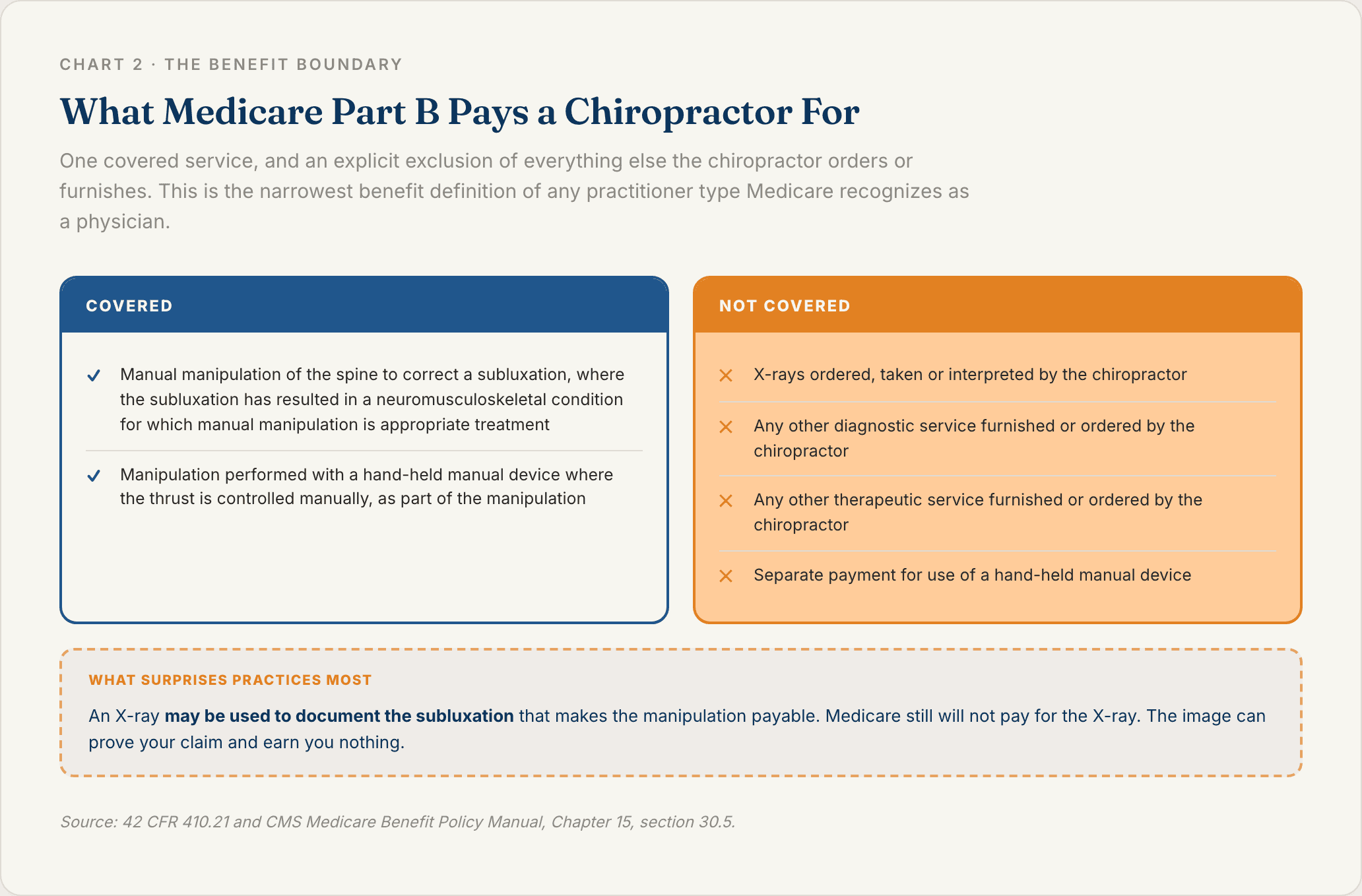
Read those two sentences together and the consequence is stark. Everything in the visit can be clinically appropriate and still fall outside the benefit. The note therefore has one job that outranks the rest: demonstrate the subluxation.
A scope note, stated plainly.Everything on this page is Medicare Part B. Cash practices, commercial payers and personal injury work are governed by their own rules, and some are stricter rather than looser. Use this as the floor rather than the whole picture.
Why the Objective Field Carries the Whole Claim
In most specialties, the Objective field records findings that support a clinical conclusion. In chiropractic it has to establish a fact the benefit is conditioned on.
That is a different job, and it catches competent clinicians. A note can contain a thorough, accurate examination and still fail, because the findings it recorded are not the findings CMS recognizes as demonstrating a subluxation.
This is a documentation problem rather than a clinical one. The examination was probably fine. The note recorded the wrong two things.
The Two of Four Rule
What PART Actually Requires
Start with the definition, because it is more specific than most people expect:
"Subluxation is defined as a motion segment, in which alignment, movement integrity, and/or physiological function of the spine are altered although contact between joint surfaces remains intact." [2]
It may be demonstrated by an X-ray or by physical examination. For physical examination, CMS names four criteria [2]:
Pain/tenderness, evaluated in terms of location, quality and intensity
Asymmetry/misalignment, identified on a sectional or segmental level
Range of motion abnormality, meaning changes in active, passive and accessory joint movements resulting in an increase or a decrease of sectional or segmental mobility
Tissue, tone changes in the characteristics of contiguous or associated soft tissues, including skin, fascia, muscle and ligament
Then the rule that decides the claim:
"To demonstrate a subluxation based on physical examination, two of the four criteria mentioned under 'physical examination' are required, one of which must be asymmetry/misalignment or range of motion abnormality." [2]
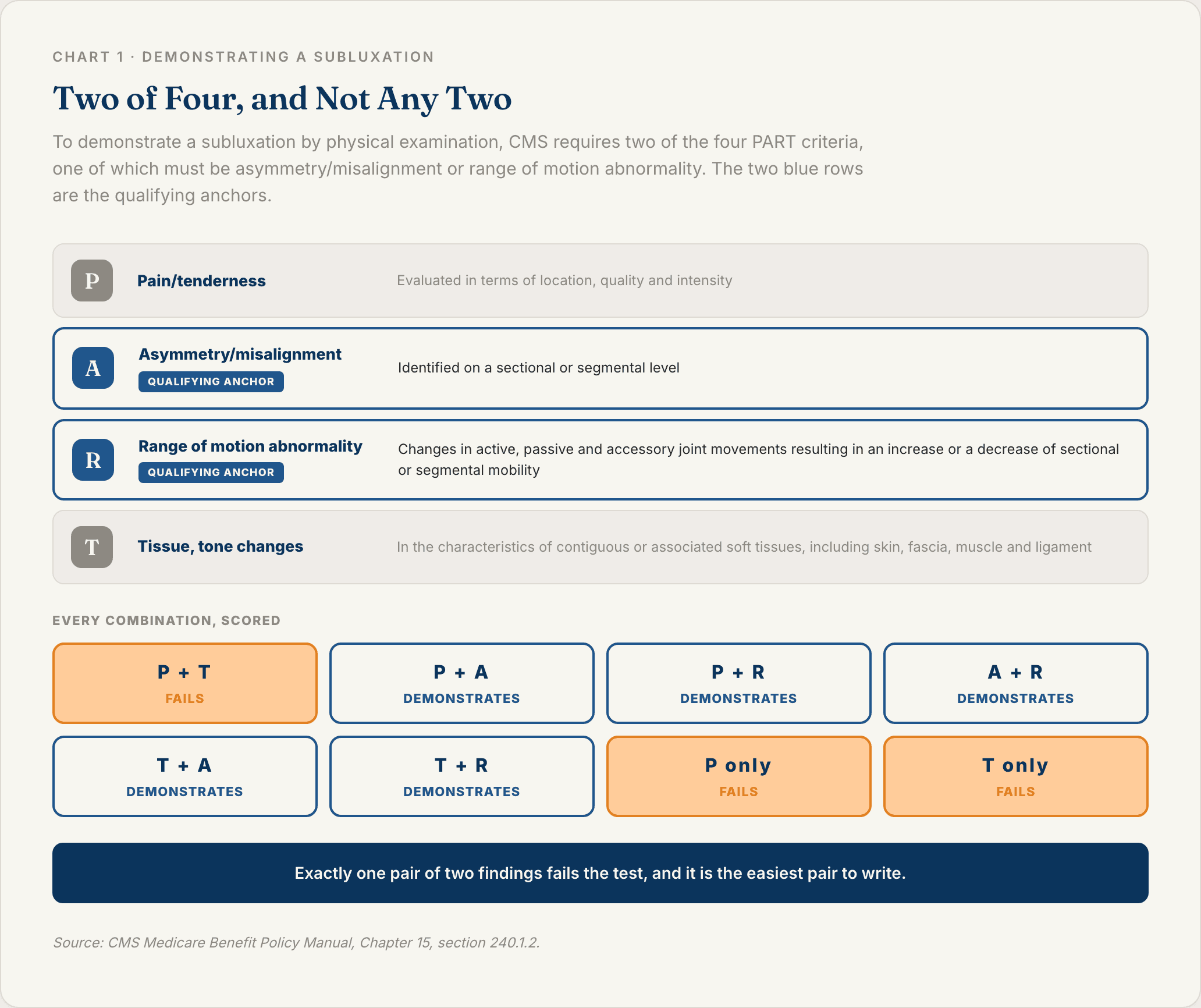
Two of four. And not any two.
The Combination Most Notes Actually Document
Here is the failure, and it is almost architectural.
Pain and tissue tone are the two easiest findings to write. Pain is what the patient came in reporting. Tissue tone is what your hands find in the first ten seconds. Both are real, both are documentable in a phrase, and neither is asymmetry nor range of motion.
Together, they fail the test.
The fix is not more documentation. It is one specific addition: whatever else the note contains, it needs asymmetry or range of motion, measured and located to a segment. Not "restricted mobility". Cervical rotation 45 degrees right, 70 degrees left, restricted at C4-C5.
If You Use an X-Ray Instead
Imaging is the other route, and it has its own timing rule that catches people out.
An X-ray may be used to document subluxation, and it "must have been taken at a time reasonably proximate to the initiation of a course of treatment". CMS defines reasonably proximate as no more than 12 months prior to or 3 months following the initiation of a course of chiropractic treatment, unless more specific X-ray evidence is warranted [2].
There are two accommodations. In certain cases of chronic subluxation such as scoliosis, an older X-ray may be accepted where the health record indicates the condition has existed longer than 12 months and there is a reasonable basis for concluding it is permanent. And a previous computed tomography (CT) scan or magnetic resonance imaging (MRI) study is acceptable evidence if it demonstrates a subluxation of the spine [2].
Now the part that surprises practices. The manual says the X-ray "can be used for documentation", and in the same passage says there is "no coverage or payment for these services" [2]. The image can prove your claim. Medicare will not pay you for taking it [1].
What the History Has to Contain
CMS also names what the patient record's history should include, and this list belongs in the Subjective field rather than scattered through the note [2]:
Symptoms causing the patient to seek treatment
Family history, if relevant
Past health history, covering general health, prior illness, injuries or hospitalizations, medications and surgical history
Mechanism of trauma
Quality and character of the symptoms or problem
Onset, duration, intensity, frequency, location and radiation of symptoms
Aggravating or relieving factors
Prior interventions, treatments and medications
Eight items. Most chiropractic Subjective fields carry three of them.
Active Treatment Versus Maintenance
The second axis, and the one that decides whether a visit is billable at all rather than whether a subluxation was proven.
The AT Modifier and What It Asserts
A chiropractor "must place an AT modifier on a claim when providing active/corrective treatment to treat acute or chronic subluxation" [2].
CMS then adds a caveat about its own modifier that is worth repeating exactly: the presence of the AT modifier "may not in all instances indicate that the service is reasonable and necessary", and contractors may deny after medical review [2].
So the modifier is an assertion you make, not a shield. What supports it is the note.
Worth separating two things that often get conflated. Coverage policy, which is everything above, sits in the Benefit Policy Manual [2]. Claim-level billing mechanics for practitioner services sit in a different manual entirely [4]. And both are revised by transmittal, so check the current version rather than a blog post, including this one [5].
Where Chronic Ends and Maintenance Begins
Three states, and the boundary between the second and third is where practices lose money.
Acute. The patient is being treated for a new injury, identified by X-ray or physical examination. Manipulation is expected to improve the condition or arrest its progression [2].
Chronic. The condition is not expected to significantly improve or resolve with further treatment, but continued therapy can be expected to result in some functional improvement[2].
Maintenance. This is the line, quoted:
"Once the clinical status has remained stable for a given condition, without expectation of additional objective clinical improvements, further manipulative treatment is considered maintenance therapy and is not covered." [2]
Maintenance therapy includes services that seek to prevent disease, promote health, prolong and enhance quality of life, or maintain or prevent deterioration of a chronic condition. When further clinical improvement cannot reasonably be expected and the treatment becomes supportive rather than corrective, it is maintenance [2].
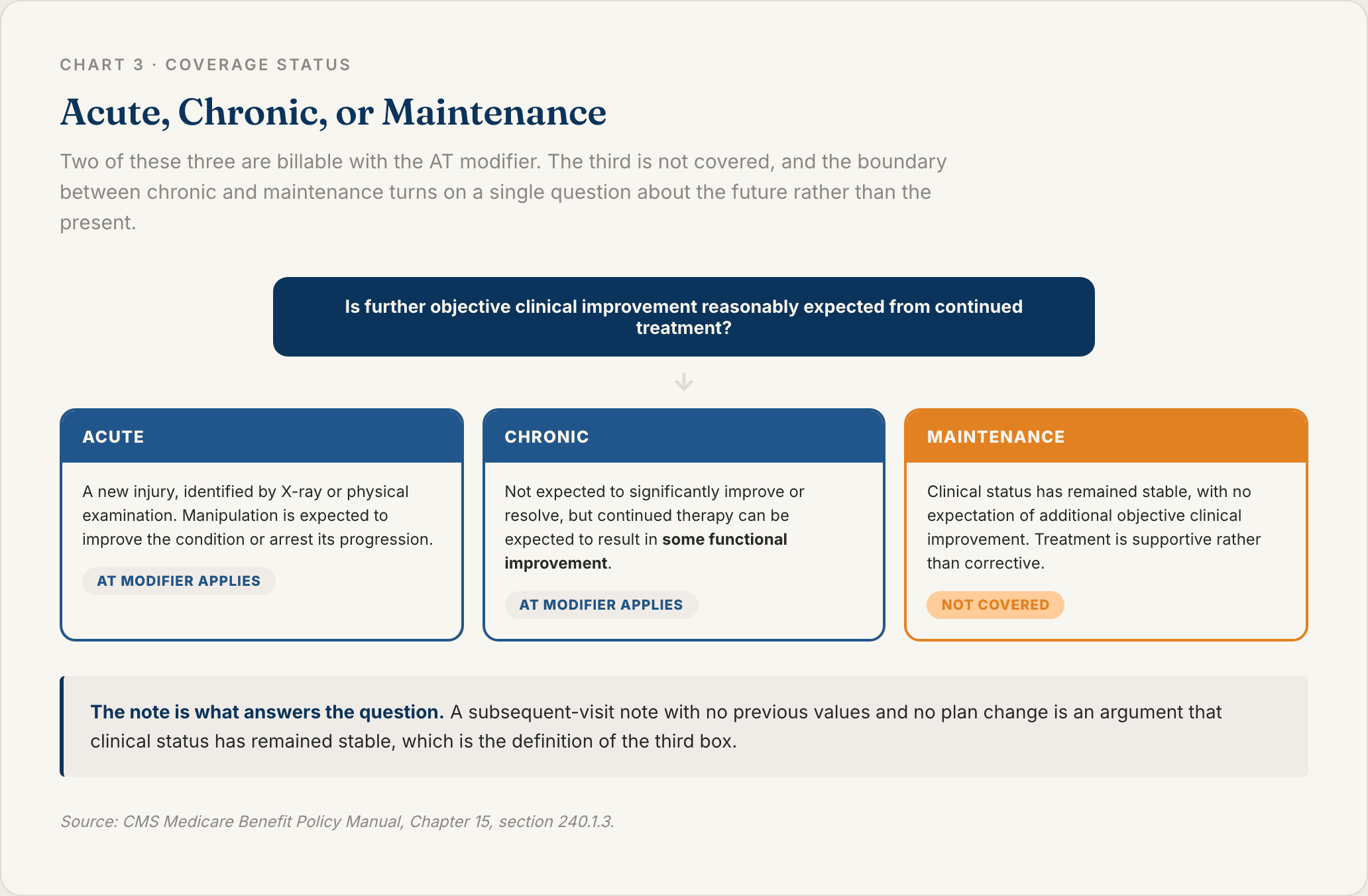
The documentation consequence is direct. Staying on the covered side of that line means the note has to show expected functional improvement, which in practice means your objective measures move or your plan changes. A subsequent-visit note identical to the last one is an argument that the clinical status has remained stable, which is the definition of maintenance.
The Chiropractic SOAP Note Templates
Two blocks rather than three. Chiropractic has an initial visit and a subsequent visit, the difference between them is the whole active-treatment argument, and a third template would be padding.
The Initial Visit Template
CHIROPRACTIC INITIAL VISIT
Patient, date of service, visit type: (initial evaluation and treatment; the baseline this sets is what every later visit is measured against, exactly as in an admission note)
S, symptoms causing the patient to seek treatment: "(in the patient's words)"
S, mechanism of trauma:(what happened, or "insidious onset" with what preceded it)
S, onset, duration, intensity, frequency, location and radiation: (each one stated, not summarized)
S, aggravating and relieving factors: (what makes it worse, what helps)
S, past health history: (general health, prior illness, injuries, hospitalizations, medications, surgical history)
S, family history: (if relevant to the presentation, or "not relevant")
S, prior interventions: (previous treatments, medications, other practitioners seen)
O, pain/tenderness: (location, quality and intensity, with the scale used)
O, asymmetry/misalignment: (sectional or segmental, with the level named)
O, range of motion abnormality: (active, passive and accessory, in degrees, with the level named; the same measure-it-do-not-describe-it discipline that governs an occupational therapy note)
O, tissue tone changes: (which tissues, where, and how they differ)
O, criteria satisfied: (state which two of the four, and confirm one is asymmetry or range of motion)
O, imaging relied on, if any: (study, date taken, and what it demonstrates)
A, subluxation level and the resulting neuromusculoskeletal condition:(both, named)
A, acute or chronic: (and the basis for the classification)
P, expected functional improvement: (what specifically should change, and by when)
P, treatment plan: (frequency, duration, and the reassessment date, stated the way a treatment plan names its elements)
Treatment delivered: (levels adjusted, technique used)
Signature, credentials, date: (the treating chiropractor)
The line to keep is "criteria satisfied". Writing it forces the check rather than leaving it implied, and it is one sentence.
The Subsequent Visit Template
CHIROPRACTIC SUBSEQUENT VISIT
Patient, date of service, visit number in this course: (for example, visit 8 of a planned 12)
S, interval change since last visit: "(what the patient reports has changed, in their words)"
S, current symptom intensity: (with the same scale used at the initial visit)
O, PART findings today with previous values alongside: (each finding, then what it was at the last assessment; the same comparison rule that makes a hospice note evidence rather than a snapshot)
O, criteria satisfied today: (which two, with one being asymmetry or range of motion)
O, response to the previous adjustment: (what happened after the last visit)
A, progress against the functional goal: (measured against the goal set at the initial visit)
A, active treatment justification: (why further objective clinical improvement is still expected)
A, AT modifier applied: (yes or no, and the reasoning if no)
P, plan change: (what is different this visit, or the reason nothing changed)
P, next reassessment: (the date)
Treatment delivered: (levels adjusted, technique used)
Signature, credentials, date: (the treating chiropractor)
The "previous values alongside" line is the one carrying the active-treatment argument. Without it, the note is a snapshot, and a series of identical snapshots reads as stable clinical status.
Where Sully.ai Fits in Chiropractic Documentation
Chiropractic runs at a volume few specialties match. Short visits, many of them, back to back. That is precisely the setting where the Objective field stops being an examination record and becomes a habit, with the same four phrases appearing visit after visit.
Sully.ai's AI scribe, used across high-volume outpatient practices, drafts the note from the visit, so what gets recorded is what was actually assessed on that patient on that day rather than what the template carried over. It runs on a single integration across Epic, Cerner, Meditech and Athenahealth.
Two boundaries, and the first one is the more important.
A scribe cannot examine.Whether asymmetry is present at C4-C5 is a finding from your hands. If the assessment was not performed, no tool recovers it from a recording, and the note will be missing the one criterion the rule most often turns on. Capturing a finding is downstream of making it.
The maintenance judgment is yours. Whether further objective clinical improvement can reasonably be expected from this patient is a clinical prediction, and applying the AT modifier is an assertion you are making on the claim. That is not a drafting decision and nothing should make it for you.
Sully operates across 5,000+ providers, has delivered 50M+ hours of work, and prices each role 80 to 90 percent below the human equivalent [6].
Two Worked Examples
An Initial Visit for Acute Low Back Pain
New patient, 41-year-old man, 22 September, initial evaluation and treatment.
S: "I lifted a washing machine on Saturday and something went in my lower back." Onset Saturday morning, four days ago, constant, 6 out of 10 at rest and 8 out of 10 on movement, central lower back radiating into the right buttock but not below the knee. Worse on sitting and on standing from sitting. Easier lying flat with knees bent. No previous back injury. General health good, no regular medications, no surgical history. Family history not relevant. Has taken ibuprofen with partial relief, no other treatment sought.
O:
Pain/tenderness: Deep aching tenderness on palpation, L4-L5 and L5-S1, 6 out of 10 on a numeric scale.
Asymmetry/misalignment: Right posterior-inferior ilium relative to left, identified at the sacroiliac articulation.
Range of motion abnormality: Lumbar flexion 40 degrees, normal 60. Right lateral flexion 15 degrees, left 25 degrees. Segmental restriction on accessory motion testing at L4-L5.
Tissue tone: Hypertonicity, right lumbar paraspinals, L3 through L5.
Criteria satisfied: Asymmetry/misalignment and range of motion abnormality. Two of four, and both are qualifying anchors.
Imaging: None taken. Subluxation demonstrated by physical examination.
A: Subluxation at L4-L5 with sacroiliac involvement, resulting in acute mechanical low back pain with referred right buttock symptoms. Acute, new injury with an identified mechanism. Manual manipulation is appropriate treatment and improvement is expected.
P: Expected functional improvement: lumbar flexion to 55 degrees or better and pain at 3 out of 10 or less within four weeks. Three visits per week for two weeks, then twice weekly for two weeks. Reassess 20 October.
Treatment delivered:Diversified adjustment, L4-L5 and right sacroiliac.
Notice that the note names both qualifying criteria explicitly, measures the range of motion in degrees, and locates every finding to a segment. Any one of those omitted and the claim gets weaker.
A Subsequent Visit at Week Four
Visit 10 of a planned 12, 20 October.
S: "I can sit through a whole film now. Still get a twinge getting out of the car." Current intensity 2 out of 10 at rest, 4 out of 10 on the specific movement.
O:
Pain/tenderness: L4-L5, 2 out of 10, was 6 out of 10 on 22 September.
Asymmetry/misalignment: Right posterior-inferior ilium, reduced but still present on motion palpation.
Range of motion abnormality: Lumbar flexion 55 degrees, was 40. Right lateral flexion 22 degrees, was 15. Left 25 degrees, unchanged.
Tissue tone: Mild residual hypertonicity right L4-L5, previously L3 through L5.
Criteria satisfied today: Asymmetry/misalignment and range of motion abnormality.
Response to previous adjustment: Reported two days of soreness then improvement, no adverse response.
A: Progress against the functional goal set 22 September: flexion target of 55 degrees met, pain target of 3 out of 10 not yet met at 4 out of 10 on provocation. Active treatment justification:right lateral flexion continues to improve visit on visit, a 7 degree gain over four weeks, and the remaining asymmetry is reducing rather than static. Further objective improvement is reasonably expected. AT modifier applied.
P: Reduce to once weekly for two weeks. Add a home extension exercise. Reassess 3 November, with discharge anticipated if the pain target is met.
Now here is the same visit written the way it usually gets written:
O:Tenderness L4-L5. Hypertonicity right lumbar paraspinals. Restricted lumbar ROM.A:Improving. Continue plan.P:Continue 1x weekly.
Every word of that is true. It satisfies neither anchor criterion, it contains no previous values, and "improving" asserts progress without evidencing it. On review it reads as a stable patient receiving ongoing supportive care, which is the definition of maintenance [2].
What Gets a Chiropractic Note Denied
Pain and tissue tone as the only two findings.The most common failure on this list. Neither is a qualifying anchor, so the pair does not demonstrate a subluxation [2].
A subluxation asserted but not located."Subluxation present" is a conclusion. The regulation is about a motion segment, so the note needs the segment.
An Objective field identical to last visit's.No previous values means no demonstrated change, and no demonstrated change is the evidentiary picture of maintenance therapy.
An X-ray outside the window.Reasonably proximate means no more than 12 months before or 3 months after initiation of the course of treatment, with narrow exceptions for documented permanent chronic conditions [2].
FAQ
What goes in a chiropractic SOAP note?
The Subjective field carries the history elements CMS names, including mechanism of trauma and the onset, duration, intensity, frequency, location and radiation of symptoms. The Objective field has to demonstrate the subluxation, which means at least two PART criteria with one being asymmetry or range of motion. The Assessment names the level and the resulting neuromusculoskeletal condition. The Plan states expected functional improvement and a reassessment date [2].
What are the PART criteria in chiropractic documentation?
Pain/tenderness, Asymmetry/misalignment, Range of motion abnormality, and Tissue tone changes. To demonstrate a subluxation by physical examination, two of the four are required, and one of them must be asymmetry/misalignment or range of motion abnormality [2].
Does Medicare pay for chiropractic X-rays?
No. An X-ray may be used to document a subluxation, but Medicare Part B "does not pay for X-rays or other diagnostic or therapeutic services furnished or ordered by a chiropractor" [1]. The image can support the claim without being payable itself.
What is the AT modifier?
The modifier a chiropractor must place on a claim when providing active or corrective treatment for an acute or chronic subluxation [2]. It asserts that the treatment is corrective rather than maintenance. CMS states plainly that its presence does not by itself establish that a service is reasonable and necessary, and contractors may still deny after review [2].
Can an AI scribe write chiropractic SOAP notes?
It can draft the note from the visit, and Sully.ai does that. What it cannot do is examine. Whether asymmetry is present at a given segment is a finding from your hands, and an assessment that was never performed cannot be recovered from a recording.
Sources
[1] U.S. Government Publishing Office — 42 CFR 410.21, Limitations on services of a chiropractor. https://www.govinfo.gov/content/pkg/CFR-2023-title42-vol2/xml/CFR-2023-title42-vol2-sec410-21.xml
[2] Centers for Medicare & Medicaid Services — Medicare Benefit Policy Manual, Chapter 15, sections 30.5, 240.1.2 and 240.1.3. https://www.cms.gov/regulations-and-guidance/guidance/manuals/downloads/bp102c15.pdf
[3] U.S. Government Publishing Office — 42 CFR 410.20, Physicians' services. https://www.govinfo.gov/content/pkg/CFR-2023-title42-vol2/xml/CFR-2023-title42-vol2-sec410-20.xml
[4] Centers for Medicare & Medicaid Services — Medicare Claims Processing Manual, Chapter 12. https://www.cms.gov/regulations-and-guidance/guidance/manuals/downloads/clm104c12.pdf
[5] Centers for Medicare & Medicaid Services — Internet-Only Manuals. https://www.cms.gov/medicare/regulations-guidance/manuals/internet-only-manuals-ioms
[6] Sully.ai — AI Medical Scribe. https://www.sully.ai/medical-scribe
TABLE OF CONTENTS
Hire your
Medical AI Team
Take a look at our Medical AI Team
AI Receptionist
Manages patient scheduling, communications, and front-desk operations across all channels.
AI Scribe
Documents clinical encounters and maintains accurate EHR/EMR records in real-time.
AI Medical Coder
Assigns and validates medical codes to ensure accurate billing and regulatory compliance.
AI Nurse
Assesses patient urgency and coordinates appropriate care pathways based on clinical needs.