"/><stop offset="1" stop-color="rgba(255, 255, 255, 0)"/></linearGradient><linearGradient id="WxV_IOPE7-2309410982-linear-gradient" x1="1" x2="0" y1="0.5951279047551217" y2="0.4048720952448783"><stop offset="0" stop-color="rgb(255, 255, 255)"/><stop offset="1" stop-color="rgba(255, 255, 255, 0)"/></linearGradient><linearGradient id="WwbAIQIz8-2309410982-linear-gradient" x1="0.43478742751482424" x2="0.6358595260107829" y1="0.26" y2="1"><stop offset="0" stop-color="rgb(255, 255, 255)"/><stop offset="1" stop-color="rgba(255, 255, 255, 0)"/></linearGradient><linearGradient id="ZWsVQcPfn-2309410982-linear-gradient" x1="0.9508213454678907" x2="0.04917865453210929" y1="0" y2="1"><stop offset="0" stop-color="rgb(255, 255, 255)"/><stop offset="1" stop-color="rgba(255, 255, 255, 0)"/></linearGradient><linearGradient id="lTyCGrzzP-2309410982-linear-gradient" x1="0.374937164194436" x2="0.625062835805564" y1="0" y2="1"><stop offset="0" stop-color="rgb(255, 255, 255)"/><stop offset="1" stop-color="rgba(255, 255, 255, 0)"/></linearGradient></defs><g d="M 658.002 1357.705 C 1020.321 1357.705 1314.04 1063.989 1314.04 701.667 C 1314.04 339.347 1020.321 45.626 658.002 45.626 C 295.681 45.626 1.96 339.347 1.96 701.667 L 0 701.667 C 0 338.263 294.598 43.665 658.002 43.665 C 1021.404 43.665 1316 338.263 1316 701.667 C 1316 1065.072 1021.404 1359.672 658.002 1359.672 C 294.598 1359.672 0 1065.072 0 701.667 L 1.96 701.667 C 1.96 1063.989 295.681 1357.705 658.002 1357.705 Z M 658.005 1265.053 C 969.154 1265.053 1221.392 1012.819 1221.392 701.667 C 1221.392 390.517 969.154 138.281 658.005 138.281 C 346.856 138.281 94.619 390.517 94.619 701.667 L 92.659 701.667 C 92.659 389.433 345.77 136.321 658.005 136.321 C 970.241 136.321 1223.352 389.433 1223.352 701.667 C 1223.352 1013.902 970.241 1267.017 658.005 1267.017 C 345.77 1267.017 92.659 1013.902 92.659 701.667 L 94.619 701.667 C 94.619 1012.819 346.856 1265.053 658.005 1265.053 Z M 658.002 1166.116 C 914.513 1166.116 1122.452 958.178 1122.452 701.667 C 1122.452 445.16 914.513 237.22 658.002 237.22 C 401.494 237.22 193.551 445.16 193.551 701.667 L 191.59 701.667 C 191.59 444.077 400.411 235.255 658.002 235.255 C 915.596 235.255 1124.412 444.077 1124.412 701.667 C 1124.412 959.261 915.596 1168.084 658.002 1168.084 C 400.411 1168.084 191.59 959.261 191.59 701.667 L 193.551 701.667 C 193.551 958.178 401.494 1166.116 658.002 1166.116 Z M 281.657 818.28 C 298.572 818.28 314.804 825.001 326.765 836.965 L 458.99 969.182 C 470.582 980.781 486.308 987.298 502.706 987.298 L 612.137 987.298 C 646.284 987.298 673.972 959.61 673.972 925.463 L 673.972 891.504 L 675.939 891.504 L 675.939 925.463 C 675.939 960.7 647.374 989.258 612.137 989.258 L 502.706 989.258 C 485.788 989.258 469.562 982.537 457.599 970.573 L 325.378 838.356 C 313.785 826.757 298.056 820.242 281.657 820.244 L 1.173 820.244 L 1.173 818.28 Z M 746.64 888.714 L 1053.046 888.714 C 1069.967 888.714 1086.194 895.435 1098.16 907.398 L 1259.381 1068.619 L 1257.99 1070.007 L 1096.772 908.79 C 1085.175 897.193 1069.446 890.679 1053.046 890.681 L 746.64 890.681 C 729.724 890.681 713.493 883.957 701.533 871.993 L 685.377 855.845 L 686.769 854.453 L 702.917 870.605 C 714.513 882.201 730.241 888.715 746.64 888.714 Z M 667.685 552 L 512.316 396.894 C 494.66 379.264 484.741 355.356 484.739 330.426 L 484.739 0 L 487.632 0 L 487.632 330.426 C 487.632 354.592 497.248 377.763 514.369 394.851 L 669.739 549.957 Z M 782.851 700.491 C 816.998 700.491 844.686 672.804 844.686 638.655 L 844.686 516.468 C 844.687 499.547 851.409 483.32 863.374 471.355 L 1177.508 157.22 L 1178.896 158.607 L 864.762 472.742 C 853.162 484.337 846.646 500.067 846.646 516.468 L 846.646 638.655 C 846.646 673.89 818.088 702.455 782.851 702.455 L 700.405 702.455 L 700.405 700.491 Z M 130.338 534.223 L 213.07 534.223 C 256.112 534.223 291.003 569.114 291.003 612.156 L 291.003 694.888 C 291.003 711.29 297.514 727.017 309.113 738.611 L 472.887 902.378 L 471.496 903.769 L 307.726 739.995 C 295.761 728.033 289.038 711.807 289.038 694.888 L 289.038 612.156 C 289.038 570.198 255.028 536.188 213.07 536.188 L 130.338 536.188 C 113.419 536.187 97.193 529.465 85.23 517.5 L 77.071 509.345 C 65.107 497.381 58.386 481.153 58.388 464.233 L 58.388 199.526 L 60.348 199.526 L 60.348 464.233 C 60.349 480.631 66.863 496.358 78.458 507.954 L 86.617 516.113 C 98.213 527.709 113.94 534.223 130.338 534.223 Z" fill="transparent" height="1359.6717183844698px" id="DcyumyANr" transform="translate(0 -43.665)" width="1316px"><g opacity="0.5"><path d="M 658.002 1314.039 C 1020.321 1314.039 1314.04 1020.324 1314.04 658.001 C 1314.04 295.681 1020.321 1.961 658.002 1.961 C 295.681 1.961 1.96 295.682 1.96 658.001 L 0 658.001 C 0 294.598 294.598 0 658.002 0 C 1021.404 0 1316 294.598 1316 658.001 C 1316 1021.407 1021.404 1316.007 658.002 1316.007 C 294.598 1316.007 0 1021.407 0 658.001 L 1.96 658.001 C 1.96 1020.324 295.681 1314.039 658.002 1314.039 Z" fill="rgb(255, 255, 255)" height="1316.0065114752902px" id="dxf13D52Y" transform="translate(0 43.665)" width="1316px"/></g><g opacity="0.3"><path d="M 565.347 1128.732 C 876.496 1128.732 1128.733 876.498 1128.733 565.346 C 1128.733 254.196 876.496 1.961 565.347 1.961 C 254.197 1.961 1.961 254.196 1.961 565.346 L 0 565.346 C 0 253.112 253.111 0 565.347 0 C 877.582 0 1130.693 253.112 1130.693 565.346 C 1130.693 877.581 877.582 1130.696 565.347 1130.696 C 253.111 1130.696 0 877.581 0 565.346 L 1.961 565.346 C 1.961 876.498 254.197 1128.732 565.347 1128.732 Z" fill="rgb(255, 255, 255)" height="1130.6960934794101px" id="if1BmYw1S" transform="translate(92.659 136.321)" width="1130.693351805604px"/></g><g opacity="0.15"><path d="M 466.412 930.861 C 722.923 930.861 930.862 722.922 930.862 466.411 C 930.862 209.905 722.923 1.965 466.412 1.965 C 209.904 1.965 1.961 209.905 1.961 466.411 L 0 466.411 C 0 208.822 208.821 0 466.412 0 C 724.006 0 932.822 208.822 932.822 466.411 C 932.822 724.005 724.006 932.828 466.412 932.828 C 208.821 932.828 0 724.005 0 466.411 L 1.961 466.411 C 1.961 722.922 209.904 930.861 466.412 930.861 Z" fill="rgb(255, 255, 255)" height="932.8284667407987px" id="ef75NsYf6" transform="translate(191.59 235.255)" width="932.8219552655086px"/></g><g opacity="0.5"><path d="M 280.484 0 C 297.399 0 313.63 6.721 325.592 18.685 L 457.817 150.902 C 469.408 162.501 485.135 169.018 501.533 169.017 L 610.964 169.017 C 645.111 169.017 672.799 141.33 672.799 107.182 L 672.799 73.223 L 674.766 73.223 L 674.766 107.182 C 674.766 142.42 646.201 170.978 610.964 170.978 L 501.533 170.978 C 484.614 170.978 468.389 164.257 456.426 152.293 L 324.205 20.076 C 312.611 8.477 296.883 1.961 280.484 1.964 L 0 1.964 L 0 0 Z" fill="url(%23cQ4xRdUtr-2309410982-linear-gradient)" height="170.97763275969464px" id="cQ4xRdUtr" transform="translate(1.173 818.28)" width="674.7656780356198px"/></g><g opacity="0.5"><path d="M 61.263 34.261 L 367.669 34.261 C 384.589 34.261 400.817 40.982 412.783 52.945 L 574.004 214.166 L 572.612 215.554 L 411.395 54.337 C 399.798 42.74 384.069 36.226 367.669 36.228 L 61.263 36.228 C 44.347 36.228 28.116 29.504 16.155 17.54 L 0 1.391 L 1.391 0 L 17.54 16.152 C 29.136 27.747 44.864 34.261 61.263 34.261 Z" fill="url(%23WxV_IOPE7-2309410982-linear-gradient)" height="215.55382175474415px" id="WxV_IOPE7" transform="translate(685.377 854.453)" width="574.0036823012563px"/></g><g opacity="0.5"><path d="M 182.946 552 L 27.577 396.894 C 9.921 379.264 0.002 355.356 0 330.426 L 0 0 L 2.893 0 L 2.893 330.426 C 2.893 354.592 12.509 377.763 29.63 394.851 L 185 549.957 Z" fill="url(%23WwbAIQIz8-2309410982-linear-gradient)" height="552px" id="WwbAIQIz8" transform="translate(484.739 0)" width="185px"/></g><g opacity="0.5"><path d="M 82.446 543.271 C 116.593 543.271 144.281 515.583 144.281 481.435 L 144.281 359.248 C 144.282 342.327 151.004 326.1 162.969 314.135 L 477.103 0 L 478.491 1.387 L 164.356 315.522 C 152.757 327.117 146.241 342.846 146.241 359.248 L 146.241 481.435 C 146.241 516.67 117.683 545.235 82.446 545.235 L 0 545.235 L 0 543.271 Z" fill="url(%23ZWsVQcPfn-2309410982-linear-gradient)" height="545.2346136318063px" id="ZWsVQcPfn" transform="translate(700.405 157.22)" width="478.4906210693257px"/></g><g opacity="0.5"><path d="M 71.95 334.696 L 154.682 334.696 C 197.724 334.696 232.616 369.588 232.616 412.63 L 232.616 495.362 C 232.616 511.764 239.126 527.491 250.725 539.084 L 414.5 702.851 L 413.108 704.243 L 249.338 540.469 C 237.373 528.507 230.651 512.281 230.651 495.362 L 230.651 412.63 C 230.651 370.672 196.64 336.661 154.682 336.661 L 71.95 336.661 C 55.031 336.661 38.805 329.939 26.843 317.974 L 18.683 309.819 C 6.719 297.854 -0.001 281.627 0 264.707 L 0 0 L 1.961 0 L 1.961 264.707 C 1.961 281.105 8.475 296.832 20.07 308.428 L 28.229 316.587 C 39.825 328.182 55.552 334.697 71.95 334.696 Z" fill="url(%23lTyCGrzzP-2309410982-linear-gradient)" height="704.2427839655832px" id="lTyCGrzzP" transform="translate(58.388 199.526)" width="414.49961191971533px"/></g></g></svg>)
Every guide to occupational therapy SOAP notes teaches you the same four letters. Subjective, Objective, Assessment, Plan.
None of them mentions that two numbers inside the note change what the visit is worth. One is the number of things your Plan field is required to name, which is four. The other is the share of treatment minutes delivered by an assistant, where crossing ten percent costs fifteen percent of the payment.
Here are three blank templates, three worked examples across outpatient, pediatric and skilled nursing settings, and both numbers explained from the regulation that sets them.
Key Takeaway: An occupational therapy (OT) SOAP note records the patient's report, the therapist's measured findings, the clinical reasoning, and the plan. For Medicare Part B outpatient occupational therapy the plan is not a free-text line. 42 CFR 410.61 requires a written plan of treatment that "prescribes the type, amount, frequency, and duration" of the services and "indicates the diagnosis and anticipated goals" [1]. A second rule governs who delivered the care. Since 1 January 2020, claims for services furnished in whole or in part by an occupational therapy assistant (OTA) must include the prescribed modifier, and since 1 January 2022 those claims are paid at 85 percent of the amount otherwise applicable [2]. "In whole or in part" means the assistant furnished all the minutes, or a portion exceeding 10 percent of the total minutes for that service or unit [2]. Sully.ai drafts the note from the session and keeps treatment minutes attributed to the clinician who delivered them.
What an OT SOAP Note Has to Carry
SOAP is a general clinical format borrowed into occupational therapy. The borrowing works, but it is imperfect in two specific ways, and both are fixable inside the note.
The Four Fields, and What Each One Is For
You know what the letters stand for, so this is brief.
Subjective is the patient's report. In occupational therapy that includes what they tell you about performance at home, which is often the most useful sentence in the note.
Objective is what you measured and observed during the session.
Assessment is your clinical reasoning. Specifically, it is where you say why this session required the skills of a therapist rather than a home program or a supervised exercise.
Plan is the treatment plan. For Medicare Part B this is a regulated document with named contents rather than a closing sentence [1].
The two sections after this one are about the Objective and the Plan, because those are the two the borrowed format handles worst.
Why the Objective Field Pulls OT Off Its Own Ground
Here is the first thing no competing page says, and it is an argument about clinical reasoning rather than compliance.
The Objective field invites measurement. The easiest things to measure are impairments: range of motion in degrees, grip strength in kilograms, manual muscle testing grades. Those numbers are precise, they are repeatable, and they fill the field quickly.
They are also the numbers least able to distinguish occupational therapy from a supervised exercise program.
What makes the service occupational therapy is performance of occupation. A note full of goniometry documents a body part. It does not document what the patient could not do before the session and can do now.
The fix is a wording habit, not a longer note. For every impairment measure you record, record the occupational performance it limits, in the same line.
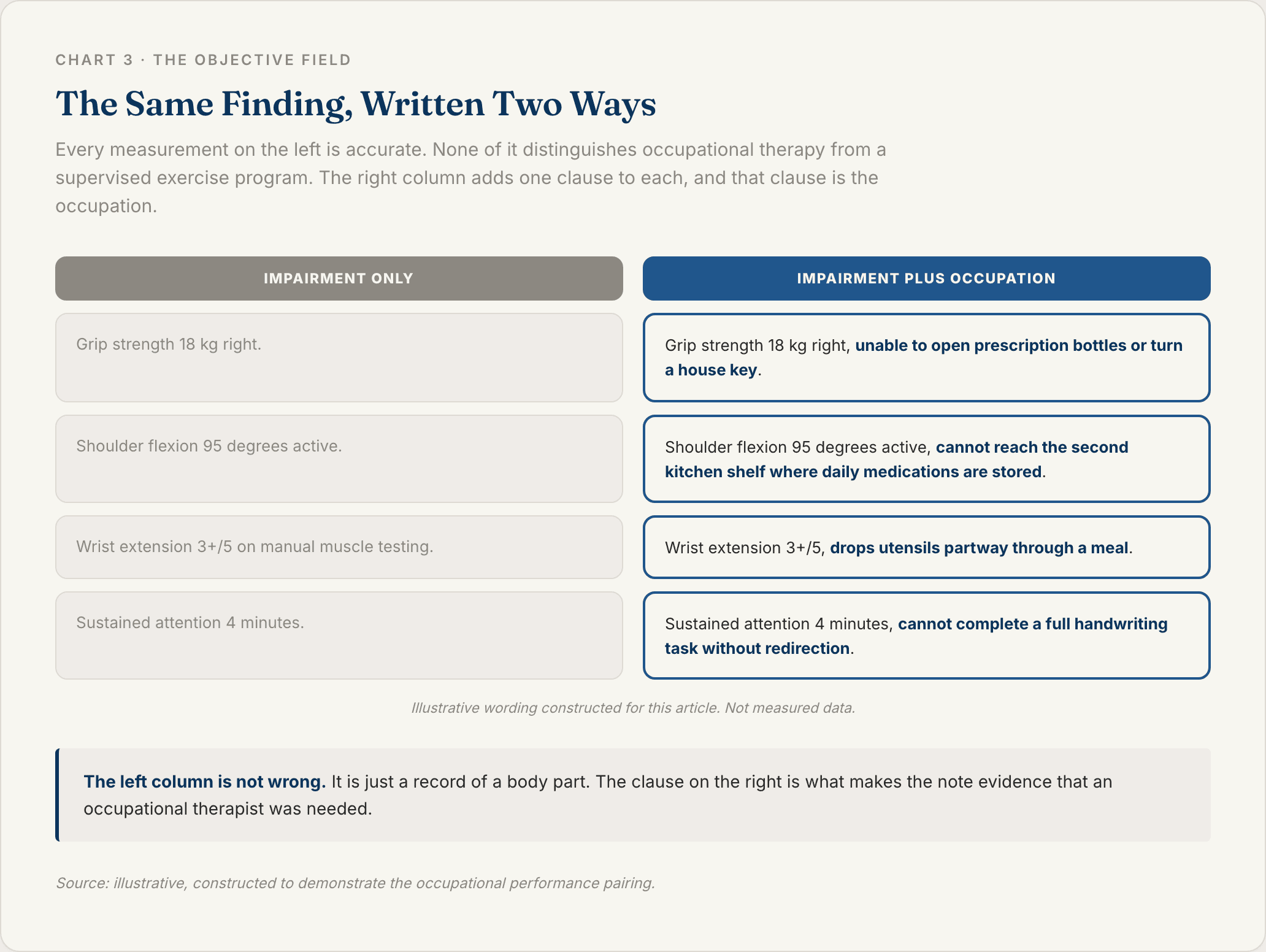
Grip strength of 18 kilograms is an impairment. Grip strength of 18 kilograms with the patient still unable to open a prescription bottle is occupational therapy. Same measurement, same session, and only one of them makes the case.
The Two Numbers That Change the Note
What 42 CFR 410.61 Requires the Plan to Name
Outpatient occupational therapy has to be furnished under a written plan of treatment [2]. The regulation is specific about what that plan contains:
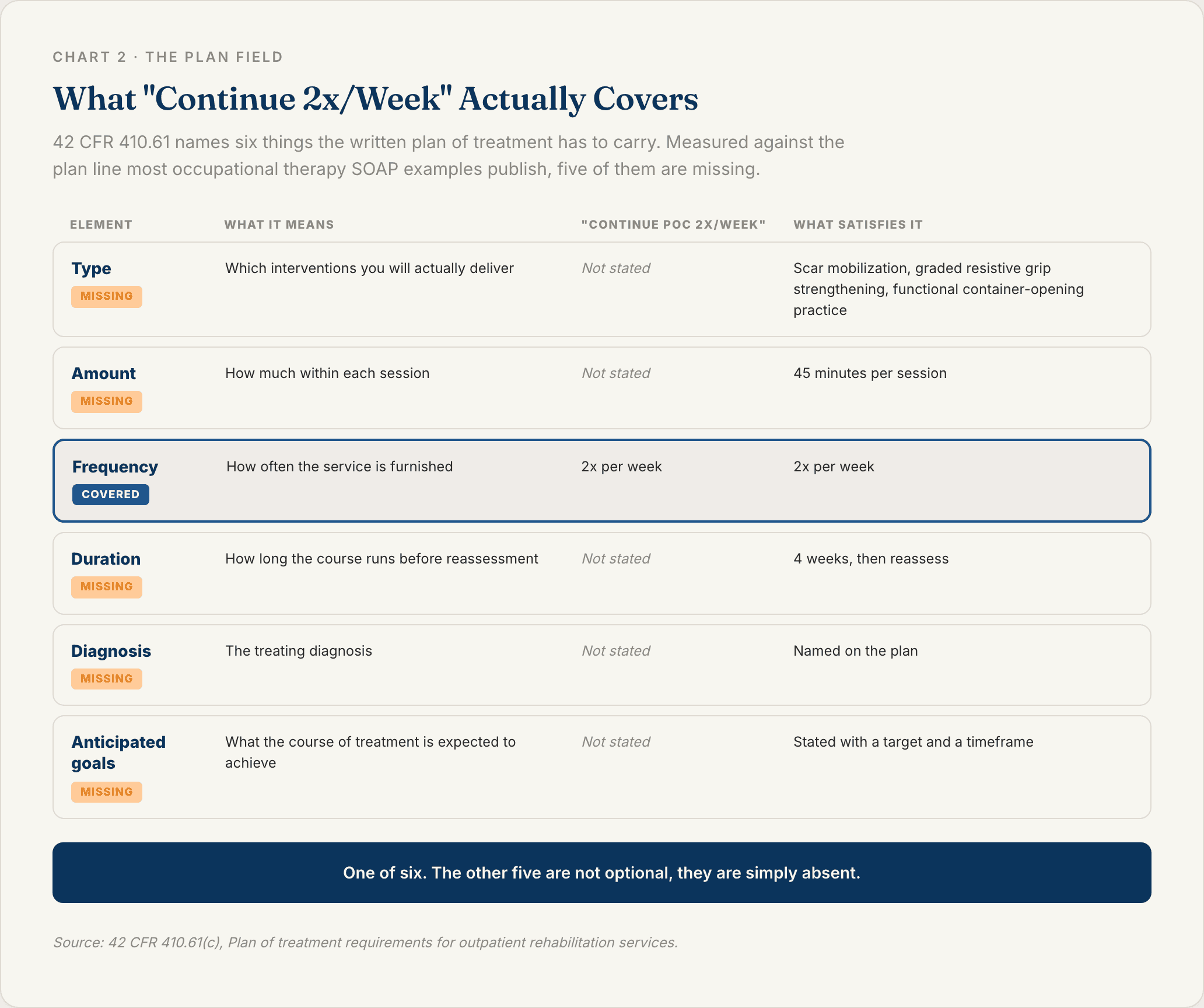
"The plan prescribes the type, amount, frequency, and duration of the physical therapy, occupational therapy, or speech-language pathology services to be furnished to the individual, and indicates the diagnosis and anticipated goals." [1]
Read that as a list. Type. Amount. Frequency. Duration. Diagnosis. Anticipated goals. Six items, four of them describing the service itself.
Now read the Plan field in almost any published OT SOAP example:
P: Continue POC 2x/week.
That is frequency. It is not type, it is not amount, and it is not duration. One of six.
Type is which interventions you will actually deliver. Amount is how much within a session. Frequency is how often. Duration is how long the course of treatment runs before it is reassessed.
Two more details from the same section, both of which get missed.
The plan is established before treatment begins, and the occupational therapist who furnishes the services is one of the people who may establish it [1]. You do not need a physician to write it.
Changes to the plan must be made in writing, signed, and "incorporated in the plan immediately" [1]. A verbal decision to drop to once weekly, carried in your head until the next progress note, is a change that has not happened yet.
The Ten Percent Rule That Decides Fifteen Percent of the Payment
This is the sharpest number on the page, and no competing article mentions it exists.
Since 1 January 2020, claims for outpatient occupational therapy services furnished in whole or in part by an occupational therapy assistant must include the prescribed modifier. Since 1 January 2022, claims carrying that modifier are paid "an amount equal to 85 percent of the amount of payment otherwise applicable for the service" [2].
So the question of who delivered the minutes is worth fifteen percent. And the threshold is precise:
"'Furnished in whole or in part' means when the occupational therapy assistant either: (A) Furnishes all the minutes of a service exclusive of the occupational therapist; or (B) ... furnishes a portion of a service, or in the case of a 15-minute (or other time interval) timed code, a portion of a unit of service separately from the part furnished by the occupational therapist such that the minutes for that portion ... exceed 10 percent of the total minutes for that service (or unit of a service)." [2]
Ten percent of the minutes decides fifteen percent of the payment.

Which produces a documentation requirement that almost no OT note format includes: minutes have to be recorded by clinician, not only in total. A note that says "45 minutes treatment" cannot answer the question the modifier rule asks.
One exception, stated accurately because it is easy to get wrong. The 10 percent test does not apply when you are deciding whether the modifier attaches to the last 15-minute unit billed on a treatment day, in the case where the therapist provides more than the midpoint of that timed code, meaning 8 or more minutes, regardless of any assistant minutes for the same service [2].
Who Counts as the Therapist and Who Counts as the Assistant
Medicare pays for outpatient occupational therapy only when the services are furnished by someone meeting the qualifications in part 484 for an occupational therapist, or by an appropriately supervised occupational therapy assistant [2].
42 CFR 484.115 defines the occupational therapist as a person who is licensed or otherwise regulated by the state where applicable, graduated from a program accredited by the Accreditation Council for Occupational Therapy Education (ACOTE), and is eligible to take or has passed the national certification examination [3].
That definition is why the minute split matters. These are two distinct credentialed roles, the payment differs between them, and the note is the only record of which one was in the room.
The regulation sets the rule. The operative detail sits one level down, in the Medicare Benefit Policy Manual chapter covering outpatient therapy [4] and in the current billing requirements CMS maintains for therapy services [5]. Both are updated more often than the regulation is, so check them against the year you are billing rather than against a blog post.
The Occupational Therapy SOAP Note Templates
Three blocks. Each is complete as written, so you can paste it straight into a chart.
The Daily Treatment Note Template
OT DAILY TREATMENT NOTE
Patient, date, setting: (outpatient, inpatient, home, school)
Treatment start and stop time: (the actual clock times, not the scheduled ones)
Total treatment minutes: (the sum, separate from the start and stop times)
Minutes by clinician: (for example "OT 38 min, OTA 7 min" with each person's credentials; this is the line the modifier rule turns on)
S, Subjective: "(the patient's own words, ideally about performance at home since the last session)"
O, Objective:(each intervention performed, the occupational performance it targets, the measures taken, and the assist level required)
A, Assessment: (why this session required the skills of a therapist, and progress against a named goal from the plan)
P, Plan:(type, amount, frequency and duration, all four named)
Billing: (each Current Procedural Terminology (CPT) code with its units, and whether the code is timed or untimed; see the documentation requirements that drive coding for how note detail and code selection connect)
Signature and credentials: (the clinician who furnished the service)
The fourth line is the one almost no template includes and the one that decides the modifier [2]. The Assessment line is the one that decides whether the service reads as skilled.
The Evaluation Note Template
OT EVALUATION NOTE
Patient, date, referral source, diagnosis: (and the referring clinician)
Occupational profile: "(what the patient says they need to be able to do, in their words)"
Prior level of function: (what they could do before, with dates or timeframes where known)
Measured findings: (each measure paired with the occupational performance it limits)
Clinical reasoning for skilled need: (why a therapist rather than a home program or an aide)
Plan of treatment, type: (the specific interventions you will deliver)
Plan of treatment, amount: (how much within each session)
Plan of treatment, frequency: (how often per week)
Plan of treatment, duration: (how many weeks before reassessment)
Diagnosis and anticipated goals: (the treating diagnosis and what you expect to achieve)
Plan established by: (name and credentials of the person establishing it, and the date, which may be the occupational therapist furnishing the services)
Signature and credentials: (the evaluating clinician)
The four Plan lines are separated deliberately. Written as one sentence they collapse back into frequency, which is the failure this whole section is about [1].
The Progress Note Template
OT PROGRESS NOTE
Patient, reporting period: (the start and end dates the note covers)
Goals with baseline, current and target: (each goal showing all three numbers, not just current)
Objective comparison to the last period: (the same measures as last time, with their previous values)
Response to intervention: (what changed because of what you did)
Clinical justification: (continue, change or discharge, and why)
Plan changes: (what changed, the date it was signed, and confirmation it was incorporated into the plan)
Signature and credentials: (the clinician completing the note)
A progress note whose only difference from the last one is the date is not a progress note. It is a copy with a new header. The same failure shows up in hospice documentation, where an unchanging note actively undermines the record.
Where Sully.ai Fits in Therapy Documentation
Therapy notes get written in the gap between patients, which on a full caseload is about two minutes, or at the end of the day across a stack of sessions.
What erodes first in that gap is anything requiring arithmetic, exactly as it does in shift documentation. Total treatment minutes. Minutes by clinician. Units by code, timed against untimed. None of it is difficult, and all of it is the first thing to become approximate when it is reconstructed six hours later.
Sully.ai's AI scribe for rehabilitation and therapy teams drafts the note from the session and keeps treatment minutes attributed to the clinician who delivered them, so the split is recorded rather than reconstructed. It runs on a single integration across Epic, Cerner, Meditech and Athenahealth.
Two boundaries worth stating plainly.
It does not decide whether the service was skilled. That judgment is the therapist's, and the Assessment field exists to record it. A drafted Assessment that describes what was done rather than why it required a therapist is the most common denial trigger in therapy documentation, and the sentence that fixes it has to come from the person who made the decision.
It cannot resolve a minute split that nobody stated. The modifier question depends on which clinician was present for which minutes. If the session does not make that distinction audible, no tool reading the recording can infer it. The habit of announcing the handoff stays with the clinicians in the room.
Sully operates across 5,000+ providers, has delivered 50M+ hours of work, and prices each role 80 to 90 percent below the human equivalent [6].
Three Worked Examples
An Outpatient Hand Therapy Visit
Post-surgical flexor tendon repair, week 6, outpatient clinic. 1400 to 1445. Total treatment minutes 45. OT 45 min.
S: "I can hold a fork now but I still can't get the lid off anything. My wife has to open the milk."
O: Scar mobilization to volar incision, 8 minutes, addressing adhesion limiting composite flexion. Active and passive range of motion, digits 2 through 5. Composite flexion now 2.5 cm pulp-to-palm distance, was 4 cm on 8 September. Grip strength 18 kg right, 41 kg left uninvolved, which leaves the patient unable to open prescription bottles or turn a house key. Graded functional task practice with jar lids of three diameters, minimal assist required for the largest.
A: Adhesion is responding to mobilization, evidenced by a 1.5 cm gain in pulp-to-palm distance over two weeks. Skilled therapy required for graded scar mobilization and for progression of resistive load within tendon repair protocol precautions, which the patient cannot self-determine. Progress toward goal 2, independent container opening, remains limited by grip strength rather than by range.
P:
Type: scar mobilization, graded resistive grip strengthening, functional container-opening practice
Amount: 45 minutes per session
Frequency: 2x per week
Duration: 4 weeks, then reassess
Billing: 97140 manual therapy, 1 unit, timed. 97530 therapeutic activities, 2 units, timed.
Every Objective measure is paired with what it stops the patient doing. The Plan names all four elements [1].
A Pediatric School-Based Session
Grade 2, fine motor and self-regulation goals, school setting. 30 minutes. OT 30 min.
S: "My hand gets tired and then my letters go wobbly." Teacher reports the student stops written work after roughly five minutes.
O: Sustained attention to handwriting task 4 minutes before first redirection, was 2 minutes on 4 September. Tripod grasp maintained for 3 of 5 trials, with grasp collapsing to a lateral pinch under fatigue. Completed 2 of 5 lines of copied text independently, which is below the classroom expectation of full-paragraph copying. Trialled a slant board and a weighted pencil; slant board improved grasp maintenance to 5 of 5 trials.
A: Grasp breakdown is fatigue-driven rather than a motor planning deficit, demonstrated by intact grasp in early trials and collapse under load. Skilled therapy required to trial and select adaptive equipment and to grade task demand, which classroom staff are not positioned to do. Progress toward the handwriting endurance goal is measurable at 2 additional minutes over two weeks.
P:
Type: adaptive equipment trial and training, graded handwriting endurance tasks, teacher consultation on classroom setup
Amount: 30 minutes per session
Frequency: 1x per week
Duration: remainder of the current term, reassessed at the education plan review
A note on setting. School-based practice is usually governed by the student's education plan rather than by Medicare Part B, so the 410.61 elements are not a legal requirement here. They are still the clearest way to write a plan that another therapist can pick up, which is why this example uses them.
A Skilled Nursing Facility Visit With an Assistant
This is the example that carries the point, so the minutes are broken out first.
Skilled nursing facility, 1000 to 1045. Total treatment minutes 45. OT 38 min. OTA 7 min.
S: "I want to get to the bathroom myself. I don't want to ring the bell at night."
O: Bed mobility and sit-to-stand training, supervision level, 20 minutes, delivered by the occupational therapist, with baseline mobility established at the initial assessment. Toilet transfer training with a raised seat, contact guard assist, 18 minutes, delivered by the occupational therapist. Upper body dressing practice, 7 minutes, delivered by the occupational therapy assistant under supervision, with the patient completing the sequence at modified independence.
A: Transfer safety has improved from moderate assist to contact guard over the reporting period, which changes the patient's night-time toileting risk directly. Skilled therapy required for progression of assist level and for equipment selection. Dressing is at modified independence and is appropriate to delegate.
P:
Type: transfer training, toileting sequence practice, upper body dressing
Amount: 45 minutes per session
Frequency: 5x per week
Duration: 2 weeks, then reassess for discharge planning
Running the threshold. The assistant furnished 7 of 45 total minutes. Seven divided by forty-five is 15.6 percent, which exceeds 10 percent, so the service counts as furnished in part by the assistant and the prescribed modifier applies [2].
Note what made that calculation possible. Not the total. The fourth line of the note.
What Gets an OT Note Denied
A Plan field that names frequency only. "Continue 2x/week" supplies one of the six elements the regulation lists [1]. Name the type, the amount and the duration alongside it.
An Assessment that describes instead of reasons. "Patient tolerated treatment well" says what happened. It does not say why the session required a therapist, which is the question being asked.
Total minutes with no clinician attribution. A note that records 45 minutes and nothing else cannot support or refute the modifier decision [2].
A progress note identical to the last one. If the measures, the goals and the justification are unchanged, the note is evidence that nothing is happening.
FAQ
What goes in the plan section of an occupational therapy SOAP note?
For Medicare Part B outpatient occupational therapy, four things about the service plus two more. 42 CFR 410.61 requires the written plan of treatment to prescribe the type, amount, frequency and duration of the services, and to indicate the diagnosis and anticipated goals [1]. A Plan field reading "continue 2x/week" supplies frequency and omits the rest.
How do you write the objective section of an OT SOAP note?
Record what you measured and observed during the session, and pair every impairment measure with the occupational performance it limits. Grip strength on its own documents an impairment. Grip strength recorded alongside the fact that the patient cannot open a prescription bottle documents occupational therapy.
What is the occupational therapy assistant modifier?
Since 1 January 2020, claims for outpatient occupational therapy furnished in whole or in part by an occupational therapy assistant must include the prescribed modifier, and since 1 January 2022 those claims are paid at 85 percent of the amount otherwise applicable [2]. That is why treatment minutes need recording by clinician rather than only as a total.
What counts as "in part" for the assistant modifier?
The assistant either furnishes all the minutes of a service without the therapist, or furnishes a portion such that the assistant's minutes exceed 10 percent of the total minutes for that service or unit [2]. One exception applies to the last 15-minute unit billed on a treatment day where the therapist provides 8 or more minutes of that timed code [2].
Can an AI scribe write occupational therapy SOAP notes?
It can draft them from the session, including the objective findings and the patient's own words, and Sully.ai keeps treatment minutes attributed to the clinician who delivered them. What it cannot do is decide whether the service required the skills of a therapist, any more than it can write the clinical reasoning in a therapy note. That reasoning belongs in the Assessment field, and it belongs to the therapist.
Sources
[1] U.S. Government Publishing Office — 42 CFR 410.61, Plan of treatment requirements for outpatient rehabilitation services. https://www.govinfo.gov/content/pkg/CFR-2023-title42-vol2/xml/CFR-2023-title42-vol2-sec410-61.xml
[2] U.S. Government Publishing Office — 42 CFR 410.59, Outpatient occupational therapy services: Conditions. https://www.govinfo.gov/content/pkg/CFR-2023-title42-vol2/xml/CFR-2023-title42-vol2-sec410-59.xml
[3] U.S. Government Publishing Office — 42 CFR 484.115, Condition of participation: Personnel qualifications. https://www.govinfo.gov/content/pkg/CFR-2023-title42-vol5/xml/CFR-2023-title42-vol5-sec484-115.xml
[4] Centers for Medicare & Medicaid Services — Medicare Benefit Policy Manual, Chapter 15, Covered Medical and Other Health Services. https://www.cms.gov/regulations-and-guidance/guidance/manuals/downloads/bp102c15.pdf
[5] Centers for Medicare & Medicaid Services — Therapy Services. https://www.cms.gov/medicare/billing/therapyservices
[6] Sully.ai — AI Medical Scribe. https://www.sully.ai/medical-scribe
TABLE OF CONTENTS
Hire your
Medical AI Team
Take a look at our Medical AI Team
AI Receptionist
Manages patient scheduling, communications, and front-desk operations across all channels.
AI Scribe
Documents clinical encounters and maintains accurate EHR/EMR records in real-time.
AI Medical Coder
Assigns and validates medical codes to ensure accurate billing and regulatory compliance.
AI Nurse
Assesses patient urgency and coordinates appropriate care pathways based on clinical needs.