"/><stop offset="1" stop-color="rgba(255, 255, 255, 0)"/></linearGradient><linearGradient id="WxV_IOPE7-2309410982-linear-gradient" x1="1" x2="0" y1="0.5951279047551217" y2="0.4048720952448783"><stop offset="0" stop-color="rgb(255, 255, 255)"/><stop offset="1" stop-color="rgba(255, 255, 255, 0)"/></linearGradient><linearGradient id="WwbAIQIz8-2309410982-linear-gradient" x1="0.43478742751482424" x2="0.6358595260107829" y1="0.26" y2="1"><stop offset="0" stop-color="rgb(255, 255, 255)"/><stop offset="1" stop-color="rgba(255, 255, 255, 0)"/></linearGradient><linearGradient id="ZWsVQcPfn-2309410982-linear-gradient" x1="0.9508213454678907" x2="0.04917865453210929" y1="0" y2="1"><stop offset="0" stop-color="rgb(255, 255, 255)"/><stop offset="1" stop-color="rgba(255, 255, 255, 0)"/></linearGradient><linearGradient id="lTyCGrzzP-2309410982-linear-gradient" x1="0.374937164194436" x2="0.625062835805564" y1="0" y2="1"><stop offset="0" stop-color="rgb(255, 255, 255)"/><stop offset="1" stop-color="rgba(255, 255, 255, 0)"/></linearGradient></defs><g d="M 658.002 1357.705 C 1020.321 1357.705 1314.04 1063.989 1314.04 701.667 C 1314.04 339.347 1020.321 45.626 658.002 45.626 C 295.681 45.626 1.96 339.347 1.96 701.667 L 0 701.667 C 0 338.263 294.598 43.665 658.002 43.665 C 1021.404 43.665 1316 338.263 1316 701.667 C 1316 1065.072 1021.404 1359.672 658.002 1359.672 C 294.598 1359.672 0 1065.072 0 701.667 L 1.96 701.667 C 1.96 1063.989 295.681 1357.705 658.002 1357.705 Z M 658.005 1265.053 C 969.154 1265.053 1221.392 1012.819 1221.392 701.667 C 1221.392 390.517 969.154 138.281 658.005 138.281 C 346.856 138.281 94.619 390.517 94.619 701.667 L 92.659 701.667 C 92.659 389.433 345.77 136.321 658.005 136.321 C 970.241 136.321 1223.352 389.433 1223.352 701.667 C 1223.352 1013.902 970.241 1267.017 658.005 1267.017 C 345.77 1267.017 92.659 1013.902 92.659 701.667 L 94.619 701.667 C 94.619 1012.819 346.856 1265.053 658.005 1265.053 Z M 658.002 1166.116 C 914.513 1166.116 1122.452 958.178 1122.452 701.667 C 1122.452 445.16 914.513 237.22 658.002 237.22 C 401.494 237.22 193.551 445.16 193.551 701.667 L 191.59 701.667 C 191.59 444.077 400.411 235.255 658.002 235.255 C 915.596 235.255 1124.412 444.077 1124.412 701.667 C 1124.412 959.261 915.596 1168.084 658.002 1168.084 C 400.411 1168.084 191.59 959.261 191.59 701.667 L 193.551 701.667 C 193.551 958.178 401.494 1166.116 658.002 1166.116 Z M 281.657 818.28 C 298.572 818.28 314.804 825.001 326.765 836.965 L 458.99 969.182 C 470.582 980.781 486.308 987.298 502.706 987.298 L 612.137 987.298 C 646.284 987.298 673.972 959.61 673.972 925.463 L 673.972 891.504 L 675.939 891.504 L 675.939 925.463 C 675.939 960.7 647.374 989.258 612.137 989.258 L 502.706 989.258 C 485.788 989.258 469.562 982.537 457.599 970.573 L 325.378 838.356 C 313.785 826.757 298.056 820.242 281.657 820.244 L 1.173 820.244 L 1.173 818.28 Z M 746.64 888.714 L 1053.046 888.714 C 1069.967 888.714 1086.194 895.435 1098.16 907.398 L 1259.381 1068.619 L 1257.99 1070.007 L 1096.772 908.79 C 1085.175 897.193 1069.446 890.679 1053.046 890.681 L 746.64 890.681 C 729.724 890.681 713.493 883.957 701.533 871.993 L 685.377 855.845 L 686.769 854.453 L 702.917 870.605 C 714.513 882.201 730.241 888.715 746.64 888.714 Z M 667.685 552 L 512.316 396.894 C 494.66 379.264 484.741 355.356 484.739 330.426 L 484.739 0 L 487.632 0 L 487.632 330.426 C 487.632 354.592 497.248 377.763 514.369 394.851 L 669.739 549.957 Z M 782.851 700.491 C 816.998 700.491 844.686 672.804 844.686 638.655 L 844.686 516.468 C 844.687 499.547 851.409 483.32 863.374 471.355 L 1177.508 157.22 L 1178.896 158.607 L 864.762 472.742 C 853.162 484.337 846.646 500.067 846.646 516.468 L 846.646 638.655 C 846.646 673.89 818.088 702.455 782.851 702.455 L 700.405 702.455 L 700.405 700.491 Z M 130.338 534.223 L 213.07 534.223 C 256.112 534.223 291.003 569.114 291.003 612.156 L 291.003 694.888 C 291.003 711.29 297.514 727.017 309.113 738.611 L 472.887 902.378 L 471.496 903.769 L 307.726 739.995 C 295.761 728.033 289.038 711.807 289.038 694.888 L 289.038 612.156 C 289.038 570.198 255.028 536.188 213.07 536.188 L 130.338 536.188 C 113.419 536.187 97.193 529.465 85.23 517.5 L 77.071 509.345 C 65.107 497.381 58.386 481.153 58.388 464.233 L 58.388 199.526 L 60.348 199.526 L 60.348 464.233 C 60.349 480.631 66.863 496.358 78.458 507.954 L 86.617 516.113 C 98.213 527.709 113.94 534.223 130.338 534.223 Z" fill="transparent" height="1359.6717183844698px" id="DcyumyANr" transform="translate(0 -43.665)" width="1316px"><g opacity="0.5"><path d="M 658.002 1314.039 C 1020.321 1314.039 1314.04 1020.324 1314.04 658.001 C 1314.04 295.681 1020.321 1.961 658.002 1.961 C 295.681 1.961 1.96 295.682 1.96 658.001 L 0 658.001 C 0 294.598 294.598 0 658.002 0 C 1021.404 0 1316 294.598 1316 658.001 C 1316 1021.407 1021.404 1316.007 658.002 1316.007 C 294.598 1316.007 0 1021.407 0 658.001 L 1.96 658.001 C 1.96 1020.324 295.681 1314.039 658.002 1314.039 Z" fill="rgb(255, 255, 255)" height="1316.0065114752902px" id="dxf13D52Y" transform="translate(0 43.665)" width="1316px"/></g><g opacity="0.3"><path d="M 565.347 1128.732 C 876.496 1128.732 1128.733 876.498 1128.733 565.346 C 1128.733 254.196 876.496 1.961 565.347 1.961 C 254.197 1.961 1.961 254.196 1.961 565.346 L 0 565.346 C 0 253.112 253.111 0 565.347 0 C 877.582 0 1130.693 253.112 1130.693 565.346 C 1130.693 877.581 877.582 1130.696 565.347 1130.696 C 253.111 1130.696 0 877.581 0 565.346 L 1.961 565.346 C 1.961 876.498 254.197 1128.732 565.347 1128.732 Z" fill="rgb(255, 255, 255)" height="1130.6960934794101px" id="if1BmYw1S" transform="translate(92.659 136.321)" width="1130.693351805604px"/></g><g opacity="0.15"><path d="M 466.412 930.861 C 722.923 930.861 930.862 722.922 930.862 466.411 C 930.862 209.905 722.923 1.965 466.412 1.965 C 209.904 1.965 1.961 209.905 1.961 466.411 L 0 466.411 C 0 208.822 208.821 0 466.412 0 C 724.006 0 932.822 208.822 932.822 466.411 C 932.822 724.005 724.006 932.828 466.412 932.828 C 208.821 932.828 0 724.005 0 466.411 L 1.961 466.411 C 1.961 722.922 209.904 930.861 466.412 930.861 Z" fill="rgb(255, 255, 255)" height="932.8284667407987px" id="ef75NsYf6" transform="translate(191.59 235.255)" width="932.8219552655086px"/></g><g opacity="0.5"><path d="M 280.484 0 C 297.399 0 313.63 6.721 325.592 18.685 L 457.817 150.902 C 469.408 162.501 485.135 169.018 501.533 169.017 L 610.964 169.017 C 645.111 169.017 672.799 141.33 672.799 107.182 L 672.799 73.223 L 674.766 73.223 L 674.766 107.182 C 674.766 142.42 646.201 170.978 610.964 170.978 L 501.533 170.978 C 484.614 170.978 468.389 164.257 456.426 152.293 L 324.205 20.076 C 312.611 8.477 296.883 1.961 280.484 1.964 L 0 1.964 L 0 0 Z" fill="url(%23cQ4xRdUtr-2309410982-linear-gradient)" height="170.97763275969464px" id="cQ4xRdUtr" transform="translate(1.173 818.28)" width="674.7656780356198px"/></g><g opacity="0.5"><path d="M 61.263 34.261 L 367.669 34.261 C 384.589 34.261 400.817 40.982 412.783 52.945 L 574.004 214.166 L 572.612 215.554 L 411.395 54.337 C 399.798 42.74 384.069 36.226 367.669 36.228 L 61.263 36.228 C 44.347 36.228 28.116 29.504 16.155 17.54 L 0 1.391 L 1.391 0 L 17.54 16.152 C 29.136 27.747 44.864 34.261 61.263 34.261 Z" fill="url(%23WxV_IOPE7-2309410982-linear-gradient)" height="215.55382175474415px" id="WxV_IOPE7" transform="translate(685.377 854.453)" width="574.0036823012563px"/></g><g opacity="0.5"><path d="M 182.946 552 L 27.577 396.894 C 9.921 379.264 0.002 355.356 0 330.426 L 0 0 L 2.893 0 L 2.893 330.426 C 2.893 354.592 12.509 377.763 29.63 394.851 L 185 549.957 Z" fill="url(%23WwbAIQIz8-2309410982-linear-gradient)" height="552px" id="WwbAIQIz8" transform="translate(484.739 0)" width="185px"/></g><g opacity="0.5"><path d="M 82.446 543.271 C 116.593 543.271 144.281 515.583 144.281 481.435 L 144.281 359.248 C 144.282 342.327 151.004 326.1 162.969 314.135 L 477.103 0 L 478.491 1.387 L 164.356 315.522 C 152.757 327.117 146.241 342.846 146.241 359.248 L 146.241 481.435 C 146.241 516.67 117.683 545.235 82.446 545.235 L 0 545.235 L 0 543.271 Z" fill="url(%23ZWsVQcPfn-2309410982-linear-gradient)" height="545.2346136318063px" id="ZWsVQcPfn" transform="translate(700.405 157.22)" width="478.4906210693257px"/></g><g opacity="0.5"><path d="M 71.95 334.696 L 154.682 334.696 C 197.724 334.696 232.616 369.588 232.616 412.63 L 232.616 495.362 C 232.616 511.764 239.126 527.491 250.725 539.084 L 414.5 702.851 L 413.108 704.243 L 249.338 540.469 C 237.373 528.507 230.651 512.281 230.651 495.362 L 230.651 412.63 C 230.651 370.672 196.64 336.661 154.682 336.661 L 71.95 336.661 C 55.031 336.661 38.805 329.939 26.843 317.974 L 18.683 309.819 C 6.719 297.854 -0.001 281.627 0 264.707 L 0 0 L 1.961 0 L 1.961 264.707 C 1.961 281.105 8.475 296.832 20.07 308.428 L 28.229 316.587 C 39.825 328.182 55.552 334.697 71.95 334.696 Z" fill="url(%23lTyCGrzzP-2309410982-linear-gradient)" height="704.2427839655832px" id="lTyCGrzzP" transform="translate(58.388 199.526)" width="414.49961191971533px"/></g></g></svg>)
Most clinical notes are read once, by someone deciding what to do next.
An admission note is different. Its entire value sits downstream, in what every later note can prove against it. Write "ambulatory" today and in six weeks nobody can demonstrate that walking 200 feet became walking 30 feet, because the baseline never held a number.
Here are three blank templates for the hospital and the facility, three worked examples including a readmission, and the four separate deadlines that start the moment a patient arrives.
Key Takeaway: An admission note records a patient's condition, history and care plan at the point they enter a hospital or facility, and it is the baseline every later note is measured against. Four clocks start on arrival, and they differ by setting. In hospitals, a medical history and physical examination (H&P) must be completed and documented no more than 30 days before or 24 hours after admission, and placed in the medical record within 24 hours after admission [1]. In long-term care, the facility must have physician orders for the resident's immediate care at the time of admission [2], must develop a baseline care plan within 48 hours [3], and must complete a comprehensive assessment using the resident assessment instrument specified by the Centers for Medicare & Medicaid Services (CMS) within 14 calendar days [2]. Sully.ai drafts the admission note from the intake conversation, so the baseline is specific enough to measure against later.
What an Admission Note Is For
The Note Everything Else Gets Compared To
Here is the part no competing page states.
Every note written during a stay carries an implicit comparison. The patient is better, worse, or unchanged. Better than what? Worse than when? The reference point is the admission note, whether or not anybody says so.
That makes the admission note the only document in the record whose value is almost entirely in what it enables somebody else to do later.
And it means a vague admission note does not fail on its own day. It fails quietly, for weeks, every time a later note tries to establish a change and finds nothing to measure against. A hospice note documenting decline needs a baseline that recorded a number. A nursing shift note reporting deterioration needs the same thing.
Why the Hardest Part Is Writing It Before You Know What Matters
Here is the genuine difficulty, and no competitor acknowledges it.
At admission you do not know which detail will matter. The skin on the left heel, the distance walked, whether the patient could manage the television remote. One of fifty possible observations will turn out to be the one somebody needs in six weeks, and you cannot know which.
You cannot solve that by writing everything. The practical resolution is narrower: record the things that are cheap to measure now and expensive to reconstruct later. Those are almost always quantities.
"Independent" is an adjective. "Walks 200 feet with a rolling walker, no rest breaks" is a measurement. Both take about the same time to write. Only one of them can be compared to anything.

The Four Clocks
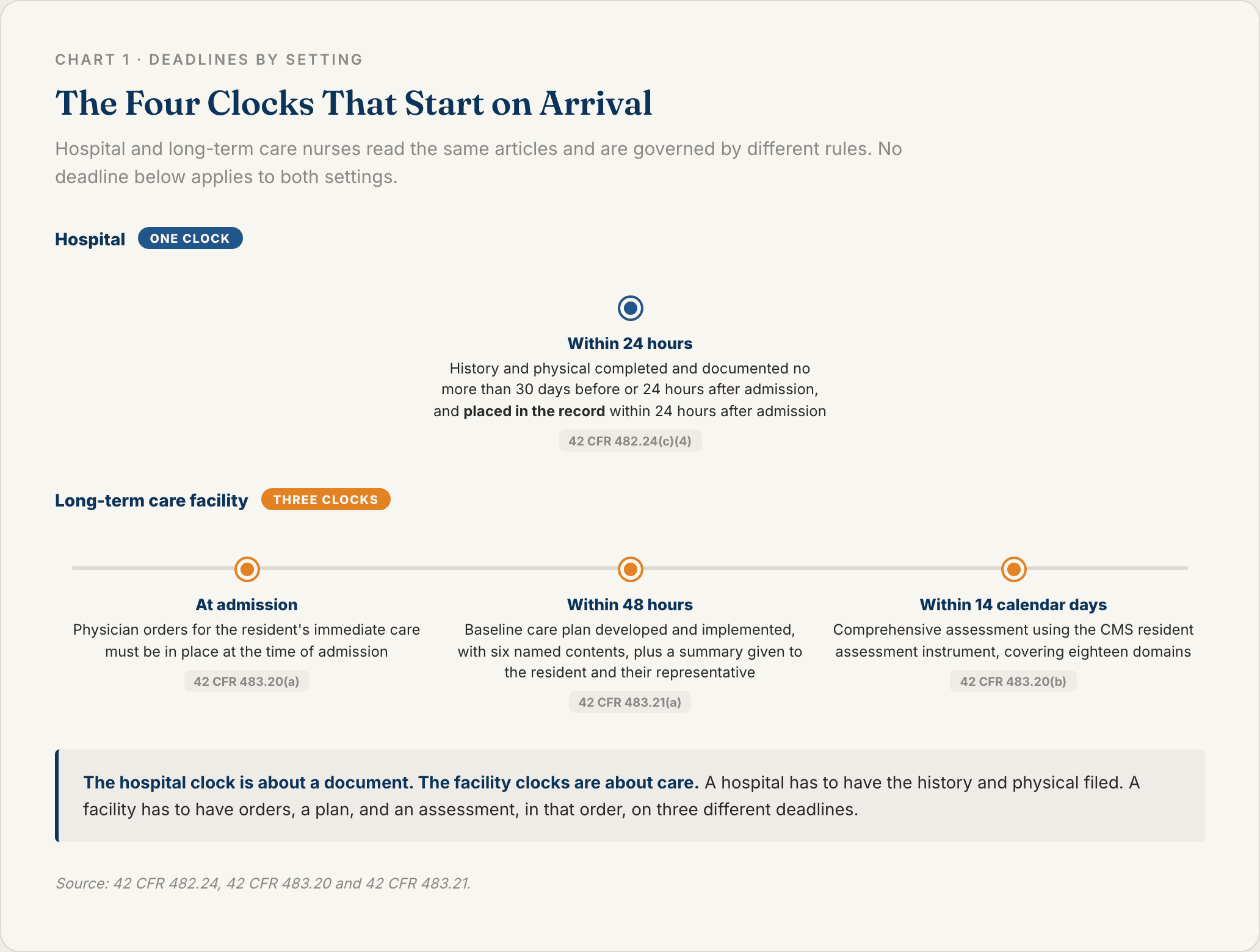
The rules differ by setting, and the distinction matters because hospital and facility nurses read the same articles while being governed by different regulations. Neither set below governs both.
In a Hospital, the History and Physical Has 24 Hours
The record must document evidence of a medical history and physical examination "completed and documented no more than 30 days before or 24 hours after admission or registration, but prior to surgery or a procedure requiring anesthesia services" [1].
Then the placement rule, which is separate and frequently missed: the H&P "must be placed in the patient's medical record within 24 hours after admission or registration, but prior to" the procedure [1].
Completing it and filing it are two obligations, and the second has its own deadline.
This is also a medical staff obligation rather than only a records one. The same requirement appears in the medical staff bylaws condition at 42 CFR 482.22, which requires the bylaws themselves to include it [4].
The entry-quality standard applies on top. All patient medical record entries must be "legible, complete, dated, timed, and authenticated in written or electronic form by the person responsible for providing or evaluating the service provided" [1]. Timed is doing work here that people miss at admission, when several things happen within the same hour and the order of them can matter later.
In Long-Term Care, Three Clocks Run at Once
Facilities carry three deadlines, and they are nothing like the hospital's single one.
At admission. "At the time each resident is admitted, the facility must have physician orders for the resident's immediate care" [2]. Not within a shift. At the time of admission.
Within 48 hours. The facility must develop and implement a baseline care plan containing "the instructions needed to provide effective and person-centered care of the resident that meet professional standards of quality care" [3]. It has six named contents: initial goals based on admission orders, physician orders, dietary orders, therapy services, social services, and a PASARR recommendation if applicable [3]. A facility may develop the full comprehensive care plan in place of the baseline plan, but only if it is done inside the same 48 hours [3].
Within 14 calendar days.A comprehensive assessment using the resident assessment instrument (RAI) specified by CMS, covering eighteen named domains [2]. CMS publishes the operative manual facilities complete that assessment against, and it is revised, so work from the current edition [5]. The deadline excludes readmissions where there has been no significant change in the resident's physical or mental condition [2].
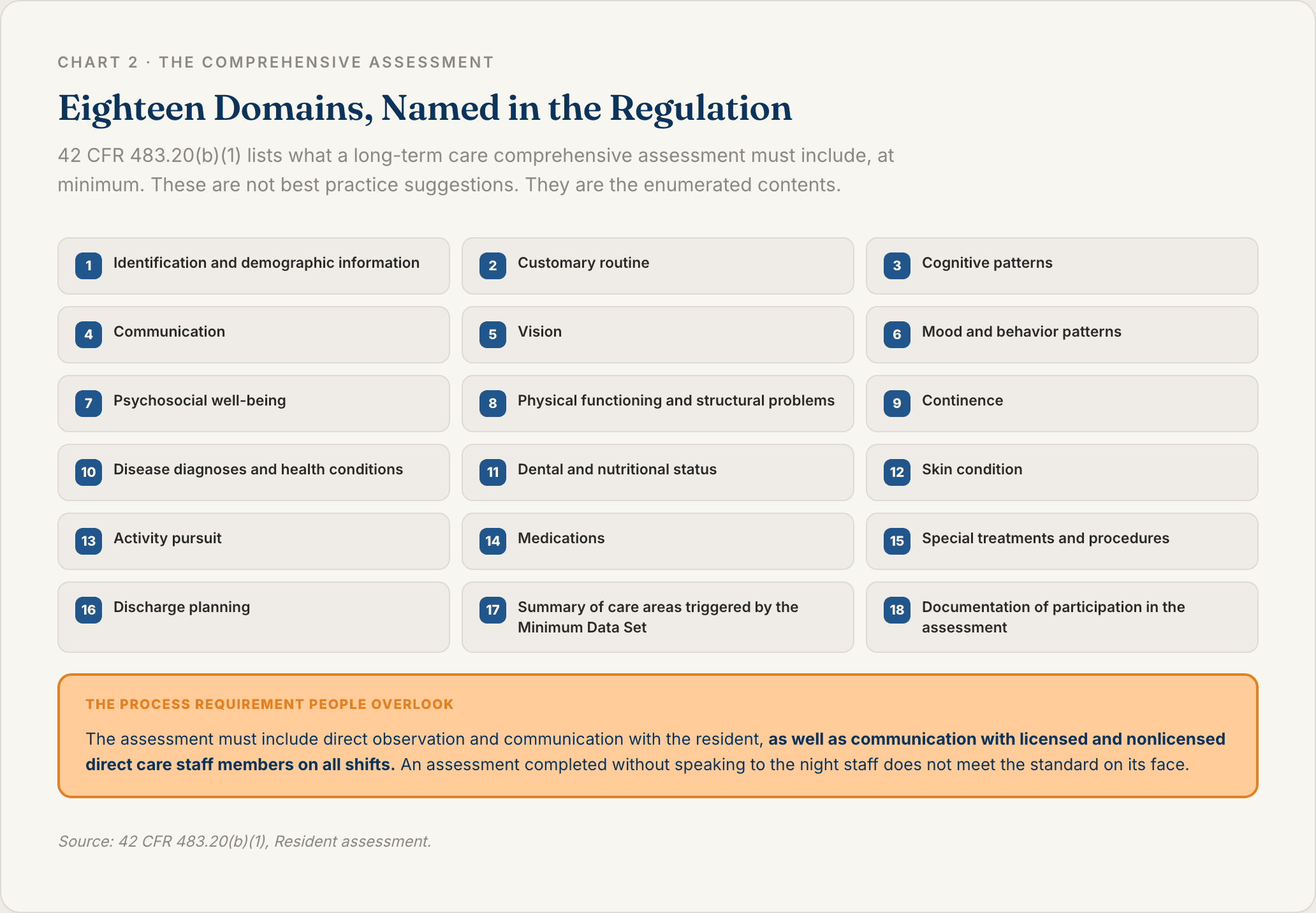
That assessment also has a process requirement people overlook. It "must include direct observation and communication with the resident, as well as communication with licensed and nonlicensed direct care staff members on all shifts" [2]. All shifts. A comprehensive assessment completed without speaking to the night staff does not meet the standard on its face.
The Patient-Facing Document Nobody Mentions
This one is genuinely absent from every competing page, and it produces a second document at admission.
42 CFR 483.21(a)(3) requires the facility to "provide the resident and their representative with a summary of the baseline care plan. " The summary must include the resident's initial goals, a summary of their medications and dietary instructions, and any services and treatments to be administered by the facility and personnel acting on its behalf [3].
So within 48 hours of admission, a facility owes two things: the care plan, and a plain-language summary of it handed to the resident and their representative.
That second document has exactly the same writing problem as the after-visit summary, and it is usually written the same way, which is to say generated from the clinical plan and handed over without translation.
The Admission Note Templates
Three blocks. Each is complete as written, so you can paste it straight into a chart.
The Nursing Admission Note Template
NURSING ADMISSION NOTE
Patient, date and time of arrival: (the actual arrival time, and who accompanied them)
Source and reason for admission: (where they came from, and why they are here)
Condition on arrival: (how they arrived, and how they presented in the first few minutes)
Vital signs: (with the time each set was taken)
Allergies: (each allergen with the reaction, not just the name)
Medications reconciled: (what they are prescribed, what they actually take, and the difference between the two)
Baseline functional status: (distances, assist levels and equipment, in numbers; not "independent"; a head-to-toe assessment covers the systems, this line covers the measurements)
Baseline cognitive status: (orientation, and what they could do when asked, not a global impression; for psychiatric admissions use a full mental status exam)
Skin assessment: (every finding with a location and a measurement in centimeters)
Continence baseline: (what is happening now, and what the patient or family says was normal)
Pain baseline: (score, the scale used, location, and what makes it worse)
Equipment and devices in place: (lines, catheters, oxygen, with sizes and sites)
Patient and family goals: (what they say they want, in their words)
Risks identified: (falls, skin, aspiration, wandering, and what you put in place for each)
Orders received: (what, from whom, and the time; note read-backs)
Signature, credentials, date and time: (the person who performed the assessment)
Three lines carry most of the future value: functional status, cognitive status and skin. They are also the three where adjectives do the most damage, because they are the three most likely to change.
The Hospital Admission History and Physical Template
ADMISSION HISTORY AND PHYSICAL
Chief complaint: "(the patient's own words, quoted)"
History of present illness: (onset, character, course and what has already been tried)
Past medical and surgical history: (with dates or approximate years)
Medications and allergies: (reconciled, with each allergy's reaction)
Family and social history: (including living situation and who is at home)
Review of systems: (by system, recording pertinent negatives as well as positives)
Physical examination: (by system, with measurements rather than impressions)
Assessment: (a numbered problem list, built the same way as the per-problem assessment in a SOAP note)
Plan: (by problem, each one tied to a numbered item above)
Timing attestation: (when the examination was performed, and by whom)
The last line exists because of the rule rather than convention. The examination has to have happened inside the window, and the note is the only evidence of when [1].
The Long-Term Care Baseline Care Plan Template
BASELINE CARE PLAN
Resident, date and time of admission: (the 48-hour clock starts here)
Initial goals based on admission orders: (what this resident is working toward, stated concretely, the way a treatment plan states its objectives)
Physician orders: (as received, with the ordering physician named)
Dietary orders: (texture, fluid consistency, restrictions, assistance needed)
Therapy services: (which disciplines, at what frequency; the occupational therapy plan has its own required elements)
Social services: (what is being arranged, and by whom)
PASARR recommendation: (the recommendation, or "not applicable" with the reason)
Completed at: (date and time, and by whom; this evidences the 48-hour rule)
Summary provided to resident and representative: (date, time, who provided it, and what it covered)
The last two lines are the ones a surveyor looks for, and they are the two most often missing. The first six are the contents the regulation names [3].
Where Sully.ai Fits in Admission Documentation
Admission is the busiest documentation moment in a stay. The clinician is assessing, taking orders, settling the patient and reassuring a family at the same time, and the note gets reconstructed afterwards from memory.
What degrades first in that reconstruction is exactly what this article argues matters: the numbers. Nobody forgets that the patient walked with a walker. Everybody forgets whether it was 200 feet or 150.
Sully.ai's AI scribe, used across hospital and post-acute settings, drafts the admission note from the intake conversation, so the detail is captured while it is still accurate rather than reassembled at the end of a shift. It runs on a single integration across Epic, Cerner, Meditech and Athenahealth.
Two boundaries, and the first one limits the claim above directly.
A scribe cannot measure. If nobody counted the distance, timed the transfer or put a ruler against the wound, there is no number to capture. The note will contain an adjective, because an adjective is all that was said out loud. Capturing measurement is downstream of taking it, and taking it is the clinician's.
Which risks matter is a clinical judgment made on arrival. Falls, skin, aspiration, wandering, elopement. Deciding which apply to this person, and what to put in place, is not a documentation task and no drafting tool performs it.
Sully operates across 5,000+ providers, has delivered 50M+ hours of work, and prices each role 80 to 90 percent below the human equivalent [6].
Three Worked Examples
A Medical Admission to a Hospital Ward
78-year-old woman, admitted 1420 from the emergency department with community-acquired pneumonia. Daughter present.
Condition on arrival: Arrived by trolley, awake, working to breathe at rest. Speaking in short phrases of four to five words.
Vital signs:1425. Temperature 38.4, heart rate 104, respiratory rate 26, blood pressure 118/64, oxygen saturation 91 percent on 2 liters via nasal cannula.
Baseline functional status: Per patient and daughter, before this illness she walked to the corner shop, roughly 400 meters, without an aid and without stopping. Today she transferred trolley to bed with one-person assist and could not tolerate standing beyond 30 seconds.
Baseline cognitive status: Oriented to person, place and year. Could not name the month. Daughter reports she normally manages her own medicines and her own diary.
Skin assessment: Sacrum intact, no redness. Left heel with a 2cm by 1.5cm non-blanching red area, no breakdown. Photograph taken and filed.
Pain baseline: 4 out of 10 on a numeric scale, right lateral chest, worse on deep inspiration and on coughing.
Risks identified: Falls, given the change from her baseline mobility. Pressure damage, given the heel finding and current immobility. Both escalated to the care plan with interventions in place.
Now the same three lines written the way they usually get written:
Ambulatory at baseline. Alert and oriented. Skin intact.
All three are defensible on the day. None of them can be compared to anything. Six weeks from now, the second version cannot prove that anything changed.
A Skilled Nursing Facility Admission
Baseline care plan, completed 26 hours after admission.
Resident, date and time of admission: Mr J, admitted 18 September at 1630 from the acute hospital following a fractured neck of femur.
Initial goals based on admission orders: Transfer with one-person assist within four weeks. Return to eating a normal texture diet within two weeks. Pain controlled well enough to participate in therapy daily.
Physician orders: As received from Dr Mensah on admission, including analgesia, anticoagulation and weight-bearing status as tolerated.
Dietary orders: Soft texture, level 2 mildly thick fluids pending the speech and language review. Assistance with set-up, feeds himself.
Therapy services: Physical therapy five times a week, occupational therapy three times a week, both commencing 19 September.
Social services: Discharge planning discussion booked with the family for 25 September. Application for home adaptation started.
PASARR recommendation: Not applicable. Level 1 screen negative, no serious mental illness or intellectual disability indicated.
Completed at: 19 September, 1845, by the registered nurse named below.
Summary provided to resident and representative: 19 September, 1915. Summary covering his initial goals, his medicines and dietary instructions, and the therapy and social services the facility will provide, given to Mr J and to his daughter, who is his representative. Both copies signed for.
The last line is the one that gets left off, and it is a requirement rather than a courtesy [3].
A Readmission Where the Baseline Already Exists
The case nobody demonstrates, and the one that comes up constantly.
The resident was here six weeks ago. A baseline exists. The admission note's job changes: instead of establishing a reference point, it establishes the distance travelled from the existing one.
Source and reason: Returned from the acute hospital, day 9, following a urinary tract infection with delirium.
Compared to the baseline of 2 August: Was transferring with one-person assist and walking 40 feet with a frame. Now requires two-person assist for transfers and has not walked. Was oriented to person, place and year; now oriented to person only, and intermittently agitated in the evenings.
Compared to the baseline of 2 August, skin: Sacrum was intact. Now a stage 2 pressure injury, 3cm by 2cm, present on arrival and photographed.
What has not changed: Continence pattern, dietary texture, and her stated goal of returning to her own room.
One note on the timing rule here. The 14-day comprehensive assessment deadline excludes readmissions where there has been no significant change in the resident's physical or mental condition [2]. This resident has changed substantially, so the exclusion does not apply and the clock runs.
What Gets an Admission Note Sent Back
Adjectives where measurements belong. "Independent", "alert", "intact" describe a moment and prove nothing about any later one. Write the number.
A medication list copied rather than reconciled. Transcribing the hospital discharge list is not reconciliation. Reconciliation is the difference between what is prescribed and what the person actually takes.
No time recorded on arrival or assessment. Entries must be dated and timed[1], and at admission several things happen inside one hour where the order matters later.
A baseline care plan with no evidence the summary reached the resident. The plan is half the requirement. The summary handed to the resident and their representative is the other half [3].
FAQ
How do you write a nursing admission note?
Record the patient's condition on arrival in measurable terms, reconcile their medications against what they actually take, establish functional, cognitive, skin, continence and pain baselines with numbers rather than adjectives, note the risks you identified and what you did about each, and record the time of every element. The test is whether a nurse reading a note six weeks from now could prove a change against yours.
What should an admission note include?
Arrival details and time, source and reason for admission, condition on arrival, vital signs, allergies with their reactions, reconciled medications, measurable baselines for function, cognition, skin, continence and pain, equipment in place, patient and family goals, identified risks, orders received, and an authenticated signature with date and time [1].
How long do you have to complete an admission assessment?
It depends entirely on the setting. In hospitals, the history and physical must be completed and documented no more than 30 days before or 24 hours after admission, and placed in the record within 24 hours [1]. In long-term care, physician orders for immediate care are required at the time of admission, a baseline care plan within 48 hours, and a comprehensive assessment within 14 calendar days [2][3].
What is a baseline care plan?
A long-term care requirement under 42 CFR 483.21. Within 48 hours of admission the facility must develop and implement a care plan containing initial goals based on admission orders, physician orders, dietary orders, therapy services, social services, and a PASARR recommendation where applicable. The facility must also provide the resident and their representative with a summary of it [3].
Can an AI scribe write admission notes?
It can draft the note from the intake conversation, and Sully.ai does that. What it cannot do is measure. If the walking distance was never counted or the wound never measured with a ruler, the note will carry an adjective, because an adjective is all that was said out loud.
Sources
[1] U.S. Government Publishing Office — 42 CFR 482.24, Condition of participation: Medical record services. https://www.govinfo.gov/content/pkg/CFR-2023-title42-vol5/xml/CFR-2023-title42-vol5-sec482-24.xml
[2] U.S. Government Publishing Office — 42 CFR 483.20, Resident assessment. https://www.govinfo.gov/content/pkg/CFR-2023-title42-vol5/xml/CFR-2023-title42-vol5-sec483-20.xml
[3] U.S. Government Publishing Office — 42 CFR 483.21, Comprehensive person-centered care planning. https://www.govinfo.gov/content/pkg/CFR-2023-title42-vol5/xml/CFR-2023-title42-vol5-sec483-21.xml
[4] U.S. Government Publishing Office — 42 CFR 482.22, Condition of participation: Medical staff. https://www.govinfo.gov/content/pkg/CFR-2023-title42-vol5/xml/CFR-2023-title42-vol5-sec482-22.xml
[5] Centers for Medicare & Medicaid Services — Long-Term Care Facility Resident Assessment Instrument (RAI) Manual. https://www.cms.gov/medicare/quality/nursing-home-improvement/resident-assessment-instrument-manual
[6] Sully.ai — AI Medical Scribe. https://www.sully.ai/medical-scribe
TABLE OF CONTENTS
Hire your
Medical AI Team
Take a look at our Medical AI Team
AI Receptionist
Manages patient scheduling, communications, and front-desk operations across all channels.
AI Scribe
Documents clinical encounters and maintains accurate EHR/EMR records in real-time.
AI Medical Coder
Assigns and validates medical codes to ensure accurate billing and regulatory compliance.
AI Nurse
Assesses patient urgency and coordinates appropriate care pathways based on clinical needs.