"/><stop offset="1" stop-color="rgba(255, 255, 255, 0)"/></linearGradient><linearGradient id="WxV_IOPE7-2309410982-linear-gradient" x1="1" x2="0" y1="0.5951279047551217" y2="0.4048720952448783"><stop offset="0" stop-color="rgb(255, 255, 255)"/><stop offset="1" stop-color="rgba(255, 255, 255, 0)"/></linearGradient><linearGradient id="WwbAIQIz8-2309410982-linear-gradient" x1="0.43478742751482424" x2="0.6358595260107829" y1="0.26" y2="1"><stop offset="0" stop-color="rgb(255, 255, 255)"/><stop offset="1" stop-color="rgba(255, 255, 255, 0)"/></linearGradient><linearGradient id="ZWsVQcPfn-2309410982-linear-gradient" x1="0.9508213454678907" x2="0.04917865453210929" y1="0" y2="1"><stop offset="0" stop-color="rgb(255, 255, 255)"/><stop offset="1" stop-color="rgba(255, 255, 255, 0)"/></linearGradient><linearGradient id="lTyCGrzzP-2309410982-linear-gradient" x1="0.374937164194436" x2="0.625062835805564" y1="0" y2="1"><stop offset="0" stop-color="rgb(255, 255, 255)"/><stop offset="1" stop-color="rgba(255, 255, 255, 0)"/></linearGradient></defs><g d="M 658.002 1357.705 C 1020.321 1357.705 1314.04 1063.989 1314.04 701.667 C 1314.04 339.347 1020.321 45.626 658.002 45.626 C 295.681 45.626 1.96 339.347 1.96 701.667 L 0 701.667 C 0 338.263 294.598 43.665 658.002 43.665 C 1021.404 43.665 1316 338.263 1316 701.667 C 1316 1065.072 1021.404 1359.672 658.002 1359.672 C 294.598 1359.672 0 1065.072 0 701.667 L 1.96 701.667 C 1.96 1063.989 295.681 1357.705 658.002 1357.705 Z M 658.005 1265.053 C 969.154 1265.053 1221.392 1012.819 1221.392 701.667 C 1221.392 390.517 969.154 138.281 658.005 138.281 C 346.856 138.281 94.619 390.517 94.619 701.667 L 92.659 701.667 C 92.659 389.433 345.77 136.321 658.005 136.321 C 970.241 136.321 1223.352 389.433 1223.352 701.667 C 1223.352 1013.902 970.241 1267.017 658.005 1267.017 C 345.77 1267.017 92.659 1013.902 92.659 701.667 L 94.619 701.667 C 94.619 1012.819 346.856 1265.053 658.005 1265.053 Z M 658.002 1166.116 C 914.513 1166.116 1122.452 958.178 1122.452 701.667 C 1122.452 445.16 914.513 237.22 658.002 237.22 C 401.494 237.22 193.551 445.16 193.551 701.667 L 191.59 701.667 C 191.59 444.077 400.411 235.255 658.002 235.255 C 915.596 235.255 1124.412 444.077 1124.412 701.667 C 1124.412 959.261 915.596 1168.084 658.002 1168.084 C 400.411 1168.084 191.59 959.261 191.59 701.667 L 193.551 701.667 C 193.551 958.178 401.494 1166.116 658.002 1166.116 Z M 281.657 818.28 C 298.572 818.28 314.804 825.001 326.765 836.965 L 458.99 969.182 C 470.582 980.781 486.308 987.298 502.706 987.298 L 612.137 987.298 C 646.284 987.298 673.972 959.61 673.972 925.463 L 673.972 891.504 L 675.939 891.504 L 675.939 925.463 C 675.939 960.7 647.374 989.258 612.137 989.258 L 502.706 989.258 C 485.788 989.258 469.562 982.537 457.599 970.573 L 325.378 838.356 C 313.785 826.757 298.056 820.242 281.657 820.244 L 1.173 820.244 L 1.173 818.28 Z M 746.64 888.714 L 1053.046 888.714 C 1069.967 888.714 1086.194 895.435 1098.16 907.398 L 1259.381 1068.619 L 1257.99 1070.007 L 1096.772 908.79 C 1085.175 897.193 1069.446 890.679 1053.046 890.681 L 746.64 890.681 C 729.724 890.681 713.493 883.957 701.533 871.993 L 685.377 855.845 L 686.769 854.453 L 702.917 870.605 C 714.513 882.201 730.241 888.715 746.64 888.714 Z M 667.685 552 L 512.316 396.894 C 494.66 379.264 484.741 355.356 484.739 330.426 L 484.739 0 L 487.632 0 L 487.632 330.426 C 487.632 354.592 497.248 377.763 514.369 394.851 L 669.739 549.957 Z M 782.851 700.491 C 816.998 700.491 844.686 672.804 844.686 638.655 L 844.686 516.468 C 844.687 499.547 851.409 483.32 863.374 471.355 L 1177.508 157.22 L 1178.896 158.607 L 864.762 472.742 C 853.162 484.337 846.646 500.067 846.646 516.468 L 846.646 638.655 C 846.646 673.89 818.088 702.455 782.851 702.455 L 700.405 702.455 L 700.405 700.491 Z M 130.338 534.223 L 213.07 534.223 C 256.112 534.223 291.003 569.114 291.003 612.156 L 291.003 694.888 C 291.003 711.29 297.514 727.017 309.113 738.611 L 472.887 902.378 L 471.496 903.769 L 307.726 739.995 C 295.761 728.033 289.038 711.807 289.038 694.888 L 289.038 612.156 C 289.038 570.198 255.028 536.188 213.07 536.188 L 130.338 536.188 C 113.419 536.187 97.193 529.465 85.23 517.5 L 77.071 509.345 C 65.107 497.381 58.386 481.153 58.388 464.233 L 58.388 199.526 L 60.348 199.526 L 60.348 464.233 C 60.349 480.631 66.863 496.358 78.458 507.954 L 86.617 516.113 C 98.213 527.709 113.94 534.223 130.338 534.223 Z" fill="transparent" height="1359.6717183844698px" id="DcyumyANr" transform="translate(0 -43.665)" width="1316px"><g opacity="0.5"><path d="M 658.002 1314.039 C 1020.321 1314.039 1314.04 1020.324 1314.04 658.001 C 1314.04 295.681 1020.321 1.961 658.002 1.961 C 295.681 1.961 1.96 295.682 1.96 658.001 L 0 658.001 C 0 294.598 294.598 0 658.002 0 C 1021.404 0 1316 294.598 1316 658.001 C 1316 1021.407 1021.404 1316.007 658.002 1316.007 C 294.598 1316.007 0 1021.407 0 658.001 L 1.96 658.001 C 1.96 1020.324 295.681 1314.039 658.002 1314.039 Z" fill="rgb(255, 255, 255)" height="1316.0065114752902px" id="dxf13D52Y" transform="translate(0 43.665)" width="1316px"/></g><g opacity="0.3"><path d="M 565.347 1128.732 C 876.496 1128.732 1128.733 876.498 1128.733 565.346 C 1128.733 254.196 876.496 1.961 565.347 1.961 C 254.197 1.961 1.961 254.196 1.961 565.346 L 0 565.346 C 0 253.112 253.111 0 565.347 0 C 877.582 0 1130.693 253.112 1130.693 565.346 C 1130.693 877.581 877.582 1130.696 565.347 1130.696 C 253.111 1130.696 0 877.581 0 565.346 L 1.961 565.346 C 1.961 876.498 254.197 1128.732 565.347 1128.732 Z" fill="rgb(255, 255, 255)" height="1130.6960934794101px" id="if1BmYw1S" transform="translate(92.659 136.321)" width="1130.693351805604px"/></g><g opacity="0.15"><path d="M 466.412 930.861 C 722.923 930.861 930.862 722.922 930.862 466.411 C 930.862 209.905 722.923 1.965 466.412 1.965 C 209.904 1.965 1.961 209.905 1.961 466.411 L 0 466.411 C 0 208.822 208.821 0 466.412 0 C 724.006 0 932.822 208.822 932.822 466.411 C 932.822 724.005 724.006 932.828 466.412 932.828 C 208.821 932.828 0 724.005 0 466.411 L 1.961 466.411 C 1.961 722.922 209.904 930.861 466.412 930.861 Z" fill="rgb(255, 255, 255)" height="932.8284667407987px" id="ef75NsYf6" transform="translate(191.59 235.255)" width="932.8219552655086px"/></g><g opacity="0.5"><path d="M 280.484 0 C 297.399 0 313.63 6.721 325.592 18.685 L 457.817 150.902 C 469.408 162.501 485.135 169.018 501.533 169.017 L 610.964 169.017 C 645.111 169.017 672.799 141.33 672.799 107.182 L 672.799 73.223 L 674.766 73.223 L 674.766 107.182 C 674.766 142.42 646.201 170.978 610.964 170.978 L 501.533 170.978 C 484.614 170.978 468.389 164.257 456.426 152.293 L 324.205 20.076 C 312.611 8.477 296.883 1.961 280.484 1.964 L 0 1.964 L 0 0 Z" fill="url(%23cQ4xRdUtr-2309410982-linear-gradient)" height="170.97763275969464px" id="cQ4xRdUtr" transform="translate(1.173 818.28)" width="674.7656780356198px"/></g><g opacity="0.5"><path d="M 61.263 34.261 L 367.669 34.261 C 384.589 34.261 400.817 40.982 412.783 52.945 L 574.004 214.166 L 572.612 215.554 L 411.395 54.337 C 399.798 42.74 384.069 36.226 367.669 36.228 L 61.263 36.228 C 44.347 36.228 28.116 29.504 16.155 17.54 L 0 1.391 L 1.391 0 L 17.54 16.152 C 29.136 27.747 44.864 34.261 61.263 34.261 Z" fill="url(%23WxV_IOPE7-2309410982-linear-gradient)" height="215.55382175474415px" id="WxV_IOPE7" transform="translate(685.377 854.453)" width="574.0036823012563px"/></g><g opacity="0.5"><path d="M 182.946 552 L 27.577 396.894 C 9.921 379.264 0.002 355.356 0 330.426 L 0 0 L 2.893 0 L 2.893 330.426 C 2.893 354.592 12.509 377.763 29.63 394.851 L 185 549.957 Z" fill="url(%23WwbAIQIz8-2309410982-linear-gradient)" height="552px" id="WwbAIQIz8" transform="translate(484.739 0)" width="185px"/></g><g opacity="0.5"><path d="M 82.446 543.271 C 116.593 543.271 144.281 515.583 144.281 481.435 L 144.281 359.248 C 144.282 342.327 151.004 326.1 162.969 314.135 L 477.103 0 L 478.491 1.387 L 164.356 315.522 C 152.757 327.117 146.241 342.846 146.241 359.248 L 146.241 481.435 C 146.241 516.67 117.683 545.235 82.446 545.235 L 0 545.235 L 0 543.271 Z" fill="url(%23ZWsVQcPfn-2309410982-linear-gradient)" height="545.2346136318063px" id="ZWsVQcPfn" transform="translate(700.405 157.22)" width="478.4906210693257px"/></g><g opacity="0.5"><path d="M 71.95 334.696 L 154.682 334.696 C 197.724 334.696 232.616 369.588 232.616 412.63 L 232.616 495.362 C 232.616 511.764 239.126 527.491 250.725 539.084 L 414.5 702.851 L 413.108 704.243 L 249.338 540.469 C 237.373 528.507 230.651 512.281 230.651 495.362 L 230.651 412.63 C 230.651 370.672 196.64 336.661 154.682 336.661 L 71.95 336.661 C 55.031 336.661 38.805 329.939 26.843 317.974 L 18.683 309.819 C 6.719 297.854 -0.001 281.627 0 264.707 L 0 0 L 1.961 0 L 1.961 264.707 C 1.961 281.105 8.475 296.832 20.07 308.428 L 28.229 316.587 C 39.825 328.182 55.552 334.697 71.95 334.696 Z" fill="url(%23lTyCGrzzP-2309410982-linear-gradient)" height="704.2427839655832px" id="lTyCGrzzP" transform="translate(58.388 199.526)" width="414.49961191971533px"/></g></g></svg>)
Search for a hospice documentation template and you will find dozens. Printable cheat sheets, admission forms, charting guides sold as PDFs.
Every one of them is for a note you are allowed to template. The note that actually decides whether your patient is covered is the one federal rule says you may not.
Here are three blank templates, three worked examples, and a plain account of the fourth document and why it works differently from the rest.
Key Takeaway: Hospice documentation has to prove something no other setting requires, that the patient is declining. Coverage rests on a physician's certification that the prognosis is a life expectancy of 6 months or less if the terminal illness runs its normal course, and that certification must carry a narrative explaining the clinical findings behind it. That narrative "must reflect the patient's individual clinical circumstances and cannot contain check boxes or standard language used for all patients" [1]. The rest of the record is templatable and tightly timed: a registered nurse completes an initial assessment within 48 hours of election, the interdisciplinary group completes a comprehensive assessment within 5 calendar days, and that assessment is updated no less frequently than every 15 days [2]. The group also prepares an individualized written plan of care reflecting patient and family goals [3]. Sully.ai captures the visit as you describe it and drafts it into your agency's note format.
What Hospice Documentation Has to Prove
In most settings a note records what is true today. In hospice the note has to build a case across time, and that changes what a good note looks like.
The Four Documents, and Who Owns Each
Four documents carry the weight, and they belong to different people.
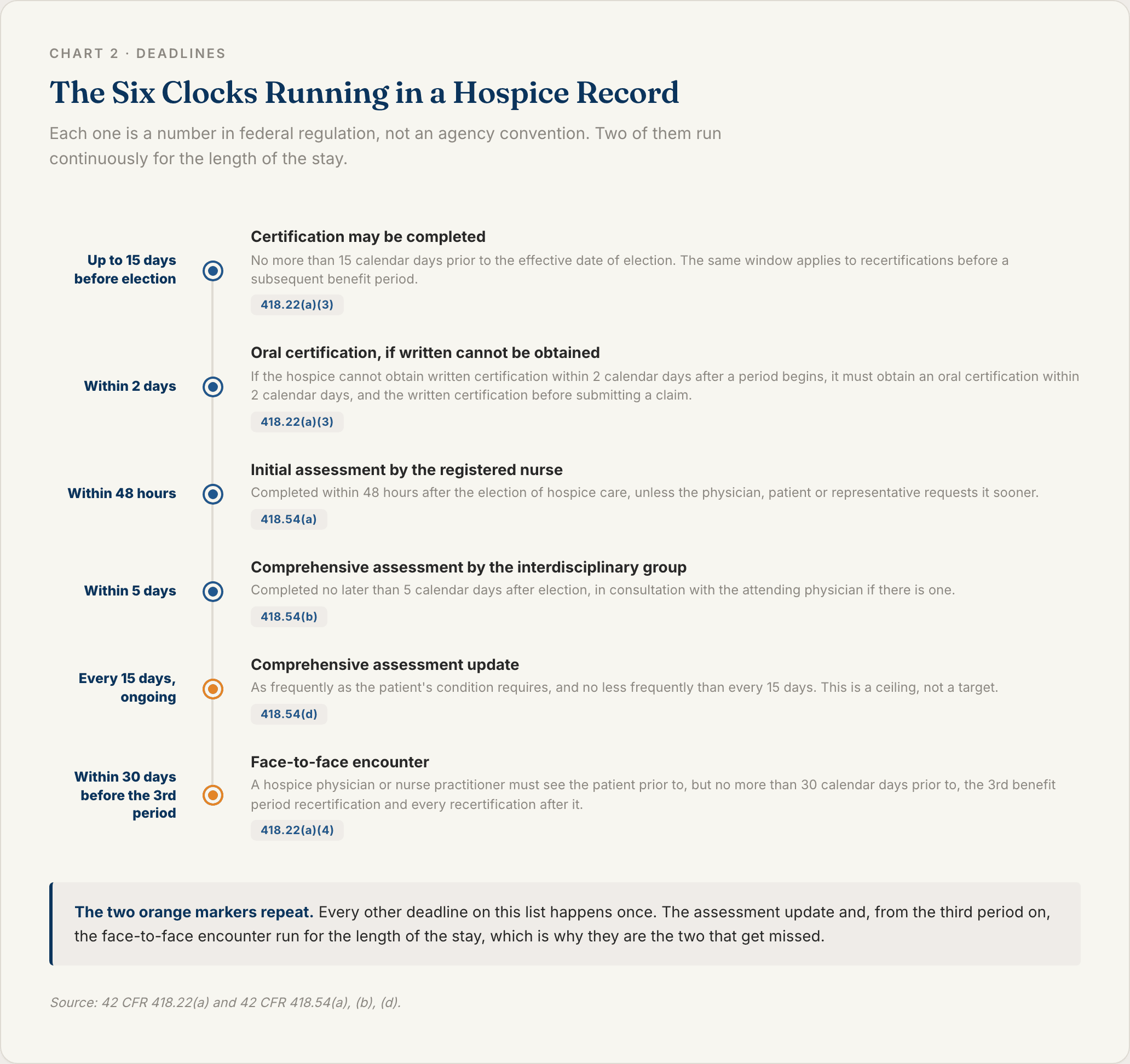
The initial assessment. A hospice registered nurse completes it within 48 hours after the election of hospice care, unless the physician, patient or representative asks for it sooner [2].
The comprehensive assessment. The interdisciplinary group completes it, in consultation with the attending physician if there is one, no later than 5 calendar days after election. It then gets updated as often as the patient's condition requires and never less often than every 15 days [2].
The plan of care. The interdisciplinary group prepares it in collaboration with the attending physician, the patient or representative, and the primary caregiver. It has to reflect patient and family goals and interventions based on the problems identified in the assessments [3].
The certification narrative. The certifying physician writes it. This is the one that is different, and the rest of this article comes back to it.
Templates below cover the first three. The fourth gets a set of questions instead, for reasons that are not stylistic.
Why "Stable" Is the Most Expensive Word in the Chart
Here is the part no competing page mentions.
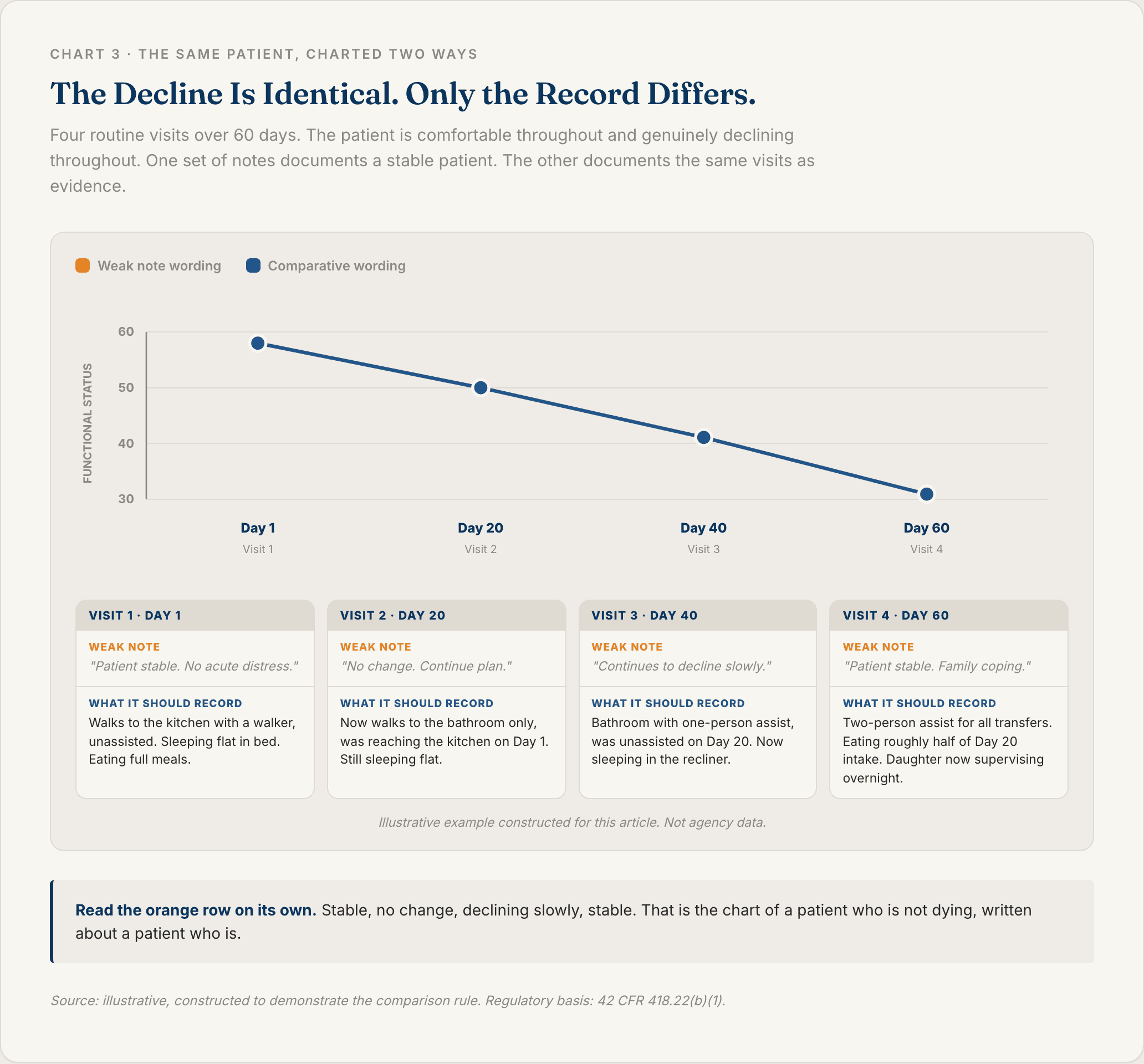
A hospice patient can be genuinely comfortable. Symptoms controlled, family coping, nothing acute. The honest note for that visit reads something like "patient stable, no acute distress, continue current plan." It is accurate. It is also the single most damaging sentence you can put in a hospice chart.
Coverage rests on a prognosis of 6 months or less [1]. A chart that records the same findings visit after visit is not neutral evidence. It is a record showing a patient who is not declining, which is the opposite of the thing the certification asserts.
The fix is not to write worse notes about comfortable patients. It is to record the comparison rather than the snapshot.
"Stable" describes your impression of the visit. It says nothing about the trajectory. Name the measurable that moved and what it was last time, and you have documented both the comfort and the decline in the same line.
This matters because somebody outside the agency reads these. Medicare Administrative Contractors publish documentation resources that agencies are measured against [4], and accreditors run education specifically on hospice documentation quality [5]. Neither of them is reading for tone. They are reading for whether the record supports the prognosis.
The One Note You Cannot Template
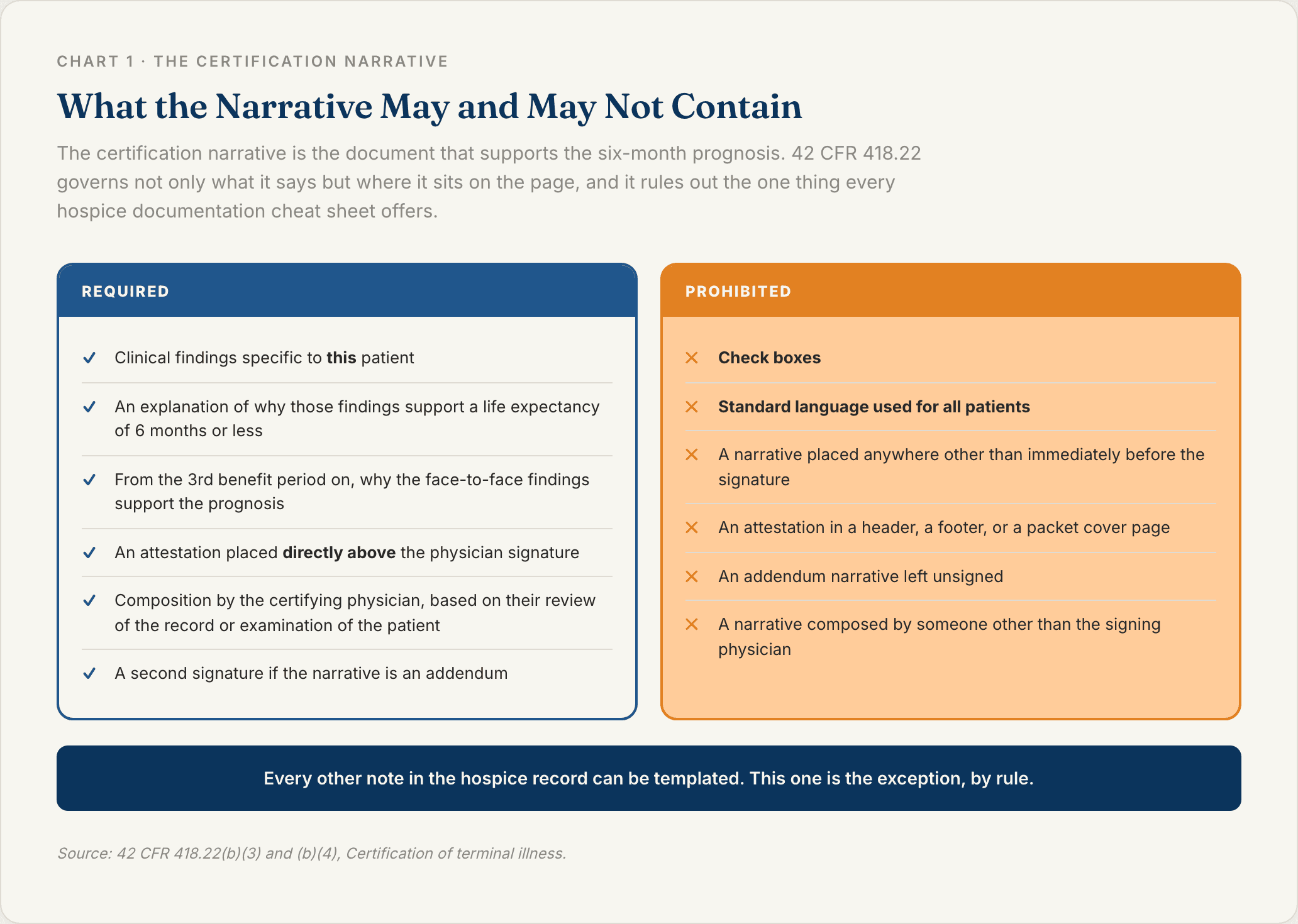
What 42 CFR 418.22 Actually Says About the Narrative
The certifying physician has to write a narrative. The regulation is specific about it:
"The physician must include a brief narrative explanation of the clinical findings that supports a life expectancy of 6 months or less as part of the certification and recertification forms, or as an addendum to the certification and recertification forms." [1]
Then the line that makes this section necessary:
"The narrative must reflect the patient's individual clinical circumstances and cannot contain check boxes or standard language used for all patients." [1]
Read that against the search term that brought most people to this page. The demand is for a hospice documentation cheat sheet. The regulation forbids exactly that, for exactly the document that determines coverage.
A narrative assembled from stock phrases is not a weak narrative. It is a non-compliant one, and it is non-compliant on its face, before anyone evaluates the clinical reasoning inside it.
Where the Attestation Has to Sit
Placement is regulated, which is unusual and tells you how much weight this document carries.
If the narrative sits inside the certification form, it "must be located immediately prior to the physician's signature." If it sits as an addendum, the physician signs the certification form and then signs again, immediately following the narrative in the addendum [1].
And the attestation itself:
"The narrative shall include a statement directly above the physician signature attesting that by signing, the physician confirms that he/she composed the narrative based on his/her review of the patient's medical record or, if applicable, his/her examination of the patient." [1]
Directly above the signature. Not in the header, not in a footer, not on the cover page of the packet.
That sentence also quietly settles a question people ask about scribes, dictation and delegated drafting. The physician is attesting that they composed it. Someone else composing it and the physician signing is the thing the attestation exists to rule out.
The Extra Requirement From the Third Benefit Period
From the third benefit period onward, two more pieces appear.
A hospice physician or hospice nurse practitioner must have a face-to-face encounter with the patient, and it has to happen prior to the recertification but no more than 30 calendar days before it [1].
Then the narrative changes. For the third benefit period recertification and every one after it, the narrative "must include an explanation of why the clinical findings of the face-to-face encounter support a life expectancy of 6 months or less" [1].
That is a different sentence from restating the findings. The findings go in the record. The narrative has to say why they mean what the certification claims they mean.
The person who performed the encounter also has to attest in writing that it happened, including the date. If that person is a nurse practitioner or a non-certifying hospice physician, the attestation has to state that the clinical findings were provided to the certifying physician for use in determining continued eligibility [1].
So the third period carries two documents, two signatures, and a narrative written by someone who may not have been in the room.
The Hospice Documentation Templates
Three blocks. Each one is complete as written, so you can paste it straight into a chart. If your agency charts in SOAP or DAP instead, the fields below map onto either format without changing what has to be recorded.
The Hospice Nursing Visit Note Template
HOSPICE VISIT NOTE
Patient, date, visit type: (routine home visit, symptom management, admission, death visit)
Arrival and departure time: (the actual times, not the scheduled ones)
Reason for this visit: (scheduled interval, or the specific problem that prompted it)
Change since last visit: (name one measurable and give its previous value, for example "ambulates to bathroom with walker, was ambulating to kitchen unassisted on 4 September")
Symptoms and scores: (pain, dyspnea, nausea, agitation, each with a score and the scale used)
Functional status: (what the patient can do today, in concrete terms, not a global impression, drawn from the same systems you cover in a head-to-toe assessment)
Intake: (oral intake, appetite, weight if taken, and what it was previously)
What was done: (assessment, interventions, medication given with time, teaching provided)
Response and reassessment: (what happened after the intervention, with the time you rechecked)
Medication changes: (what changed, who ordered it, and why)
Family and caregiver status: (coping, capability, anything that affects the plan)
For the next visit: (what the next clinician should specifically check)
Signature and credentials: (the person who provided or evaluated the care)
The fourth line is the one that does the eligibility work, and it is the line most agencies leave out. Everything above and below it describes today. Only that line describes the direction of travel.
The Interdisciplinary Group Note Template
INTERDISCIPLINARY GROUP (IDG) NOTE
Patient, meeting date, benefit period: (which period, and which day of it)
Present, by role: (physician, registered nurse, social worker, pastoral or other counselor, each named)
Problems carried from the comprehensive assessment: (list them as they appear in the assessment, not paraphrased)
Change since the last meeting, per discipline: (nursing, social work, spiritual care, each stating progress or decline against a named problem)
Plan of care changes: (what changed, and who is responsible for each change)
Patient and family goals reviewed: (what the patient and family said they want, in their words where possible)
Next review date: (the date, and anything that would trigger an earlier review)
The regulation requires the group to include a physician, a registered nurse, a social worker, and a pastoral or other counselor [3]. Naming who was present by role, rather than by initials, is what makes the note evidence that the required group met.
The Comprehensive Assessment Update Template
COMPREHENSIVE ASSESSMENT UPDATE
Patient, date, days since last update: (the interval cannot exceed 15 days)
Condition causing admission: (including the presence or lack of objective data and subjective complaints)
Complications and risk factors: (anything affecting care planning)
Functional status: (including the patient's ability to understand and participate in their own care)
Imminence of death: (state it, even when the answer is not imminent)
Severity of symptoms: (each symptom, scored, against the previous update)
Drug profile: (all prescription, over the counter, herbal and alternative treatments, reviewed for effectiveness, side effects, actual or potential interactions, duplicate therapy, and any therapy needing laboratory monitoring)
Bereavement: (the family's social, spiritual and cultural capacity to cope, and what changed, following the same psychosocial assessment discipline used at intake)
Referrals needed: (further evaluation by other health professionals)
What has changed since the initial assessment: (the cumulative picture, not just this interval)
Progress toward desired outcomes: (against the goals named in the plan of care)
Response to care:(what the interventions achieved)
Signature and credentials: (and the discipline completing the update)
The eight factors in the middle are the ones the regulation names for the comprehensive assessment, and the last three are what the update specifically has to add [2].
What Goes in the Certification Narrative Instead of a Template
This one is deliberately not a template, and that is the point of the page.
What follows is a set of questions for the certifying physician to answer in their own words. It is not a form, and it should not be turned into one.
Which measurable has declined since the last certification, and by how much?
Which clinical findings in this patient's record support a life expectancy of 6 months or less?
What is the disease trajectory here, in this patient, rather than in this diagnosis generally?
For the third benefit period and later: what did the face-to-face encounter show, and why do those findings support the prognosis?
Has the attestation been placed directly above the signature?
If this is an addendum, has it been signed separately from the certification form?
Answer those in prose, in the physician's own words, about one patient. That is the whole requirement, and it is also the reason no blank version of this block appears anywhere on this page.
Where Sully.ai Fits in Hospice Documentation
Hospice visits happen in living rooms, frequently with the family in the room, and the note gets written afterward. In a car, at the next stop, or at the end of a six-visit day.
What gets lost in that gap is predictable. Not the symptom scores, which are easy to recall, and not the interventions. What gets lost is the comparison to the last visit, because it is the only part of the note that requires looking something up. It is also, as this article has argued throughout, the part carrying the eligibility.
Sully.ai's AI scribe captures the visit as you describe it and drafts it into your agency's own note format, so the visit note exists before you leave the driveway rather than six hours later. It runs on a single integration across Epic, Cerner, Meditech and Athenahealth.
Two boundaries worth stating plainly.
It does not write the certification narrative, and it should not. The regulation requires the physician to attest that they composed the narrative based on their own review of the record or examination of the patient [1]. A drafted narrative that a physician signs is precisely the arrangement that attestation exists to prevent. The same applies to eligibility itself. That is a clinical and physician judgment, and no documentation tool makes it.
It can only capture a comparison you actually say out loud. If you walk out thinking "she's weaker than Tuesday" and never voice it, there is nothing to transcribe. The habit of naming the previous value stays with the clinician. What the tool removes is the cost of writing it down later, not the discipline of noticing it. The same boundary applies wherever an AI scribe is used.
Sully operates across 5,000+ providers, has delivered 50M+ hours of work, and prices each role 80 to 90 percent below the human equivalent [6].
Three Worked Examples
A Routine Home Visit Where the Patient Is Comfortable
This is the hard one, and the one that teaches the argument.
Eighty-one year old woman, end stage heart failure, third routine visit this month. Comfortable. Nothing happened.
Here is the note most people write:
Patient stable. No acute distress. Denies pain. Continue current plan of care. Family coping well.
Everything in it is true. It is also, on review, a record of a patient who does not appear to be dying.
Here is the same visit, same findings, recorded as a comparison:
Change since last visit:Now sleeping in the recliner overnight; was still sleeping flat in bed on 2 September. Ambulates to the bathroom with a walker and one-person assist; was ambulating that distance with a walker alone two weeks ago.Symptoms:Denies pain at rest, 2 out of 10 on exertion. Dyspnea at 15 feet, was at 40 feet on 2 September.Intake:Eating roughly half of what she was in August, per daughter. Refused lunch during the visit, which the daughter reports is now typical.Family and caregiver status:Daughter coping, now providing overnight supervision she was not providing a month ago.
The patient is just as comfortable in the second version. The difference is that the second version is evidence.
A Symptom Crisis Visit
Unscheduled visit, pain crisis, 1415 to 1520.
Reason for this visit: Daughter called at 1330 reporting pain unrelieved by the scheduled dose.
Change since last visit: Pain now requiring breakthrough dosing three times daily; was requiring it once daily on 8 September.
Symptoms: Pain 8 out of 10 at arrival, left hip and lower back, described by the patient as "worse when anyone moves me."
What was done: Morphine sulfate 10 mg oral solution given at 1425 per standing order. Repositioned with two-person assist. Daughter taught to pre-medicate 30 minutes before any transfer.
Response and reassessment: Pain 3 out of 10 at 1500. Patient able to tolerate repositioning at 1510 without vocalizing.
Medication changes: On-call physician notified at 1440 using SBAR. Scheduled dose increased, order received and read back.
For the next visit: Confirm the daughter is pre-medicating before transfers, and reassess whether three-times-daily breakthrough has become the new baseline.
The intervention and the response are separate recorded events with separate times. That is the same discipline that governs any nursing note, and it is what turns "gave morphine" into a record of clinical care.
A Recertification Visit Before the Third Benefit Period
Face-to-face encounter, nurse practitioner, 22 days before the start of the third benefit period.
The nurse practitioner records the visit as a clinical note, then produces the attestation:
I conducted a face-to-face encounter with this patient on 16 September 2026. The clinical findings of that visit have been provided to the certifying physician for use in determining continued eligibility for hospice care. [Signature, credentials, date]
The certifying physician then writes the narrative. A short excerpt, to show what patient-specific looks like:
Since the last certification this patient's PPS has fallen from 40 to 30, she now requires two-person assist for all transfers where one month ago she transferred with one, and oral intake has dropped to roughly a third of baseline with a 4 kg weight loss over 8 weeks. The face-to-face encounter on 16 September confirmed increasing somnolence and new dependence in feeding. Taken together, the rate of functional decline across two consecutive benefit periods, rather than any single finding, supports a life expectancy of 6 months or less if the illness runs its normal course. By signing below, I confirm that I composed this narrative based on my review of the patient's medical record and my examination of the patient. [Signature, credentials, date]
Notice what that narrative does not say. It does not name the diagnosis and stop. It gives numbers, gives their previous values, and then makes an argument about the rate of change. And the attestation sits directly above the signature, where the regulation requires it [1].
What Gets a Hospice Note Flagged
A narrative built from stock phrases. "Patient continues to decline and remains appropriate for hospice services" is standard language used for all patients, which is the thing the regulation names [1]. It also contains no clinical findings, which is what the narrative is required to explain.
An assessment update dated 19 days after the last one. The ceiling is 15 days, and it is a number, not a target [2].
A visit note with no previous value anywhere in it. This is the quiet one. Nothing in it is wrong. It simply does not do the job the record exists to do.
An addendum narrative with one signature. If the narrative is an addendum, the physician signs the certification form and signs again following the narrative [1]. One signature is an incomplete certification.
FAQ
What is required in hospice documentation?
Federal rule sets four things. A registered nurse completes an initial assessment within 48 hours of election. The interdisciplinary group completes a comprehensive assessment within 5 calendar days and updates it no less frequently than every 15 days. The group prepares an individualized written plan of care reflecting patient and family goals. And the certifying physician writes a narrative explaining the clinical findings that support a life expectancy of 6 months or less [1][2][3].
Can you use a template for hospice charting?
For visit notes, interdisciplinary group notes and assessment updates, yes, and most agencies do. For the physician's certification narrative, no. The regulation states the narrative must reflect the patient's individual clinical circumstances and cannot contain check boxes or standard language used for all patients [1].
Why does hospice documentation focus on decline?
Because coverage rests on a prognosis of 6 months or less if the terminal illness runs its normal course [1]. A chart recording the same findings visit after visit does not support that prognosis. Documenting decline is not pessimism, it is the evidence that the patient still qualifies for the benefit they are receiving.
What is the hospice face-to-face encounter requirement?
From the third benefit period onward, a hospice physician or nurse practitioner must have a face-to-face encounter with the patient no more than 30 calendar days before the recertification. That person attests in writing that the encounter happened, including the date, and the recertification narrative must explain why those findings support a life expectancy of 6 months or less [1].
How often does the hospice comprehensive assessment have to be updated?
As frequently as the patient's condition requires, and never less frequently than every 15 days. The update has to consider changes since the initial assessment and must include the patient's progress toward desired outcomes and their response to care [2]. Sully.ai drafts the update from the visit itself, so the interval gets met without a separate writing session.
Sources
[1] U.S. Government Publishing Office — 42 CFR 418.22, Certification of terminal illness. https://www.govinfo.gov/content/pkg/CFR-2023-title42-vol3/xml/CFR-2023-title42-vol3-sec418-22.xml
[2] U.S. Government Publishing Office — 42 CFR 418.54, Condition of participation: Initial and comprehensive assessment of the patient. https://www.govinfo.gov/content/pkg/CFR-2023-title42-vol3/xml/CFR-2023-title42-vol3-sec418-54.xml
[3] U.S. Government Publishing Office — 42 CFR 418.56, Condition of participation: Interdisciplinary group, care planning, and coordination of services. https://www.govinfo.gov/content/pkg/CFR-2023-title42-vol3/xml/CFR-2023-title42-vol3-sec418-56.xml
[4] CGS Administrators— Hospice Quick Resource Tools. https://www.cgsmedicare.com/hhh/education/materials/hospice_qrt.html
[5] Accreditation Commission for Health Care — Hospice Documentation: Painting the Picture. https://www.achc.org/wp-content/uploads/2022/04/hospice-webinar-painting-the-picture.pdf
[6] Sully.ai — AI Medical Scribe. https://www.sully.ai/medical-scribe
TABLE OF CONTENTS
Hire your
Medical AI Team
Take a look at our Medical AI Team
AI Receptionist
Manages patient scheduling, communications, and front-desk operations across all channels.
AI Scribe
Documents clinical encounters and maintains accurate EHR/EMR records in real-time.
AI Medical Coder
Assigns and validates medical codes to ensure accurate billing and regulatory compliance.
AI Nurse
Assesses patient urgency and coordinates appropriate care pathways based on clinical needs.