"/><stop offset="1" stop-color="rgba(255, 255, 255, 0)"/></linearGradient><linearGradient id="WxV_IOPE7-2309410982-linear-gradient" x1="1" x2="0" y1="0.5951279047551217" y2="0.4048720952448783"><stop offset="0" stop-color="rgb(255, 255, 255)"/><stop offset="1" stop-color="rgba(255, 255, 255, 0)"/></linearGradient><linearGradient id="WwbAIQIz8-2309410982-linear-gradient" x1="0.43478742751482424" x2="0.6358595260107829" y1="0.26" y2="1"><stop offset="0" stop-color="rgb(255, 255, 255)"/><stop offset="1" stop-color="rgba(255, 255, 255, 0)"/></linearGradient><linearGradient id="ZWsVQcPfn-2309410982-linear-gradient" x1="0.9508213454678907" x2="0.04917865453210929" y1="0" y2="1"><stop offset="0" stop-color="rgb(255, 255, 255)"/><stop offset="1" stop-color="rgba(255, 255, 255, 0)"/></linearGradient><linearGradient id="lTyCGrzzP-2309410982-linear-gradient" x1="0.374937164194436" x2="0.625062835805564" y1="0" y2="1"><stop offset="0" stop-color="rgb(255, 255, 255)"/><stop offset="1" stop-color="rgba(255, 255, 255, 0)"/></linearGradient></defs><g d="M 658.002 1357.705 C 1020.321 1357.705 1314.04 1063.989 1314.04 701.667 C 1314.04 339.347 1020.321 45.626 658.002 45.626 C 295.681 45.626 1.96 339.347 1.96 701.667 L 0 701.667 C 0 338.263 294.598 43.665 658.002 43.665 C 1021.404 43.665 1316 338.263 1316 701.667 C 1316 1065.072 1021.404 1359.672 658.002 1359.672 C 294.598 1359.672 0 1065.072 0 701.667 L 1.96 701.667 C 1.96 1063.989 295.681 1357.705 658.002 1357.705 Z M 658.005 1265.053 C 969.154 1265.053 1221.392 1012.819 1221.392 701.667 C 1221.392 390.517 969.154 138.281 658.005 138.281 C 346.856 138.281 94.619 390.517 94.619 701.667 L 92.659 701.667 C 92.659 389.433 345.77 136.321 658.005 136.321 C 970.241 136.321 1223.352 389.433 1223.352 701.667 C 1223.352 1013.902 970.241 1267.017 658.005 1267.017 C 345.77 1267.017 92.659 1013.902 92.659 701.667 L 94.619 701.667 C 94.619 1012.819 346.856 1265.053 658.005 1265.053 Z M 658.002 1166.116 C 914.513 1166.116 1122.452 958.178 1122.452 701.667 C 1122.452 445.16 914.513 237.22 658.002 237.22 C 401.494 237.22 193.551 445.16 193.551 701.667 L 191.59 701.667 C 191.59 444.077 400.411 235.255 658.002 235.255 C 915.596 235.255 1124.412 444.077 1124.412 701.667 C 1124.412 959.261 915.596 1168.084 658.002 1168.084 C 400.411 1168.084 191.59 959.261 191.59 701.667 L 193.551 701.667 C 193.551 958.178 401.494 1166.116 658.002 1166.116 Z M 281.657 818.28 C 298.572 818.28 314.804 825.001 326.765 836.965 L 458.99 969.182 C 470.582 980.781 486.308 987.298 502.706 987.298 L 612.137 987.298 C 646.284 987.298 673.972 959.61 673.972 925.463 L 673.972 891.504 L 675.939 891.504 L 675.939 925.463 C 675.939 960.7 647.374 989.258 612.137 989.258 L 502.706 989.258 C 485.788 989.258 469.562 982.537 457.599 970.573 L 325.378 838.356 C 313.785 826.757 298.056 820.242 281.657 820.244 L 1.173 820.244 L 1.173 818.28 Z M 746.64 888.714 L 1053.046 888.714 C 1069.967 888.714 1086.194 895.435 1098.16 907.398 L 1259.381 1068.619 L 1257.99 1070.007 L 1096.772 908.79 C 1085.175 897.193 1069.446 890.679 1053.046 890.681 L 746.64 890.681 C 729.724 890.681 713.493 883.957 701.533 871.993 L 685.377 855.845 L 686.769 854.453 L 702.917 870.605 C 714.513 882.201 730.241 888.715 746.64 888.714 Z M 667.685 552 L 512.316 396.894 C 494.66 379.264 484.741 355.356 484.739 330.426 L 484.739 0 L 487.632 0 L 487.632 330.426 C 487.632 354.592 497.248 377.763 514.369 394.851 L 669.739 549.957 Z M 782.851 700.491 C 816.998 700.491 844.686 672.804 844.686 638.655 L 844.686 516.468 C 844.687 499.547 851.409 483.32 863.374 471.355 L 1177.508 157.22 L 1178.896 158.607 L 864.762 472.742 C 853.162 484.337 846.646 500.067 846.646 516.468 L 846.646 638.655 C 846.646 673.89 818.088 702.455 782.851 702.455 L 700.405 702.455 L 700.405 700.491 Z M 130.338 534.223 L 213.07 534.223 C 256.112 534.223 291.003 569.114 291.003 612.156 L 291.003 694.888 C 291.003 711.29 297.514 727.017 309.113 738.611 L 472.887 902.378 L 471.496 903.769 L 307.726 739.995 C 295.761 728.033 289.038 711.807 289.038 694.888 L 289.038 612.156 C 289.038 570.198 255.028 536.188 213.07 536.188 L 130.338 536.188 C 113.419 536.187 97.193 529.465 85.23 517.5 L 77.071 509.345 C 65.107 497.381 58.386 481.153 58.388 464.233 L 58.388 199.526 L 60.348 199.526 L 60.348 464.233 C 60.349 480.631 66.863 496.358 78.458 507.954 L 86.617 516.113 C 98.213 527.709 113.94 534.223 130.338 534.223 Z" fill="transparent" height="1359.6717183844698px" id="DcyumyANr" transform="translate(0 -43.665)" width="1316px"><g opacity="0.5"><path d="M 658.002 1314.039 C 1020.321 1314.039 1314.04 1020.324 1314.04 658.001 C 1314.04 295.681 1020.321 1.961 658.002 1.961 C 295.681 1.961 1.96 295.682 1.96 658.001 L 0 658.001 C 0 294.598 294.598 0 658.002 0 C 1021.404 0 1316 294.598 1316 658.001 C 1316 1021.407 1021.404 1316.007 658.002 1316.007 C 294.598 1316.007 0 1021.407 0 658.001 L 1.96 658.001 C 1.96 1020.324 295.681 1314.039 658.002 1314.039 Z" fill="rgb(255, 255, 255)" height="1316.0065114752902px" id="dxf13D52Y" transform="translate(0 43.665)" width="1316px"/></g><g opacity="0.3"><path d="M 565.347 1128.732 C 876.496 1128.732 1128.733 876.498 1128.733 565.346 C 1128.733 254.196 876.496 1.961 565.347 1.961 C 254.197 1.961 1.961 254.196 1.961 565.346 L 0 565.346 C 0 253.112 253.111 0 565.347 0 C 877.582 0 1130.693 253.112 1130.693 565.346 C 1130.693 877.581 877.582 1130.696 565.347 1130.696 C 253.111 1130.696 0 877.581 0 565.346 L 1.961 565.346 C 1.961 876.498 254.197 1128.732 565.347 1128.732 Z" fill="rgb(255, 255, 255)" height="1130.6960934794101px" id="if1BmYw1S" transform="translate(92.659 136.321)" width="1130.693351805604px"/></g><g opacity="0.15"><path d="M 466.412 930.861 C 722.923 930.861 930.862 722.922 930.862 466.411 C 930.862 209.905 722.923 1.965 466.412 1.965 C 209.904 1.965 1.961 209.905 1.961 466.411 L 0 466.411 C 0 208.822 208.821 0 466.412 0 C 724.006 0 932.822 208.822 932.822 466.411 C 932.822 724.005 724.006 932.828 466.412 932.828 C 208.821 932.828 0 724.005 0 466.411 L 1.961 466.411 C 1.961 722.922 209.904 930.861 466.412 930.861 Z" fill="rgb(255, 255, 255)" height="932.8284667407987px" id="ef75NsYf6" transform="translate(191.59 235.255)" width="932.8219552655086px"/></g><g opacity="0.5"><path d="M 280.484 0 C 297.399 0 313.63 6.721 325.592 18.685 L 457.817 150.902 C 469.408 162.501 485.135 169.018 501.533 169.017 L 610.964 169.017 C 645.111 169.017 672.799 141.33 672.799 107.182 L 672.799 73.223 L 674.766 73.223 L 674.766 107.182 C 674.766 142.42 646.201 170.978 610.964 170.978 L 501.533 170.978 C 484.614 170.978 468.389 164.257 456.426 152.293 L 324.205 20.076 C 312.611 8.477 296.883 1.961 280.484 1.964 L 0 1.964 L 0 0 Z" fill="url(%23cQ4xRdUtr-2309410982-linear-gradient)" height="170.97763275969464px" id="cQ4xRdUtr" transform="translate(1.173 818.28)" width="674.7656780356198px"/></g><g opacity="0.5"><path d="M 61.263 34.261 L 367.669 34.261 C 384.589 34.261 400.817 40.982 412.783 52.945 L 574.004 214.166 L 572.612 215.554 L 411.395 54.337 C 399.798 42.74 384.069 36.226 367.669 36.228 L 61.263 36.228 C 44.347 36.228 28.116 29.504 16.155 17.54 L 0 1.391 L 1.391 0 L 17.54 16.152 C 29.136 27.747 44.864 34.261 61.263 34.261 Z" fill="url(%23WxV_IOPE7-2309410982-linear-gradient)" height="215.55382175474415px" id="WxV_IOPE7" transform="translate(685.377 854.453)" width="574.0036823012563px"/></g><g opacity="0.5"><path d="M 182.946 552 L 27.577 396.894 C 9.921 379.264 0.002 355.356 0 330.426 L 0 0 L 2.893 0 L 2.893 330.426 C 2.893 354.592 12.509 377.763 29.63 394.851 L 185 549.957 Z" fill="url(%23WwbAIQIz8-2309410982-linear-gradient)" height="552px" id="WwbAIQIz8" transform="translate(484.739 0)" width="185px"/></g><g opacity="0.5"><path d="M 82.446 543.271 C 116.593 543.271 144.281 515.583 144.281 481.435 L 144.281 359.248 C 144.282 342.327 151.004 326.1 162.969 314.135 L 477.103 0 L 478.491 1.387 L 164.356 315.522 C 152.757 327.117 146.241 342.846 146.241 359.248 L 146.241 481.435 C 146.241 516.67 117.683 545.235 82.446 545.235 L 0 545.235 L 0 543.271 Z" fill="url(%23ZWsVQcPfn-2309410982-linear-gradient)" height="545.2346136318063px" id="ZWsVQcPfn" transform="translate(700.405 157.22)" width="478.4906210693257px"/></g><g opacity="0.5"><path d="M 71.95 334.696 L 154.682 334.696 C 197.724 334.696 232.616 369.588 232.616 412.63 L 232.616 495.362 C 232.616 511.764 239.126 527.491 250.725 539.084 L 414.5 702.851 L 413.108 704.243 L 249.338 540.469 C 237.373 528.507 230.651 512.281 230.651 495.362 L 230.651 412.63 C 230.651 370.672 196.64 336.661 154.682 336.661 L 71.95 336.661 C 55.031 336.661 38.805 329.939 26.843 317.974 L 18.683 309.819 C 6.719 297.854 -0.001 281.627 0 264.707 L 0 0 L 1.961 0 L 1.961 264.707 C 1.961 281.105 8.475 296.832 20.07 308.428 L 28.229 316.587 C 39.825 328.182 55.552 334.697 71.95 334.696 Z" fill="url(%23lTyCGrzzP-2309410982-linear-gradient)" height="704.2427839655832px" id="lTyCGrzzP" transform="translate(58.388 199.526)" width="414.49961191971533px"/></g></g></svg>)
A SOAP note is written for other clinicians. A treatment plan is written for the team and the payer. A certification narrative is written for a reviewer.
The after-visit summary (AVS) is written for the patient. It is the only clinical document that is, and almost every convention that makes a chart note good makes an AVS worse.
Here are three blank templates, three worked examples including the visit that ended without a diagnosis, and what the research actually says goes wrong with these documents.
Key Takeaway:An after-visit summary is the document a patient leaves a visit with, covering what happened, what changed, and what to do next. It is the only clinical note written for the patient rather than for the record, and the research on it is unambiguous. A 2025 scoping review in BMC Health Services Research covering 73 studies found the barriers to be technical language, inconsistent formatting and limited electronic health record (EHR) integration, and the facilitators to be simplified language, tailored content and stakeholder involvement [1]. There is a regulatory reason it exists in most practices too: under 42 CFR 495.24, eligible professionals must use clinically relevant information from certified EHR technology to identify patient-specific educational resources and provide them [2]. Sully.ai drafts the clinical note and the patient-facing summary from the same conversation.
What an After Visit Summary Is
It is the page handed over at checkout or posted to the portal. It usually contains what was discussed, what was found, what changed, and what happens next.
That much every guide agrees on. The part nobody addresses is who is going to read it.
Every Other Note Has a Clinical Reader. This One Does Not.
Here is the part no competing page states.
A chart note, whether that is a progress note or a shift note, is read by somebody with clinical training, in a professional context, for a specific purpose. Every convention of clinical writing is tuned for that reader. Abbreviations save time because the reader knows them. Precision matters because decisions depend on it. Hedged language is honest because the reader understands uncertainty. Density is a virtue because the reader is scanning.
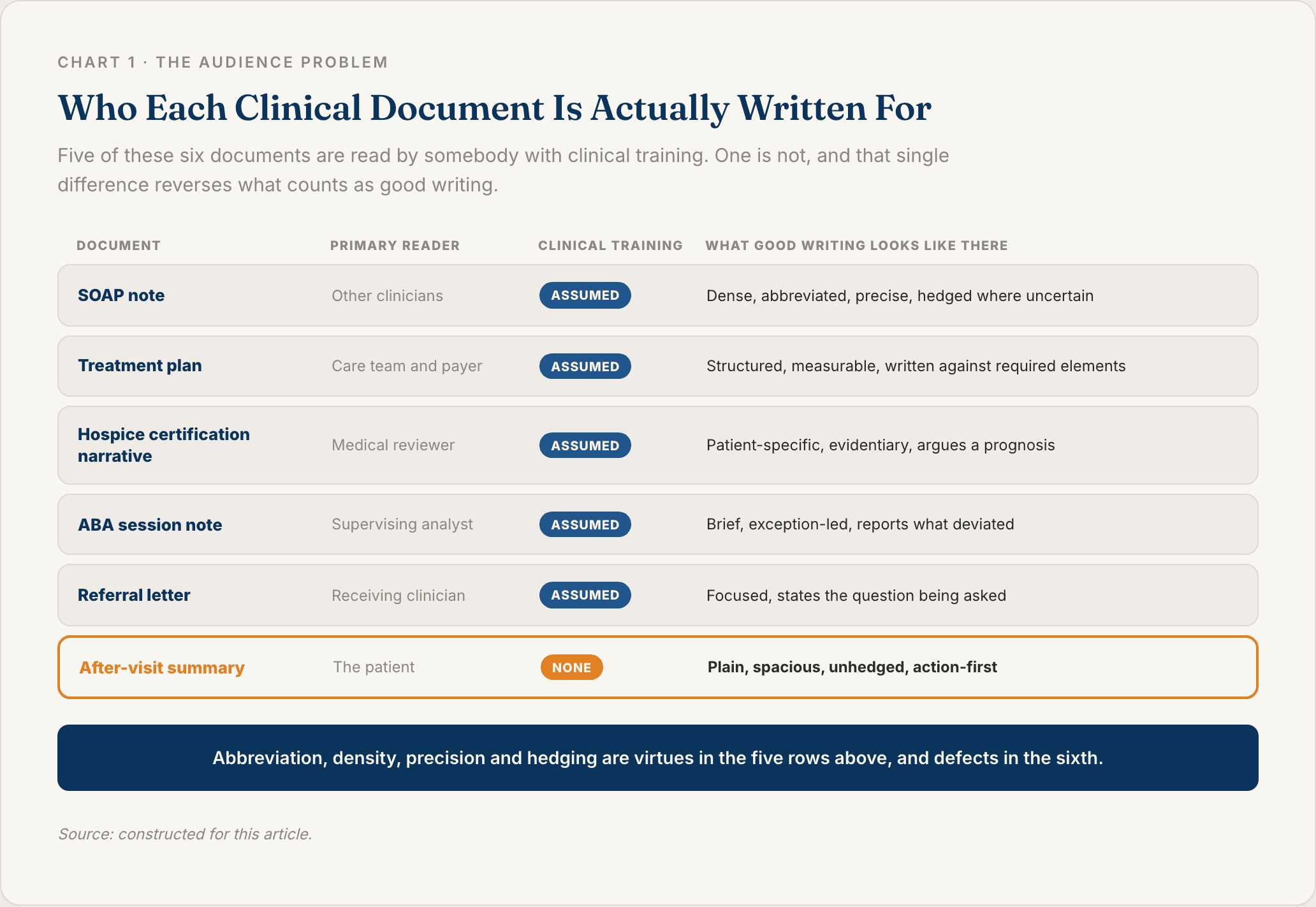
Now change the reader. The AVS is read by somebody with no clinical training, quite possibly worried, often alone, usually several hours later when they have forgotten half of what was said.
Every one of those four virtues becomes a defect. Abbreviations become noise. Precision becomes intimidation. Hedging becomes ambiguity about whether they should be worried. Density becomes a wall of text that gets folded into a bag.
This is not a writing-quality problem. It is an audience problem, and it is why AVS documents generated straight from the chart fail so reliably.
What the Evidence Says Goes Wrong
This does not have to be argued from opinion, because it has been studied properly.
A scoping review published in BMC Health Services Research in December 2025 examined stakeholder perspectives on after-visit and discharge summaries. Seventy-three studies met the inclusion criteria, most conducted in the United States, most focused on discharge summary implementation [1].
The findings are specific enough to act on:
Barriers:technical language, inconsistent formatting, and limited EHR integration [1].
Facilitators:simplified language, tailored content, and stakeholder involvement [1].
Reported outcomes where these documents worked: better patient understanding of their condition, improved adherence to medical advice and treatment plans, and enhanced care continuity during transitions [1].
Two things are worth drawing out. First, the barrier list is a writing problem and a formatting problem, not a technology problem. Second, this is not a new discovery that current tooling has since solved. The difficulty of optimizing the after-visit summary was documented in the International Journal of Medical Informatics back in 2018 [3], and the Agency for Healthcare Research and Quality has funded work specifically on computer-generated after-visit summaries [4]. The problem is well described and still largely unfixed.
The Requirement Most Practices Satisfy Without Noticing
There is no federal rule that says "you must produce an after-visit summary." What exists is an obligation that the AVS happens to discharge.
42 CFR 495.24 sets a patient electronic access objective. For eligible professionals (EPs), it carries two measures. The first is that for more than 80 percent of unique patients seen, the patient or their authorized representative is provided timely access to view online, download and transmit their health information. The second is that the professional "must use clinically relevant information from CEHRT to identify patient-specific educational resources and provide" them [2].
That second measure is an education obligation. In most practices, the after-visit summary is where it lands, usually because the EHR was configured that way rather than because anybody chose it.
A caveat worth stating plainly. Program objectives, measures and thresholds are updated, and the certified EHR technology (CEHRT) definition moves with them. Check the requirements for the year you are reporting rather than trusting any article, including this one [5].
The After Visit Summary Templates
Three blocks. Each is complete as written, and each is deliberately written in plain language, because that is the entire point of the document. The clinical record is a separate note.
The Standard Visit Summary Template
AFTER VISIT SUMMARY
Who you saw and when: (clinician name, role, date of visit)
What we talked about today: (one sentence, plain words, no abbreviations)
What we found: (results, measurements and findings, each with what it means for this person)
What we changed about your medicines: (each change stated as started, stopped, or dose changed; if nothing changed, say so)
What to do before your next visit: (a numbered list of actions, each one something the patient physically does)
What to watch for, and when to call: (specific observable changes, each with the number to call)
Your next appointment: (date and time if booked, or exactly who will contact them and when)
How to ask a question: (portal, phone number, and the hours)
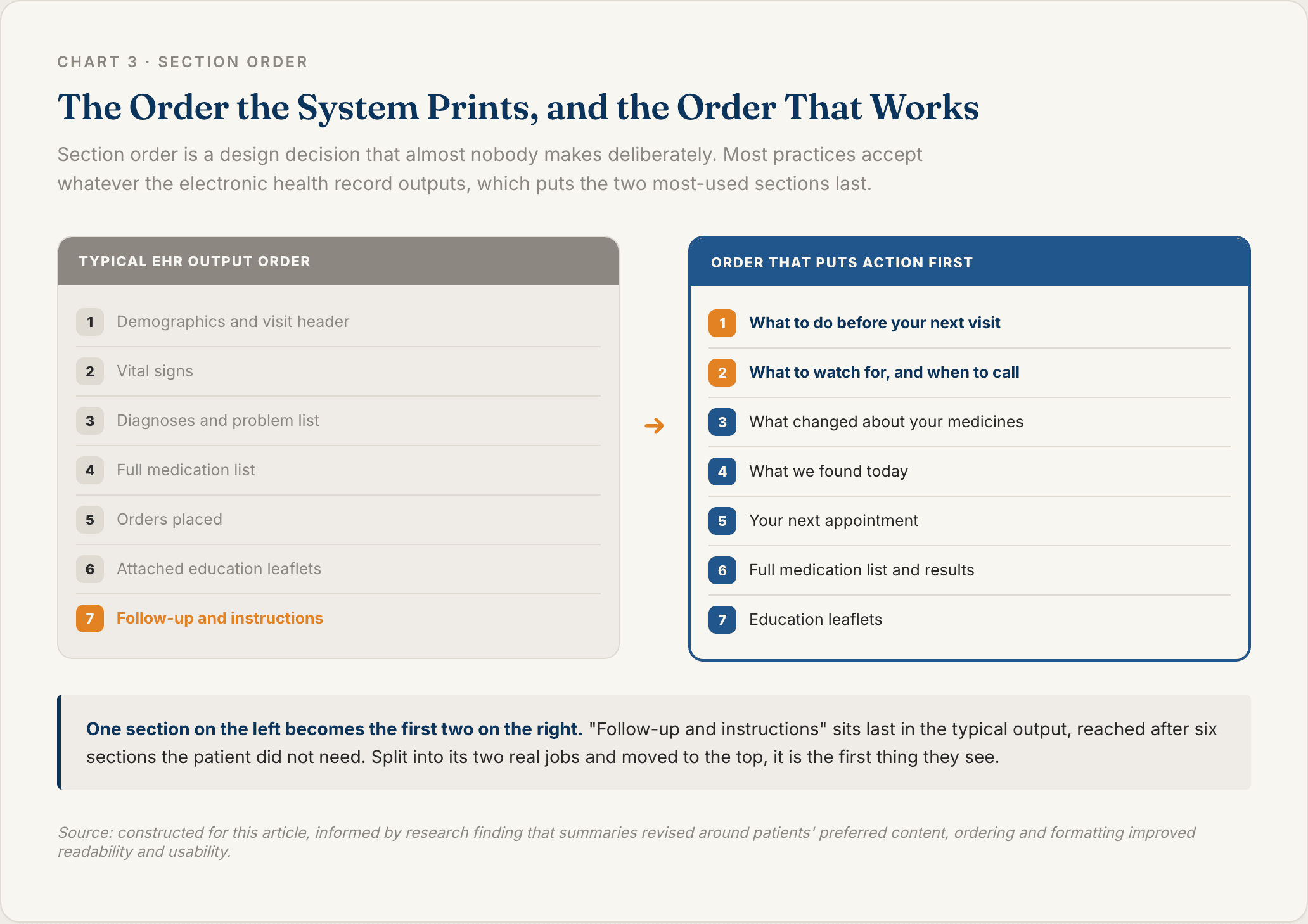
The sixth line is the one patients use most and the one auto-generated summaries bury at the bottom or omit. Put it where it can be found at 9pm by somebody who is worried.
The Medication Change Block
Medication is where an unclear summary does the most harm, so it gets its own block.
YOUR MEDICINES
What changed: (started, stopped, or dose changed, in those words)
What it is for: (the reason, in plain language, for each medicine that changed)
How to take it: (how much, how often, with or without food, what time of day)
What to stop: (name anything being stopped explicitly, including anything over the counter)
If you miss a dose: (what to do, stated for this medicine rather than generically)
What you might notice: (common effects that are expected and not a cause for alarm)
What means you should call us: (specific effects that warrant contact, with the number)
The single most common defect in an after-visit summary is a medicine named without its purpose. "Lisinopril 20mg daily" tells a patient nothing they can use. "Lisinopril, for your blood pressure" is the same line doing its job.
The Follow-Up and Red Flags Block
WHAT HAPPENS NEXT
Your next contact: (when, and whether the practice books it or the patient does)
Tests we are waiting on: (which tests, and how the results will reach the patient)
If results are normal: (what happens, including whether they will hear anything at all)
Call us if: (each item an observable event the patient can recognize, not a clinical sign)
Who to call, in hours: (number and hours)
Who to call, out of hours: (number, and what service it reaches)
What counts as an emergency: (what to do, and where to go)
"Return if symptoms worsen" is not a red flag a patient can act on. Worse how, and worse than what? Replace it with the observable version: "Call us if you are more short of breath walking up the stairs than you were this week, or if your ankles are more swollen in the morning."
Where Sully.ai Fits in Patient-Facing Documentation
The reason most after-visit summaries read like chart notes is that they were generated from chart notes. The document is downstream of a document written for a different reader, so it inherits the wrong voice by default.
Sully.ai's AI scribe, used across primary care and specialty practices, drafts the clinical note and the patient-facing summary from the same conversation. That matters structurally rather than just for speed: the summary can be built from the words the clinician actually used when explaining things to the patient, instead of being translated back out of the note afterwards. It runs on a single integration across Epic, Cerner, Meditech and Athenahealth.
Two boundaries, and the second is a real limit on the claim above.
Nothing automated should choose a patient's red flags. Which warning signs a given person needs depends on their risk, their comorbidities and their circumstances, not on their diagnosis. That is a clinical judgment and it belongs to the clinician who saw them.
A summary inherits the framing of the conversation it came from. If the plain-language explanation never happened out loud, there is nothing to draft it from. A tool can carry a good explanation into the document. It cannot supply one that was never given. The translation still has to happen in the room.
Sully operates across 5,000+ providers, has delivered 50M+ hours of work, and prices each role 80 to 90 percent below the human equivalent [6].
Three Worked Examples
A Routine Primary Care Visit With a Medication Change
Here is the chart line, then the summary line, for the same visit.
In the chart: BP 158/94, uncontrolled HTN on lisinopril 10mg. Increase to 20mg daily. Recheck 4/52. Cont. home BP log.
In the summary:
What we found: Your blood pressure today was 158/94. We would like it under 140/90, so it is still higher than we want.
What we changed about your medicines: We are increasing your lisinopril. You were taking one 10mg tablet each morning. From tomorrow, take two 10mg tablets each morning, which makes 20mg. Lisinopril is for your blood pressure. If you miss a morning, take it when you remember that day, but skip it if it is nearly bedtime.
What you might notice: A dry cough or feeling a bit light-headed when you stand up quickly. Both are common in the first couple of weeks.
What means you should call us: Light-headedness that does not settle after a week, any swelling of the lips or tongue, or a cough that stops you sleeping. Call the surgery on 555-0100.
What to do before your next visit: Keep taking your blood pressure at home twice a week and write it in the log. Bring the log with you.
Your next appointment: In four weeks. Reception will call you this week to book it.
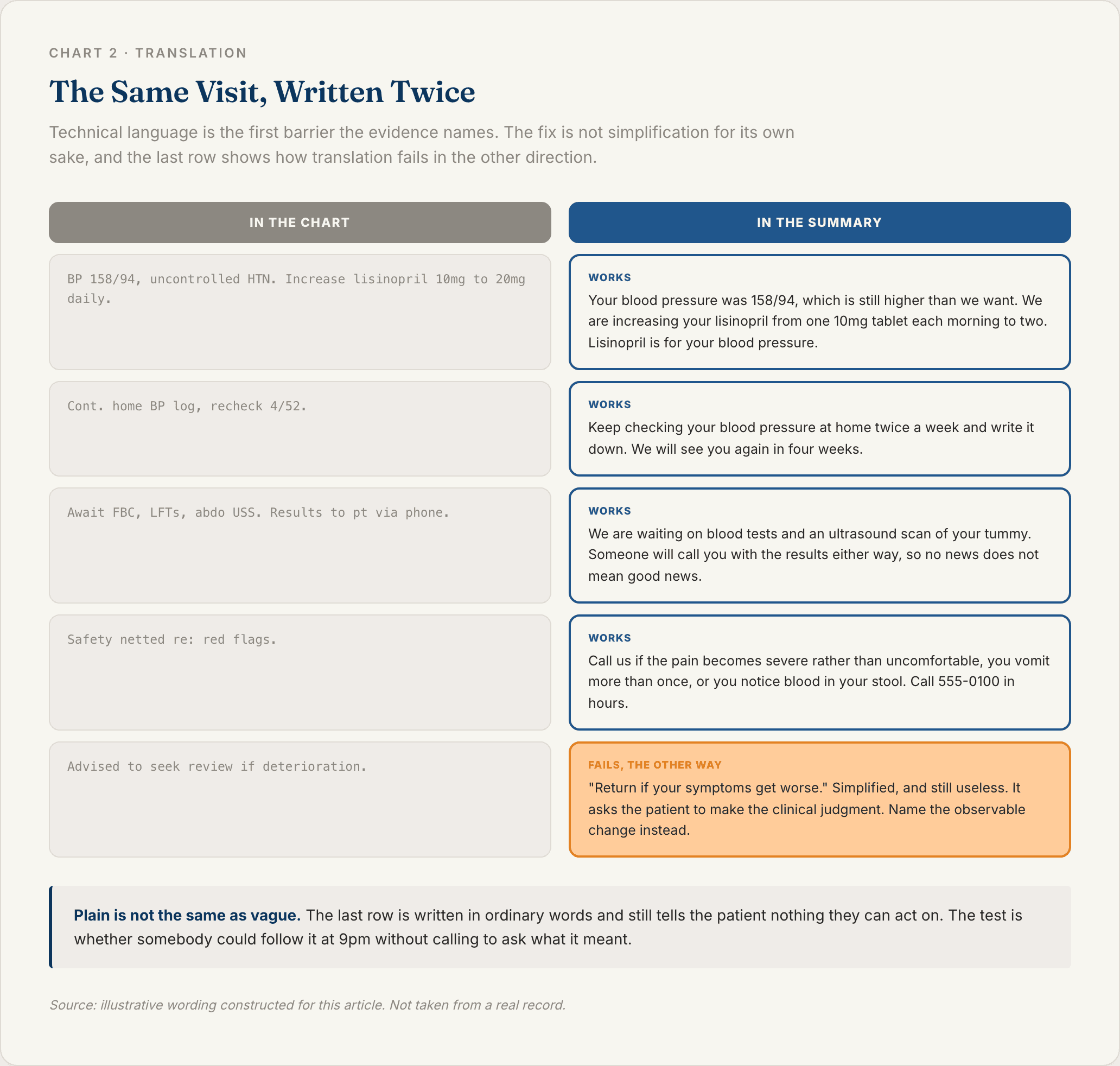
Same visit, same clinical content, roughly 40 seconds more work. The difference is that the second version can be acted on by the person it was written for.
A Visit That Ended in Uncertainty
This is the hardest AVS to write and the one nobody demonstrates.
Tests are pending, the diagnosis is not settled, and the temptation is to write nothing until it is. This is the mirror image of the therapy note problem, where the difficulty is deciding what to leave out rather than what to say. That leaves the patient with the least information at the moment they are most anxious.
What we talked about today: You have had stomach pain and some weight loss over the past two months, and we agreed we need more information before we know what is causing it.
What we found: Your examination today was normal. That is reassuring but it does not give us the answer on its own.
Tests we are waiting on: Blood tests taken today, and an ultrasound scan of your abdomen. The blood tests should be back within three working days. The scan appointment will come in the post within about two weeks.
If results are normal: We will still contact you. You will hear from us either way, so no news does not mean good news.
How you will get results: A member of the team will call you on the number ending 4471. Results also appear in your portal.
Call us if: The pain becomes severe rather than uncomfortable, you vomit more than once, you cannot keep fluids down, or you notice blood in your stool or black stools. Call 555-0100 in hours, or 111 out of hours.
What we are thinking: There are several possible explanations and most of them are treatable. We are not going to guess before the tests come back.
Notice the last line. Saying "we do not know yet" explicitly is more reassuring than silence, because the patient fills silence with their own worst case.
A Specialist Visit With a Complex Plan
When several people are involved, the summary's job is sequencing and ownership.
Who you saw: Dr Adeyemi, rheumatology, 23 September.
What we talked about today :Your joint pain and the results of the blood tests your GP arranged.
What happens next, in order:
This week, we arrange: A hand and foot X-ray. The radiology department will write to you.
Within two weeks, you do: Start methotrexate 15mg once a week, on the same day each week. Take the folic acid the day after.
In four weeks, we arrange: A blood test to check how you are tolerating the medicine. The nurse will call you to book it.
In three months, we arrange: A follow-up appointment with me.
Ongoing, your GP does: Repeat prescriptions once we have written to them, which will be within a week.
Call us if: You develop a fever, a sore throat that is not settling, or any unusual bruising. Those need checking before your next blood test rather than after.
Every line says who does it. A plan that lists five things without saying who arranges each one leaves the patient assuming somebody else has it in hand, which is how people fall out of a pathway.
What Makes an After Visit Summary Useless
Abbreviations and clinical terms carried straight from the note. Technical language is the first barrier the evidence names [1]. If a word would need explaining out loud, it needs replacing on the page.
A medicine named without its purpose. The most common single defect, and the easiest to fix. Add four words.
"Return if symptoms worsen" as the only red flag. It asks the patient to make the clinical judgment you were trained for. Name the observable change instead.
A summary longer than the patient will read. Inconsistent formatting is the second barrier in the evidence [1], and length compounds it. If the whole page matters equally, none of it does.
FAQ
What is an after visit summary?
It is the document a patient receives at the end of a visit, in print or through the portal, covering what happened, what changed and what to do next. It is the only clinical document written for the patient rather than for the record, which is why the writing conventions that serve a chart note work against it.
What should an after visit summary include?
Who the patient saw, what was discussed and found in plain language, any medication changes with the reason for each, what to do before the next visit, what to watch for and when to call, and how results will reach them. Research on after-visit and discharge summaries identifies simplified language and tailored content as the factors that improve usability [1].
Is an after visit summary the same as the medical record?
No. It is generated from the record and forms part of the patient's health information, but it does not replace the clinical note. The chart note documents the encounter for clinical and billing purposes, and the level of detail in it drives the code. The summary communicates the visit to the patient. Write both, and do not let one become the other.
Are after visit summaries required?
There is no single rule naming the document. The obligation sits inside federal program measures. 42 CFR 495.24 requires eligible professionals to provide timely electronic access to health information and to use clinically relevant information from certified EHR technology to identify and provide patient-specific educational resources [2]. Most practices satisfy the education element through the after-visit summary. Measures are updated, so check the current year [5].
Can an AI scribe write the after visit summary?
It can draft it from the same conversation that produces the clinical note, and Sully.ai does that. What it should not do is decide which warning signs a particular patient needs, because that depends on their risk rather than on their diagnosis.
Sources
[1] Monaci M, Romão ME, Bigi S, Barello S — After-visit and discharge summaries: a scoping review of stakeholder perspectives and experiences. BMC Health Services Research, 1 December 2025. https://pmc.ncbi.nlm.nih.gov/articles/PMC12771842/
[2] U.S. Government Publishing Office — 42 CFR 495.24, Stage 3 meaningful use objectives and measures. https://www.govinfo.gov/content/pkg/CFR-2023-title42-vol5/xml/CFR-2023-title42-vol5-sec495-24.xml
[3] International Journal of Medical Informatics — Challenges optimizing the after visit summary, December 2018. https://pmc.ncbi.nlm.nih.gov/articles/PMC6326571/
[4] Agency for Healthcare Research and Quality — Evaluation of Computer Generated After-Visit Summaries to Support Patient-Centered Care. https://digital.ahrq.gov/ahrq-funded-projects/evaluation-computer-generated-after-visit-summaries-support-patient-centered
[5] Centers for Medicare & Medicaid Services — Promoting Interoperability Programs. https://www.cms.gov/medicare/regulations-guidance/promoting-interoperability-programs
[6] Sully.ai — AI Medical Scribe. https://www.sully.ai/medical-scribe
TABLE OF CONTENTS
Hire your
Medical AI Team
Take a look at our Medical AI Team
AI Receptionist
Manages patient scheduling, communications, and front-desk operations across all channels.
AI Scribe
Documents clinical encounters and maintains accurate EHR/EMR records in real-time.
AI Medical Coder
Assigns and validates medical codes to ensure accurate billing and regulatory compliance.
AI Nurse
Assesses patient urgency and coordinates appropriate care pathways based on clinical needs.